WALTHERS
HO Scale
Ready-To-Run
THIS IS PART OF THE
EMPIRE BUILDER SET
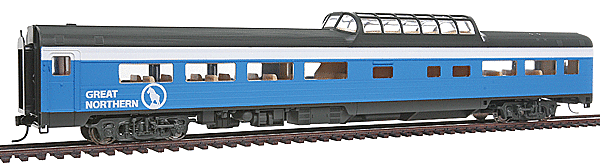
" BIG SKY BLUE " Paint Scheme
BUDD STREAMLINED
VISTA DOME - 48 seat COACH Car
Out-Of-Production
DISCONTINUED By the Manufacturer
" EMPIRE BUILDER " series in the GOLDEN AGE OF RAILROADING
This is the LIMITED EDITION SERIES with detailed INTERIORS
This is the BUDD STREAMLINED
VISTA DOME - 48 seat COACH Car
Post-war plans for the new streamlined version were unveiled in early 1945 with the arrival of EMD E7A-A diesels attired in brilliant Omaha Orange and Pullman Green (later known as the Empire Builder scheme); deliveries of matching cars continued through 1947.
The Empire Builder reached its pinnacle of luxury in 1955 with the arrival of brand-new Vista-Dome and full or Great Dome cars offering incredible views of western scenery.
This longer and heavier train was pulled by A-B-B-A sets of F units. Based on the 1955 train, Walthers offers a complete series of authentic models to re-create this legendary streamliner:
" BIG SKY BLUE " New Paint Scheme
Car Features:
Accurately scaled from engineering drawings
Scaled Dimensions & Rivet Detail
Complete End, Roof & Underbody Detailing
Factory - Installed Side Door Hand Rails
Scale set-back windows
Correct Trucks with RP-25 Metal Wheels
Detailed full Interiors
Full Decal Set
Removable Roof
Standard Draft Gear Box with Knuckle Couplers
Light pick ups installed (accepts light bar - sold separately)
Crisp detailed, realistic lettering, matched to prototype photographs
Realistic satin paint finish, great for weathering
Great for weathering with chalks or airbrush
Detailed truck side frames
Low-friction, nonmagnetic, needlepoint metal axles, no lubrication required
Minimum Radius 24 inches recommended
BIG SKY BLUE PAINT SCHEME:
“We call it Big Sky Blue because it so vividly typifies the magnificent Big Sky country of plains, mountains and water where our busy tracks run.” That’s how the Great Northern Railway introduced their striking new colors. With the mountains of Glacier National Park rising in the distance, the eastbound Empire Builder turns those words into action as it crosses the north fork of the Two Medicine River. Now this is a paint scheme.
GN’s Big Sky Blue paint scheme was inspired, brilliant, and doomed. Born in 1967, it was a bright star in a difficult decade for America’s railroads. Freight business was flat, as truckers took advantage of the newly constructed Interstate highway system. Inflation cranked up wages and costs. The factors driving today’s railroad renaissance – intermodal piggyback and stack trains, unit trains of grain and low sulphur Western coal, fuel-efficient locomotives, reduced workforce, and most important, deregulation – were years or decades away.
On top of all that, there was the “passenger problem.” Starting in 1956, the Interstate Highway System built a concrete web across the country, enabling motorists to travel much faster and stop whenever they wanted. Airlines were replacing propeller-driven aircraft with jets, slashing flight times and greatly increasing comfort and reliability.
Passengers deserted the railroads in droves – but the railroads needed permission from the Interstate Commerce Commission to shut down their passenger trains. Even though the trains were hemorrhaging money, people with no alternative to rail travel often testified at the ICC hearings, making the railroad company look like a villain. Most railroads were simply trying to survive the 1960s, so they kept a low public profile.
Great Northern was affected by these problems just as much as other roads, but they chose a different approach. GN President John M. Budd stated that “regardless of how we feel about it, the public views the railroads through their passenger services. Since this is the window that we are viewed through, we must either shine the window or cover it with a dark shade.”
Budd believed GN had stories worth telling: modern high horsepower diesels like EMD’s SD45 and General Electric’s U33C (above); 100 ton hopper cars for export unit grain trains; line relocations to reduce fuel costs and increase train speeds; Centralized Traffic Control for more efficient operations; and well-maintained track in a day when many railroads were sinking into the mud.
Budd commissioned Lippincott and Margulies of New York to develop a new image for the Great Northern Railway. He told L&M there were “no sacred cows, or goats.” The GN’s mascot “Rocky” had been part of their image since 1921, and railroads are notoriously resistant to change, but Budd gave L&M the green signal to dump him if they saw fit.
Rocky's new 1967 look
However, when L&M interviewed people in GN’s territory, they were surprised how closely folks associated Rocky with the Great Northern Railway. Rather than dumping the iconic mountain goat, L&M turned him into “a more vigorous, dynamic critter – symbolic of modern, growing Great Northern.”
From the Big Sky Country of Montana came the new color, “Big Sky Blue,” replacing the stately Omaha Orange and Pullman Green color scheme the GN had used since 1941. Stone grey set off the brilliant sky blue, separated by a bold white stripe. Visually stunning, thoroughly modern, and elegantly simple all at the same time, the new image flew in the face of public perception that railroading was a dying industry.
GN introduced the new image on its annual Board of Directors special in April 1967. The train was pulled by the first locomotive painted in Big Sky Blue, SD45 407 (below) and freshly delivered sister 412, which had been rushed out of the factory in primer paint to receive Big Sky Blue for the special. The train included six business cars also freshly attired in Big Sky Blue, as well as Great Dome Lounge 1394 Prairie View, the first Empire Builder car to carry the new colors.
The new image was unveiled for the press the following month with SD45 407 and Great Dome Prairie View. President Budd (from left), Mrs. Jerald Brenhofer, stenographer, and John L. Robson, Vice President-Operations, posed with a newspaper ad announcing the new image at the Dale Street Shops in St. Paul, Minnesota.
As the decade wore on, passenger losses were clearly endangering the rail industry's financial health, and some railroads responded by deliberately driving customers away. They removed dining and sleeping cars, rescheduled trains to make them inconvenient, put them in sidings to wait for freight trains, and cut back maintenance. The trains and stations got dirty and run down; dispirited train crews got surly and indifferent. All this was calculated to hasten the day the ICC would let them discontinue the trains.
But not Great Northern. They shined the window of public perception by keeping their passenger trains clean, friendly and on time. And oh, that color! Next to a Big Sky Blue streamliner, the competition’s trains looked a little . . dated.
The GN discontinued its secondary passenger trains just like other railroads – but they upgraded the Empire Builder, Western Star and other trains, refurbishing coaches from other railroads and giving them a coat of Big Sky Blue.
GN even bought six new EMD SDP40 passenger locomotives in 1966 and added eight SDP45s the next year (right, pulling the westbound Empire Builder past Glacier Park), replacing middle-aged locomotives with modern, reliable power. Mr. Budd was shining that window.
Westbound Empire Builder passing Glacier Park
While President Budd told the press that there would be no “crash program” to repaint the Great Northern’s rolling stock in the new colors, the GN’s paint shops applied it furiously between April 1967 and the March 1970 Burlington Northern merger. Historians have verified at least 237 locomotives were repainted or delivered in Big Sky Blue during that three year period - that's another Big Sky Blue locomotive every four days. This is all the more surprising because GN also painted some equipment in experimental Burlington Northern schemes during this period.
Three years. That was all. But those three years produced 12-car Empire Builders all in Big Sky Blue, 100 car unit grain trains all in Big Sky Blue, solid sets of numerous GN locomotives in Big Sky Blue, and thousands of GN boxcars all across the nation showing anyone who cared that the Great Northern wasn’t dying – on the contrary. Since the Boeing factory producing the new 747 Jumbo Jet was served by the GN, and the railroad acquired specialized new freight cars to haul 747 components, Great Northern could call themselves a modern space age business.
Even as the GN was looking ahead to better days, there was a dark cloud hanging over Big Sky Blue. President Budd spent much of his working day planning and preparing for a railroad merger that would supplant the Great Northern’s identity. Why, then, did he commission a new image for his railroad, and implement it with remarkable speed? Perhaps he was hoping to influence the brand of the new railroad, or at least explore some possibilities.
The Big Sky Blue era ended abruptly on March 3, 1970, when Jim Hill’s 19th Century dream of combining his empire into one railroad was finally realized. The Chicago, Burlington and Quincy; the Great Northern; the Northern Pacific; the Spokane, Portland and Seattle; and the Pacific Coast railroads were merged together to create the Burlington Northern Railroad. The new company’s image included the distinctive BN logo and Cascade Green paint scheme designed by L&M, who had certainly earned the job with their work with Great Northern. The old railroads’ locomotives became part of the BN fleet, and by 1977 all of them had been painted in Cascade Green.
On May 1, 1971, Amtrak took over the BN’s intercity passenger trains. Most of the Big Sky Blue passenger cars were purchased by Amtrak, who repainted their entire fleet in red, white, blue and platinum mist paint by 1977. GN 1331, a Big Sky Blue dome coach, was the very last Amtrak car to carry the colors of its previous owner.
The GN passenger cars Amtrak didn't buy were used in work service or business car trains by BN, and by 1977 none were left in Big Sky Blue. Many freight cars continued to carry blue paint for many years; a few wood chip hoppers still wore their faded Big Sky Blue as late as 2010. But by 1977, all the locomotives and passenger cars had been repainted or retired.
Ten years after its introduction, Big Sky Blue was extinct.
Since 1977 a number of Great Northern passenger cars have been restored in the pre-1967 Omaha Orange colors, and some of these cars operate on special occasions. But no passenger cars or locomotives had been fully restored in Big Sky Blue until GN 441 was painted in July 2009. It is the only Big Sky Blue locomotive in the world.
Mainline freight service was the last stronghold for steam power in America. By the late 1930s, diesels had proven themselves as switchers and as power for the new streamlined trains, but there were doubts that they could ever be practical in freight service.
That all changed in late 1939 when EMD rolled out its brand-new FT locomotive. Borrowing some basic design elements from E series passenger power, but in a shorter, more powerful package, the demonstrator set out on a 35-state tour that covered nearly 90,000 miles. Railroads were amazed at what this single A-B-B-A lash-up with its incredible 5400 horsepower could do, and orders came quickly. With its proven track record, EMD was the only builder allowed to construct road diesel power during the materials shortages of World War II.
We do combine shipping on
multiple purchases. If you do a Buy It
Now the transaction requires immediate payment for each item separately.
What you need to do is put it in the shopping cart and then
when you go to checkout it will recalculate the shipping and combine the items
for you.
If you pay first I am unable to make any adjustment because
ebay has then taken its fees on the shipping as well. If you have a concern message me and I can
work something out for you.
THIS IS AN ASSEMBLED Item
The item is NEW in the original box from old stock
PERSONAL INVENTORY:
Many of these unique items are from my personal inventory
which was accumulated over the years.
They are hard to part with but due to downsizing in retirement they too
are looking for a good home which can appreciate and enjoy them.
STORE INVENTORY:
Having discontinued my Hobby Store and left frigid
“Minne-Snow-Da” I have relocated and retired to the warmer part of the country,
Down to Sunny TEXAS.
I will be Liquidating the remaining stock.
I will be listing items over the next year or so clearing
them out.
Please see the photos we take actual photos of each item
Most of these items are New in the box removed only to take
photos of them.