
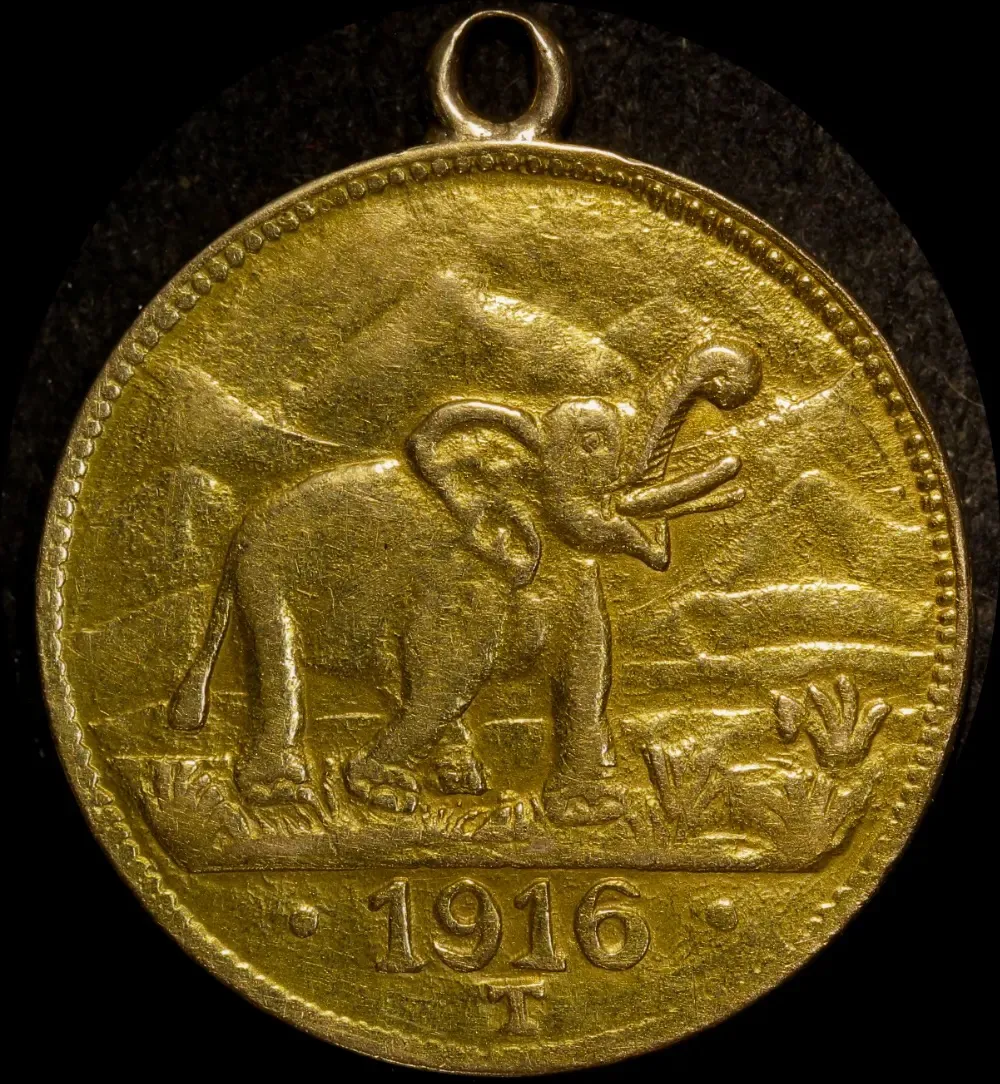
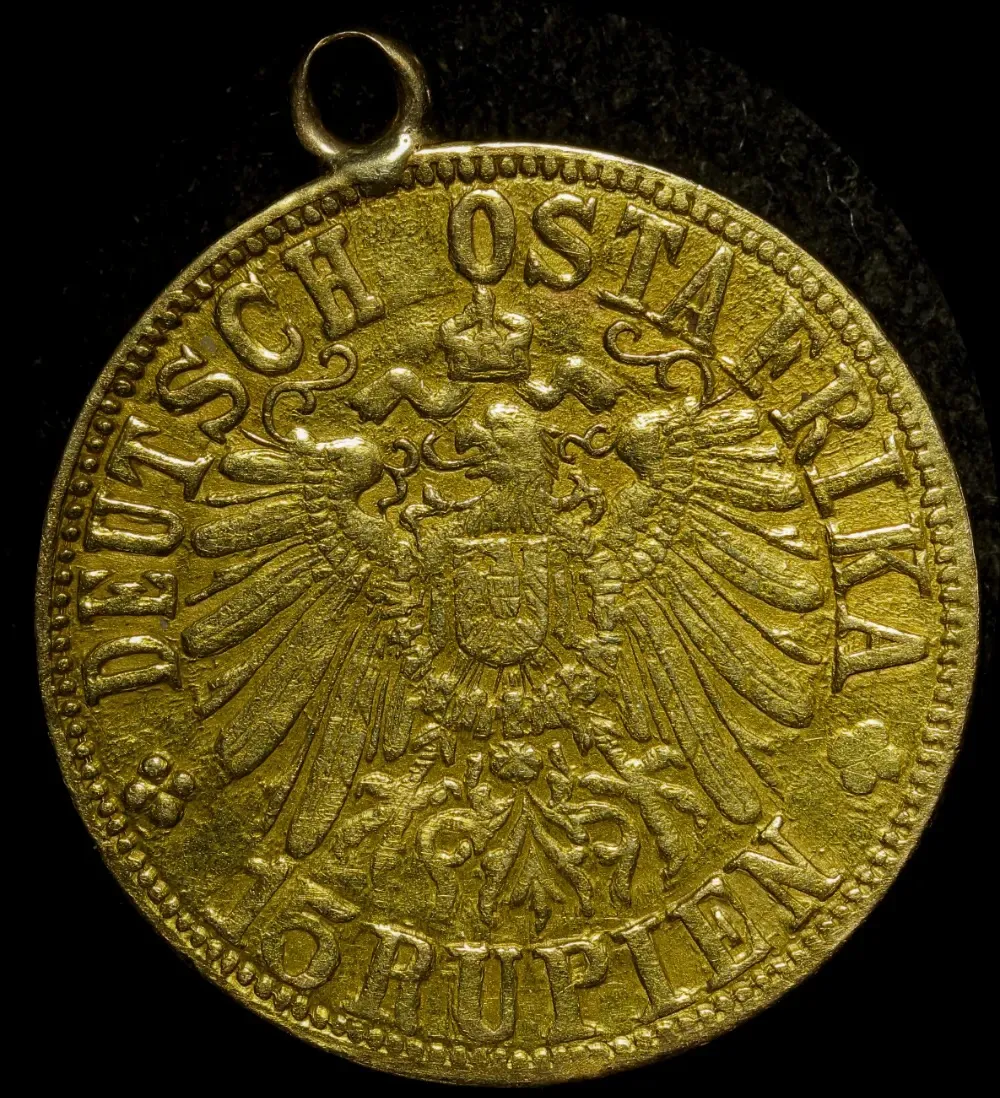
German East Africa 1916 Gold 15 Rupien KM# 16.1 good VF
German East Africa 1916 Gold 15 Rupien KM# 16.1 good VF
Obverse: Crowned German imperial eagle with wings displayed, legend DEUTSCH OSTAFRIKA above and denomination 15 RUPIEN below; the right arabesque of the wing ends beneath the "T" of OSTAFRIKA (early die variety).
Reverse: Elephant advancing right with trumpeting trunk raised, mountain peaks (traditionally identified as Kilimanjaro) in the background, date 1916 below with mintmark "T" for Tabora.
Metal: Gold | Diameter: 22.5mm | Weight: 7.168g
Purity: 75.0% | Nett Weight: 0.1728ozt AGW
Mintage: 9,803
Provenance:
1916 - Acquired by Grigori Klonaridis in Tabora (modern Tanzania)
1958 - Handed down to Kosta Dionysios Alexandratos (grandson of Grigori Klonaridis)
2026 - Deena Alexandratos (Wife of the deceased Kosta Dionysios Alexandratos)
This celebrated coin was held for 3 generations of the same family across 2 continents.
A Wartime Emergency Coin
During the First World War, the Allied naval blockade cut German East Africa off from imported currency and precious metals. The colonial administration responded by producing its own coinage using locally mined gold.
Reliable currency was urgently needed to pay soldiers, workers, and merchants. Askari troops and local workers reportedly preferred gold to the emergency paper notes issued by the colonial bank, as precious-metal coinage retained tangible value in an economy isolated from the institutions supporting its currency.
As British and Belgian forces advanced and Dar es Salaam was lost, the administration moved inland to Tabora. A temporary mint was established there using railway workshop machinery and improvised equipment. Some tools and rolling mills were reportedly salvaged from the German cruiser SMS Königsberg, which had been scuttled in the Rufiji Delta in 1915.
The production team included African and Indian workers and seven Sinhalese goldsmiths recruited from Zanzibar. Dies were engraved individually rather than produced from a master die, contributing to the distinctive variations and somewhat irregular strikes collectors prize today.
Minting continued from approximately April until September 1916, when Belgian forces occupied Tabora and brought the operation to an end.
Designs Used
The obverse features the crowned Reichsadler, or German imperial eagle, surrounded by the inscription “DEUTSCH OSTAFRIKA” and the denomination “15 RUPIEN.”
The reverse depicts a trumpeting African elephant before a mountainous landscape, often identified as Mount Kilimanjaro. The date 1916 and the “T” mintmark for Tabora appear below.
Despite the makeshift conditions under which it was produced, the coin is admired for its evocative design. It is also the only German imperial gold coin bearing the Tabora “T” mintmark, making it a key issue in German colonial numismatics.
Die Varieties and Mintage
Two principal die varieties are recognised:
-
KM#16.1: Approximately 9,035 pieces. The arabesque at the top of the eagle’s right wing ends beneath the “T” in “OSTAFRIKA.”
-
KM#16.2: Approximately 6,395 pieces. The arabesque ends beneath the first “A.”
This gives a combined mintage of approximately 15,430 coins.
KM#16.1 was reportedly struck at the temporary mint in a Tabora railway warehouse. The scarcer KM#16.2 is associated with a second operation at nearby Lulanguru, where a steam press normally used to extract oil from nuts was adapted for coin production.
The gold came from the Kironda mine near Sekenke, roughly 200 kilometres northeast of Tabora. Naturally alloyed with silver and copper, it required refining to reach the intended fineness.
The design is credited to R. Vogt, with the dies reportedly cut by a Sinhalese goldsmith from Zanzibar. Mining engineer Dr Friedrich Schumacher managed the gold supply, while Governor Heinrich Schnee authorised the emergency coinage.
Historical Significance
Before the war, German East Africa was Germany’s largest African colony and had an economy supported by coffee, sisal, rubber, railways, and trade through Dar es Salaam. The blockade and Allied advance dismantled this system, making Tabora one of the administration’s final inland strongholds.
The coin therefore represents more than an improvised currency issue. Struck from local gold by a multinational workforce using salvaged equipment, it records the final phase of German colonial rule in East Africa. Germany lost its colonies after the war, and the German East African Rupie was eventually replaced by British-administered currency.
With its low original mintage, limited surviving population, distinctive design, and direct connection to the East African campaign, the Tabora Pound remains an important wartime gold coin. For collectors, a well-preserved example offers a tangible link to a remarkable episode in monetary and First World War history.
Lorem ipsum dolor sit amet, consectetur adipiscing elit. Mauris tempor sit amet arcu eu aliquet. Sed condimentum justo et nisi molestie, eu rhoncus lorem elementum.
| SKU | 217306 |
