
The Book of Common Prayer The Administration of The Sacraments Oxford Dioscesan 1881
Thank you for viewing our items, all proceeds go directly to our charity AGE UK MK
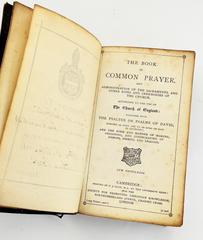
This is a Very rare Antiquarian Victorian-era printing of The Book of Common Prayer, the foundational liturgical text of the Church of England.
The specific title page details yield insights into its publication context, printing style, and target audience:
1. The Printers and Publishers
The Printer (C. J. Clay): Charles John Clay was the printer for Cambridge University Press from 1854 to 1894. The imprint "C.J. Clay, M.A. at the University Press" indicates this specific copy was likely manufactured during the high-Victorian period, roughly between the late 1850s and the 1880s.
The Publisher (SPCK): The Society for Promoting Christian Knowledge (founded in 1698) is one of the oldest publishing houses in England. During the 19th century, the SPCK heavily subsidized the printing of bibles and prayer books to make them affordable and widely accessible for everyday churchgoers, school children, and missionary work.
2. Format and Typography
Long Primer: This refers to the historical type size used to print the text, which is roughly equivalent to a modern 10-point font. It was preferred for pocket prayer books because it was compact yet still readable during a church service.
24mo (Vigesimo-quarto): This denotes the book's format. The printer folded a single sheet of paper into 24 leaves (48 pages). This resulted in a pocket-sized, portable book designed for individuals to easily carry with them to weekly worship.
Cum Privilegio: Latin for "With Privilege." Because the Book of Common Prayer is a crown-protected text in England, only the Royal Printers (Eyre & Spottiswoode) and the university presses of Oxford and Cambridge held the legal monopoly to print it.
3. Historical Text Content
The 1662 Text: While printed in the late 19th century, the actual text inside is the 1662 revision of the Prayer Book. This revision followed the English Civil War and the restoration of the monarchy under King Charles II, establishing a standardized structure for morning and evening prayers, baptisms, marriages, and communion that remained virtually unchanged for centuries.
The Psalter:
As noted on the title page, the book includes the complete Psalter (Psalms of David). These are "pointed," meaning they feature special punctuation markings to guide the congregation or choir on how to chant or sing the verses out loud in church