
Television To-Day & To-Morrow 1930 1st Ed Hardback John Logie Baird Pitman Rare
Thank you for viewing our items, all proceeds go directly to our charity AGE UK MK
Television To-Day & To-Morrow 1930 1st Ed Hardback John Logie Baird Pitman Rare
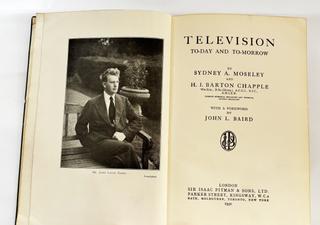
Television: To-Day and To-Morrow is historically recognized as the first standard, comprehensive textbook published on the subject of television technology. Released in 1930 by Sir Isaac Pitman & Sons, Ltd. in London, it was written to document and explain the rapid transition of television from a wild science-fiction concept into a concrete, working medium.
Authorship & Dynamic
The book relies on a unique blending of journalism and hard engineering to make complex concepts digestible to both professionals and the public:
Sydney A. Moseley: A highly prominent British journalist, war correspondent, and early broadcaster. Moseley was a fierce public champion of television who actively managed public relations and business strategies to get the technology funded and recognised. H. J. Barton Chapple: A highly distinguished electrical engineer and technical academic. Chapple provided the rigorous technical execution, mathematical proofs, and schematic breakdowns that gave the book its structural, authoritative weight.
Technical Context & Content
The text serves as a definitive time capsule for Mechanical Television technology.
Unlike the electronic television systems that grew common in the late 1930s and 1940s, the systems detailed in this book relied on physical, rapidly spinning parts:
The Baird System:
The book focuses extensively on the pioneering work of John Logie Baird, explaining the operations of his mechanical "Televisor".Nipkow Disks: It details how rotating metal disks perforated with a spiral of square holes were utilized to mechanically scan an image, break it down into lines of light, and convert it into electrical impulses via photoelectric cells.
Synchronicity:
A major portion of the text addresses the monumental engineering challenge of the era: ensuring that the motor spinning the disk in the broadcast studio spun at the exact same fraction of a second as the motor in a viewer's home receiver to prevent the picture from tearing apart.
Historical Significance
When Moseley first proposed the book, contemporary critics and colleagues widely dismissed television as an outright hoax, a financial trick, or a literal impossibility. In fact, when John Logie Baird first approached the Daily Express newspaper to promote his invention, the terrified news editor famously told his staff to "get rid of a lunatic downstairs" who claimed he had a machine for "seeing by wireless".
The quick succession of the book into multiple subsequent editions over the following years served as definitive proof that mechanical television had successfully moved out of experimental basements and directly into public reality