*Please contact us prior to purchase if your country isn’t listed. If you live in the USA, we will use UPS instead of EMS due to the temporal halt of EMS shipment.
Also, please note that, effective August 7, 2025, the U.S. baseline import tariff on products shipped from Japan has been raised to 15%. As a result, you will be required to pay approximately 15% customs duty upon delivery. We kindly ask for your understanding regarding this change. And, we won’t accept cancellation if the customers in the USA deny to pay the customs duty. We would like you to keep this information in mind before placing an order from our ebay shop.
We will ship your order via UPS for reliable and timely delivery. If you have any questions, please feel free to contact us.
1.0-1.5 month after you place an order
*There might be delay in shipment depending on countries
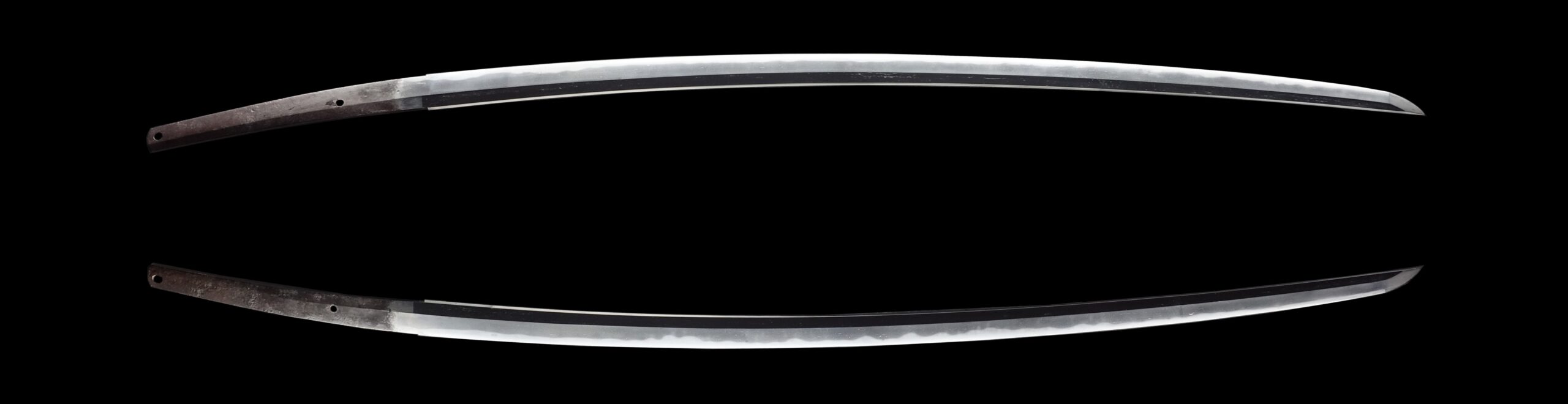
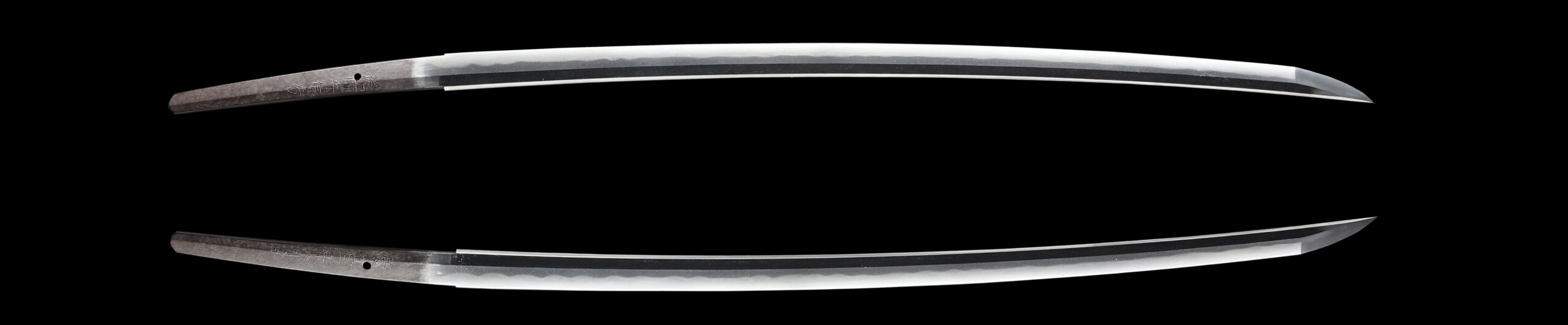
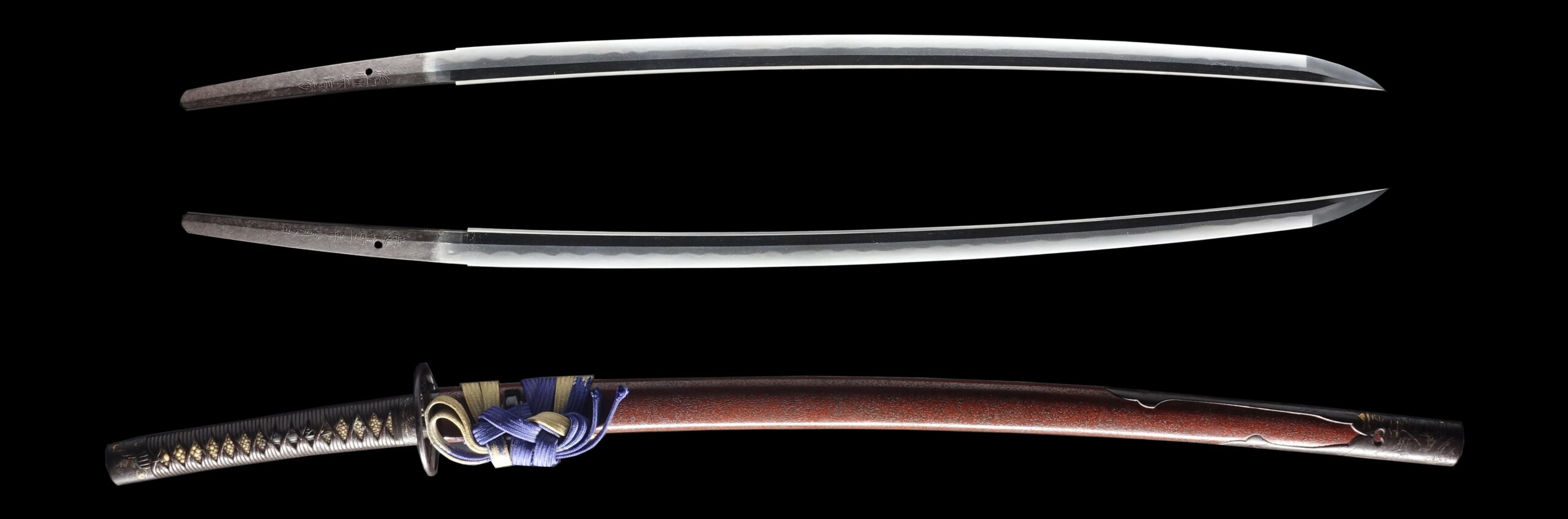
| Category | Katana (SHIN SHIN TO) |
| Age | The 2nd year of the Keio era (1866) |
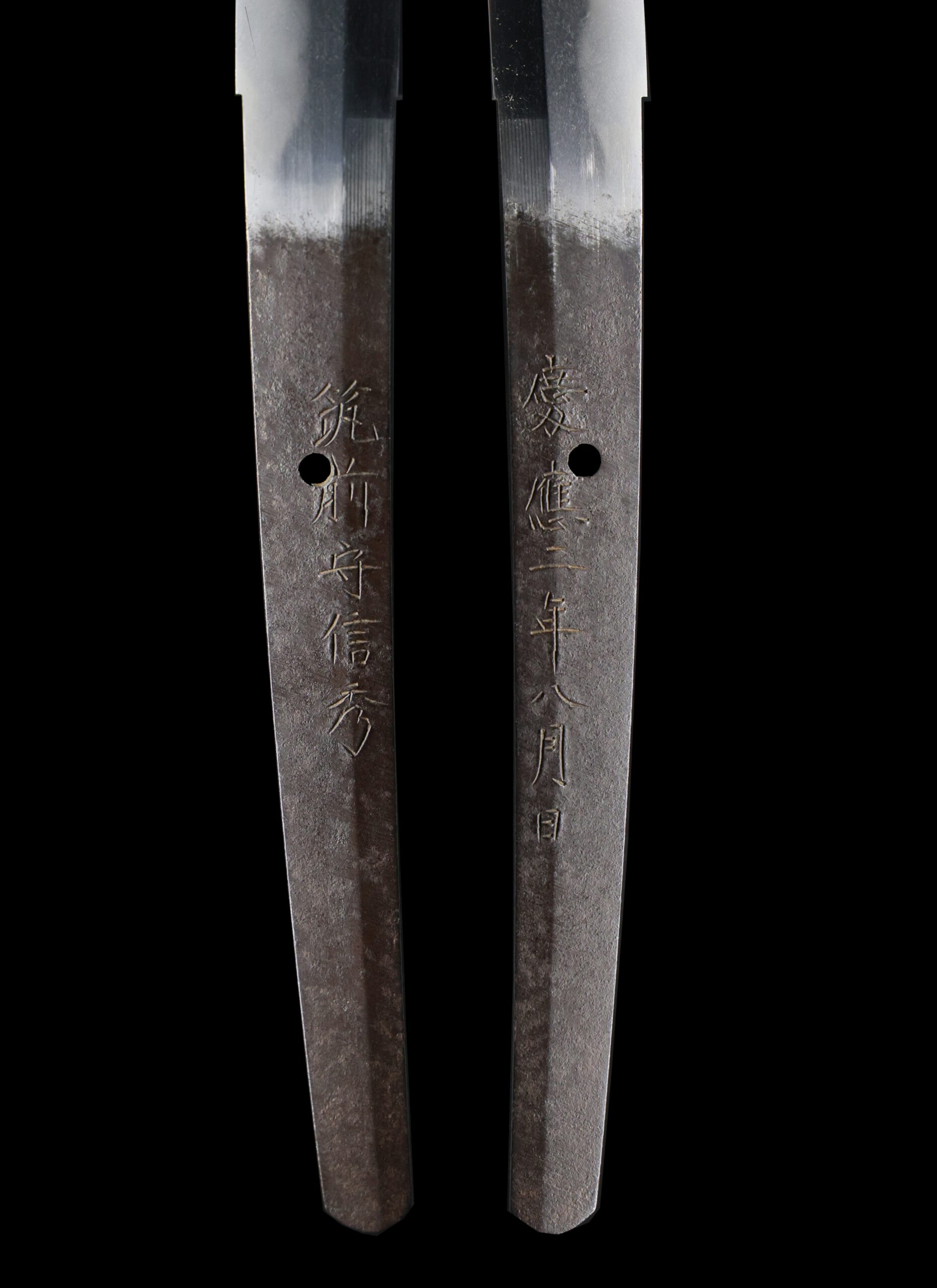
| Swordsmith | Chikuzen no Kami Nobuhide (筑前守信秀) |
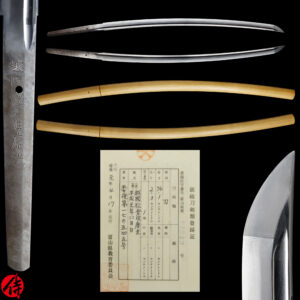
| Certificate | NBTHK Tokubetsu Hozon Certificate |
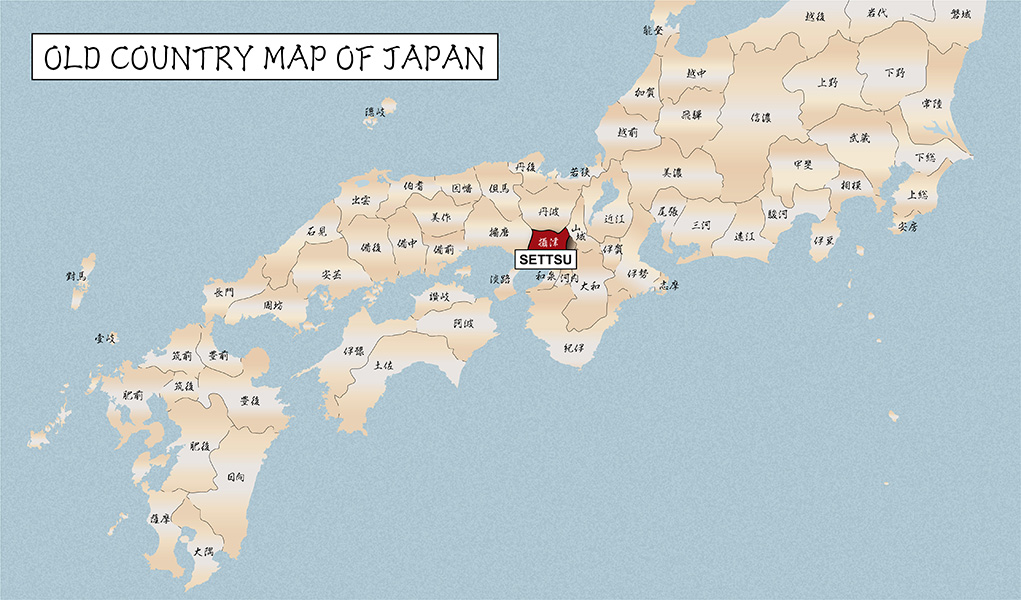
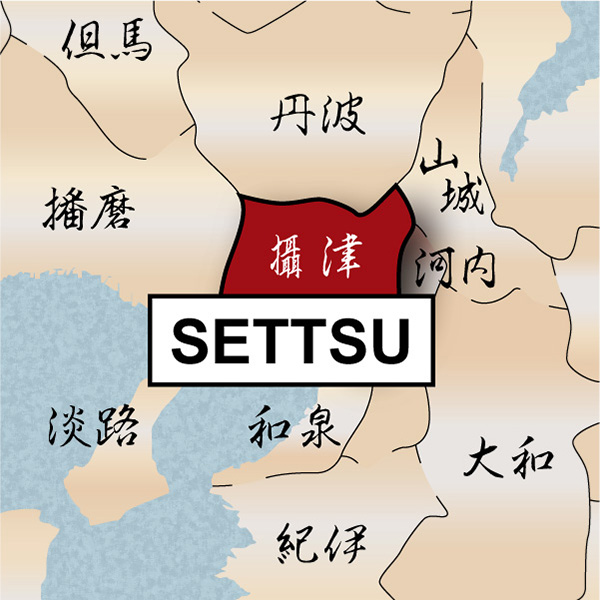
| Location | Musashi, Osaka Echigo province |
| Blade Size | Cutting Edge Length: 71.0 cm (27.9 inches) Curvature: 1.3 cm (0.51 inches) |
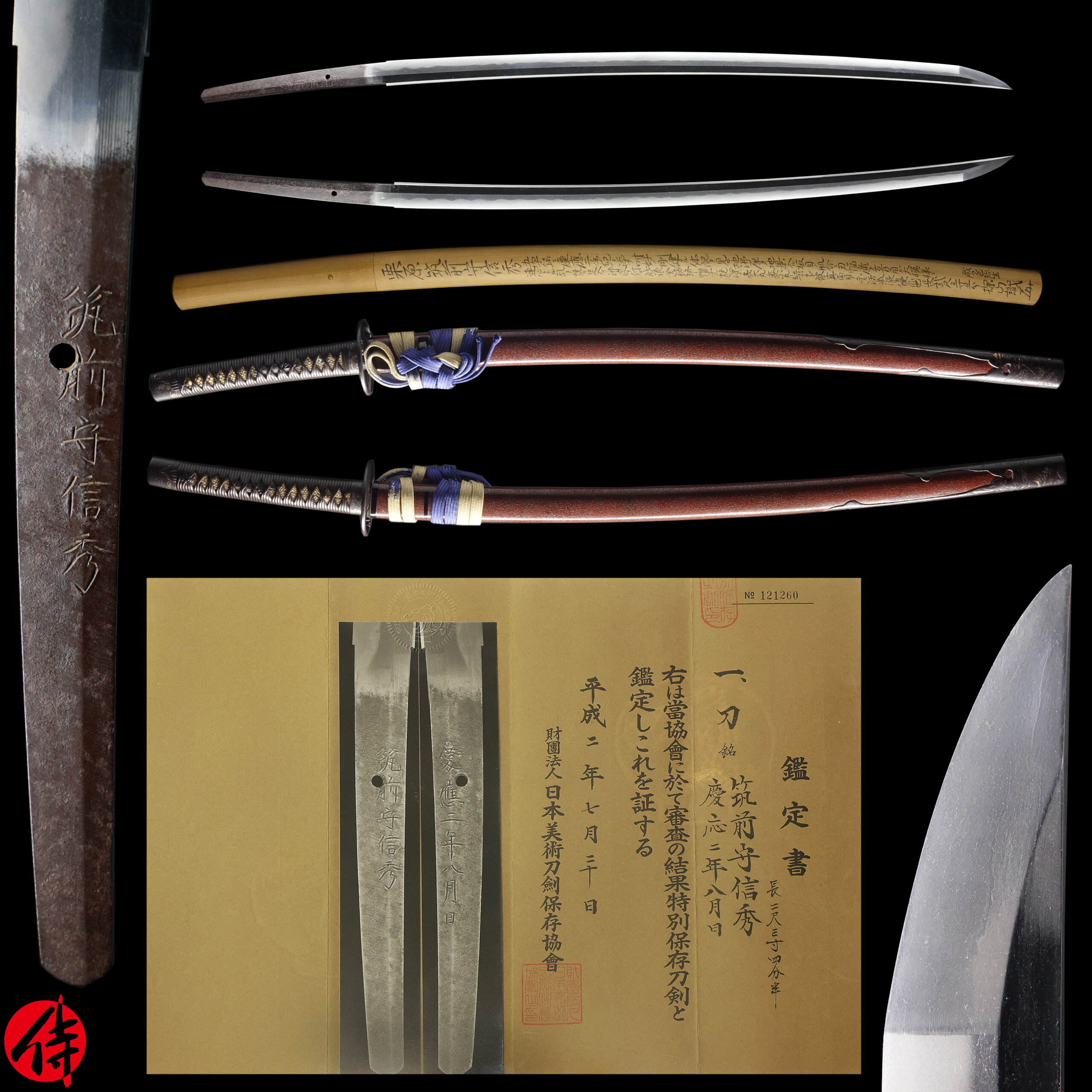
This blade was signed by Chikuzen no Kami Nobuhide (筑前守信秀) in the 2nd year of the Keio era (1866: The end of the Edo period). He is considered a top-tier swordsmith at the end of the Edo period. Nobuhide was born in Echigo province (today’s Nigata prefecture) in the 12th year of the Bunka era (1815). In the 12th year of the Bunsei era (1829), he moved to Kyoto and became a famous mirror craftsman. Eventually, he relocated to Edo city (today’s Tokyo) to become an apprentice of Kiyomaro in the third year of the Ka-Ei era (1850). Nobuhide was about 34-35 years old when he first studied sword-forging techniques from Kiyamaro, one of the most skilled and renowned swordsmiths at the end of the Edo period. Kiyomaro was just two years older than Nobuhide back then. He was so talented that he mastered superb craftsmanship from Kiyomaro in less than three years. Nobuhide was treated as Kiyomaro’s No1 apprentice.
Nobuhide became an independent swordsmith in the fifth year of the Ka-Ei era (1852). In the first year of the Keio era (1865), he received an honorable official title Chikuzen no Kami (筑前守) from the emperor Komei. According to historical records, he stayed in Sagami province (today’s Kanagawa prefecture) during 1853-1854. And he resided in Osaka between 1864-1867. Based on this information, we believe this blade was made in Osaka.
In his early career, he signed Nobuhide (信秀) and then changed it to Kurihara Kenji Nobuhide (栗原謙司信秀). And lastly, he signed Taira Nobuhide (平信秀). Nobuhide was active between 1852-1877 (the 5th year of Ka-Ei~10th year of the Meiji era). He is known as one of the three masters of the sword-forging at the end of the Edo period. The other two are Gassan Sadakazu and Honjo Yoshitane. Nobuhide is considered one of the top-tier swordsmiths among Japanese sword experts and collectors.
Even after the Samurai era ended in 1868, Nobuhide kept forging swords. And in the second year of the Meiji era (1869: post Samurai era), he was requested by the emperor Meiji to forge a ceremonial sword, which was considered one of the highest honors for any swordsmiths.
The Meiji government also ordered him to create three divine mirrors and a holy blade for a newly built shrine called Shokonsha (today’s Yasukuni shrine).
Shokonsha was built to honor the spirits of those who died during the civil war at the end of the Edo period. This fact suggests that Nobuhide was one of Japan’s most respected and acknowledged swordsmiths. He finished this project in the 7th year of the Meiji era (1874). And, he came back to Echigo province and restarted making mirrors for shrines. He died at the age of 66 in his house in Tokyo.
Also, this blade is distinguished by its elegant ō-kissaki (大切先, large point). The long, extended tip not only enhances the sword’s visual presence but also reflects the powerful and refined craftsmanship of its maker. The bold silhouette created by the elongated kissaki lends the entire blade a sense of grandeur and dignity.
It is appraised as a Tokubetsu Hozon Token (特別保存刀剣) issued by NBTHK (Nihon Bijutsu Touken Hozon Kyokai:日本美術刀剣保存協会). This authentication paper was only given to authentic Japanese swords, especially well preserved and high quality with artistic value.
*Please keep in mind that there is partial Kitae Kizu right above the Habaki area. If you like to know the detailed condition, please feel free to contact us.
【Blade】
Cutting Edge Length(Nagasa):71.0 cm (27.9 inches)
Curvature(Sori):1.3 cm (0.51 inches)
Hamon:
The crystalline structure which forms along the cutting edge of a blade as a result of the hardening process
Jimon(Jihada):
visible steel surface pattern created by folding and hammering during forging process
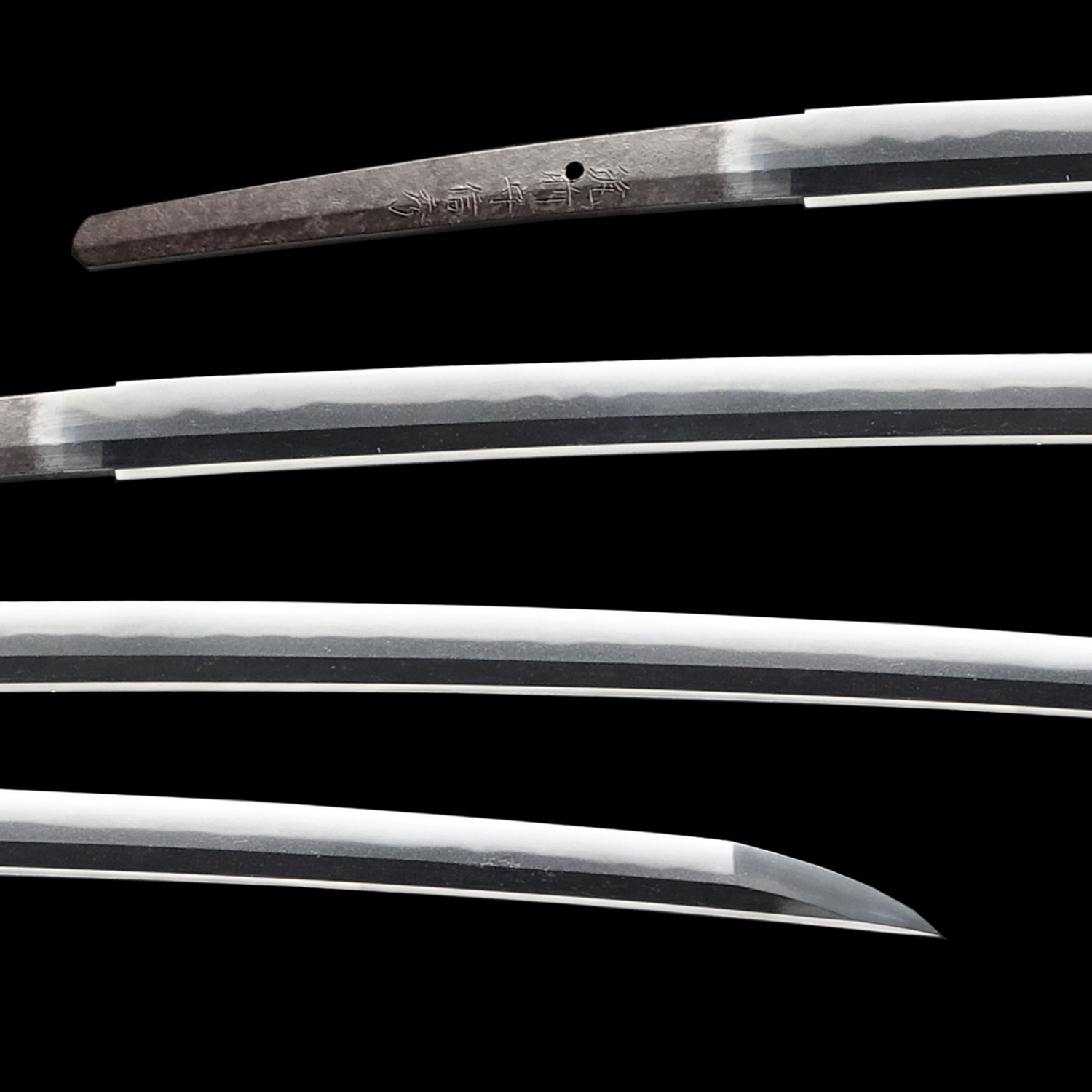
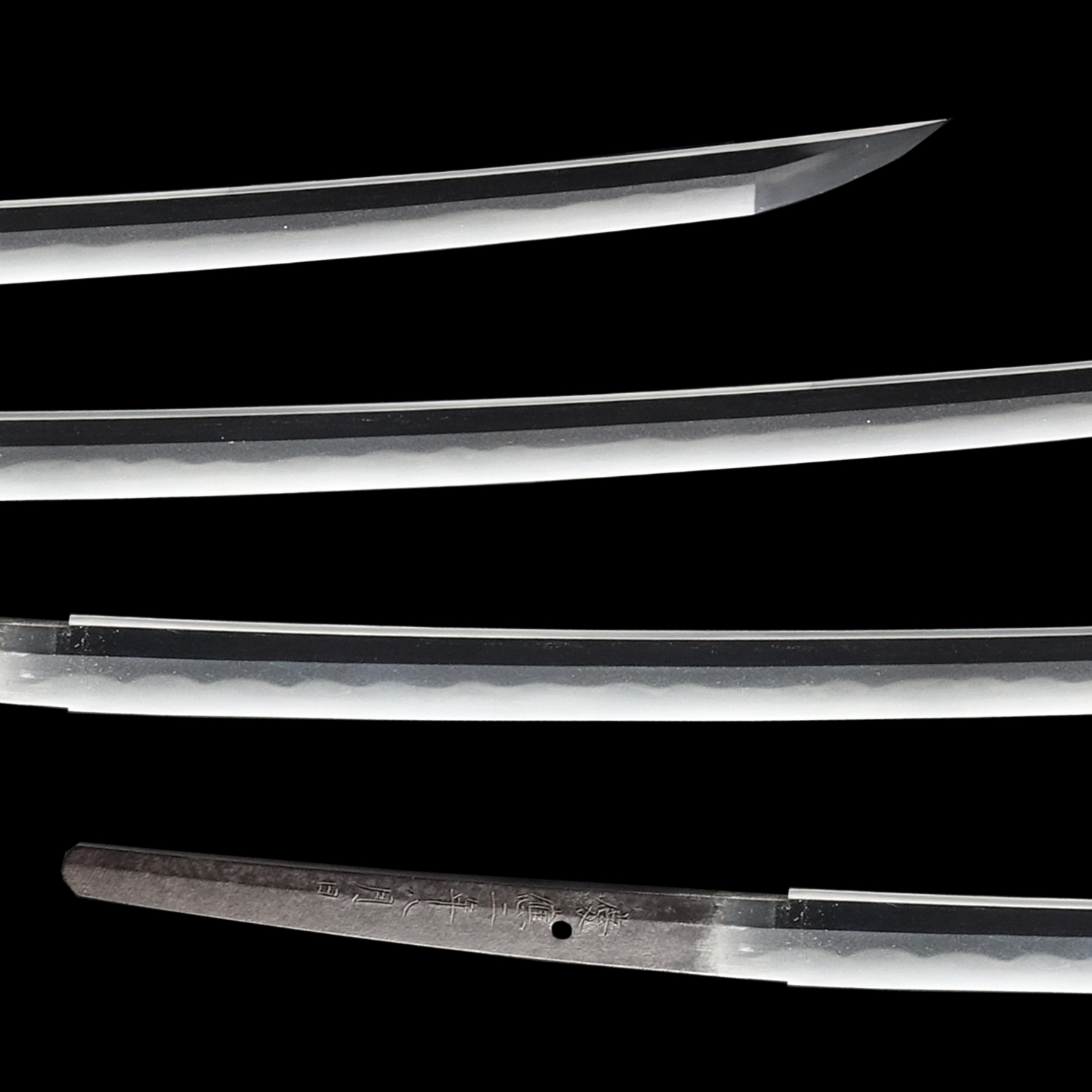
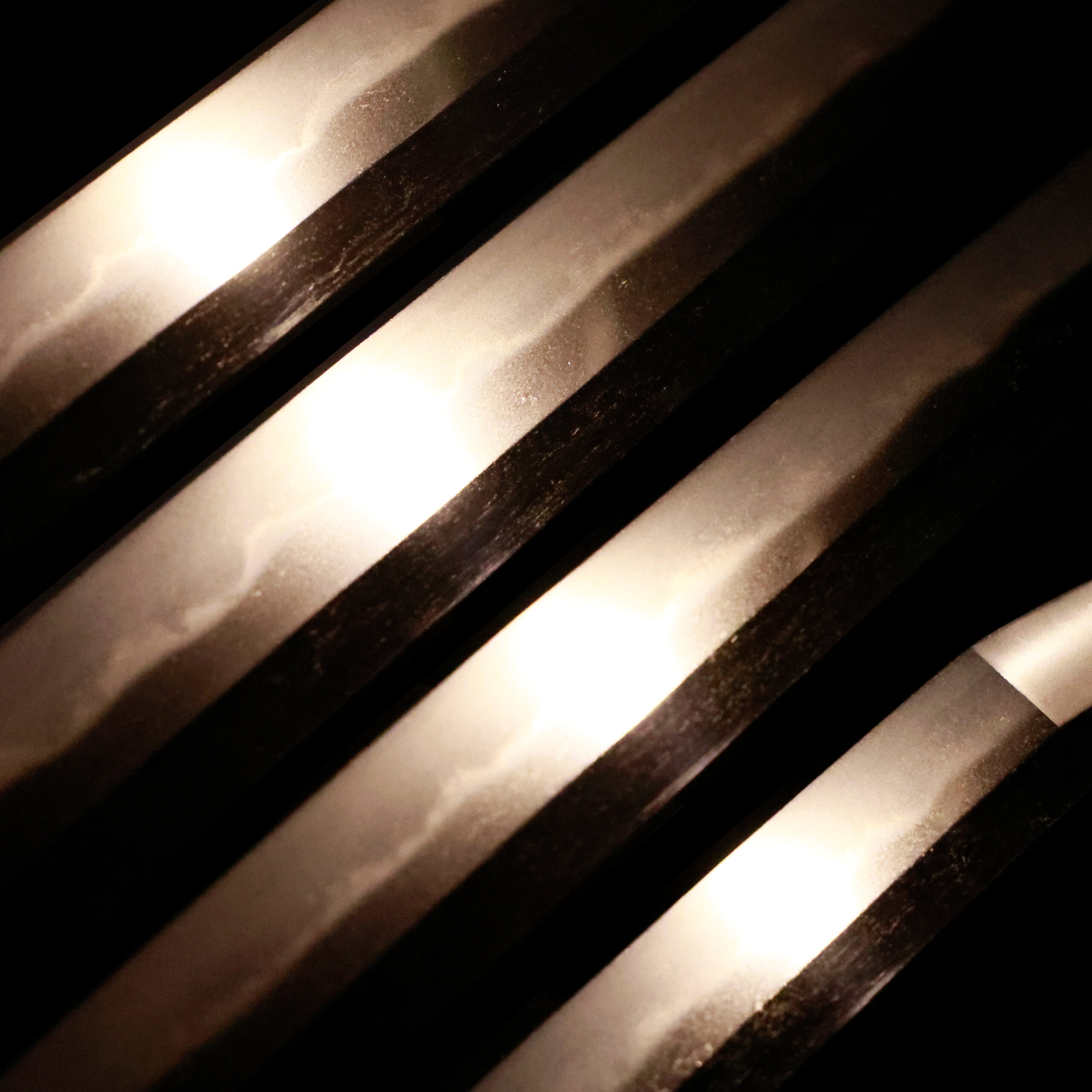
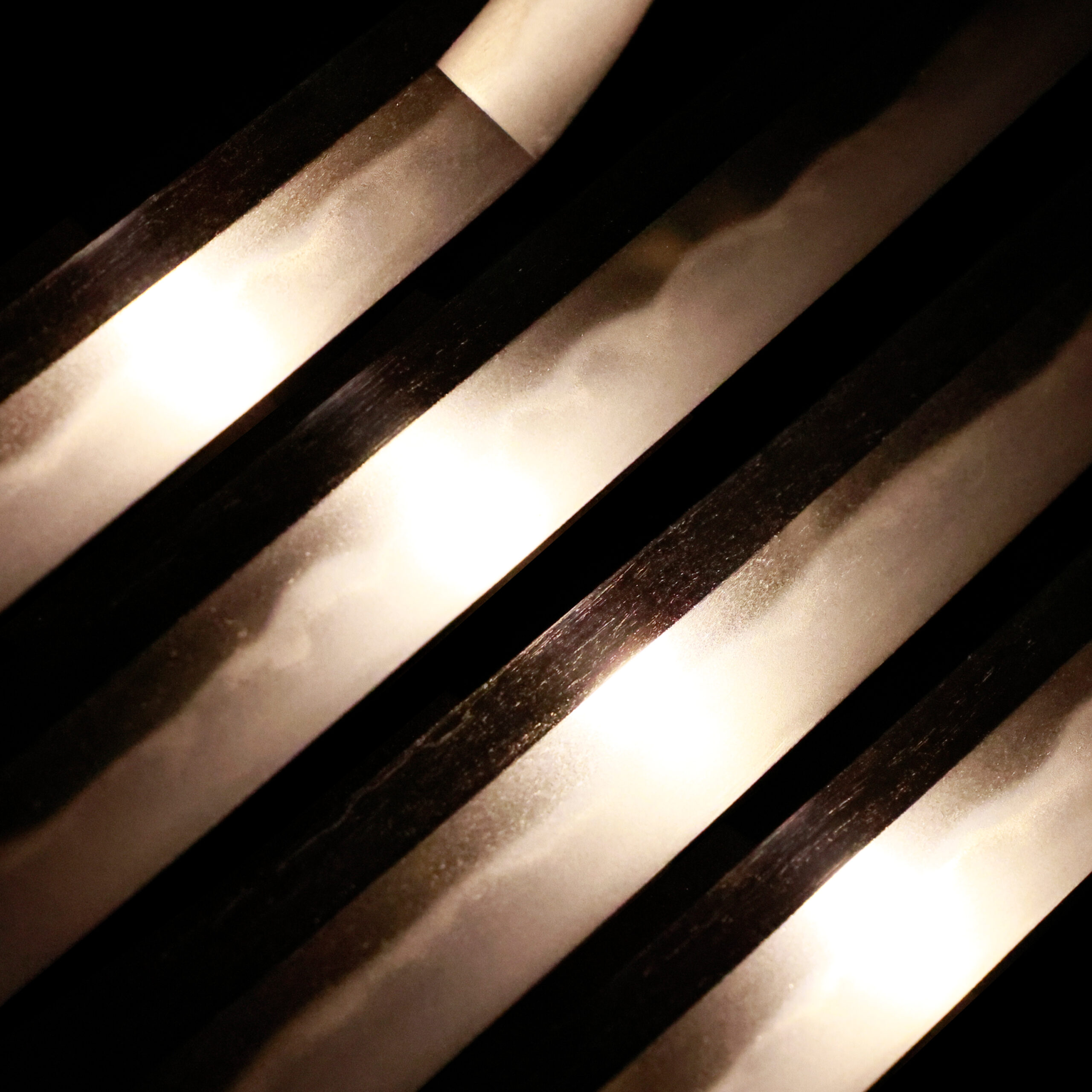
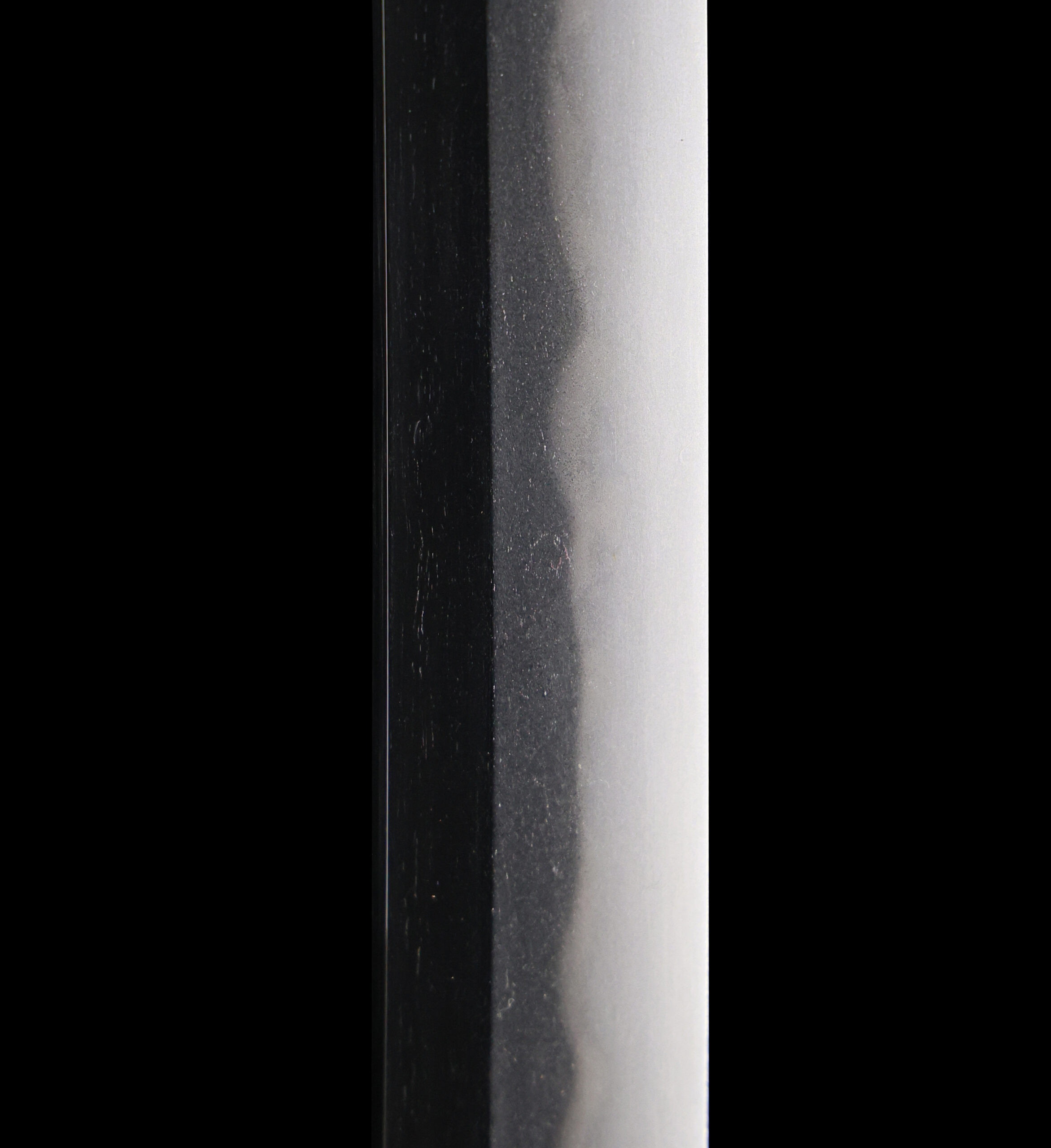
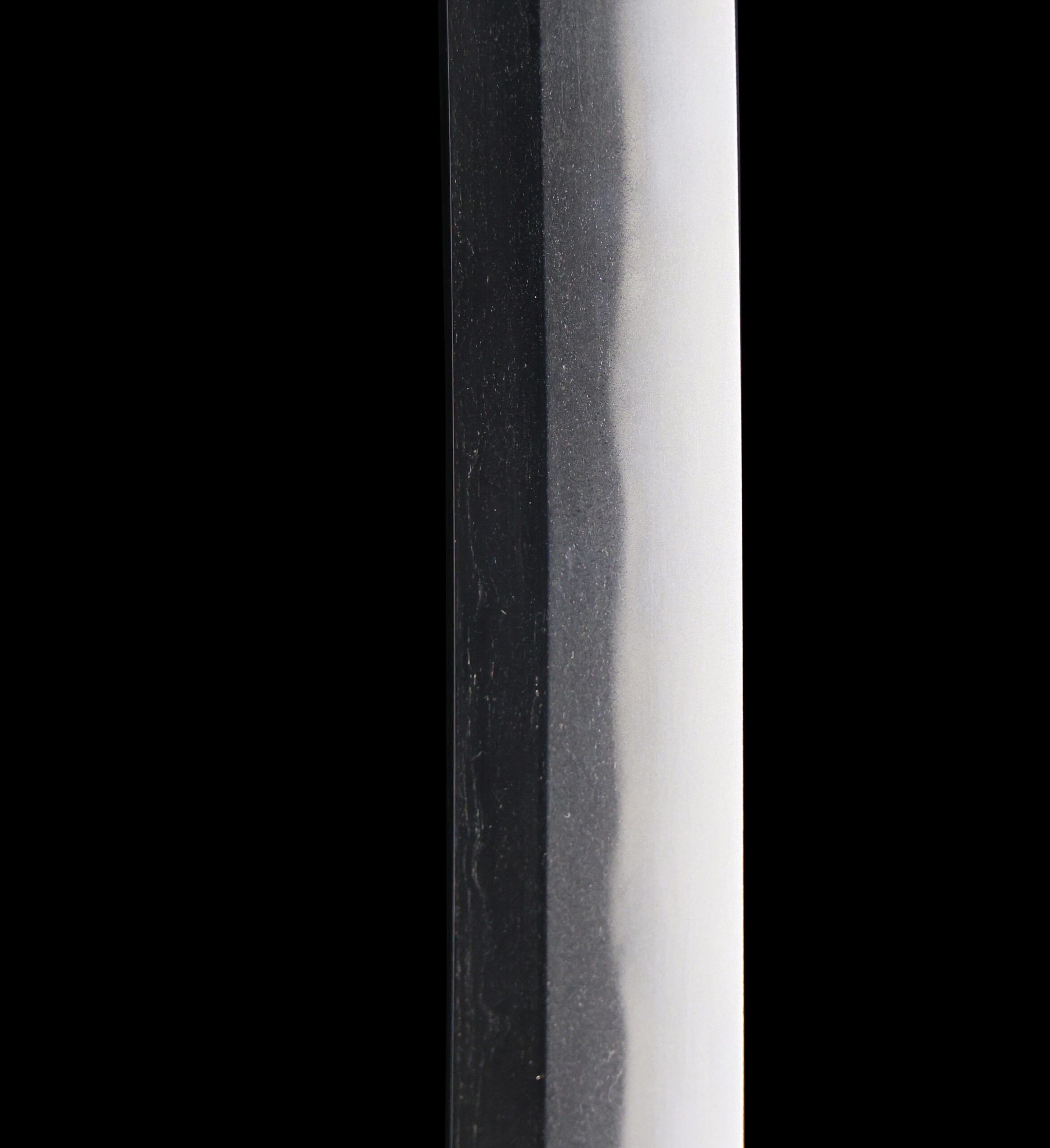
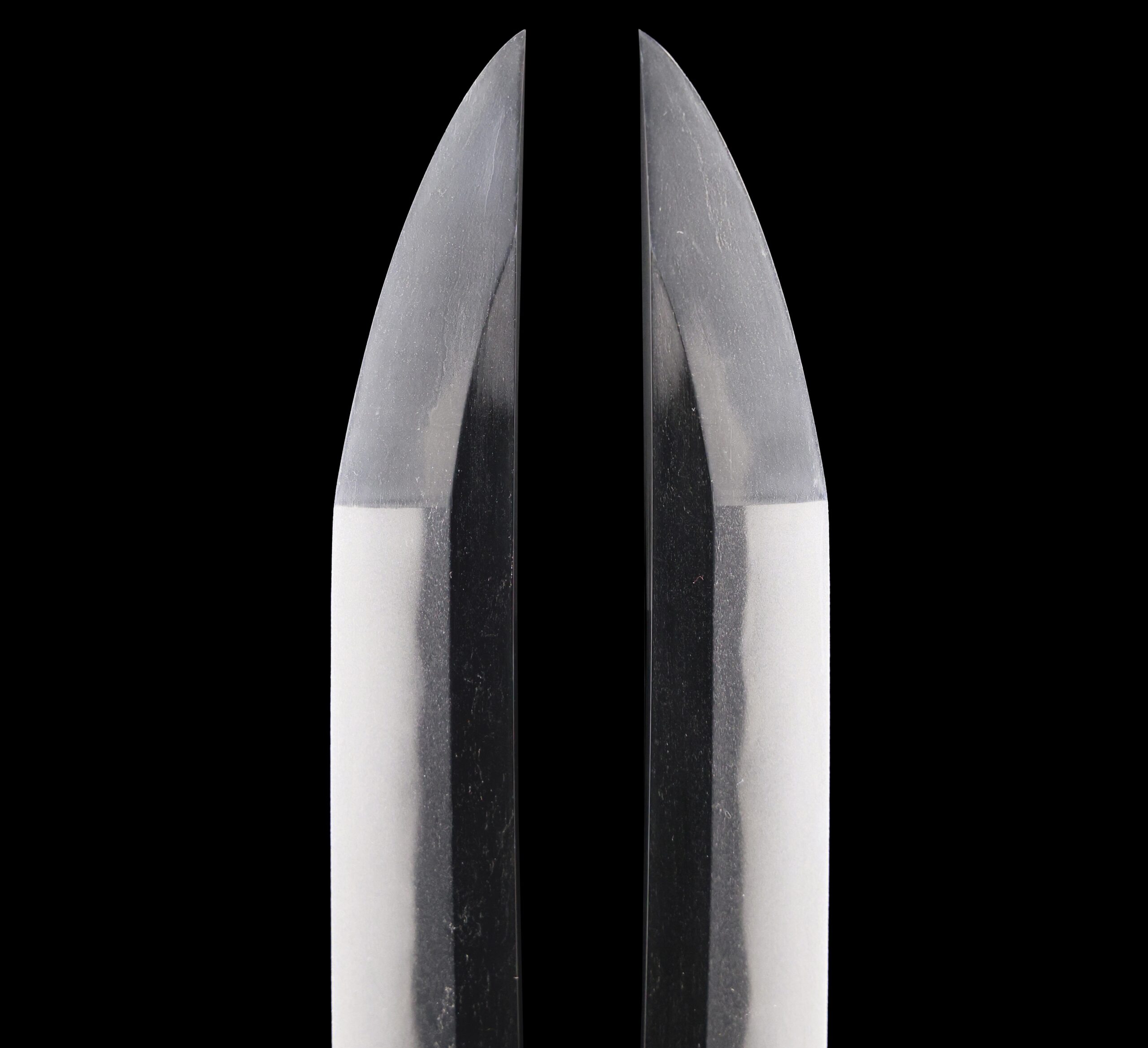
Kissaki:Kissaki is the tip of the Japanese sword.
Nakago:Nakago is the tang of the Japanese sword.
Japanese swordsmiths left the black rust on the tang because it prevents red rust while the tang is in its handle. And the discoloration of the tang was created over time, and it is a great indicator for a Japanese sword specialist to estimate when the sword was forged.
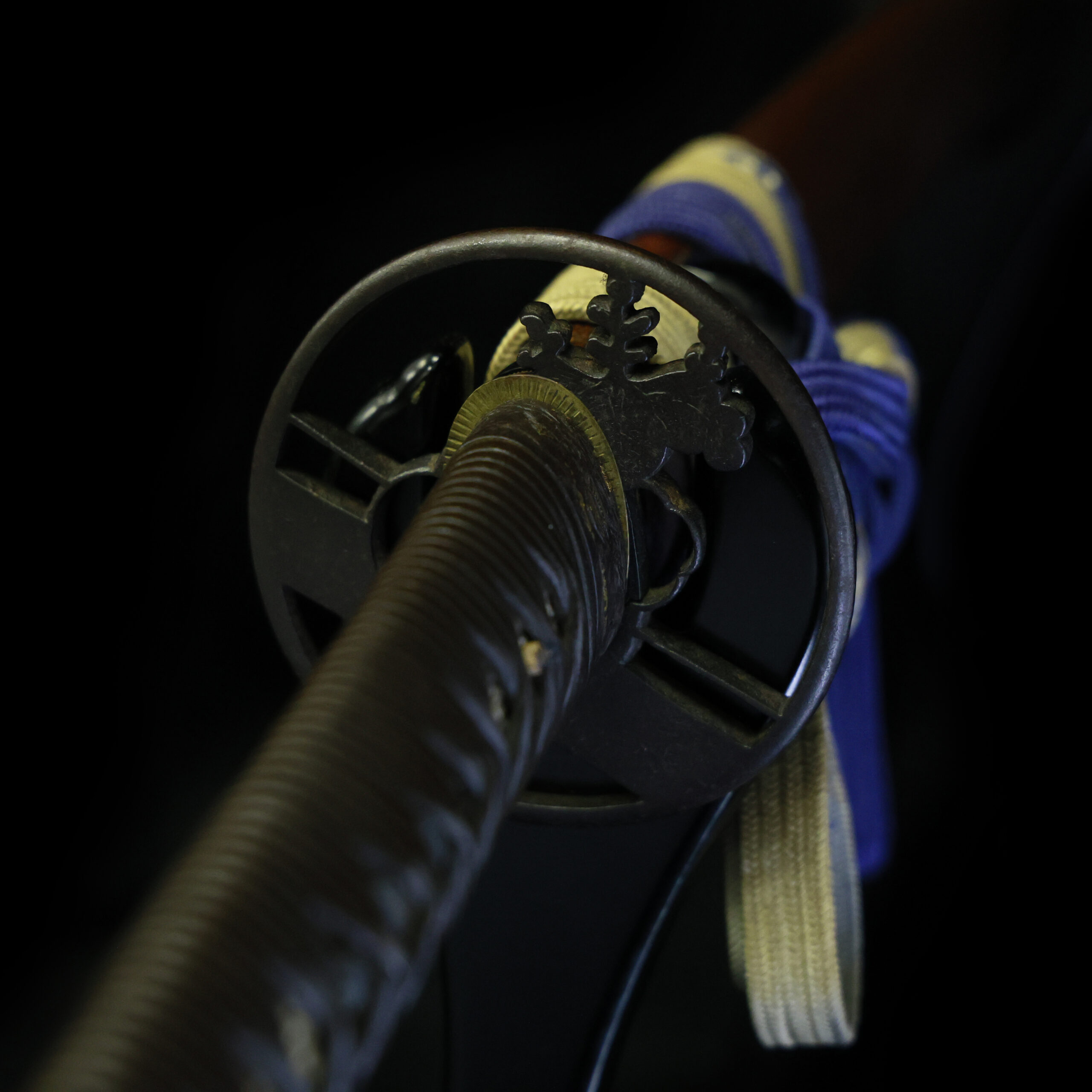
Koshirae:Koshirae is the mounting of the Japanese sword. There are several parts that consist of Koshirae such as Saya (Scabbard), Tsuka (Handle), Tsuba (Handguard).
Fuchi-Kashira:A pair of matching sword fittings that cover the upper and bottom parts of its sword hilt.
The design of the fuchi-kashira appears to be inspired by traditional Chinese landscape paintings (山水画, sansui-ga), which often depict natural scenes such as mountains, rivers, and trees in a harmonious and poetic composition. This motif reflects a deep appreciation for nature and serenity, as well as the cultural exchange between China and Japan in classical art.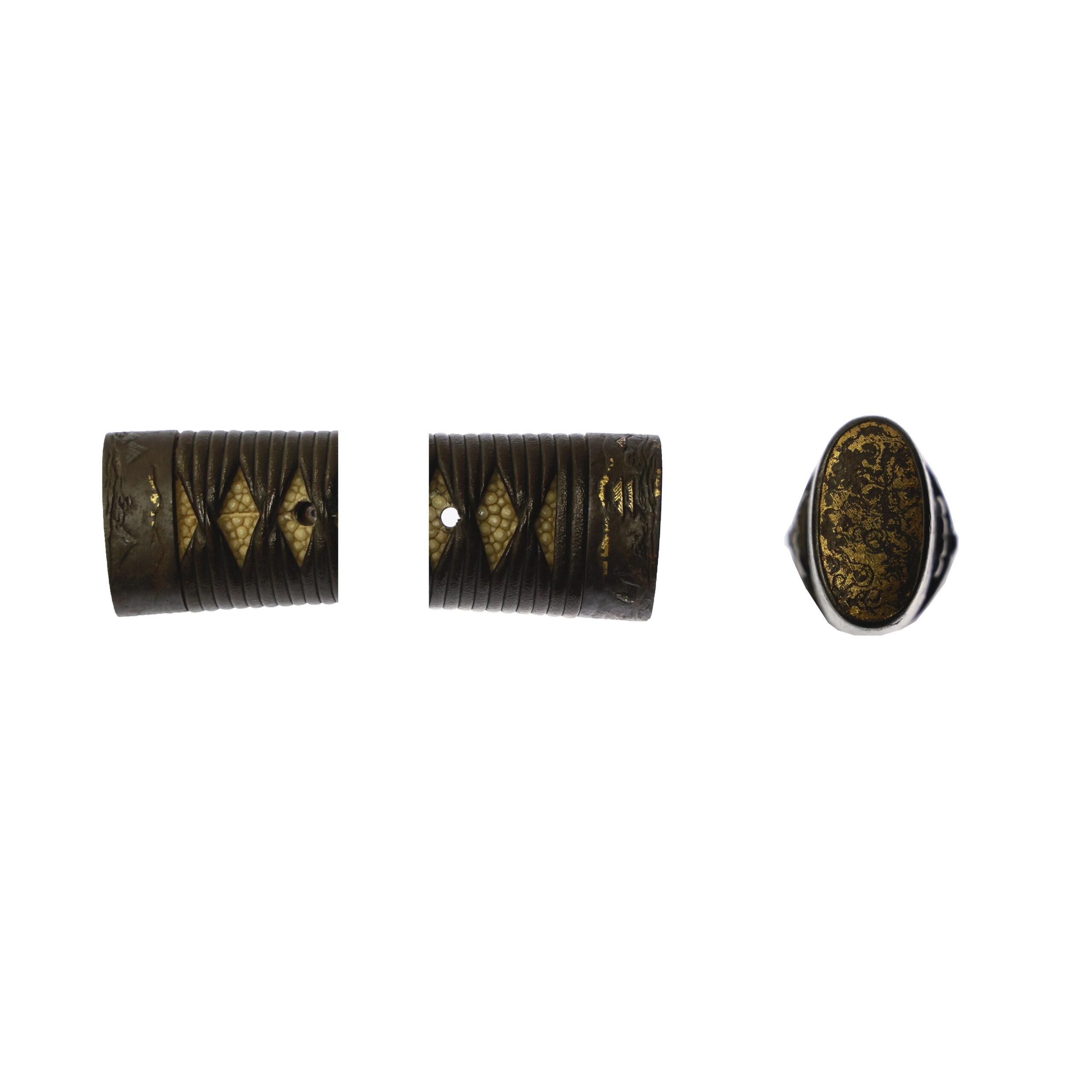
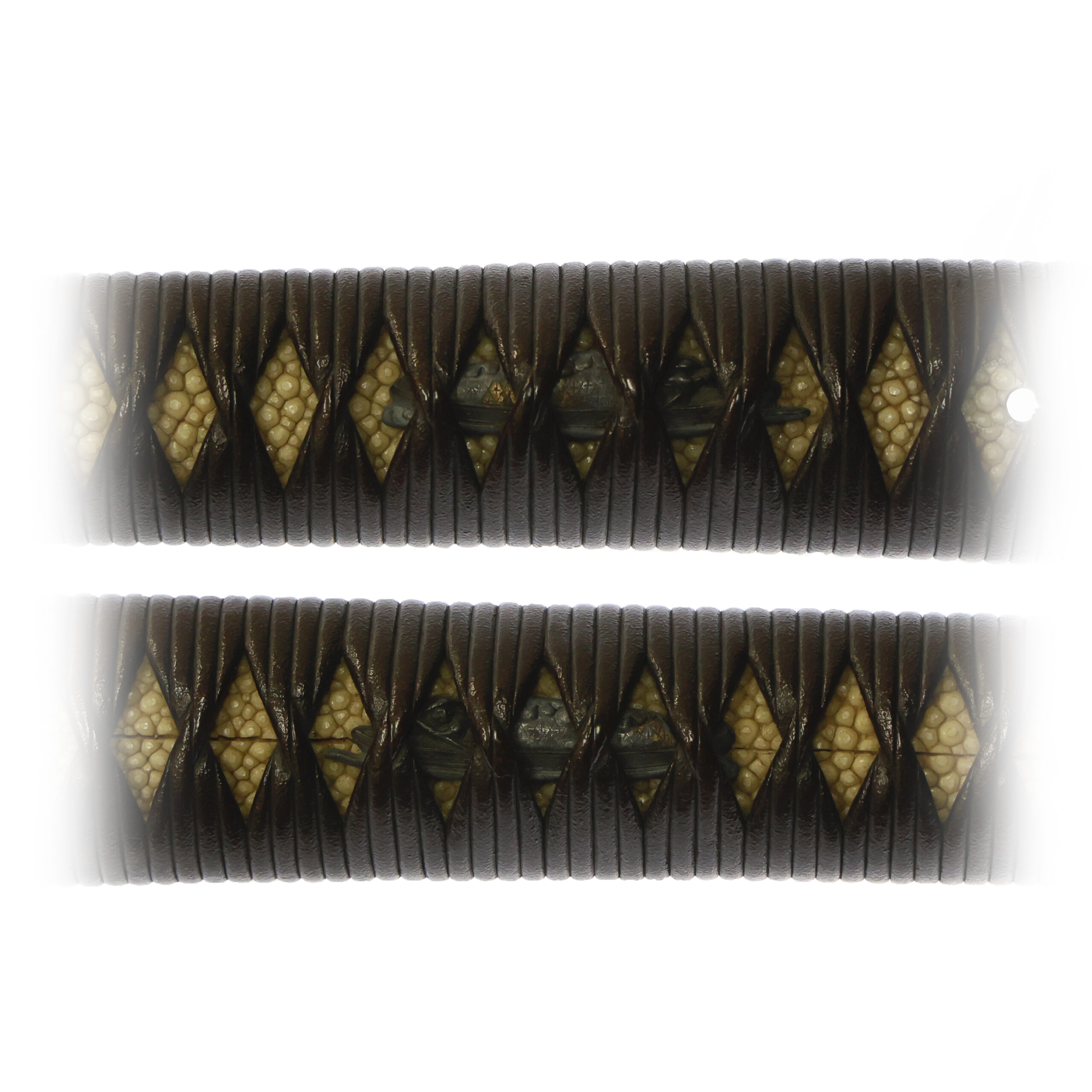
Tsuka and Menuki:Tsuka is the handle of the Japanese sword and Menuki is its decoration.
This menuki depicts a figure rowing a small boat. Combined with the landscape motifs on the other sword fittings, it creates a harmonious and evocative scene.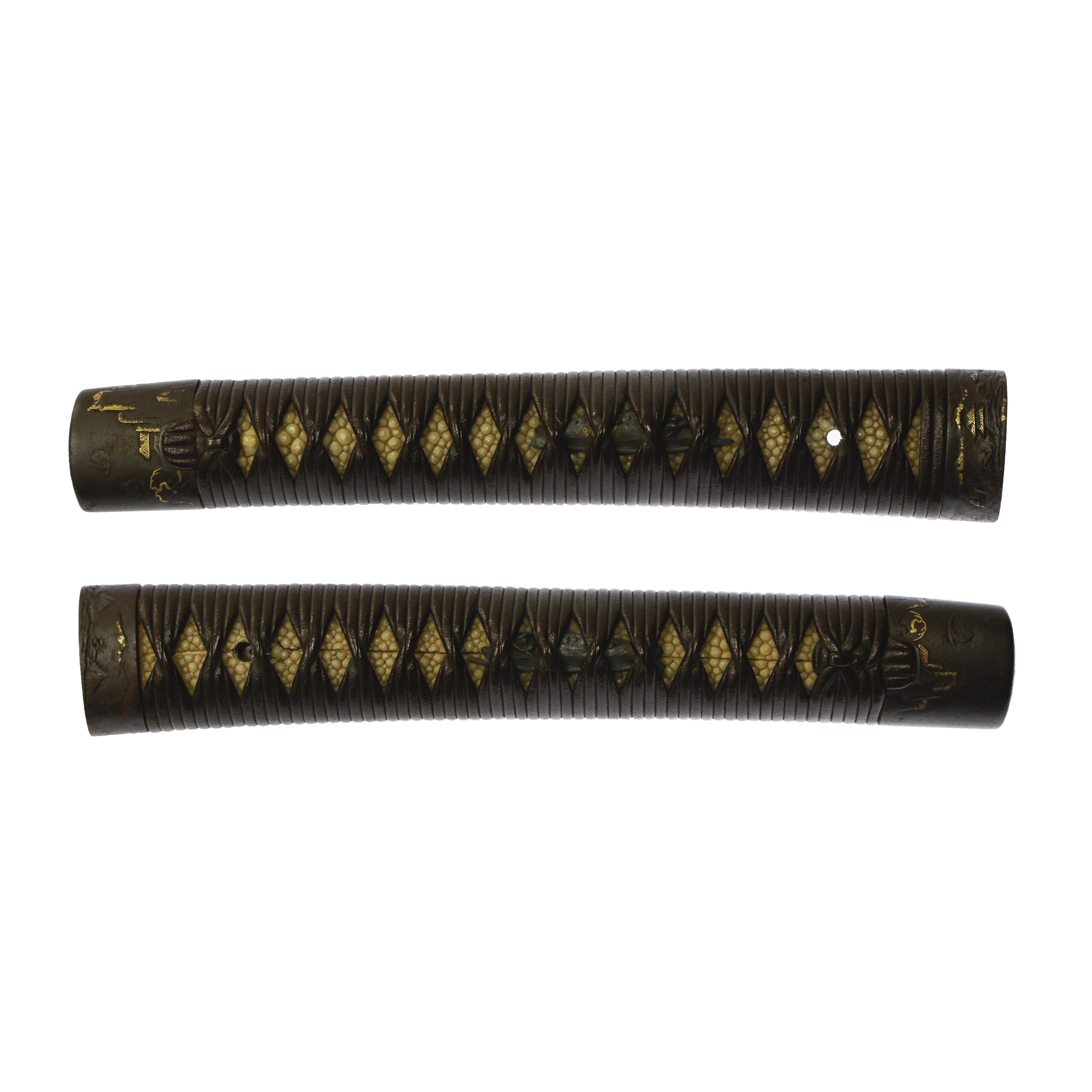
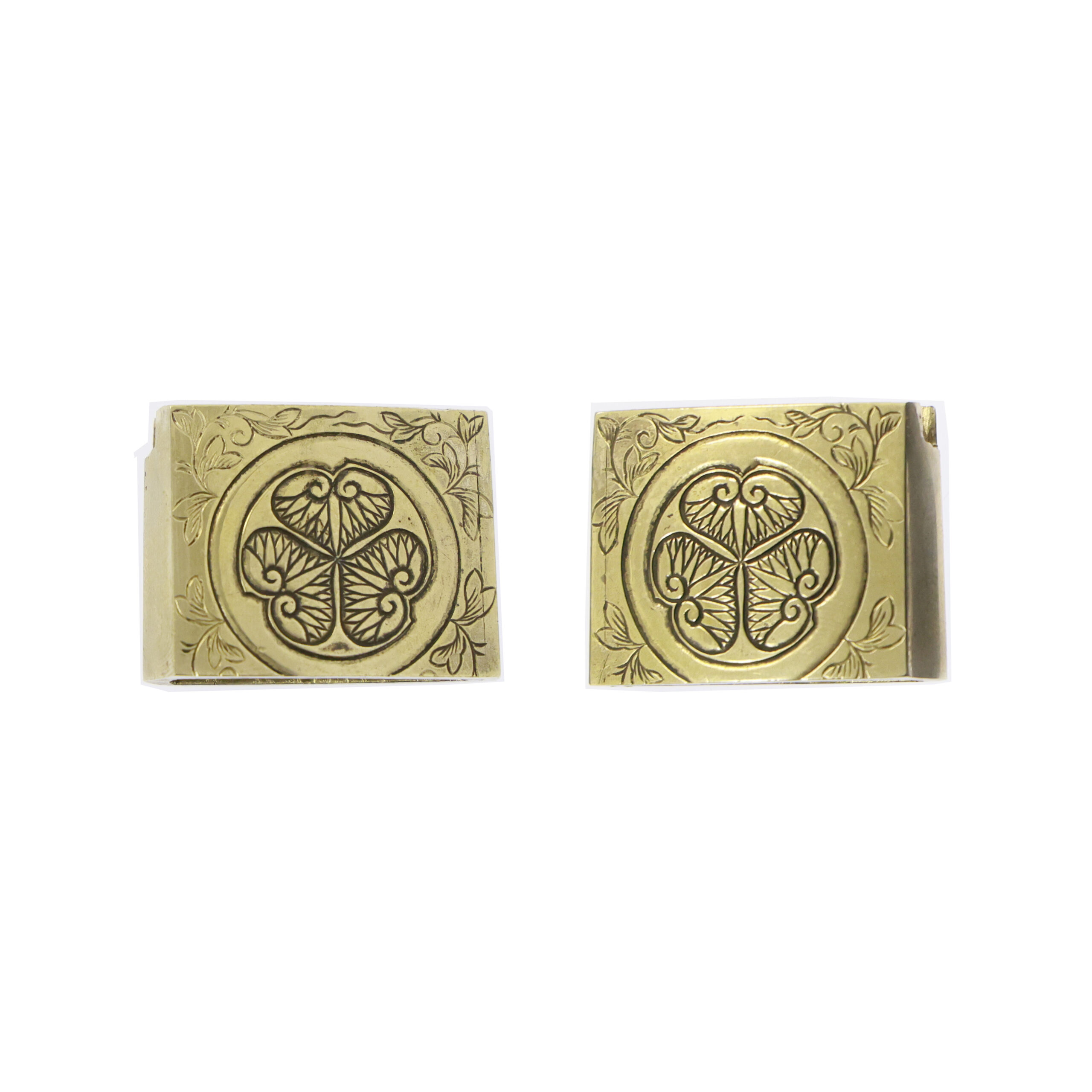
Tsuba and Habaki:Tsuba is the handguard for the Japanese Sword and Habaki is the equipment to make the blade not touch its scabbard inside. It prevents the blade from getting rusty and chipped.
This tsuba showcases an intricate openwork design (透かし彫り, sukashi-bori) of the “Go-san no Kiri” (五三の桐, Five-three Paulownia), a traditional Japanese crest composed of stylized paulownia leaves and flowers. This crest has long been associated with imperial authority and later with the Japanese government, symbolizing power, dignity, and tradition. The sukashi-bori technique—where parts of the metal are meticulously cut away to create patterns using negative space—not only highlights the artisan’s skill but also gives the tsuba a sense of lightness and visual depth.
The theme of this Habaki is Tokugawa Aoi mon (徳川葵紋). It is known as the family crest of Tokugawa Shogunate family led by Tokugawa Ieyasu, a famous military commander of the Warring States period. This plant pattern has also been used for the crest of the Kamo shrine in Kyoto prefecture. As mentioned above, the famous Shogunate family, the Tokugawa family, had their family crest with three leaves of Aoi due to the relationship with the Kamo shrine. As its leaves have a habit of always facing the sun, and the word “Aoi” is taken as “Aogu (仰ぐ, looking up)” for the sun, people thought the Aoi pattern would bring good fortune.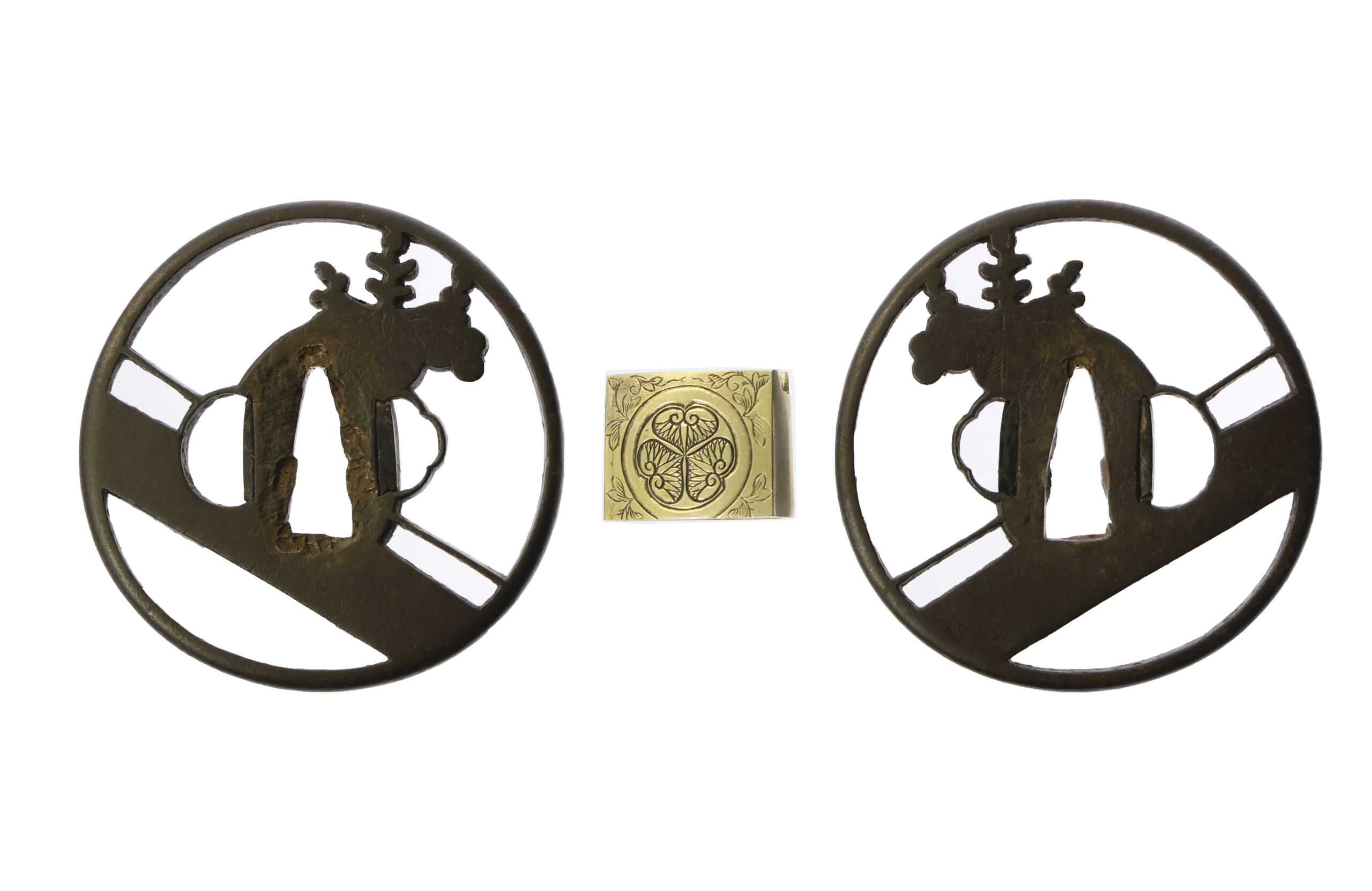
Saya:Saya is the scabbard for the Japanese sword.
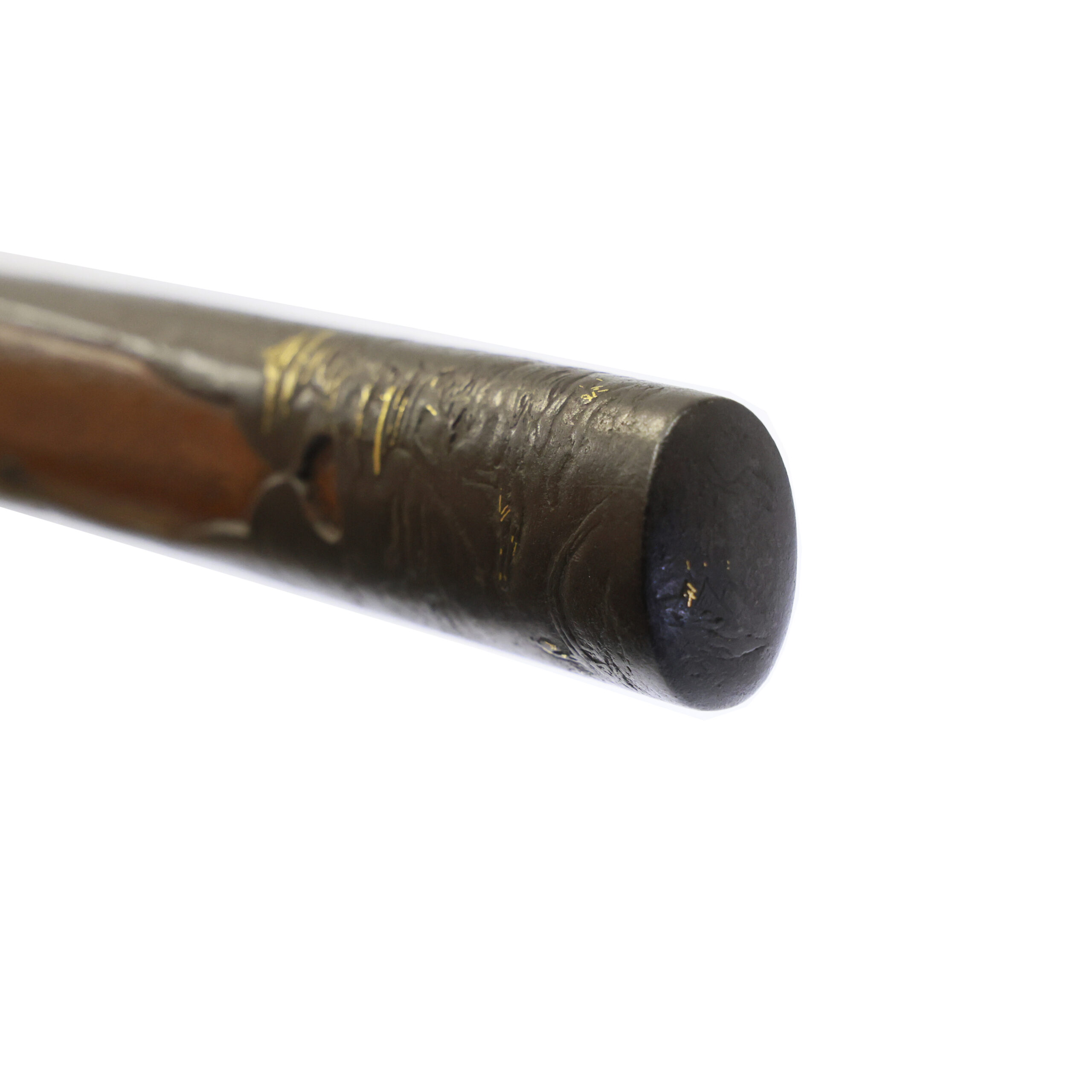
The Kojiri (end cap of the scabbard) is decorated with what appears to be a Buddhist pagoda. Pagodas trace their origins back to the ancient Indian stupa—structures built to house sacred relics—and spread throughout East Asia along with the dissemination of Buddhism. In Japan, they are known for their multi-tiered architecture, with famous examples such as the five-story pagoda at Hōryū-ji Temple in Nara, a UNESCO World Heritage site. These structures are regarded as symbols of sacred space and spiritual elevation in the Buddhist tradition.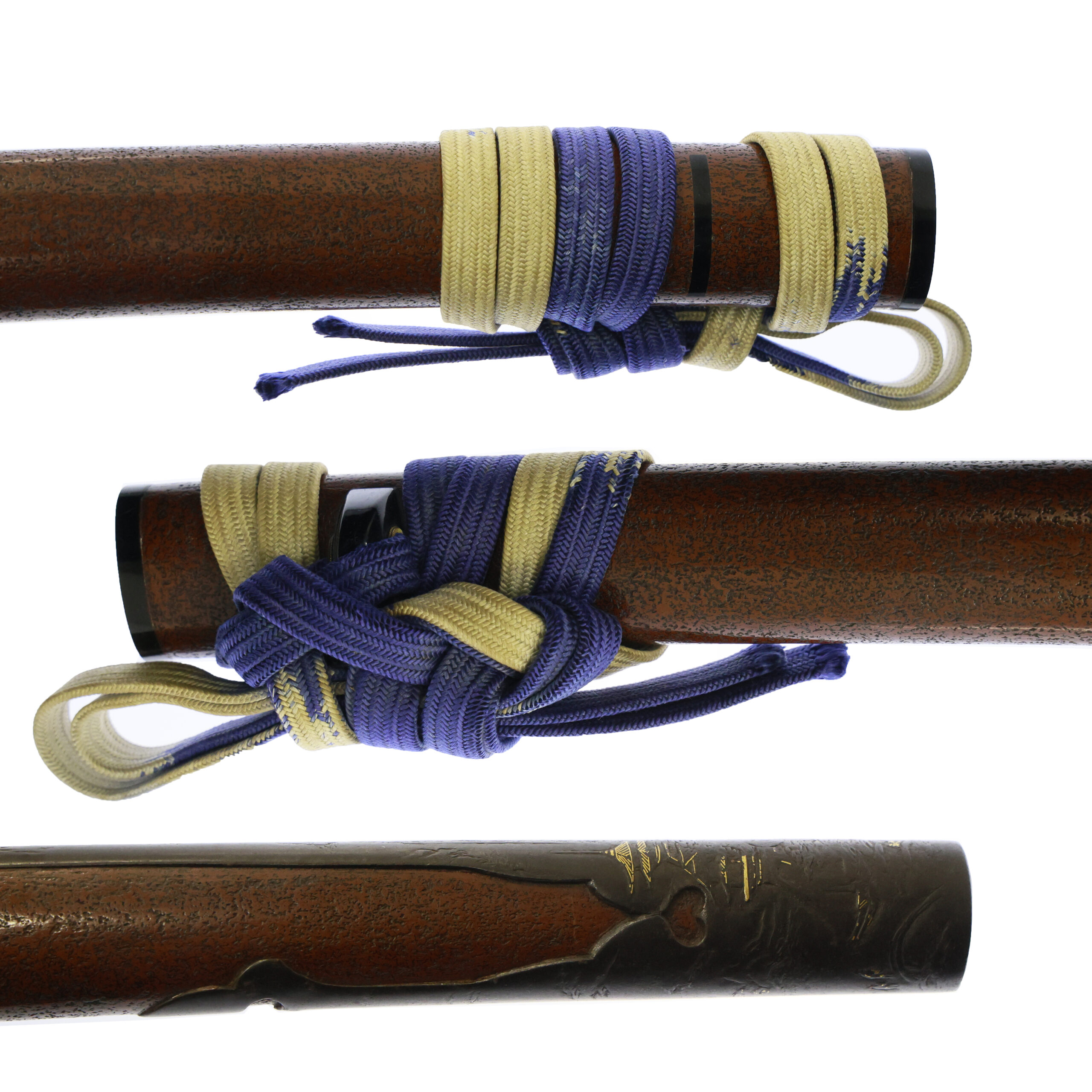
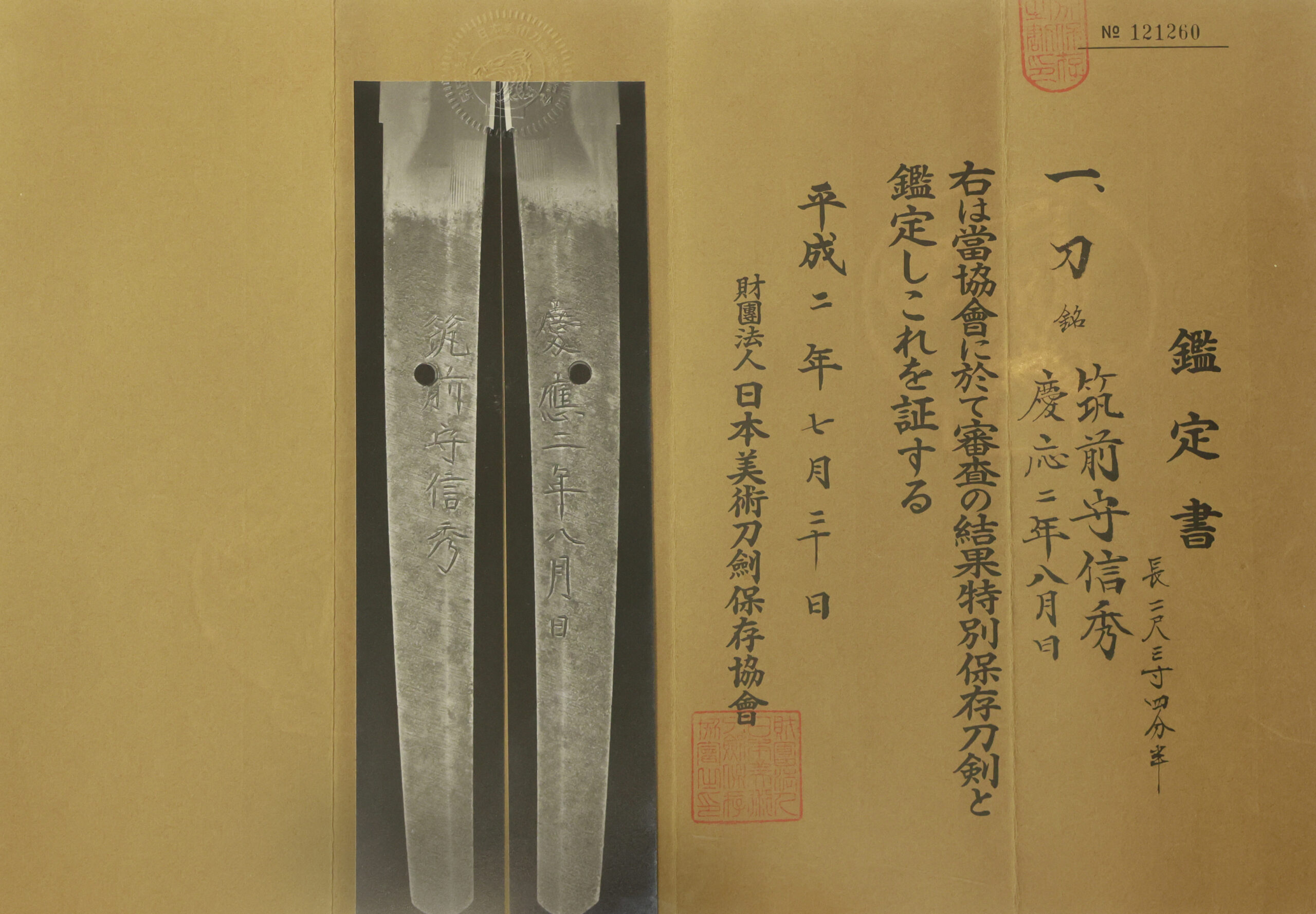
Authentication Paper:NBTHK TOKUBETSU Hozon Certificate for the blade (No. 121260)
NBTHK, also known as Nihon Bijutsu Touken Hozon Kyokai (the Society for the Preservation of the Japan Art Sword), is one of the oldest Japanese sword appraising organizations in modern-day Japan. They authenticated the blade on July 20th in the 2nd year of Heisei (1990). They appraised it as Tokubetsu Hozon Touken, the blade especially worth preserving for Japanese society. The purchaser will receive this original certificate as well. We can also translate what is written into English and make a PDF file for your record if you request.
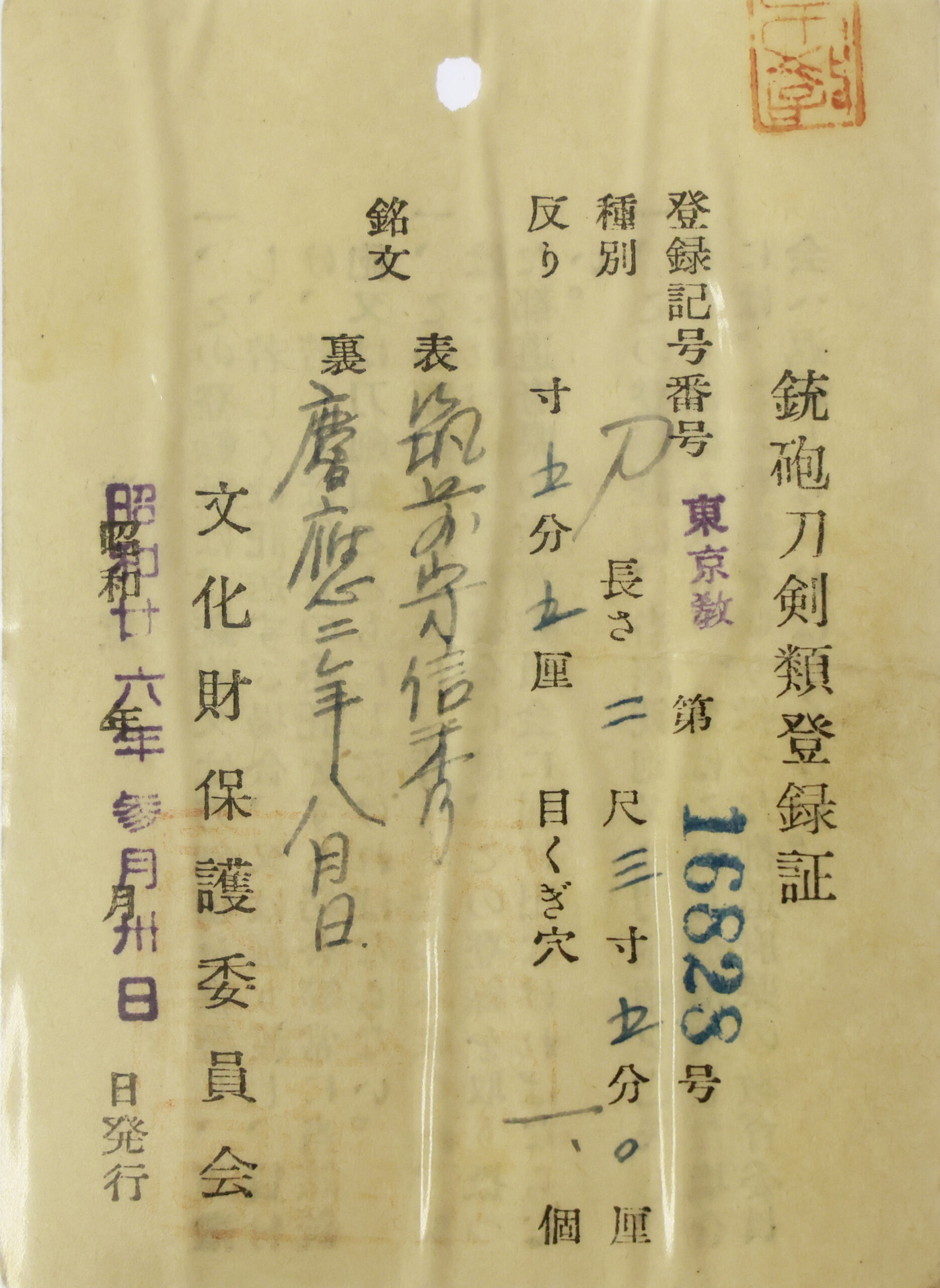
Registration Number : Tokyo 16828
The Board of Education in Tokyo issued a registration paper for this sword. It is called Jyu Hou Token Rui Tourokusho (銃砲刀剣類登録証). Bunkacho (The Agency for Cultural Affairs) acknowledges a Japanese sword with this paper as a work of art.
The sword needs to be traditionally hand-forged and made of Tamahagane carbon steel to be registered in the system. With this paper, its owner in Japan can legally own an authentic Japanese sword. Based on this registration number, we will apply for its export permit.
This paper will need to be returned to the board of education when the sword is being shipped abroad, but you can receive a copy of it. An English translation of this registration paper is available on request.
Antique Japanese Sword and Export process
The antique Japanese swords we deal with on eBay are hand-forged edged swords, which are at least 100 years old or older. Each Japanese sword is registered under the Agency for Cultural Affairs and the Board of Education in Japan. They issue a registration paper for each Japanese sword for the owner in Japan to legally possess it. After receiving the full payment from you, we will return the registration paper to the Board of Education and apply for its permit to Agency for Cultural Affairs(Bunkacho) to legally export the sword from Japan to other countries. It normally takes around 2-4 weeks months to receive this permit. And we would like you to expect at least 1-1.5 months for your order to arrive at your given address after you ordered.
Shipping
We have shipped authentic Japanese swords to the USA, Mexico, Germany and France. If you don't live in these countries and like to order, please contact us first before making a purchase. We offer Free International Shipping as long as we can send antique Japanese swords by EMS. We normally ship by EMS(Express Mail Service) provided by Japan Post. Please keep in mind that we will use UPS for those who live in the USA.
We will send you a tracking number for your order as soon as we hand it to the post office. We will put 100 % insurance on the shipping document without any extra charge. Based on the total amount, there might be a duty tax for you to pay, depending on the countries. We use package cushioning to protect the item and put it in a PVC pipe, which is one of the most secure packages because of its durability.
It will normally takes 5-14 days for the item to arrive at your given address after we dispatch it. Time of delivery is estimated as accurately as possible by the carrier but does not take into account any delays beyond our control such as by inclement weather, post office holiday seasons.
Terms Condition
Please note that your use of e-bay is governed by the following terms. These Terms are between you and Samurai Museum and govern our respective rights and obligations.
Items posted on eBay page are supposed to be shipped to the USA, Canada , France Hong Kong or Mexico. If you are ordering from those countries, we offer you free shipping. You are responsible for paying all customs fees and your local taxes. Please check your domestic law to confirm if it is allowed to import antique Japanese swords before making any purchase.
You must be at least 18 years of age or older to buy Japanese swords. Samurai Museum will not be responsible if one harms others or hurts oneself by misusing the items he or she purchased from us. We deal with original edged samurai swords, which might be dangerous if wrongly used.
Samurai Museum is not responsible for any lost package that is incorrectly addressed due to customer error. We make our shipping labels based on the information a customer provides, If you register your address incorrectly, you are bound to inform us immediately. Please also bear in mind that damage or loss caused by custom or post office is beyond our control. If the item were lost or damaged by the shipping carrier(EMS), they would compensate for your damage. Please contact us immediately in this case.
Shipping from Tokyo Japan
Thank you for checking our item.
TO CHECK MORE ANTIQUE JAPANESE SWORDS FOR SALE
Copyright © 2025-2026 Samurai Museum. All rights reserved.