GHOSTBUSTERS
ULTIMATE VISUAL HISTORY MOVIE SPECIAL EFFECTS CARTOONS TOYS HB
HARDBOUND BOOK in ENGLISH by
DANIEL WALLACE
FOREWORD BY DAN AYKROYD
INTRODUCTION BY IVAN REITMAN
PART 1: THE ORIGINAL MOVIE
WHO YOU GONNA CALL?
WHAT ARE YOU SUPPOSED TO BE?
SOME KIND OF COSMONAUT?
NICE SHOOTING, TEX
GHOST FEVER GRIPS NEW YORK CITY
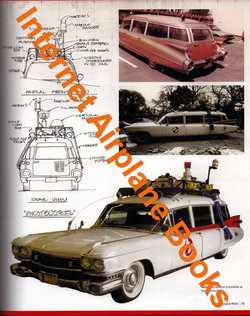
THE GHOSTBUSTERS VEHICLE
AMBULANCE
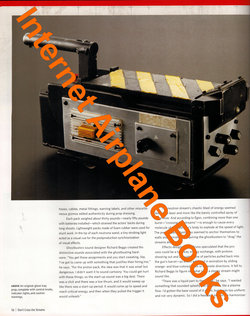
DON�T CROSS THE STREAMS
WE HAVE THE TOOLS AND WE HAVE
THE TALENT
WHO BROUGHT THE DOG?
AIR FOR THE FLAT TOP
LIBRARY GHOST
SLIMER
DREAM GHOST
THE ESCAPEES
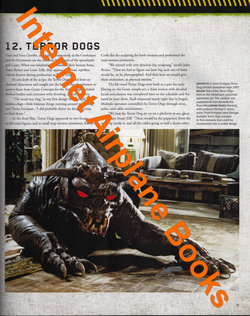
TERROR DOGS
MR. STAY PUFT MARSHMELLOW MAN
TOTAL PROTONIC REVERSAL
PART 2: THE SEQUEL
WILL THERE BE ANY MORE OF THEM?
THE ECOMOBILE MARK II
THE SCOLERI BROTHERS
SPOOKS, SPECTRES AND GHOSTS
GALORE
THE STATUE OF LIBERTY
MUSEUM OF SLIME
PART 3: THE EXPANDED
GHOSTBUSTERS UNIVERSE
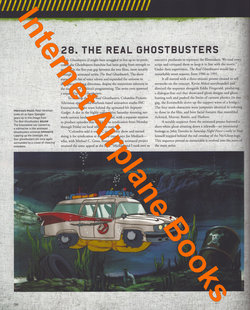
THE REAL GHOSTBUSTERS
EXTREME GHOSTBUSTERS
GHOSTBUSTERS VIDEO GAMES
GHOSTBUSTERS IN COMIC BOOKS
GHOSTBUSTER TOYS AND MERCHANDISE
-------------------------------
Additional Information from
Internet Encyclopedia
Ghostbusters is a 1984 American
supernatural comedy film directed by Ivan Reitman and written by Dan Aykroyd
and Harold Ramis. It stars Bill Murray, Aykroyd, and Ramis as Peter Venkman,
Ray Stantz, and Egon Spengler, three eccentric parapsychologists who start a
ghost-catching business in New York City. It also stars Sigourney Weaver and
Rick Moranis, and features Annie Potts, Ernie Hudson, and William Atherton in
supporting roles.
Based on his fascination with
spirituality, Aykroyd conceived Ghostbusters as a project starring himself and
John Belushi, in which they would venture through time and space battling
supernatural threats. Following Belushi's death in 1982, and with Aykroyd's
concept deemed financially impractical, Ramis was hired to help rewrite the
script to set it in New York City and make it more realistic. It was the first
comedy film to employ expensive special effects, and Columbia Pictures,
concerned about its relatively high $25�30 million budget, had little faith in
its box office potential. Filming took place from October 1983 to January 1984,
in New York City and Los Angeles. Due to competition for special effects
studios among various films in development at the time, Richard Edlund used
part of the budget to found Boss Film Studios, which employed a combination of
practical effects, miniatures, and puppets to deliver the ghoulish visuals.
Ghostbusters was released on
June 8, 1984, to critical acclaim and became a cultural phenomenon. It was
praised for its blend of comedy, action, and horror, and Murray's performance
was often singled out for praise. It earned at least $282 million worldwide
during its initial theatrical run and was the second-highest-grossing film of
1984 in the United States and Canada, and the then-highest-grossing comedy
ever. It was the number-one film in US theaters for seven consecutive weeks and
one of only four films to gross more than $100 million that year. Further
theatrical releases have increased the worldwide total gross to around $370
million, making it one of the most successful comedy films of the 1980s. In
2015, the Library of Congress selected it for preservation in the National Film
Registry. Its theme song, "Ghostbusters" by Ray Parker Jr., was also
a number-one hit.
With its effect on popular
culture, and a dedicated fan following, the success of Ghostbusters launched a
multi-billion dollar multimedia franchise. This included the popular animated
television series The Real Ghostbusters (1986), its follow-up Extreme Ghostbusters
(1997), video games, board games, comic books, clothing, music, and haunted
attractions. Ghostbusters was followed in 1989 by Ghostbusters II, which fared
less well financially and critically, and attempts to develop a second sequel
paused in 2014 following Ramis's death. After a 2016 reboot received mixed
reviews and underperformed financially, a second sequel to the 1984 film,
Ghostbusters: Afterlife (2021), was released, followed by Ghostbusters: Frozen
Empire (2024).
Plot
After Columbia University
parapsychology professors Peter Venkman, Ray Stantz, and Egon Spengler
experience their first encounter with a ghost at the New York Public Library,
the university dean dismisses the credibility of their paranormal-focused research
and fires them. The trio responds by establishing "Ghostbusters", a
paranormal investigation and elimination service operating out of a disused
firehouse. They develop high-tech nuclear-powered equipment to capture and
contain ghosts, although business is initially slow.
Following a paranormal encounter
in her apartment, cellist Dana Barrett visits the Ghostbusters. She recounts
witnessing a demonic dog-like creature in her refrigerator utter a single word:
"Zuul". Ray and Egon research Zuul and details of Dana's building
while Peter inspects her apartment and unsuccessfully attempts to seduce her.
The Ghostbusters are hired to remove a gluttonous ghost from the Sedgewick
Hotel. Having failed to properly test their equipment, Egon warns the group
that crossing the energy streams of their proton pack weapons could cause a
catastrophic explosion. They capture the ghost and deposit it in an
ecto-containment unit under the firehouse. Supernatural activity rapidly
increases across the city and the Ghostbusters become famous; they hire a
fourth member, Winston Zeddemore, to cope with the growing demand.
Suspicious of the Ghostbusters,
Environmental Protection Agency inspector Walter Peck asks to evaluate their
equipment, but Peter rebuffs him. Egon warns that the containment unit is
nearing capacity and supernatural energy is surging across the city. Peter
meets with Dana and informs her that Zuul was a demigod worshipped as a servant
to "Gozer the Gozerian", a shapeshifting god of destruction. Upon
returning home, Dana is possessed by Zuul; a similar entity possesses her
neighbor, Louis Tully. Peter arrives and finds the possessed Dana/Zuul claiming
to be "the Gatekeeper". Louis is brought to Egon by police officers
and claims that he is "Vinz Clortho, the Keymaster". The Ghostbusters
agree that they must keep the pair separated.
The next morning, Peck returns
with law enforcement and city workers to have the Ghostbusters arrested and
their containment unit deactivated, causing an explosion that releases the
captured ghosts. Louis/Vinz escapes in the confusion and makes his way to the
apartment building to join Dana/Zuul. In jail, Ray and Egon reveal that Ivo
Shandor, leader of a Gozer-worshipping cult in the early 20th century, designed
Dana's building to function as an antenna to attract and concentrate spiritual
energy to summon Gozer and bring about the apocalypse. Faced with supernatural
chaos across the city, the Ghostbusters convince the mayor to release them.
The Ghostbusters travel to a
hidden temple located on top of the building as Dana/Zuul and Louis/Vinz open
the gate between dimensions and transform into demonic dogs. Gozer appears as a
woman and attacks the Ghostbusters, then disappears when they attempt to
retaliate, with its disembodied voice demanding the Ghostbusters "choose
the form of the destructor". Ray inadvertently recalls a beloved corporate
mascot from his childhood, and Gozer reappears as a gigantic Stay Puft
Marshmallow Man that begins destroying the city. Against his earlier advice,
Egon instructs the team to cross their proton energy streams at the dimensional
gate. The resulting explosion destroys Gozer's avatar, banishing it back to its
dimension, and closes the gateway. The Ghostbusters then rescue Dana and Louis
from the wreckage and are welcomed on the street as heroes.
Cast
Bill Murray as Peter Venkman
Dan Aykroyd as Ray Stantz
Sigourney Weaver as Dana Barrett
Harold Ramis as Egon Spengler
Rick Moranis as Louis Tully
Annie Potts as Janine Melnitz
William Atherton as Walter Peck
Ernie Hudson as Winston
Zeddemore
In addition to the main cast,
Ghostbusters features David Margulies as Lenny Clotch, Mayor of New York,
Michael Ensign as the Sedgewick Hotel manager, and Slavitza Jovan as Gozer
(voiced by Paddi Edwards). It also features astrologist Ruth Hale Oliver as the
Library Ghost, Alice Drummond as the Librarian, Jennifer Runyon and Steven Tash
as Peter's psychological test subjects, Timothy Carhart as a violinist, and
Reginald VelJohnson as a corrections officer. Playboy Playmate Kymberly Herrin
appears as a seductive ghost in Ray's dreams.
Roger Grimsby, Larry King, Joe
Franklin, and Casey Kasem make cameo appearances as themselves; Kasem in a
voice-only role. In addition, Kasem's wife, Jean, appears as the tall guest at
Louis' party; along with Debbie Gibson in her film debut and porn star Ron
Jeremy. Director Ivan Reitman provided the voice to Slimer and other
miscellaneous ghost voices.
Ghostbusters was inspired by Dan
Aykroyd's fascination with and belief in the paranormal, which he inherited
from his father, who later wrote the book A History of Ghosts; his mother, who
claimed to have seen ghosts; his grandfather, who experimented with radios to
contact the dead; and his great-grandfather, a renowned spiritualist. In 1981,
Aykroyd read an article on quantum physics and parapsychology in The Journal of
the American Society for Psychical Research, which gave him the idea of
trapping ghosts. He was also drawn to the idea of modernizing the comedic ghost
films of the mid-20th century by comics such as Abbott and Costello (Hold That
Ghost, 1941), Bob Hope (The Ghost Breakers, 1940) and the Bowery Boys (Ghost
Chasers, 1951).
Aykroyd wrote the script,
intending to star alongside Eddie Murphy and his close friend and fellow
Saturday Night Live (SNL) alumnus John Belushi, before Belushi's accidental
death in March 1982. Aykroyd recalled writing one of Belushi's lines when
producer and talent agent Bernie Brillstein called to inform him of Belushi's
death. He turned to another former SNL castmate, Bill Murray, who agreed to
join without an explicit agreement, which is how he often worked. Aykroyd
pitched his concept to Brillstein as three men who chase ghosts and included a
sketch of the Marshmallow Man character he had imagined. He likened the
Ghostbusters to pest-control workers, saying that "calling a Ghostbuster
was just like getting rats removed". Aykroyd believed Ivan Reitman was the
logical choice to direct, based on his successes with films such as Animal
House (1978) and Stripes (1981). Reitman was aware of the film's outline while
Belushi was still a prospective cast member; this version took place in the
future with many groups of intergalactic ghostbusters, and felt it "would
have cost something like $200 million to make". Aykroyd's original 70- to
80-page script treatment was more serious in tone and intended to be scary.
Reitman met with Aykroyd at
Art's Delicatessen in Studio City, Los Angeles, and explained that his concept
would be impossible to make. He suggested that setting it entirely on Earth
would make the extraordinary elements funnier, and that focusing on realism
from the beginning would make the Marshmallow Man more believable by the end.
He also wanted to portray the Ghostbusters' origins before starting their
business: "This was beginning of the 1980s�everyone was going into
business". After the meeting, they met Harold Ramis at Burbank Studios.
Reitman had worked with Ramis on previous films and believed he could better
execute the tone he intended for the script than Aykroyd. He also felt Ramis
should play a Ghostbuster. After reading the script, Ramis joined the project
immediately.
Although the script required
considerable changes, Reitman pitched the film to Columbia Pictures executive
Frank Price in March 1983. Price found the concept funny, but was unsure of the
project, as comedies were seen to have limited profitability. He said the film
would take a big budget due to its special effects and popular cast. Reitman
reportedly said they could work with $25�30 million;[c] varying figures have
been cited. Price agreed, as long as the film could be released by June 1984.
Reitman later admitted he made up the figure, basing it on three times the
budget for Stripes, which seemed "reasonable". This left 13 months to
complete the film, with no finished script, effects studio, or filming start
date. Reitman hired his previous collaborators Joe Medjuck and Michael C. Gross
as associate producers. Columbia's CEO Fay Vincent sent his lawyer Dick Gallop
to Los Angeles to convince Price not to pursue the film, but Price disagreed.
Gallop returned to the head office to report that Price was "out of
control".
As the title
"Ghostbusters" was legally restricted by the 1970s children's show
The Ghost Busters, owned by Universal Studios, several alternative titles were
considered, including "Ghoststoppers", "Ghostbreakers", and
"Ghostsmashers". Price parted ways with Columbia early in
Ghostbusters' production and became head of Universal Pictures, at which point
he sold Columbia the title for $500,000 plus 1% of the film's profits. Given
Hollywood's accounting practices�used by studios to artificially inflate a
film's production costs to limit royalty or tax payouts�the film technically
never made a profit for Universal to be owed a payment.
Writing
Aykroyd, Ramis, and Reitman
began reworking the script, first at Reitman's office, then sequestering
themselves and their families on Martha's Vineyard, Massachusetts. Aykroyd had
a home there, and they worked day and night in his basement for about two weeks.[9]
Aykroyd was willing to rework his script; he considered himself a "kitchen
sink" writer who created the funny situations and paranormal jargon, while
Ramis refined the jokes and dialogue. They wrote separately, then rewrote each
other's drafts. Many scenes had to be cut, including an asylum haunted by
celebrities, and an illegal ghost-storage facility in a New Jersey gas station.
Their initial draft was completed when they left the Vineyard in mid-July 1983,
and a third and near-final draft was ready by early August. When Murray flew to
New York after filming The Razor's Edge (1984) to meet Aykroyd and Ramis, he
offered little input on the script or his character. Having written for Murray
multiple times, Ramis said he knew "how to handle his character's voice".
It was decided early on that
Ramis's character would be the brains of the Ghostbusters, Aykroyd's the heart,
and Murray's the mouth. Aykroyd drew inspiration from fiction archetypes:
"Put Peter Venkman, Raymond Stantz, and Egon Spengler together, and you
have the Scarecrow, the Lion, and the Tin Man". His concept called for the
Ghostbusters to have a boss and to be directed into situations, but Ramis
preferred they be in control "of their own destiny" and make their
own choices. This led to the development of more distinct identities for the
characters: Peter as the cool, modern salesman; Ray as the honest, enthusiastic
technician; and Egon as the factual, stoic intellectual.
Reitman thought the most
difficult parts of the writing were determining the story's goal, who the
villain was and their goal, why ghosts were manifesting, and how a towering
Marshmallow Man would appear. The creature was one of many elaborate supernatural
entities in Aykroyd's initial treatment, originally intended to emerge from the
East River only 20 minutes into the film. It stood out to Reitman but concerned
him because of the relatively realistic tone they were taking. Meanwhile,
Reitman searched for a special effects studio, eventually recruiting Richard
Edlund in the same two-week span.
Cast and characters
Murray was considered essential
to Ghostbusters' potential success, but he was known for not committing to
projects until late. Price agreed to fund Murray's passion project The Razor's
Edge, believing if it failed it would lose little money, and hoping the gesture
would secure Murray's commitment to Ghostbusters. Michael Keaton, Chevy Chase,
Tom Hanks, Robin Williams, Steve Guttenberg, and Richard Pryor were also
considered for the role. Christopher Walken, John Lithgow, Christopher Lloyd,
Jeff Goldblum, and Keaton were considered to portray Egon. Ramis was inspired
by the cover of a journal on abstract architecture for Egon's appearance,
featuring a man wearing a three-piece tweed suit and wire-rim glasses, his hair
standing straight up. He took the character's first name from a Hungarian
refugee with whom he attended school, and the surname from German historian
Oswald Spengler. Apart from the three main stars, Medjuck was largely
responsible for casting the roles.
Hudson auditioned five times for
the role of Winston Zeddemore. According to him, an earlier version of the
script gave Winston a larger role as an Air Force demolitions expert with an
elaborate backstory. Excited by the part, he agreed to the job for half his
usual salary. The night before shooting began, he received a new script with a
greatly reduced role; Reitman told him the studio wanted to expand Murray's
part. Aykroyd said Winston was the role intended for Eddie Murphy, although
Reitman denied this. Gregory Hines and Reginald VelJohnson were also considered
for the part.
Daryl Hannah, Denise Crosby,
Julia Roberts, and Kelly LeBrock auditioned for the role of Dana Barrett, but
Sigourney Weaver attracted the filmmakers' attention. There was resistance to
casting her because of the generally serious roles she had played in Alien
(1979) and The Year of Living Dangerously (1982). She revealed her comedic
background, developed at the Yale School of Drama, and began walking on all
fours and howling like a dog during her audition. It was her suggestion for
Dana to become possessed by Zuul; Reitman said this solved problems with the
last act by giving the characters personal stakes in the events. Weaver also
changed Dana's occupation from a model to a musician, saying that Dana can be
somewhat strict, but has a soul because she plays the cello.
John Candy was offered the role
of Louis Tully. He told Reitman he did not understand the character and
suggested portraying Tully with a German accent and multiple German Shepherds,
but the filmmakers felt there were already enough dogs in the film. Candy chose
not to pursue the role. Reitman had previously worked with Rick Moranis and
sent him the script; he accepted the role an hour later. Moranis developed many
aspects of his character, including making him an accountant, and ad-libbed the
lengthy speech at Tully's party. Sandra Bernhard turned down the role of the
Ghostbusters' secretary Janine Melnitz, which went to Annie Potts. When she
arrived for her first day of filming, Reitman rushed Potts into the current
scene. She quickly changed out of her street clothes and borrowed a pair of
glasses worn by the set dresser which her character subsequently wore
throughout the film.
William Atherton was chosen for
the role of Walter Peck after he had appeared in the Broadway play Broadway.
Peck was described as akin to Margaret Dumont's role as a comedic foil to the
Marx Brothers. Atherton said: "It can't be funny, and I don't find [the
Ghostbusters] in the least bit charming. I have to be outraged." The role
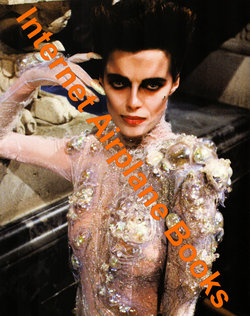
of the Sumerian god Gozer the Gozerian, envisioned as a business-suited
architect, was originally intended for Paul Reubens. When he passed on the
idea, Yugoslavian actress Slavitza Jovan was cast and the character changed to
one inspired by the androgynous looks of Grace Jones and David Bowie. Paddi
Edwards was uncredited as the voice of Gozer, dubbing over Jovan's strong
Slavic accent. Reitman's wife and their children, Jason and Catherine, filmed a
cameo appearance as a family fleeing Dana's building, but the scene was cut
because Jason was too scared by the setup to perform a second take.
Filming
Principal photography began in
New York City on October 28, 1983. On the first day, Reitman brought Murray to
the set, still unsure if he had read the script. Filming in New York lasted for
approximately six weeks, finishing just before Christmas. Reitman was conscious
they had to complete the New York phase before they encountered inhospitable
December weather. At the time, choosing to shoot in New York City was
considered risky. In the early 1980s, many saw the city as synonymous with
fiscal disaster and violence, and Los Angeles was seen as the center of the
entertainment industry. In a 2014 interview, Reitman said he chose New York
because "I wanted the film to be ... my New York movie". As Reitman
was working with comedians, he encouraged improvisation, adapting multiple
takes and keeping the cast creations that worked, but directing them back to
the script.
Some guerrilla filmmaking took
place, capturing spontaneous scenes at iconic locations around the city,
including one shot at Rockefeller Center where the actors were chased off by a
real security guard. A scene was shot on Central Park West with extras chanting
"Ghostbusters" before the name had been cleared. Medjuck contacted
the studio, urging them to secure permission to use the word as the title.
The building at 55 Central Park
West served as the home of Weaver's character and the setting of the
Ghostbusters' climactic battle with Gozer. The art department added extra
floors and embellishments using matte paintings, models, and digital effects to
create the focal point of ghostly activity. During shooting of the final scene
at the building, city officials allowed the closure of the adjacent streets
during rush hour, affecting traffic across a large swath of the city. Gross
commented that, from the top of the building, they could see traffic queuing
all the way to Brooklyn. At various points, a police officer drew his gun on a
taxi driver who refused orders; in a similar incident, another officer pulled a
driver through his limo window. When angry citizens asked Medjuck what was
being filmed, he blamed Francis Ford Coppola filming The Cotton Club (1984).
Aykroyd encountered science-fiction writer Isaac Asimov, a man he admired, who
complained, "You guys are inconveniencing this building, it's just awful;
I don't know how they got away with this!" Directly next to 55 Central
Park West is the Holy Trinity Lutheran Church, which is stepped on by the
Marshmallow Man.
Other locations included New
York City Hall, the New York Public Library main branch, the Lincoln Center for
the Performing Arts, Columbus Circle, the Irving Trust Bank on Fifth Avenue,
and Tavern on the Green. Firehouse, Hook & Ladder Company 8 in the Tribeca
neighborhood was used as the Ghostbusters' headquarters. Columbia University
allowed its Havemeyer Hall to stand in for the fictional Weaver Hall, on the
condition the university not be identified by name.
Filming moved to Los Angeles,
resuming between Christmas and the New Year. Due to the film's use of practical
effects, skilled technicians were needed who resided mainly in the city and
soundstages that were non-existent in New York. Despite its setting, most of
Ghostbusters was filmed on location in Los Angeles or on sets at Burbank
Studios. Location scouts searched for buildings that could replicate the
interiors of buildings being filmed in New York.[1][34] Reitman tried using the
interior of Hook & Ladder 8, but was unable to take it over long enough
because it was an active fire station. Interior firehouse shots were taken
instead at the decommissioned Fire House No. 23 in downtown Los Angeles. The
building design, while common in New York, was a rarity in Los Angeles. An
archival photograph of an active crew in Fire House No. 23 from 1915 was hung
in the background of the Ghostbusters' office.
Filming in the main reading room
of the New York Public Library was only allowed in the early morning and had to
be concluded by 10:00 am. The basement library stacks were represented by the
Los Angeles Central Library as Reitman said they were interchangeable. The
Millennium Biltmore Hotel stood in for the scenes set at the fictional
Sedgewick Hotel. Principal photography concluded at the end of January 1984,
after between 55 and 62 days of filming.
Post-production
The short production schedule
and looming release date meant Reitman edited the film while it was being shot.
There was often only time for a few takes.[9][16] Reitman sometimes found
making an effects-laden movie frustrating, as the special effects had to be
storyboarded and filmed in advance; there was no option to go back and produce
new scenes. As Gross described it: "[Y]ou storyboard in advance, that's
like editing in advance. You've got a scene, they're going to approve that
scene, and we're going to spend nine months doing that cut. There's no second
takes, no outtakes, there's no coverage. You can cut stuff, but you can't add
stuff. It made [Reitman] so confined that it really bothered him".
A deleted scene involved a
segment at "Fort Detmerring" where Ray has a sexual encounter with a
female ghost. The scene was intended to introduce a love interest for Aykroyd.
Ramis believed it was extraneous to the fast-moving plot, however, so Reitman
used the footage as a dream sequence during the mid-film montage instead.
Editor Sheldon Kahn sent Reitman black-and-white reels of sequences during
filming. They not only allowed him to make changes, but he considered they also
helped him understand how to better pace the film. Kahn completed the first
full cut three weeks after filming concluded. The final cut runs for 105
minutes.
Music
The Ghostbusters score was
composed by Elmer Bernstein and performed by the 72-person Hollywood Studio
Symphony orchestra at The Village in West Los Angeles, California. It was
orchestrated by David Spear and Bernstein's son Peter. Elmer Bernstein had
previously scored several of Reitman's films and joined the project early on,
before all the cast had been signed. Reitman wanted a grounded, realistic score
and did not want the music to tell the audience when something was funny.
Bernstein used the ondes Martenot (effectively a keyboard equivalent of a
theremin) to produce the "eerie" effect. Bernstein had to bring a
musician from England to play the instrument because there were so few trained
ondists. He also used three Yamaha DX7 synthesizers. In a 1985 interview
Bernstein described Ghostbusters as the most difficult score he had written,
finding it challenging to balance the varying comedic and serious tones. He
created an "antic" theme for the Ghostbusters he described as
"cute, without being really way out". He found the latter parts of
the film easier to score, aiming to make it sound "awesome and
mystical".
Early on Reitman and Bernstein
discussed the idea that Ghostbusters would feature popular music at specific
points to complement Bernstein's original score. This includes
"Magic" by Mick Smiley, which plays during the scene when the ghosts
are released from the Ghostbusters headquarters. Bernstein's main theme for the
Ghostbusters was later replaced by Ray Parker Jr.'s "Ghostbusters".
Bernstein personally disliked the use of these songs, particularly
"Magic", but said, "it's very hard to argue with something like
["Ghostbusters"], when it is up in the top ten on the charts".
Music was required for a montage
in the middle of the film, and "I Want a New Drug" by Huey Lewis and
the News was used as a temporary placeholder because of its appropriate tempo.
Reitman was later introduced to Parker Jr. who developed "Ghostbusters"
with a similar riff to match the montage.[10] There were approximately 50 to 60
different theme songs developed for Ghostbusters by different artists before
Parker Jr.'s involvement, though none was deemed suitable. Huey Lewis was
approached to compose the film's theme, but was already committed to work on
Back to the Future (1985).
Design
During the thirteen-month
production, all the major special effects studios were working on other films.
Those that remained were too small to work on the approximately 630 individual
effects shots needed for Ghostbusters. At the same time, special effects
cinematographer Richard Edlund planned to leave Industrial Light & Magic
(ILM) and start his own business. Reitman convinced Columbia to collaborate
with Metro-Goldwyn-Mayer (MGM), which also needed an effects studio, to advance
Edlund $5 million to establish his own company, Boss Film Studios. According to
Edlund, lawyers used much of the setup time finalizing the contract, leaving
only ten months remaining to build the effects studio, shoot the scenes, and
composite the images. The Boss Film Studios' team was split to complete work on
Ghostbusters and MGM's science-fiction film 2010: The Year We Make Contact. The
$5 million effects came in at $700,000 over budget. The strict filming schedule
meant most of the effects shots were captured in one take. Gross oversaw both
the creation of Boss Film Studios, and the hiring of many conceptual designers
including comic book artists Tanino Liberatore (whose work went unused) and
Bernie Wrightson (who helped conceive several ghost designs), and storyboarder Thom
Enriquez, whose designs contributed to the "Onion Head ghost".
Creature effects
Edlund's previous work on the
supernatural horror film Poltergeist (1982) served as a reference for the ghost
designs in Ghostbusters. Gross said it was difficult to balance making the
ghosts a genuine threat while fitting the film's more comedic tone.Special
effects artist Steve Johnson sculpted the gluttonous, slimy, green ghost then
known as the "Onion Head ghost" on set due to the puppet's unpleasant
smell. The creature was given the name "Slimer" in the 1986 animated
television series The Real Ghostbusters. The Slimer design took six months and
cost approximately $300,000. After struggling to complete a design due to
executive interference, Johnson took at least three grams of cocaine and
completed the final design in one night, based in part on Aykroyd's and Ramis's
wish for the creature to homage Belushi. The full-size foam rubber puppet was
worn by Mark Wilson and filmed against a black background. Puppeteers
manipulated the model's movements with cables.
Aykroyd tasked his friend,
referred to as the Viking, with designing the Marshmallow Man, asking for a
combination of the Michelin Man and the Pillsbury Doughboy in a sailor hat. The
Marshmallow Man outfit was built and portrayed by actor and special effects
artist Bill Bryan, who modeled his walk on Godzilla. There were eighteen foam
suits, each costing between $25,000 and $30,000; seventeen of them, worn by
stuntman Tommy Cesar, were burned as part of filming. Bryan used a separate air
supply due to the foam's toxicity. There were three different heads for the
suit, built from foam and fiberglass, with different expressions and movements
controlled by cable mechanisms. The costume was filmed against scale models to
finish the effect. The effects team was able to find only one model of a police
car at the correct scale and bought several, modifying them to represent
different vehicles. The water from a burst hydrant hit by a remote-controlled
car was actually sand as the water did not scale down. The
"marshmallow" raining down on the crowd after it is destroyed was
shaving cream. After seeing the intended 150 pounds (68 kg) of shaving cream to
be used, Atherton insisted on testing it. The weight knocked a stuntman down,
and they ended up using only 75 pounds (34 kg). The cream acted as a skin
irritant after hours of filming, giving some of the cast rashes.
Johnson also sculpted the Zombie
Cab Driver puppet. It was the only puppet shot on location in New York City.
Johnson based it on a reanimated corpse puppet he had made for An American
Werewolf in London (1981). Johnson and Wilson collaborated on the Library
Ghost, creating a puppet operated by up to 20 cables running through the torso
that controlled aspects such as moving the head, arms, and pulling rubber skin
away from the torso to transform it from a humanoid into a monstrous ghoul. The
original Library Ghost puppet was considered too scary for younger audiences
and was repurposed for use in Fright Night (1985). The library catalog scene
was accomplished live in three takes, with the crew blowing air through copper
pipes to force the cards into the air. These had to be collected and
reassembled for each take. Reitman used a multi-camera setup to focus on the librarian
and the cards flying around her and a wider overall shot. The floating books
were hung on strings.
Randy Cook was responsible for
creating the quarter-scale stop-motion puppets of Gozer's minions Zuul and
Vinz, the Terror Dogs, when in motion. The model was heavy and unwieldy, and it
took nearly thirty hours to film it moving across a 30-foot (9.1 m) stage for
the scene where it pursues Louis Tully across a street.[56] For the scene where
Dana is pinned to her chair by demonic hands before a doorway beaming with
light, Reitman said he was influenced by Close Encounters of the Third Kind
(1977). A rubber door was used to allow distortion as if something was trying
to come through it, while grips concealed in a trapdoor beneath the chair,
burst through it while wearing demonic dog-leg gloves. Made before the advent
of computer-generated imagery (CGI), any non-puppet ghosts had to be animated.
It took up to three weeks to create one second of footage. For Gozer, Slavitza
Jovan wore red contact lenses that caused her a great deal of pain, and she
wore a harness to move around the set.
Technology and equipment
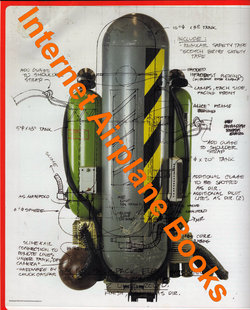
Hardware consultant Stephen Dane
was responsible for designing most of the Ghostbusters' iconic equipment,
including the "proton packs" used to wrangle ghosts, ghost traps, and
their vehicle, the Ectomobile. The equipment had to be designed and built in
the six weeks before filming began in September 1983. Inspired by a military
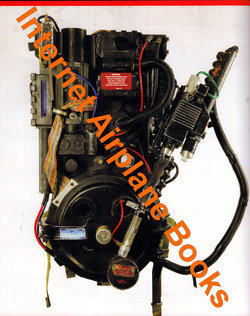
issue flamethrower, the "proton packs" consisted of a handheld proton
stream firing "neutrino wand" connected by a hose to a backpack said
to contain a nuclear accelerator. Dane said he "went home and got foam
pieces and just threw a bunch of stuff together to get the look. It was highly
machined, but it had to look off-the-shelf and military surplus".
Following Reitman's tweaks to
the design, on-screen models of the "proton packs" were made from a
fiberglass shell with an aluminum backplate bolted to a United States Army
backpack frame. Each pack weighed approximately 30 pounds (14 kg) with the
batteries for lighting installed, and strained the actors' backs during the
long shoots. Two lighter versions were made; a hollow one with surface details
for wide shots, and a foam rubber version for action scenes. The fiberglass
props were created by special effects supervisor Chuck Gaspar, based on Dane's
design. Gaspar used rubber molds to create identical fiberglass shells. The
"neutrino wand" had a flashbulb at the tip, giving animators an
origin point for the proton streams. Fake walls laced with pyrotechnics were
used to practically create the damage of the proton streams. The
"Psychokinetic Energy meter" ("PKE meter") prop was built
using an Iona SP-1 handheld shoe polisher as a base, to which lights and
electronics were affixed. The PKE meter prop was designed and built by John
Zabrucky of Modern Props in partnership with an outside fabricator. The
technology was designed to not be overly fancy or sleek, emphasizing the
characters' scientific backgrounds combined with the homemade nature of their
equipment.
The Ectomobile was in the first
draft of Aykroyd's script, and he and John Daveikis developed some early
concepts for the car. Dane developed fully detailed drawings for the interior
and exterior and supervised the transformation of the 1959 Cadillac Miller-Meteor
ambulance conversion into the Ectomobile. According to Aykroyd, the actual
vehicle was "an ambulance that we converted to a hearse and then converted
to an ambulance". Early concepts featured a black car with purple and
white strobe lights giving it a supernatural glow, but this idea was scrapped
after cinematographer L�szl� Kov�cs noted that dark paint would not film well
at night. The concept also had fantastic features such as the ability to
dematerialize and travel inter-dimensionally. Two vehicles were purchased, one
for the pre-modification scenes. Dane designed its high-tech roof array with
objects including a directional antenna, an air-conditioning unit, storage
boxes and a radome.[64] Because of its size, the roof rack was shipped to
Manhattan on an airplane, while the car was transported to the East Coast by
train. Sound designer Richard Beggs created the siren from a recording of a
leopard snarl, cut and played backward.
Logo and sets
In the script, Aykroyd described
the Ghostbusters clothing and vehicle as bearing a no symbol with a ghost
trapped in it, crediting the Viking with the original concept. The final design
fell to Gross, who had volunteered to serve as art director. As the logo would
be required for props and sets, it needed to be finalized quickly, and Gross
worked with Boss Film artist and creature design consultant Brent Boates who
drew the final concept, and R/GA animated the logo for the film's opening.
According to Gross, two versions of the logo exist, with one having
"ghostbusters" written across the diagonal part of the sign. Gross
did not like how it looked and flipped the diagonal bar to read top left to
bottom right instead, but they later removed the wording. According to Gross,
this is the correct version of the sign that was used throughout Europe. The
bottom left to top right version was used in the United States as that was the
design of the No symbol there.
Medjuck also hired John DeCuir
as production designer. The script did not specify where Gozer would appear,
and DeCuir painted the top of Dana's building with large, crystal doors that
opened as written in the script. The fictional rooftop of 55 Central Park West
was constructed at Stage 12 on the Burbank Studios lot. It was one of the
largest constructed sets in film history and was surrounded by a 360-degree
cyclorama painting. The lighting used throughout the painting consumed so much
power that the rest of the studio had to be shut down, and an additional four
generators added, when it was in use.Small models such as planes were hung on
string to animate the backdrop. The set was built three stories off the ground
to allow for filming from low angles.
The first three floors and
street-front of Dana's building were recreated as sets for filming, including
the climactic earthquake scene where hydraulics were used to raise broken parts
of the street.Broken pieces of pavement and the road were positioned outside
the real location to create a seamless transition between the two shots. DeCuir
said: "They had one night to dress the street. When people went home early
in the evening everything was normal, and when the little old ladies came out
to walk their dogs in the morning, the whole street had erupted. Apparently,
people complained to the New York Police Department and their switchboard lit
up." For the scene where Dana's apartment explodes outwards, Weaver stood
on set as the stunt happened. Similarly, the scene of Weaver rotating in the
air was performed on set using a body-cast and mechanical arm concealed in the
curtains, a trick Reitman learned working with magician Doug Henning.
Developing merchandise for a
film was still a relatively new practice at the time of Ghostbusters' release,
and it was only following the success of Star Wars merchandise that other
studios attempted to duplicate the idea. The unexpected success of Ghostbusters
meant Columbia did not have a comprehensive merchandising plan in place to
fully capitalize on the film at the peak of its popularity. They were able to
generate additional revenue, however, by applying the popular "no
ghosts" logo to a variety of products. Much of the merchandising success
came from licensing the rights to other companies based on the success of the
1986 animated spin-off The Real Ghostbusters. Merchandise based directly on the
film did not initially sell well until The Real Ghostbusters, which on its own
helped generate up to $200 million in revenue in 1988, the same year the
Ghostbusters proton pack was the most popular toy in the United Kingdom. A
successful Ghostbusters video game was released alongside the film. The film
also received two novelizations, Ghostbusters by Larry Milne (released with the
film), and Ghostbusters: The Supernatural Spectacular by Richard Mueller
(released in 1985). "Making Ghostbusters", an annotated script by
Ramis, was released in 1985.
In the years since its release,
Ghostbusters merchandise has included: soundtrack albums, action figures,
books, Halloween costumes, various Lego and Playmobil sets including the
Ectomobile and Firehouse, board games, slot machines, pinball machines,
bobbleheads, statues, prop replicas, neon signs, ice cube trays, Minimates,
coin banks,Funko Pop figures, footwear, lunch boxes, and breakfast cereals. A
Slimer-inspired limited-edition citrus-flavored Hi-C Ecto Cooler drink first
released in 1987, was one of the more popular items, and did not cease
production until 2001. The Slimer character became iconic and popular,
appearing in video games, toys, cartoons, sequels, toothpaste, and juice boxes.