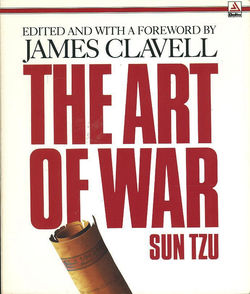
THE ART OF WAR SUN TZU (JAMES CLAVELL)
ANCIENT MILITARY STRATEGY TACTICS BUSINESS THINKING LEGAL
SOFTBOUND
BOOK
---------------------------------------------------------------------------
Additional
Information from Internet Encyclopedia
The
Art of War is an ancient Chinese military treatise dating from the Spring and
Autumn period in 5th century BC. The work, which is attributed to the ancient
Chinese military strategist Sun Tzu ("Master Sun", also spelled
Sunzi), is composed of 13 chapters. Each one is devoted to a distinct aspect of
warfare and how that applies to military strategy and tactics. For almost 1,500
years it was the lead text in an anthology that would be formalised as the
Seven Military Classics by Emperor Shenzong of Song in 1080. The Art of War
remains the most influential strategy text in East Asia. It has a profound
influence on Eastern and Western military thinking, business tactics, legal
strategy and beyond.
The
book was first translated and published into French in 1772 (re-published in
1782) by the Jesuit Jean Joseph Marie Amiot and a partial translation into
English was attempted by British officer Everard Ferguson Calthrop in 1905
under the title The Book of War. The first annotated English translation was
completed and published by Lionel Giles in 1910. Numerous military and
political leaders such as Mao Zedong, V� Nguy�n Gi�p, and Norman Schwarzkopf,
Jr. have drawn inspiration from the work.
The
Art of War is traditionally attributed to a military general from the late 6th
century BC known as "Master Sun" (Sunzi or Sun Tzu), though its
earliest parts probably date to at least 100 years later. Sima Qian's 1st
century BC work Records of the Grand Historian (Shiji), the first of China's 24
dynastic histories, records an early Chinese tradition stating that a text on
military matters was written by a "Sun Wu" from the State of Qi, and that
this text had been read and studied by King Hel� of Wu (r. 514�495 BC). This
text was traditionally identified with the received Master Sun's Art of War.
The conventional view, which is still widely held in China, was that Sun Wu was
a military theorist from the end of the Spring and Autumn period (776�471 BC)
who fled his home state of Qi to the southeastern kingdom of Wu, where he is
said to have impressed the king with his ability to train even dainty palace
ladies in warfare and to have made Wu's armies powerful enough to challenge
their western rivals in the state of Chu.
The
prominent strategist, poet, and warlord Cao Cao in the early 3rd century AD
authored the earliest known commentary to the Art of War. Cao's preface makes
clear that he edited the text and removed certain passages, but the extent of
his changes were unclear historically. The Art of War appears throughout the
bibliographical catalogs of the Chinese dynastic histories, but listings of its
divisions and size varied widely. In the early 20th century, the Chinese writer
and reformer Liang Qichao, theorized that the text was actually written in the
4th century BC by Sunzi's purported descendant Sun Bin, as a number of
historical sources mention a military treatise he wrote.
Around
the 12th century, some scholars began to doubt the historical existence of
Sunzi, primarily on the grounds that he is not mentioned in the historical
classic The Commentary of Zuo (Zuo zhuan 左傳), which mentions most of the notable figures from
the Spring and Autumn period. The name "Sun Wu" (孫武) does
not appear in any text prior to the Records of the Grand Historian,[6] and has
been suspected to be a made-up descriptive cognomen meaning "the fugitive
warrior": the surname "Sun" is glossed as the related term
"fugitive" (x�n 遜), while "Wu" is the ancient Chinese
virtue of "martial, valiant" (wǔ 武), which corresponds to Sunzi's role as the hero's
doppelg�nger in the story of Wu Zixu. Unlike Sun Wu, Sun Bin appears to have
been an actual person who was a genuine authority on military matters, and may
have been the inspiration for the creation of the historical figure
"Sunzi" through a form of euhemerism.
In
1972, the Yinqueshan Han slips were discovered in two Han dynasty (206 BC � AD
220) tombs near the city of Linyi in Shandong Province. Among the many bamboo
slip writings contained in the tombs, which had been sealed around 134 and 118
BC, respectively were two separate texts, one attributed to "Sunzi",
corresponding to the received text, and another attributed to Sun Bin, which
explains and expands upon the earlier The Art of War by Sunzi. The Sun Bin
text's material overlaps with much of the "Sunzi" text, and the two
may be "a single, continuously developing intellectual tradition united
under the Sun name". This discovery showed that much of the historical
confusion was due to the fact that there were two texts that could have been
referred to as "Master Sun's Art of War", not one. The content of the
earlier text is about one-third of the chapters of the modern The Art of War,
and their text matches very closely. It is now generally accepted that the
earlier The Art of War was completed sometime between 500 and 450 BC.
The
Art of War has been applied to many fields well outside of the military. Much
of the text is about how to fight wars without actually having to do battle: It
gives tips on how to outsmart one's opponent so that physical battle is not
necessary. As such, it has found application as a training guide for many
competitive endeavors that do not involve actual combat.
Many
business books have applied the lessons taken from the book to office politics
and corporate strategy. Many Japanese companies make the book required reading
for their key executives. The book is also popular among Western business
circles citing its utilitarian value regarding management practices. Many
entrepreneurs and executives have turned to it for inspiration and advice on
how to succeed in competitive business situations. The book has also been
applied to the field of education.
The
Art of War has been the subject of legal books and legal articles on the trial
process, including negotiation tactics and trial strategy.
The
Art of War has also been applied in the world of sports. National Football
League coach Bill Belichick is known to have read the book and used its lessons
to gain insights in preparing for games.Australian cricket as well as Brazilian
association football coaches Luiz Felipe Scolari and Carlos Alberto Parreira
are known to have embraced the text. Scolari made the Brazilian World Cup squad
of 2002 study the ancient work during their successful campaign.
The
Art of War is often quoted while developing tactics and/or strategy in
Electronic Sports. Particularly, one of the fundamental books about e-sports,
"Play To Win" by Massachusetts Institute of Technology graduate David
Sirlin, is actually just an analysis about possible applications of the ideas
from The Art of War in modern Electronic Sports.
The
Art of War was released in 2014 as an e-book companion alongside the Art of War
DLC for Europa Universalis IV, a PC strategy game by Paradox Development
Studios, with a forward by Thomas Johansson.
Chapter
Summaries
Detail
Assessment and Planning (Chinese: 始計) explores the five fundamental factors (the Way,
seasons, terrain, leadership, and management) and seven elements that determine
the outcomes of military engagements. By thinking, assessing and comparing
these points, a commander can calculate his chances of victory. Habitual
deviation from these calculations will ensure failure via improper action. The
text stresses that war is a very grave matter for the state and must not be
commenced without due consideration.
Waging
War (Chinese: 作戰) explains how to understand the economy of
warfare and how success requires winning decisive engagements quickly. This
section advises that successful military campaigns require limiting the cost of
competition and conflict.
Strategic
Attack (Chinese: 謀攻) defines the source of strength as unity, not
size, and discusses the five factors that are needed to succeed in any war. In
order of importance, these critical factors are: Attack, Strategy, Alliances,
Army and Cities.
Disposition
of the Army (Chinese: 軍形) explains the importance of defending existing
positions until a commander is capable of advancing from those positions in
safety. It teaches commanders the importance of recognizing strategic
opportunities, and teaches not to create opportunities for the enemy.
Forces
(Chinese: 兵勢) explains the use of creativity and timing in
building an army's momentum.
Weaknesses
and Strengths (Chinese: 虛實) explains how an army's opportunities come from the
openings in the environment caused by the relative weakness of the enemy and
how to respond to changes in the fluid battlefield over a given area.
Military
Maneuvers (Chinese: 軍爭) explains the dangers of direct conflict and how
to win those confrontations when they are forced upon the commander.
Variations
and Adaptability (Chinese: 九變) focuses on the need for flexibility in an army's
responses. It explains how to respond to shifting circumstances successfully.
Movement
and Development of Troops (Chinese: 行軍) describes the different situations in which an
army finds itself as it moves through new enemy territories, and how to respond
to these situations. Much of this section focuses on evaluating the intentions
of others.
Terrain
(Chinese: 地形) looks at the three general areas of resistance
(distance, dangers and barriers) and the six types of ground positions that
arise from them. Each of these six field positions offers certain advantages
and disadvantages.
The
Nine Battlegrounds (Chinese: 九地) describes the nine common situations (or stages)
in a campaign, from scattering to deadly, and the specific focus that a
commander will need in order to successfully navigate them.
Attacking
with Fire (Chinese: 火攻) explains the general use of weapons and the
specific use of the environment as a weapon. This section examines the five
targets for attack, the five types of environmental attack and the appropriate
responses to such attacks.
Intelligence and Espionage (Chinese: 用間) focuses on the importance of developing good
information sources, and specifies the five types of intelligence sources and
how to best manage each of them.