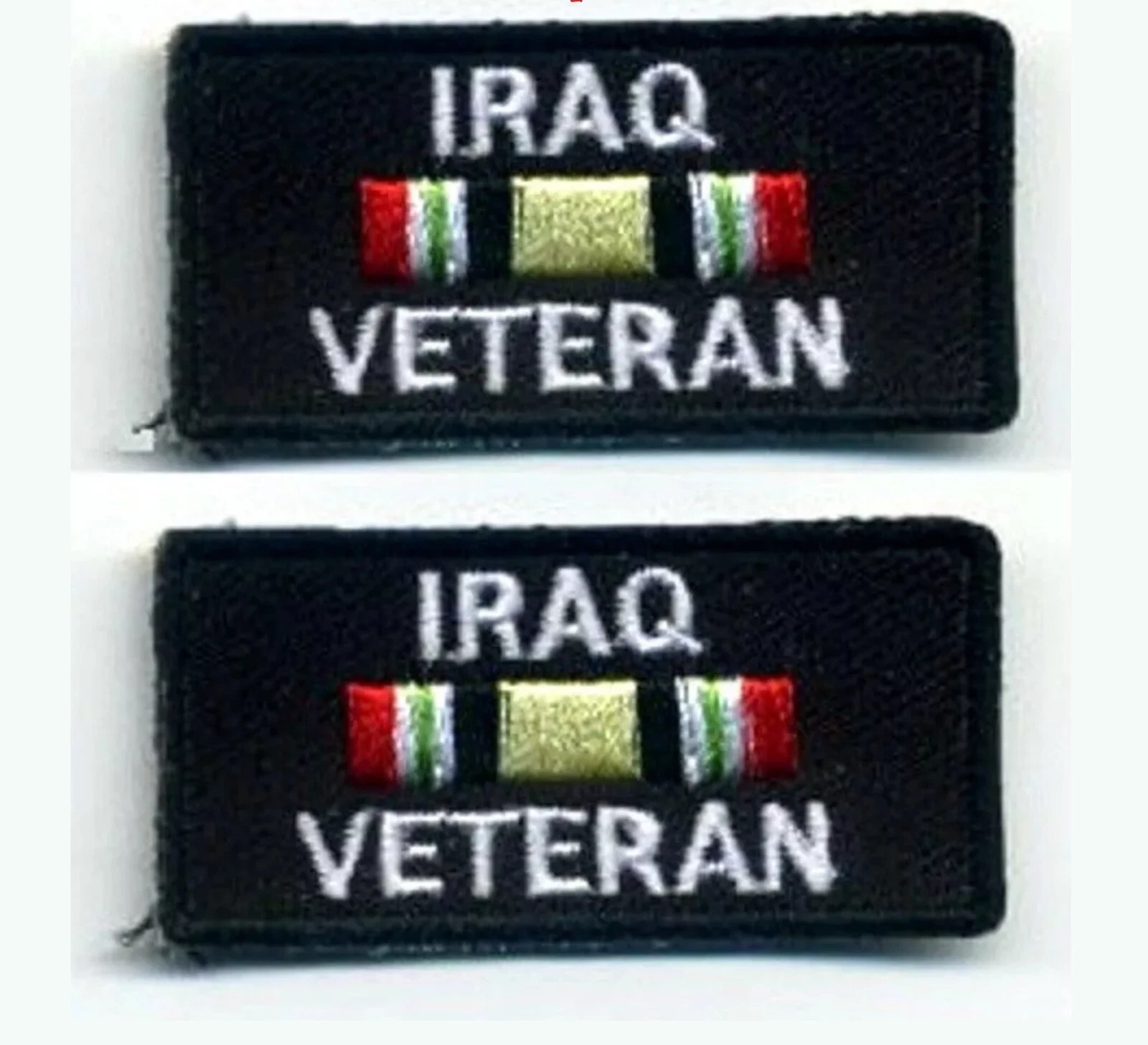
This is an Original (not cheap import copy) GULF WAR OIF OPERATION IRAQI FREEDOM WAR TROPHY INSIGNIA: IRAQ VETERAN 2 in x 4 in 2-TAB SET. You will receive the item as shown in the first photo. Please note that there are color variations due to settings on different PCs/Monitors. The color shown on your screen may not be the true color. Personal check payment is welcomed.
The Gulf War (2 August 1990 – 28 February 1991), codenamed Operation Desert Shield (2 August 1990 – 17 January 1991) for operations leading to the buildup of troops and defense of Saudi Arabia and Operation Desert Storm (17 January 1991 – 28 February 1991) in its combat phase, was a war - in the Persian Gulf region - waged by coalition forces from 34 nations led by the United States against Iraq in response to Iraq's invasion and annexation of Kuwait.
The war is also known under other names, such as the Persian Gulf War, First Gulf War, Gulf War I, Kuwait War, First Iraq War, or Iraq War before the term "Iraq War" became identified instead with the 2003 Iraq War (also referred to in the U.S. as "Operation Iraqi Freedom"). The Iraqi Army's occupation of Kuwait that began 2 August 1990 was met with international condemnation, and brought immediate economic sanctions against Iraq by members of the U.N. Security Council. U.S. President George H. W. Bush deployed U.S. forces into Saudi Arabia and urged other countries to send their own forces to the scene. An array of nations joined the Coalition, the largest military alliance since World War II. The great majority of the Coalition's military forces were from the U.S., with Saudi Arabia, the United Kingdom and Egypt as leading contributors, in that order. Saudi Arabia paid around US$36 billion of the US$60 billion cost.
The war was marked by the introduction of live news broadcasts from the front lines of the battle, principally by the U.S. network CNN. The war has also earned the nickname Video Game War after the daily broadcast of images from cameras on board U.S. bombers during Operation Desert Storm.
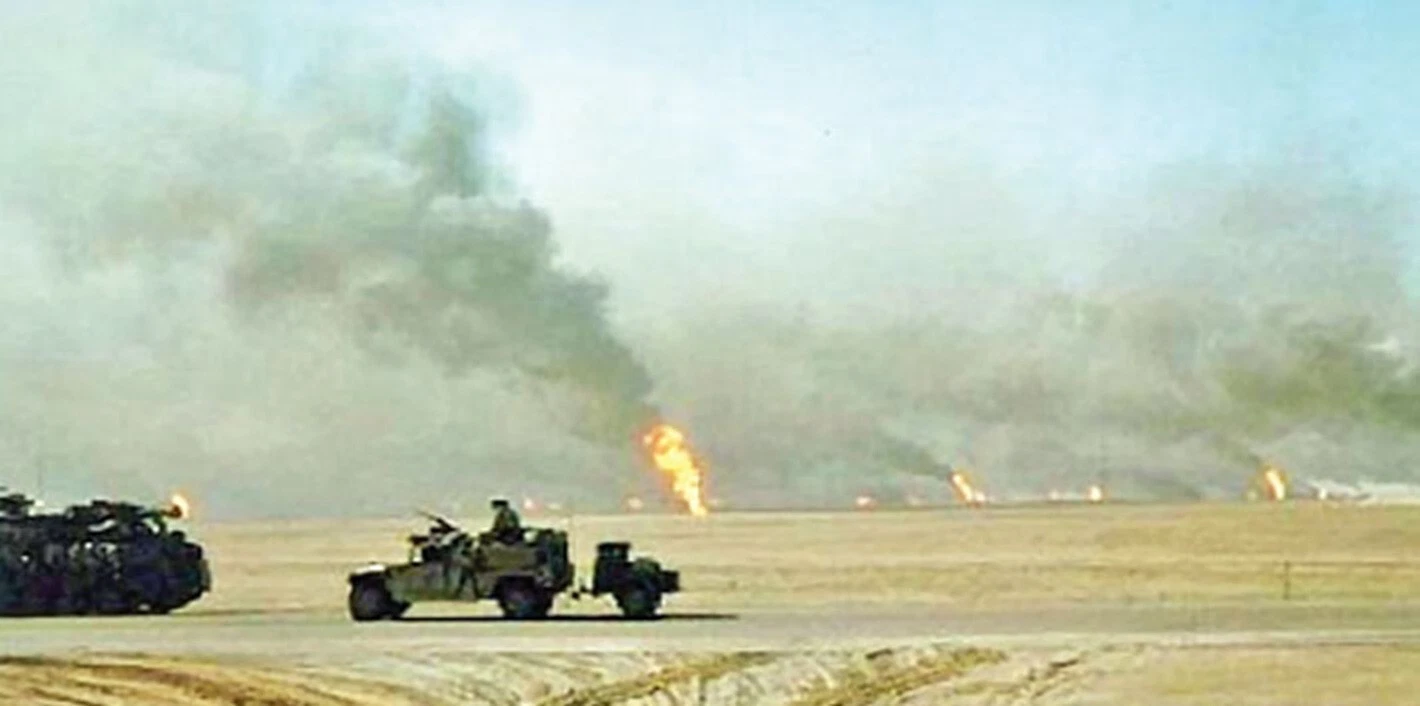
The initial conflict to expel Iraqi troops from Kuwait began with an aerial and naval bombardment on 17 January 1991, continuing for five weeks. This was followed by a ground assault on 24 February. This was a decisive victory for the Coalition forces, who drove the Iraqi military from Kuwait and advanced into Iraqi territory. The Coalition ceased its advance and declared a cease-fire 100 hours after the ground campaign started. Aerial and ground combat was confined to Iraq, Kuwait, and areas on Saudi Arabia's border. Iraq launched Scud missiles against Coalition military targets in Saudi Arabia and against Israel. The Gulf War was an armed conflict between Iraq and a 42-country coalition led by the United States. The coalition's efforts against Iraq were carried out in two key phases: Operation Desert Shield, which marked the military buildup from August 1990 to January 1991; and Operation Desert Storm, which began with the aerial bombing campaign against Iraq on 17 January 1991 and came to a close with the American-led liberation of Kuwait on 28 February 1991.
On 2 August 1990, Iraq, governed by Saddam Hussein, invaded neighboring Kuwait and fully occupied the country within two days. The invasion was primarily over disputes regarding Kuwait's alleged slant drilling in Iraq's Rumaila oil field, as well as to cancel Iraq's large debt to Kuwait from the recently ended Iran-Iraq War. After Iraq briefly occupied Kuwait under a rump puppet government known as the Republic of Kuwait, it split Kuwait's sovereign territory into the Saddamiyat al-Mitla' District in the north, which was absorbed into Iraq's existing Basra Governorate, and the Kuwait Governorate in the south, which became Iraq's 19th governorate.
The invasion of Kuwait was met with immediate international condemnation, including the adoption of UN Security Council Resolution 660, which demanded Iraq's immediate withdrawal from Kuwait, and the imposition of comprehensive international sanctions against Iraq with the adoption of UN Security Council Resolution 661. British prime minister Margaret Thatcher and U.S. president George H. W. Bush deployed troops and equipment into Saudi Arabia and urged other countries to send their own forces. Many countries joined the American-led coalition forming the largest military alliance since World War II. The bulk of the coalition's military power was from the United States, with Saudi Arabia, the United Kingdom, and Egypt as the largest lead-up contributors, in that order.
United Nations Security Council Resolution 678, adopted on 29 November 1990, gave Iraq an ultimatum, expiring on 15 January 1991, to implement Resolution 660 and withdraw from Kuwait, with member-states empowered to use "all necessary means" to force Iraq's compliance. Initial efforts to dislodge the Iraqis from Kuwait began with aerial and naval bombardment of Iraq on 17 January, which continued for five weeks. As the Iraqi military struggled against the coalition attacks, Iraq fired missiles at Israel to provoke an Israeli military response, with the expectation that such a response would lead to the withdrawal of several Muslim-majority countries from the coalition. The provocation was unsuccessful; Israel did not retaliate and Iraq continued to remain at odds with most Muslim-majority countries. Iraqi missile barrages against coalition targets in Saudi Arabia were also largely unsuccessful, and on 24 February 1991, the coalition launched a major ground assault into Iraqi-occupied Kuwait. The offensive was a decisive victory for the coalition, who liberated Kuwait and promptly began to advance past the Iraq–Kuwait border into Iraqi territory. A hundred hours after the beginning of the ground campaign, the coalition ceased its advance into Iraq and declared a ceasefire. Aerial and ground combat was confined to Iraq, Kuwait, and areas straddling the Iraq–Saudi Arabia border.
The conflict marked the introduction of live news broadcasts from the front lines of the battle, principally by the American network CNN. It has also earned the nickname Video Game War, after the daily broadcast of images from cameras onboard American military aircraft during Operation Desert Storm. The Gulf War has also gained fame for some of the largest tank battles in American military history: the Battle of Medina Ridge, the Battle of Norfolk, and the Battle of 73 Easting.
Other items in other pictures are for your reference only, available in my eBay Store. They will make a great addition to your SSI Shoulder Sleeve Insignia collection. You find only US Made items here, with the same LIFETIME warranty. I will send replacement patch if you return the damaged patch under normal use. 20101801
**eBay REQUIRES ORDER BE SENT WITH TRACKING, PLEASE SELECT USPS 1ST CLASS SERVICE w/TRACKING** **eBay REQUIRES ORDER BE SENT WITH TRACKING, PLEASE SELECT USPS GROUND ADVANTAGE SERVICE w/TRACKING**
| 
We'll cover your purchase price plus shipping. |
FREE 30-day No-Question return
ALL US-MADE PATCHES HAVE LIFETIME WARRANTY We do not compete price with cheap import copies. Watch out for cheap import copies with cut-throat price; We beat cheap copies with Original design, US-Made Quality and customer services. Once a customer, a LIFETIME of services
|