WW2
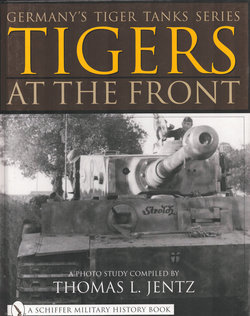
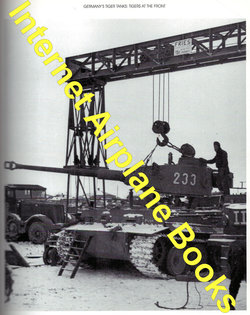
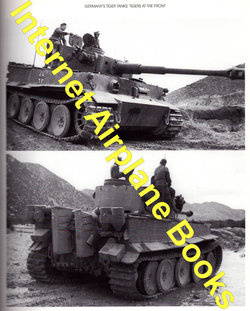
GERMAN TIGER TANKS (I & II) AT THE FRONT NORTH AFRICA RUSSIA ITALY NORMANDY
NW EUROPE HUNGARY
SCHIFFER MILITARY HISTORY
HARDBOUND BOOK in ENGLISH by THOMAS L. JENTZ
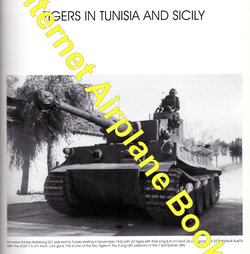
TIGERS IN TUNISIA AND SICILY
NORTH AFRICA SCHWERE PANZER ABTEILUNG 501 & s. PANZER-ABTEILUNG 504
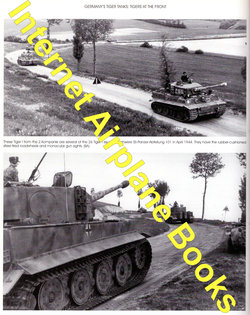
TIGER I ON THE EASTERN FRONT (s.
Panzer-Abteilung 501, s. Panzer-Abteilung 502, s. Panzer-Abteilung 503, s. Panzer-Abteilung
505, s. Panzer-Abteilung 506, s. Panzer-Abteilung 507, s. Panzer-Abteilung 509,
s. Panzer-Abteilung 510, s.SS-Pz.Kompanie “Leibstandarte Ad*lf H*tler”, s.SS-Pz.Kompanie
”Das Reich”, s.SS-Pz.Kompanie Totenkopf”, s.SS-Pz.Kompanie III. Abteilung “Grossdeutschland”)
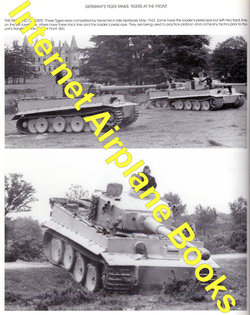
TIGER I TANK IN ITALY (TIGERGRUPPE
MEYER AUGUST 1943, SCHWERE PANZER ABTEILUNG 508, SCHWERE PANZER ABTEILUNG 504
JUNE 1944)
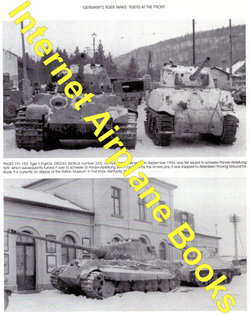
TIGER I TANK ON THE WESTERN
FRONT (SCHWERE SS-PANZER ABTEILUNG 101, MICHAEL WITTMAN, VILLERS BOCAGE, BATTLE
OF THE BULGE ARDENNES OFFENSIVE, PANZER ABTEILUNG (Fkl) 301, ZIMMERIT)
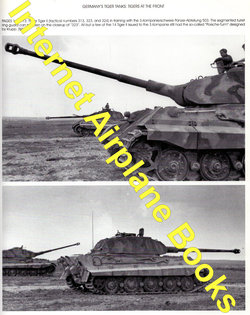
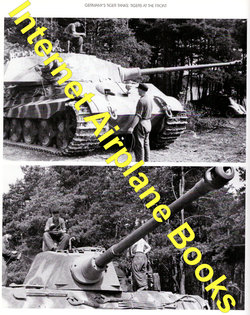
TIGER II ON THE WESTERN FRONT
(PANZER LEHR, s. Panzer-Abteilung 503, SCHWERE SS-PANZER ABTEILUNG 101, SCHWERE
PANZER ABTEILUNG 506, RHINE WATCH DECEMBER 1944, SCHWERE PANZER ABTEILUNG 507)
TIGER II ON THE EASTERN FRONT
(BUDAPEST)
-------------------------------
Additional
Information from Internet Encyclopedia
The Tiger I was a German heavy
tank of World War II that began operational duty in 1942 in Africa and in the
Soviet Union, usually in independent heavy tank battalions. It gave the German
Army its first armored fighting vehicle that mounted the 8.8 cm (3.5 in) KwK 36
gun (derived from the 8.8 cm Flak 36, the famous "eighty-eight"
feared by Allied troops). 1,347 were built between August 1942 and August 1944.
After August 1944, production of the Tiger I was phased out in favor of the
Tiger II.
While the Tiger I has been
called an outstanding design for its time, it has also been criticized for
being overengineered, and for using expensive materials and labor-intensive
production methods. In the early period, the Tiger was prone to certain types
of track failures and breakdowns. It was expensive to maintain, but generally
mechanically reliable. It was difficult to transport and vulnerable to immobilization
when mud, ice, and snow froze between its overlapping and interleaved
Schachtellaufwerk-pattern road wheels, often jamming them solid.
The tank was given its nickname
"Tiger" by the ministry for armament and ammunition by 7 August 1941,
and the Roman numeral was added after the Tiger II entered production. It was
classified with ordnance inventory designation Sd.Kfz. 182. The tank was later
re-designated as Panzerkampfwagen VI Ausführung E (abbreviated as Pz.Kpfw. VI
Ausf. E) in March 1943, with ordnance inventory designation Sd.Kfz. 181.
Today, only nine Tiger I tanks
survive in museums and private collections worldwide. As of 2021, Tiger 131
(captured during the North African campaign) at the UK's Tank Museum is the
only example restored to running order.
On 22 June 1941, Germany
launched Operation Barbarossa, the invasion of the Soviet Union. The Germans
encountered large numbers of Soviet T-34 medium and KV-1 heavy tanks. According
to Henschel designer Erwin Aders, "There was great consternation when it
was discovered that the Soviet tanks were superior to anything available to the
Heer."
Weight increase to 45 tonnes and
an increase in gun calibre to 8.8 cm (3.5 in) were ordered for it on 26 May
1941.[24] The due date for the new prototypes was set for 20 April 1942, Adolf
Hitler's 53rd birthday. Unlike the Panther tank, the designs did not
incorporate sloped armour.
Porsche and Henschel submitted
prototype designs, each making use of the Krupp-designed turret. They were
demonstrated at Rastenburg in front of Hitler. The Henschel design was
accepted, mainly because the Porsche VK 4501 (P) prototype design used a troubled
petrol-electric transmission system which needed large quantities of copper for
the manufacture of its electrical drivetrain components, a strategic war
material of which Germany had limited supplies with acceptable electrical
properties for such uses. Production of the Panzerkampfwagen VI Ausf. H began
in August 1942. Expecting an order for his tank, Porsche built 100 chassis.
After the contract was awarded to Henschel, they were used for a new
turretless, casemate-style tank destroyer; 91 hulls were converted into the
Panzerjäger Tiger (P) in early 1943.
The Tiger was still at the
prototype stage when it was first hurried into service, and therefore changes
both large and small were made throughout the production run. A redesigned
turret with a lower cupola was the most significant change. The river-fording
submersion capability and an external air-filtration system were dropped to cut
costs.
The Tiger differed from earlier
German tanks principally in its design philosophy. Its predecessors balanced
mobility, armour and firepower and were sometimes outgunned by their opponents.
While heavy, this tank was not
slower than the best of its opponents. Although the general design and layout
were broadly similar to the Panzer IV medium tank, the Tiger weighed more than
twice as much. This was due to its substantially thicker armour, the larger
main gun, greater volume of fuel and ammunition storage, larger engine, and a
more solidly built transmission and suspension.
Armour
The Tiger I had frontal hull
armour 100 mm (3.9 in) thick, frontal turret of 100 mm and gun mantlet with a
varying thickness of 120 to 200 mm (4.7 to 7.9 in).[26] The Tiger had 60 mm
(2.4 in) thick hull side plates and 80 mm (3.1 in) armour on the side superstructure/sponsons,
while turret sides and rear were 80 mm. The top and bottom armour was 25 mm (1
in) thick; from March 1944, the turret roof was thickened to 40 mm (1.6 in).
Armour plates were mostly flat, with interlocking construction. This flat
construction encouraged angling the Tiger hull roughly 30-45° when firing in
order to increase effective thickness. The Tiger I's armour was up to 200 mm on
the gun mantlet.
Gun
The 56-calibre long 8.8 cm KwK
36 was chosen for the Tiger. A combination of a flat trajectory from the high
muzzle velocity and precision from the Leitz Turmzielfernrohr TZF 9b sight
(later replaced by the monocular TZF 9c) made it very accurate. In British
wartime firing trials, five successive hits were scored on a 16 by 18 in (410
by 460 mm) target at a range of 1,200 yards (1,100 m). Compared with the other
contemporary German tank guns, the 8.8 cm KwK 36 had superior penetration to
the 7.5 cm KwK 40 on the Sturmgeschütz III and Panzer IV but inferior to the
7.5 cm KwK 42 on the Panther tank under ranges of 2,500 metres. At greater
ranges, the 8.8 cm KwK 36 was superior in penetration and accuracy. British
trials found the gun took from 6 to 16 seconds to reload varying on turret
position and consequently which storage bin was being used.
The ammunition for the Tiger had
electrically fired primers. Four types of ammunition were available but not all
were fully available; the PzGr 40 shell used tungsten, which was in short
supply as the war progressed.
PzGr. 39 (armour-piercing,
capped, ballistic cap)
PzGr. 40 (armour-piercing,
composite rigid)
Hl. Gr. 39 (high explosive
anti-tank)
sch. Sprgr. Patr. L/4.5
(incendiary shrapnel)
Engine and drive
The rear of the tank held an
engine compartment flanked by two separate rear compartments each containing a
fuel tank and radiator. The Germans had not developed an adequate diesel
engine, so a petrol (gasoline) powerplant had to be used instead. The original
engine used was a 21.35 L (1,303 in3) 12-cylinder Maybach HL210 P45 developing
485 kW (650 hp) at 3,000 rpm and a top speed of 38 km/h (24 mph). It was found
to be underpowered for the vehicle from the 251st Tiger onwards. It was
replaced by the upgraded HL 230 P45, a 23.095 L (1,409 in3) engine developing
521 kW (699 hp) at 3,000 rpm.[30] The main difference between these engines was
that the original Maybach HL 210 used an aluminium engine block while the
Maybach HL 230 used a cast-iron engine block. The cast-iron block allowed for
larger cylinders (and thus, greater displacement) which increased the power
output to 521 kW (699 hp). The engine was in V-form, with two cylinder banks
set at 60 degrees. An inertia starter was mounted on its right side, driven via
chain gears through a port in the rear wall. The engine could be lifted out
through a hatch on the rear hull roof. In comparison to other V12 and various
vee-form gasoline engines used for tanks, the eventual HL 230 engine was nearly
4 L (240 in3) smaller in displacement than the Allied British Rolls-Royce
Meteor V12 AFV power plant, itself adapted from the RR Merlin but de-rated to
448 kW (601 hp) power output; and the American Ford-designed precursor V12 to
its Ford GAA V-8 AFV engine of 18 litre displacement, which in its original V12
form would have had the same 27 L (1,600 in3) displacement as the Meteor.
The engine drove the front
sprockets through a drivetrain connecting to a transmission in the front
portion of the lower hull; the front sprockets had to be mounted relatively low
as a result. The Krupp-designed 11-tonne turret had a hydraulic motor whose
pump was powered by mechanical drive from the engine. A full rotation took
about a minute.
Another new feature was the
Maybach-Olvar hydraulically controlled semi-automatic pre-selector gearbox. The
extreme weight of the tank also required a new steering system. Germany's Argus
Motoren, where Hermann Klaue had invented a ring brake in 1940, supplied them
for the Arado Ar 96[34] and also supplied the 55 cm (22 in) disc. Klaue was
acknowledged in the patent application that he had improved, it can even be
traced back to British designs dating to 1904. It is unclear whether Klaue's
patent ring brake was used in the Tiger brake design.
The clutch-and-brake system,
typical for lighter vehicles, was retained only for emergencies. Normally,
steering depended on a double differential, Henschel's development of the
British Merritt-Brown system first encountered in the Churchill tank. The
vehicle had an eight-speed gearbox, and the steering offered two fixed radii of
turns on each gear, thus the Tiger had sixteen different radii of turn. In
first gear, at a speed of a few km/h, the minimal turning radius was 3.44 m (11
ft 3 in). In neutral gear, the tracks could be turned in opposite directions,
so the Tiger I pivoted in place. There was a steering wheel instead of either a
tiller – or, as most tanks had at that time, twin braking levers – making the
Tiger I's steering system easy to use, and ahead of its time.
Powered turret traverse was
provided by the variable speed Boehringer-Sturm L4 hydraulic motor, which was
driven from the main engine by a secondary drive shaft. On early production
versions of the Tiger maximum turret traverse was limited to 6 degrees per
second, whilst on later versions a selectable high speed traverse gear was
added. Thus, the turret could be rotated 360 degrees at up to 6 degrees per
second in low gear independent of engine rpm (same as on early production
versions), or up to 19 degrees per second with the high-speed setting and
engine at 2,000 rpm, and at over 36 degrees per second at the maximum allowable
engine speed of 3,000 rpm. The direction and speed of traverse was controlled
by the gunner through foot pedals, the speed of traverse corresponding to the
level of depression the gunner applied to the foot pedal. This system allowed
for very precise control of powered traverse, a light touch on the pedal
resulting in a minimum traverse speed of 0.1 degrees per second (360 degrees in
60 minutes), unlike in most other tanks of the time (e.g., the US M4 Sherman or
Soviet T-34) this allowed for fine laying of the gun without the gunner needing
to use his traverse handwheel.
The suspension used sixteen
torsion bars, with eight suspension arms per side. To save space, the swing
arms were leading on one side and trailing on the other side; this is called an
H suspension setup. There were three road wheels (one of them double, closest
to the track's centre) on each arm, in a so-called Schachtellaufwerk
overlapping and interleaved arrangement, similar to that pioneered on German
half-tracked military vehicles of the pre-World War II era, with the Tiger I
being the first all-tracked German AFV built in quantity to use such a road
wheel arrangement. The wheels had a diameter of 800 mm (31 in) in the
Schachtellaufwerk arrangement for the Tiger I's suspension, providing a high uniform
distribution of the load onto the track, at the cost of increased maintenance.
Removing an inner wheel that had
lost its solid rubber tire (a common occurrence) required the removal of up to
nine other wheels first. During the rainy period that brought on the autumn
rasputitsa mud season and onwards into the winter conditions on the Eastern
front, the roadwheels of a Schachtellaufwerk-equipped vehicle could also become
packed with mud or snow that could then freeze.[citation needed] Presumably,
German engineers, based on the experience of the half-tracks, felt that the
improvement in off-road performance, track and wheel life, mobility with wheels
missing or damaged, plus additional protection from enemy fire was worth the
maintenance difficulties of a complex system vulnerable to mud and ice. This
approach was carried on, in various forms, to the Panther and the
non-interleaved wheel design for the Tiger II. Eventually, a new 80 cm diameter
'steel' wheel design with an internally sprung steel-rim tire was substituted.
As these new wheels could carry more weight, the outermost wheel on each
suspension arm was removed. The same wheels would also be used on the Tiger II.
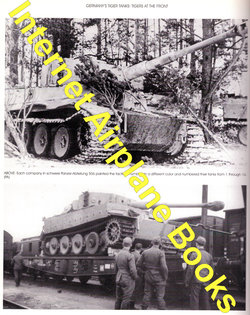
Tiger at the Henschel plant is
loaded onto a special rail car. The outer road wheels have been removed and
narrow tracks put in place to decrease vehicle width, allowing it to fit within
the loading gauge of the German rail network.
To support the considerable
weight of the Tiger, the tracks were 725 mm (28.5 in) wide. To meet
rail-freight size restrictions, narrower 520 mm (20 in) wide 'transport' tracks
(Verladeketten) could be installed. For Tigers equipped with rubber-tired
wheels, this also required the outermost roadwheel on each axle (16 total) to
be removed. The track replacement and wheel removal took 30 minutes for each
side of the tank. However, in service, Tigers were frequently transported by
rail with their combat tracks fitted, as long as the train crew knew there were
no narrow tunnels or other obstructions on the route that would prevent an
oversized load from passing, despite this practice being strictly forbidden.
The internal layout was typical
of German tanks. Forward was an open crew compartment, with the driver and
radio-operator seated at the front on either side of the gearbox. Behind them
the turret floor was surrounded by panels forming a continuous level surface.
This helped the loader to retrieve the ammunition, which was mostly stowed
above the tracks. Three men were seated in the turret; the loader to the right
of the gun facing to the rear, the gunner to the left of the gun, and the
commander behind him. There was
also a folding seat on the right for the loader. The turret had a full circular
floor and 157 cm (62 in) headroom. Early versions of the Tiger I's turret
included two pistol ports; however, one of these was replaced with a loader
escape hatch and the other was removed from later designs.
Post-war testing by the Allies
found the tank to be uncomfortable and spartan. For example, the gunner
suffered from clumsy controls and a cramped area. This was in contrast to
German crews who found them to be spacious and comfortable.
Production of the Tiger I began
in August 1942 at the factory of Henschel und Sohn in Kassel, initially at a
rate of 25 per month and peaking in April 1944 at 104 per month. An official
document of the time stated that the first Tiger I was completed on 4 August.
1,355 had been built by August 1944, when production ceased. Deployed Tiger I's
peaked at 671 on 1 July 1944. It took about twice as long to build a Tiger I as
another German tank of the period. When the improved Tiger II began production
in January 1944, the Tiger I was soon phased out.
In 1943, Japan bought several
specimens of German tank designs for study. A single Tiger I was apparently
purchased, along with a Panther and two Panzer IIIs, but only the Panzer IIIs
were actually delivered. The undelivered Tiger was loaned to the German
Wehrmacht by the Japanese government.
Many modifications were
introduced during the production run to improve automotive performance,
firepower and protection. Simplification of the design was implemented, along
with cuts due to raw material shortages. In 1942 alone, at least six revisions
were made, starting with the removal of the Vorpanzer (frontal armour shield)
from the pre-production models in April. In May, mudguards bolted onto the side
of the pre-production run were added, while removable mudguards saw full
incorporation in September. Smoke discharge canisters, three on each side of
the turret, were added in August 1942. In later years, similar changes and
updates were added, such as the addition of Zimmerit (a non-magnetic anti-mine
coating), in late 1943. Due to slow production rates at the factories,
incorporation of the new modifications could take several months.
Eager to make use of the
powerful new weapon, Hitler ordered the vehicle be pressed into service months
earlier than had been planned. A platoon of four Tigers went into action on 23
September 1942 near Leningrad. Operating in swampy, forested terrain, their
movement was largely confined to roads and tracks, making defence against them
far easier. Many of these early models were plagued by problems with the
transmission, which had difficulty handling the great weight of the vehicle if
pushed too hard. It took time for drivers to learn how to avoid overtaxing the
engine and transmission, and many broke down. The most significant event from
this engagement was that one of the Tigers became stuck in swampy ground and had
to be abandoned. Captured largely intact, it enabled the Soviets to study the
design and prepare countermeasures.
The 503rd Heavy Panzer Battalion
was deployed to the Don Front in the autumn of 1942, but arrived too late to
participate in Operation Winter Storm, the attempt to relieve Stalingrad. It
was subsequently engaged in heavy defensive fighting in the Rostov-on-Don and
adjacent sectors in January and February 1943.
In July 1943, two heavy tank
battalions (503rd and 505th) took part in Operation Citadel, including the
Battle of Kursk, with one battalion each on the northern (505th) and southern
(503rd) flanks of the Kursk salient the operation was designed to encircle.
Although the Tiger often proved dominating, when it saw action, the operation
ultimately failed and the Germans were again put on the defensive. The
resulting withdrawal led to the loss of many broken-down Tigers which had to be
abandoned, with battalions unable to perform required maintenance or repairs.
Tigers were usually employed in
separate heavy tank battalions (schwere Panzer-Abteilung) under army command.
These battalions would be deployed to critical sectors, either for breakthrough
operations or, more typically, counter-attacks. A few favoured divisions, such
as the Grossdeutschland, and the 1st SS Leibstandarte Adolf Hitler, 2nd SS Das
Reich, and 3rd SS Totenkopf Panzergrenadier Divisions at Kursk, had a Tiger
company in their tank regiments. The Grossdeutschland Division had its Tiger
company increased to a battalion as the III Panzer Battalion of the Panzer
Regiment Grossdeutschland. 3rd SS Totenkopf retained its Tiger I company
through the entire war. 1st SS and 2nd SS had their Tiger companies taken away
and incorporated into the 101st SS Tiger Battalion, which was part of 1st SS
Panzer Corps.
The Tiger was originally
designed to be an offensive breakthrough weapon, but by the time it went into
action, the military situation had changed dramatically, and its main use was
on the defensive, as a mobile anti-tank and infantry gun support weapon.
Tactically, this also meant moving the Tiger units constantly to parry
breakthroughs, causing excessive mechanical wear. As a result, Tiger battalions
rarely entered combat at full strength.
---------------------------------
The Tiger II was a German heavy
tank of the Second World War. The final official German designation was
Panzerkampfwagen Tiger Ausf. B, often shortened to Tiger B. The ordnance
inventory designation was Sd.Kfz. 182. (Sd.Kfz. 267 and 268 for command
vehicles). It was also known informally as the Königstiger (German for Bengal
tiger, lit. 'King Tiger'). Contemporaneous Allied soldiers often
called it the King Tiger or Royal Tiger.
The Tiger II was the successor
to the Tiger I, combining the latter's thick armour with the armour sloping
used on the Panther medium tank. It was the costliest German tank to produce at
the time. The tank weighed almost 70 tonnes and was protected by 100 to 185 mm
(3.9 to 7.3 in) of armour to the front. It was armed with the long barrelled
(71 calibres) 8.8 cm KwK 43 anti-tank cannon. The chassis was also the basis
for the Jagdtiger turretless Jagdpanzer anti-tank vehicle.
The Tiger II was issued to heavy
tank battalions of the Army and the Waffen-SS. It was first used in combat by
503rd Heavy Panzer Battalion during the Allied invasion of Normandy on 11 July
1944; on the Eastern Front, the first unit to be outfitted with the Tiger II
was the 501st Heavy Panzer Battalion. Due to heavy Allied bombing, only 492
were produced.
Development started in 1937 with
a design contract awarded to Henschel. Another design contract followed in
1939, given to Porsche. Both prototypes used the same turret design from Krupp.
The main differences were in the hull, transmission, suspension and automotive
features.
The Henschel version used a
conventional hull design with sloped armour resembling the layout of the
Panther tank. It had a rear-mounted engine and used nine steel-tired,
eighty-centimetre-diameter overlapping road wheels per side with internal
springing, mounted on transverse torsion bars, in a similar manner to the
original Henschel-designed Tiger I. To simplify maintenance, however, the
wheels were only overlapping without being interleaved—the full
Schachtellaufwerk rubber-rimmed road-wheel system that had been in use on
nearly all German half-tracks used the interleaved design, later inherited by
the Tiger I and Panther.
The Porsche hull designs
included a rear-mounted turret and a mid-mounted engine. The suspension was the
same as on the Elefant tank destroyer. This had six road wheels per side
mounted in paired bogies sprung with short longitudinal torsion bars that were
integral to the wheel pair; this saved internal space and facilitated repairs.
One Porsche version had a gasoline-electric drive (fundamentally identical to a
Diesel-electric transmission, only using a gasoline-fueled engine as the prime
mover), similar to a gasoline-electric hybrid but without a storage battery;
two separate drivetrains in parallel, one per side of the tank, each consisting
of a hybrid drive train; gasoline engine–electric generator–electric
motor–drive sprocket. This method of propulsion had been used on the rejected
Tiger (P) design, which had been rebuilt as Elefant, and in some US designs and
was put into production in the French World War I era Saint-Chamond tank and
post-World War I Char 2C. The Porsche suspension components were later used on
a few of the later Jagdtiger tank destroyers. Another proposal was to use
hydraulic drives; Dr. Porsche's unorthodox designs gathered little favour.
Henschel won the design
contract, and all Tiger IIs were produced by the firm. Two turret designs were
used in production vehicles. The initial design is often misleadingly called
the "Porsche" turret due to the misbelief that it was designed by
Porsche for their Tiger II prototype; in fact it was the initial Krupp design
for both prototypes. This turret had a rounded front and steeply sloped sides,
with a difficult-to-manufacture curved bulge on the turret's left side to
accommodate the commander's cupola. Fifty early turrets were mounted to
Henschel hulls and used in action. In December 1943 the more common
"production" turret, sometimes erroneously called the
"Henschel" turret, was simplified with a significantly thicker flat
face (which eliminated the shot trap caused by the curved face of the earlier
turret), and less-steeply sloped sides, which avoided the need for a bulge for
the commander's cupola, and added additional room for ammunition storage.
A tank turret with an almost
square, flat, vertical face, the sides are almost vertical, and curve laterally
only slightly.
The angular front of the
"production turret" designed by Krupp (erroneously called
"Henschel turret") taken during Operation Panzerfaust in Budapest, 15
October 1944. The rough Zimmerit coating is evident, used to prevent magnetic
mines from adhering to the tank's armour.
The turrets were designed to
mount the 8.8 cm KwK 43 L/71 gun. Combined with the Turmzielfernrohr 9d (German
"turret telescopic sight") monocular sight by Leitz, which all but a
few early Tiger IIs used, it was a very accurate and deadly weapon. During
practice, the estimated probability of a first-round hit on a 2 m (6 ft 7 in)
high, 2.5 m (8 ft 2 in) wide target was 100 percent at 1,000 m (1,100 yd),
95–97 percent at 1,500 m (1,600 yd) and 85–87 percent at 2,000 m (2,200 yd),
depending on ammunition type.[citation needed] Recorded combat performance was
lower, but still over 80 percent at 1,000 m, in the 60s at 1,500 m and the 40s
at 2,000 m. Penetration of armoured plate inclined at 30 degrees was 202 and
132 mm (8.0 and 5.2 in) at 100 m (110 yd) and 2,000 m (2,200 yd) respectively
for the Panzergranate 39/43 projectile (PzGr – armour-piercing shell), and 238
and 153 mm (9.4 and 6.0 in) for the PzGr. 40/43 projectile between the same
ranges.[citation needed] The Sprenggranate 43 (SpGr) high-explosive round was
available for soft targets, or the Hohlgranate or Hohlgeschoss 39 (HlGr – HEAT
or High-explosive anti-tank warhead) round, which had 90 mm (3.5 in)
penetration at any range, could be used as a dual-purpose munition against soft
or armoured targets.
Powered turret traverse was
provided by the variable speed Boehringer-Sturm L4S hydraulic motor, which was
driven from the main engine by a secondary drive shaft. A high and a low speed
setting was available to the gunner via a lever on his right. The turret could
be rotated 360 degrees at 6º/second in low gear independent of engine rpm, at
19º/second – the same as with the Tiger I – with the high speed setting and
engine at 2000 rpm, and over 36º/second at the maximum allowable engine speed
of 3,000 rpm. The direction and speed of traverse was controlled by the gunner
through foot pedals, whilst a high torque low speed (useful when on slopes) or
low torque high speed final gearing could be selected via a control lever near
his left arm. This system allowed for very precise control of powered traverse,
a light touch on the pedal resulting in a minimum traverse speed of 0.1 deg/sec
(360 degrees in 60 min), unlike in most other tanks of the time (e.g. US M4
Sherman or Soviet T-34 medium tanks) this allowed for fine laying of the gun
without the gunner needing to use his traverse handwheel. If power was lost,
such as when the tank ran out of fuel, the turret could be slowly traversed by
hand, assisted by the loader who had an additional wheel, which could manually
rotate the turret at a rate of one-half a degree per each revolution of the hand
crank; a 20° turret rotation required 40 full cranks of the handwheel, and to
turn the turret a full 360° the gunner would be required to crank the handwheel
720 full revolutions.
Like all German tanks, the Tiger
II had a petrol engine; in this case the same 700 PS (690 hp, 515 kW) V-12
Maybach HL 230 P30 which powered the much lighter Panther and Tiger I tanks.
The Tiger II was under-powered, like many other heavy tanks of World War II,
and consumed a lot of fuel, which was in short supply for the Germans. The
transmission was the Maybach OLVAR OG 40 12 16 Model B, giving eight forward
gears and four reverse, which drove the steering gear. This was the Henschel L
801, a double radius design which proved susceptible to failure. Transverse
torsion bar suspension supported the hull on nine axles per side. Overlapped
800 mm (31 in) diameter road wheels with rubber cushions and steel tyres rode
inside the tracks.[24] Late production Tiger Is received the same wheels, which
were one of the few interchangeable parts between the two tanks.
Like the Tiger I, each tank was
issued with two sets of tracks: a normal "battle track" and a
narrower "transport" version used during rail movement. The transport
tracks reduced the overall width of the load and could be used to drive the
tank short distances on firm ground. The crew were expected to change to normal
battle tracks as soon as the tank was unloaded. Ground pressure was 0.76 kg/cm2
(10.8 psi).
The command variant of the Tiger
II was designated Panzerbefehlswagen Tiger Ausf. B. It had two versions,
Sd.Kfz. 267 and Sd.Kfz. 268. These had reduced ammunition capacity (only 63
rounds of 8.8 cm ammunition) to provide room for the extra radios and equipment,
and had additional armour on the engine compartment. The Sd.Kfz. 267 was to
have used FuG 8 and FuG 5 radio sets, with the most notable external changes
being a two-metre-long (6.6 ft) rod antenna mounted on the turret roof and a
Sternantenne D ("Star antenna D"), mounted on an insulated base (the
105 mm Antennenfuß Nr. 1), which was protected by a large armoured cylinder.
This equipment was located on the rear decking in a position originally used
for deep-wading equipment. The Sd.Kfz. 268 used FuG 7 and FuG 5 radios with a
two-metre rod antenna mounted on the turret roof and a 1.4 metre rod antenna
mounted on the rear deck.
The first combat use of the
Tiger II was by the 1st Company of the 503rd Heavy Panzer Battalion
(s.H.Pz.Abt. 503) during the Battle of Normandy, opposing the Canadian
offensive Operation Atlantic between Troarn and Demouville on 18 July 1944. Two
were lost in combat, while the company commander's tank became irrecoverably
trapped after falling into a bomb crater created during Operation Goodwood.
On the Eastern Front, it was
first used on 12 August 1944 by the 501st Heavy Panzer Battalion (s.H.Pz.Abt.
501) resisting the Lvov–Sandomierz Offensive. It attacked the Soviet bridgehead
over the Vistula River near Baranów Sandomierski. On the road to Oględów, three
Tiger IIs were destroyed in an ambush by a few T-34-85s.[49] Because these
German tanks suffered ammunition explosions, which caused many crew fatalities,
main gun rounds were no longer allowed to be stowed within the turret, reducing
capacity to 68. Up to fourteen Tiger IIs of the 501st were destroyed or
captured in the area between 11 and 14 August to ambushes and flank attacks by
both Soviet T-34-85 and IS-2 tanks, and ISU-122 assault guns in inconvenient
sandy terrain. The capture of three operational Tiger IIs allowed the Soviets
to conduct tests at Kubinka and to evaluate its strengths and weaknesses.
On 15 October 1944, Tiger IIs of
503rd Heavy Panzer Battalion played a crucial role during Operation
Panzerfaust, supporting Otto Skorzeny's troops in taking the Hungarian capital
of Budapest, which ensured that the country remained with the Axis until the
end of the war. The 503rd then took part in the Battle of Debrecen. The 503rd
remained in the Hungarian theater of operations for 166 days, during which time
it accounted for at least 121 Soviet tanks, 244 anti-tank guns and artillery
pieces, five aircraft and a train. This was set against the loss of 25 Tiger
IIs; ten were knocked out by Soviet troops and burned out, two were sent back
to Vienna for a factory overhaul, while thirteen were blown up by their crews
for various reasons, usually to prevent them from falling into enemy hands.
The Tiger II was also used in
significant numbers, distributed into four heavy panzer battalions, during the
Ardennes Offensive (also known as the 'Battle of the Bulge') of December 1944.
At least 150 Tiger IIs were present, nearly a third of total production; most
were lost over the course of the offensive.
Some Tiger IIs were also present
during the Soviet Vistula–Oder and East Prussian Offensives in January 1945, as
well as the German Lake Balaton Offensive in Hungary in March 1945, the Battle
of the Seelow Heights in April 1945, and the Battle of Berlin at the end of the
war.
The 103rd SS Heavy Panzer
Battalion (s.SS Pz.Abt. 503) claimed approximately 500 kills in the period from
January to April 1945 on the Eastern Front for the loss of 45 Tiger IIs (most
of which were abandoned and destroyed by their own crews after mechanical
breakdowns or for lack of fuel).