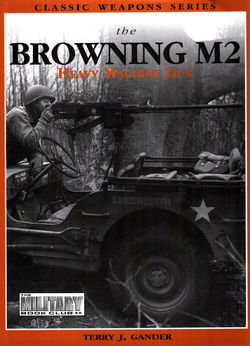
BROWNING M2 HEAVY MACHINE GUN HBDJ WW1
WW2 US ARMY USMC USN USAAF KOREA VIETNAM "MA DEUCE"
CLASSIC
WEAPONS SERIES
***LIKE
NEW CONDITION***
HARDBOUND BOOK with DUSTJACKET
BY
TERRY J. GANDER
ORIGINS
(JOHN MOSES BROWNING, RECOIL ACTUATED MG / SHORT RECOIL)
WW1
MODELS M1917 AND M1918
THE
M2 (0.50 in / 12.7mm) (0.50-inch M1921 AIR DEFENSE)
US
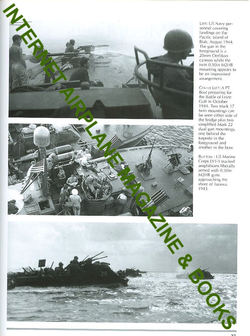
NAVY WW2 M2�s (MARK 21 MOUNT, MARK 22 / M46 PEDESTAL, US ARMY M65 PEDESTAL, US
ARMY M43A1 PEDESTAL MOUNTING, MARK 17 TWIN MACHINE GUN MOUNT, USN PT BOAT
MOUNTINGS, USMC LVT-1 MOUNTINGS)
M2HB
(HEAVY BARREL) MOUNTINGS (M2 TRIPOD MOUNT, M3 TRIPOD MOUNT, M63 AIR DEFENSE
MOUNT, M45 MAXSON MOUNT �QUAD FIFTY�, M55 MAXSON MOUNT, M24 / M31 TRUCK MOUNT)
TANK
GUNS (WW2, KOREA, VIETNAM)
AIRCRAFT
GUNS (CONVAIR 250CH-3 TWIN GUN TURRET FOR PB4Y, SPERRY 250SH-1 (A-13) BALL
TURRET, AN-M2 AIRCRAFT GUN MOUNT MARK 1)
BRITISH
LONG RANGE DESERT RECONNAISSACE GROUP LRDRG
WW2
M33 TWIN 0.50 CAL M2HB TT MAXSON MOUNT
DEVELOPMENTS
REPLACEMENTS
FRESH
FIELDS
AMMUNITION
DATA
YOU
WILL FIND GREAT DEALS ON HARD-TO-FIND AVIATION, ARMOR, NAUTICAL AND MILITARIA
MAGAZINES AT MY EBAY STORE �INTERNET AIRPLANE MAGAZINES AND BOOKS�!
I
HAVE HUNDREDS OF ADDITIONAL LISTINGS USING THE SIMPLE �BUY-IT-NOW� FORMAT. I
SPECIALIZE IN AVIATION REFERENCE MAGAZINES AND BOOKS. I ALSO CARRY TITLES ON
MILITARY HISTORY, ARMOR, TANKS, SHIPS, ELITE SPECIAL UNITS AND AMERICAN CIVIL
WAR. THESE ARE EXCELLENT GIFTS & REFERENCES FOR PILOTS, MILITARY AIRCREW,
VETERANS, MILITARY RE-ENACTORS, SCALE MODELERS & AIRCRAFT ENTHUSIASTS.
TITLES CURRENTLY LISTED INCLUDED: THE ELITE, TAKE OFF, WARPLANE, PROFILE
PUBLICATIONS, AIRCRAFT ILLUSTRATED, AIRCRAFT ILLUSTRATED EXTRA, AIR COMBAT, AIR
ENTHUSIAST, AMERICAN AIRMAN AND THE ILLUSTRATED ENCYCLOPEDIA OF AIRCRAFT.
HARD
TO FIND GIFTS FOR SCALE MODELERS, PILOTS, AIRCREW & VETERANS
HERE'S
AN INEXPENSIVE FATHER'S DAY GIFT, BIRTHDAY PRESENT OR CHRISTMAS PRESENT FOR THE
VETERAN, REENACTOR, SCALE MODELER, MILITARIA ENTHUSIAST OR HISTORY CHANNEL
LOVER IN YOUR FAMILY
PAYMENT
INSTRUCTIONS:
AFTER
THE AUCTION HAS COMPLETED, YOU WILL RECEIVE AN INVOICE FROM ME. PAYPAL
ACCEPTED. ALL AUCTIONS MUST BE COMPLETED WITHIN 10 DAYS. I WILL DO MY PART AND
SHIP ASAP AFTER RECEIVING PAYMENT (SEE MY FEEDBACK FILE).
MONEY
BACK GUARANTEE!
YOU
WILL LOVE MY CUSTOMER FRIENDLY RETURN POLICY. I WANT YOU OR YOUR GIFT RECIPIENT
TO BE HAPPY WITH YOUR PURCHASE. I GUARANTEE THAT THE ITEM SHIPPED WILL BE AS
DESCRIBED. YOU MAY RETURN THE ITEM WITHIN 14 DAYS FOR ANY REASON. JUST EMAIL ME
AND RETURN POST THE PACKAGE ADEQUATELY PROTECTED AGAINST SHIPPING DAMAGE) AND I
WILL RETURN YOUR ITEM PURCHASE PRICE IN FULL.
I
WILL LEAVE POSITIVE FEEDBACK FOR YOU
I
WILL POST POSITIVE FEEDBACK FOR YOU AFTER THE TRANSACTION IS COMPLETE AND I AM
REASONABLY SURE THAT YOU HAVE RECEIVED THE ITEM. IF THERE IS ANY PROBLEM,
PLEASE EMAIL ME TO WORK THINGS OUT BEFORE LEAVING FEEDBACK. MY GOAL IS TO LEAVE
EVERY CUSTOMER 100% SATISFIED WITH MY PRODUCTS AND SERVICE.
--------------------------------------------------------------------------------------------------
Additional
Information from Internet Encyclopedia
The
M2 Machine Gun or Browning .50 Caliber Machine Gun is a heavy machine gun
designed toward the end of World War I by John Browning. Its design is similar
to Browning's earlier M1919 Browning machine gun, which was chambered for the
.30-06 cartridge. The M2 uses the much larger and much more powerful .50 BMG
cartridge, which was developed alongside and takes its name from the gun itself
(BMG standing for Browning Machine Gun). It has been referred to as "Ma
Deuce�, in reference to its M2 nomenclature. The design has had many specific
designations; the official designation for the current infantry type is
Browning Machine Gun, Cal. .50, M2, HB, Flexible. It is effective against
infantry, unarmored or lightly armored vehicles and boats, light fortifications
and low-flying aircraft.
The
Browning .50 caliber machine gun has been used extensively as a vehicle weapon
and for aircraft armament by the United States from the 1930s to the present.
It was heavily used during World War II, the Korean War, the Vietnam War, the
Falklands War, the Soviet�Afghan War, the Gulf War, the Iraq War and the War in
Afghanistan in the 2000s and 2010s. It is the primary heavy machine gun of NATO
countries, and has been used by many other countries as well. The M2 has been
in use longer than any other firearm in U.S. inventory except the .45 ACP M1911
pistol, also designed by John Browning.
The
current M2HB is manufactured in the U.S. by General Dynamics and U.S.
Ordnance[16] for use by the U.S. government, and for allies via Foreign
Military Sales, as well as foreign manufacturers such as FN Herstal.
Machine
guns were heavily used in World War I, and weapons of larger than rifle caliber
began appearing on both sides of the conflict. The larger rounds were needed to
defeat the armor that was being introduced to the battlefield, both on the
ground and in the air. During World War I, the Germans introduced a heavily
armored airplane, the Junkers J.I. The armor made aircraft machine guns using
conventional rifle ammunition (such as the .30-06) ineffective.[17]
Consequently,
the American Expeditionary Force's commander General John J. Pershing asked for
a larger caliber machine gun.[18] Pershing asked the Army Ordnance Department
to develop a machine gun with a caliber of at least 0.50 inches (12.7 mm) and a
muzzle velocity of at least 2,700 feet per second (820 m/s).[17] U.S. Col. John
Henry Parker, commanding a machine gun school in France, observed the
effectiveness of a French 11 mm (0.43 in) incendiary armor-piercing round. The
Army Ordnance Department ordered eight experimental Colt machine guns rechambered
for the French 11 mm cartridge.[19] The French 11 mm round was found to be
unsuitable because its velocity was too low. Pershing wanted a bullet of at
least 670 gr (43 g) and a muzzle velocity of 2,700 ft/s (820 m/s). Development
with the French round was dropped.[19]
Around
July 1917, John M. Browning started redesigning his .30-06 M1917 machine gun
for a larger and more powerful round. Winchester worked on the cartridge, which
was a scaled-up version of the .30-06. Winchester initially added a rim to the
cartridge because the company wanted to use the cartridge in an anti-tank
rifle, but Pershing insisted the cartridge be rimless.[19] The first .50
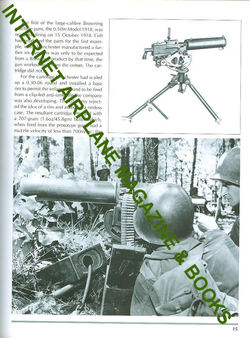
machine gun underwent trials on 15 October 1918. It fired at less than 500
rounds per minute, and the muzzle velocity was only 2,300 ft/s (700 m/s).
Cartridge improvements were promised.[20] The gun was heavy, difficult to
control, fired too slowly for the anti-personnel role, and was not powerful
enough against armor.[21]
While
the .50 was being developed, some German T Gewehr 1918 anti-tank rifles and
ammunition were seized. The German rounds had a muzzle velocity of 2,700 ft/s
(820 m/s), an 800 gr (52 g) bullet, and could pierce[clarification needed]1 in
(25 mm) at 250 yd (230 m).[22] Winchester improved the .50 caliber round to
have similar performance. Ultimately, the muzzle velocity was 2,750 ft/s (840
m/s).[23]
Efforts
by John M. Browning and Fred T. Moore resulted in the water-cooled Browning
machine gun, caliber .50, M1921. An aircraft version was termed the Browning
aircraft machine gun, caliber .50, M1921. These guns were used experimentally
from 1921 until 1937. They had light-weight barrels and the ammunition fed only
from the left side. Service trials raised doubts whether the guns would be suitable
for aircraft or for anti-aircraft use. A heavy barrel M1921 was considered for
ground vehicles.[24]
John
M. Browning died in 1926. Between 1927 and 1932, S.H. Green studied the design
problems of the M1921 and the needs of the armed services. The result was a
single receiver design that could be turned into seven types of .50 caliber
machine guns by using different jackets, barrels, and other components. The new
receiver allowed right or left side feed. In 1933, Colt manufactured several
prototype Browning machine guns (including what would be known as the M1921A1
and M1921E2). With support from the Navy, Colt started manufacturing the M2 in
1933.[25] FN Herstal (Fabrique Nationale) has manufactured the M2 machine gun
since the 1930s.[26] General Dynamics, U.S. Ordnance, and Manroy Engineering
(UK) are other current manufacturers.[citation needed]
A
variant without a water jacket, but with a thicker-walled, air-cooled barrel
was designated the M2 HB (HB for Heavy Barrel). The added mass and surface area
of the heavy barrel compensated somewhat for the loss of water-cooling, while
reducing bulk and weight: the M2 weighs 121 lb (55 kg) with a water jacket, but
the M2 HB weighs 84 lb (38 kg). Due to the long procedure for changing the
barrel, an improved system was developed called QCB (quick change barrel). The
lightweight "Army/Navy" prefixed AN/M2 "light-barrel"
version of the Browning M2 weighing 60 pounds (27 kg) was also developed, and
became the standard .50-caliber aviation machine gun of the World War II-era
for American military aircraft of nearly every type,[27] readily replacing
Browning's own air-cooled .30 caliber machine gun design in nearly all American
aircraft installations.
The
Browning M2 is an air-cooled, belt-fed machine gun. The M2 fires from a closed
bolt, operated on the short recoil principle. The M2 fires the .50 BMG
cartridge, which offers long range, accuracy and immense stopping power. The
closed bolt firing cycle made the M2 usable as a synchronized machine gun on
aircraft before and during World War II, as on the early versions of the
Curtiss P-40 fighter.
The
M2 is a scaled-up version of John Browning's M1917 .30 caliber machine gun,
even using the same timing gauges.
The
M2 has varying cyclic rates of fire, depending on the model. The M2HB (heavy
barrel) air-cooled ground gun has a cyclical rate of 450-575 rounds per minute.
The early M2 water-cooled AA guns had a cyclical rate of around 450�600
rpm.[29] The AN/M2 aircraft gun has a cyclic rate of 750�850 rpm; this
increases to 1,200 rpm for AN/M3 aircraft guns. These maximum rates of fire are
generally not achieved in use, as sustained fire at that rate will wear out the
bore within a few thousand rounds, necessitating replacement. In addition to
full automatic, the M2HB can be selected to fire single-shots or at less than
40 rounds per minute, or rapid fire for more than 40 rounds per minute. Slow
and rapid firing modes use 5-7 round bursts with different lengths of pause
between bursts.
The
M2 has an effective range of 1,830 metres (2,000 yd) and a maximum effective
range of 2,000 metres (2,200 yd) when fired from the M3 tripod. In its
ground-portable, crew-served role as the M2HB, the gun itself weighs 84 pounds
(38 kg) and the assembled M3 tripod another 44 pounds (20 kg). In this
configuration, the V-shaped "butterfly" trigger is located at the
very rear of the weapon with a "spade handle" hand-grip on either
side of it and the bolt release in the center. The spade handles are gripped
and the butterfly trigger is depressed with one or both thumbs. Recently, new
rear buffer assemblies have used squeeze triggers mounted to the hand grips,
doing away with the butterfly triggers.
When
the bolt release is locked down by the bolt latch release lock on the buffer
tube sleeve, the gun functions in fully automatic mode. Conversely, the bolt
release can be unlocked into the up position resulting in single-shot firing
(the gunner must press the bolt latch release to send the bolt forward). Unlike
virtually all other modern machine guns, it has no safety (although a sliding
safety switch has recently been fielded to USMC armorers for installation on
their weapons and is standard-issue for the U.S. Army for all M2s). Troops in
the field have been known to add an improvised safety measure against
accidental firing by slipping an expended shell casing under the butterfly
trigger. The upgraded M2A1 has a manual trigger block safety.
Because
the M2 was designed to operate in many configurations, it can be adapted to
feed from the left or right side of the weapon by exchanging the belt-holding
pawls, and the front and rear cartridge stops (three-piece set to include link
stripper), then reversing the bolt switch. The operator must also convert the
top-cover belt feed slide assembly from left to right hand feed as well as the
spring and plunger in the feed arm. This will take a well trained individual
less than two minutes to perform.
The
charging assembly may be changed from left to right hand charge. A right hand
charging handle spring, lock wire and a little "know-how" are all
that are required to accomplish this. The M2 can be battle-ready and easily
interchanged if it is preemptively fitted with a retracting slide assembly on
both sides of the weapon system. This eliminates the need to have the weapon
removed from service to accomplish this task.
At
some point during World War 2 the Frankford Arsenal developed a squeeze bore
version of the M2HB which reduced the bullet size from .50 to .30 caliber.
There
are several different types of ammunition used in the M2HB and AN aircraft
guns. From World War II through the Vietnam War, the big Browning was used with
standard ball, armor-piercing (AP), armor-piercing incendiary (API), and
armor-piercing incendiary tracer (APIT) rounds. All .50 ammunition designated
"armor-piercing" was required to completely perforate 0.875 inches
(22.2 mm) of hardened steel armor plate at a distance of 100 yards (91 m) and
0.75 inches (19 mm) at 547 yards (500 m).[33] The API and APIT rounds left a
flash, report, and smoke on contact, useful in detecting strikes on enemy
targets; they were primarily intended to incapacitate thin-skinned and lightly
armored vehicles and aircraft, while igniting their fuel tanks.[34]
Current
ammunition types include M33 Ball (706.7 grain) for personnel and light
material targets, M17 tracer, M8 API (622.5 grain), M20 API-T (619 grain), and
M962 SLAP-T. The latter ammunition along with the M903 SLAP (Saboted Light
Armor Penetrator) round can perforate 1.34 inches (34 mm) of FHA (face-hardened
steel plate) at 500 metres (550 yd), 0.91 inches (23 mm) at 1,200 metres (1,300
yd), and 0.75 inches (19 mm) at 1,500 metres (1,600 yd). This is achieved by
using a 0.30-inch-diameter (7.6 mm) tungsten penetrator. The SLAP-T adds a
tracer charge to the base of the ammunition. This ammunition was type
classified in 1993.
When
firing blanks, a large blank-firing adapter (BFA) of a special type must be
used to allow the recoil operated action to cycle. This functions on the
principle of a recoil booster, to increase the recoil force acting on the short
recoil action. This is the exact antithesis of a muzzle brake. Without this
adaptor, the reduced-charge blank cartridge would develop too little recoil to
cycle the action fully. The adapter is very distinctive, attaching to the
muzzle with three rods extending back to the base. The BFA can often be seen on
M2s during peacetime operations.
At
the outbreak of the Second World War the United States had versions of the M2
in service as fixed aircraft guns, anti-aircraft defensive guns (on aircraft,
ships, or boats), infantry (tripod-mounted) guns, and as dual purpose
anti-aircraft and anti-vehicular weapons on vehicles.[37][38]
The
.50 AN/M2 light-barrel aircraft Browning used in planes had a rate of fire of
approximately 800 rounds per minute, and was used singly or in groups of up to
eight guns for aircraft ranging from the P-47 Thunderbolt to the B-25 Mitchell
bomber, which in the last J-version of the Mitchell could have up to fourteen
M2s firing forward for ground attack missions - eight in a solid
metal-structure nose, four more mounted in a pair of conformal twin-gunned gun
pods on the lower cockpit sides, and two more if the forward dorsal turret's
pair of M2 guns were also aimed straight forward. The later A-26 bested this
with up to a maximum of 16/18 machine guns, 8 in the nose, four more per wing
in flush-mount pods, plus 2 guns in the dorsal turret.
In
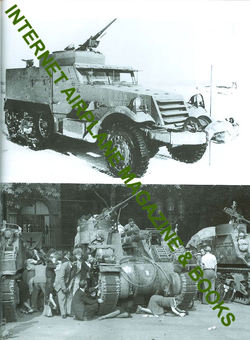
the dual-purpose vehicle mount, the M2HB (heavy barrel) proved extremely
effective in U.S. service: the Browning's .50 caliber AP and API rounds could
easily penetrate the engine block or fuel tanks of a German Bf 109 fighter
attacking at low altitude,[39] or perforate the hull plates and fuel tanks of a
German half-track or light armored car.[33][40][41] While the dual-purpose
mounting was undeniably useful, it did normally require the operator to stand
when using the M2 in a ground role, exposing him to return fire.[42] Units in
the field often modified the mountings on their vehicles, especially tanks and
tank destroyers, to provide more operator protection in the anti-vehicular and
anti-personnel role.[43] The weapon was particularly hated by the Germans,
whose attacks and ambushes against otherwise helpless stalled motor convoys
were frequently broken up by .50 caliber machine gun fire.[44][45] Vehicles
would frequently "recon by fire" with the M2 Browning, i.e. they
would fire continuously at suspected points of ambush while moving through
areas still containing enemy forces. One vehicle would fire exclusively to the
right, the following vehicle to the left, the next one to the right, and so on
in order to cover both flanks of the advancing convoy.
Besides
vehicle-mounted weapons, the heavy weapons companies in a World War II U.S.
Army infantry battalion or regiment were each issued one M2 Browning with
tripod (ground) mount.[46] Mounted on a heavily sandbagged tripod, the M2HB
proved very useful in either a defensive role or to interdict or block road
intersections from use by German infantry and motorized forces.[47] Hearing the
sound of an M2 could often cause enemy infantry to take cover.[48] There are
numerous instances of the M2 Browning being used against enemy personnel,
particularly infantry assaults[49] or for interdiction or elimination of enemy
artillery observers or snipers at distances too great for ordinary infantry
weapons.
The
M2HB was not widely used in the Pacific campaign for several reasons, including
the weight of the gun, the nature of infantry jungle combat, and because road
intersections were usually easily outflanked.[53] However, it was used by
fast-moving motorized forces in the Philippines to destroy Japanese blocking
units on the advance to Manila.[47] The quad mount .50 was also used to destroy
Japanese emplacements.
The
M2HB was used in Korea and Vietnam, and later in both Operation Desert Storm,
the Afghan theater of Operation Enduring Freedom and in Iraq. In 2003, U.S.
Army SFC Paul Ray Smith used his M2HB mounted on an M113 armored personnel
carrier to kill 20 to 50 enemies who were attacking a U.S. outpost, preventing
an aid station from being overrun and allowing wounded soldiers to be
evacuated, SFC Smith was killed during the firefight and was posthumously
awarded the Medal of Honor.