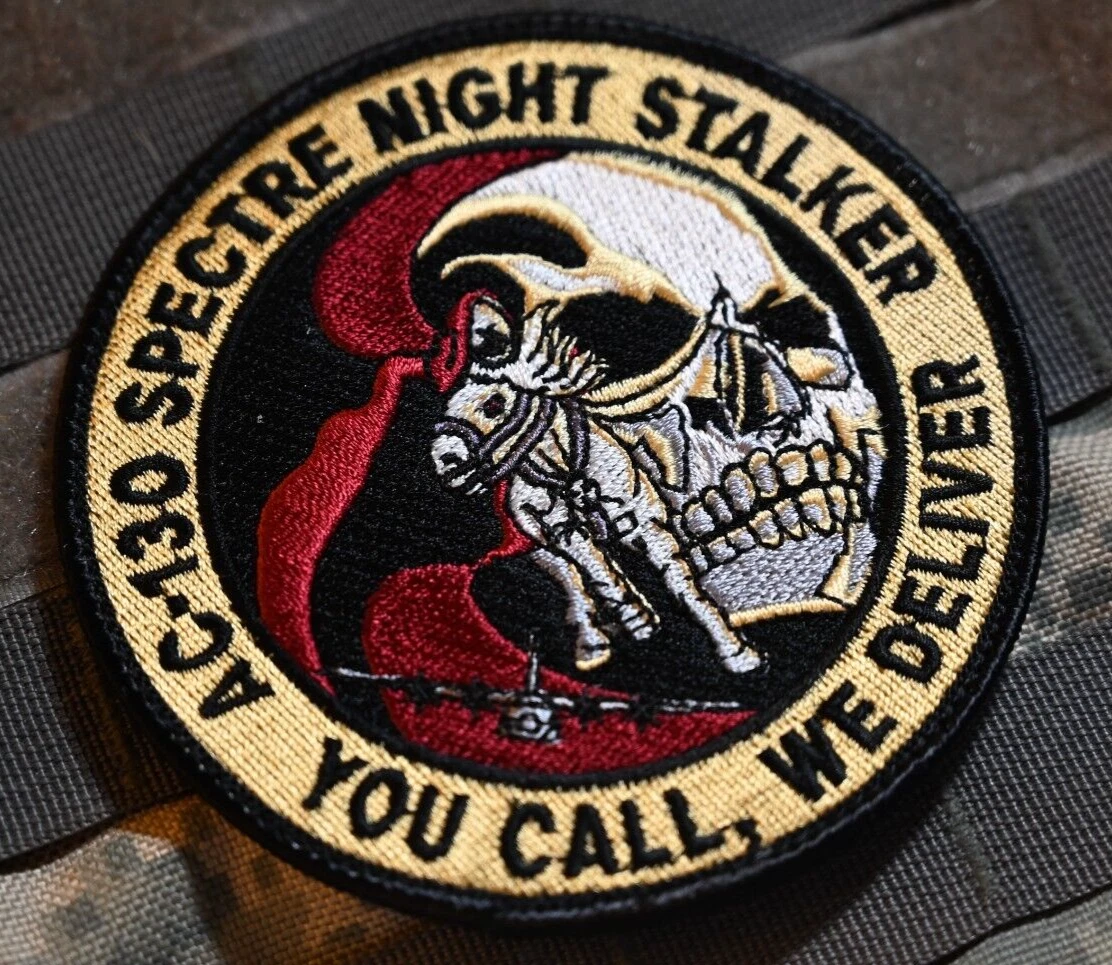
This is a very special Original (not cheap import copy) AFSOC JTAC TACP COMBAT CONTROL CCT BOMB DROPPER DEATH on CALL vêlkrö AC-130 PATCH: FIRE FROM SKY. You will receive the item as shown in the first photo. Please note that there are color variations due to settings on different PCs/Monitors. The color shown on your screen may not be the true color. Personal check payment is welcomed.
The Lockheed AC-130 gunship is a heavily armed, long-endurance, ground-attack variant of the C-130 Hercules transport, fixed-wing aircraft. It carries a wide array of ground-attack weapons that are integrated with sensors, navigation, and fire-control systems. Unlike other modern military fixed-wing aircraft, the AC-130 relies on visual targeting. Since its large profile and low operating altitudes around 7,000 feet (2,100 m) make it an easy target, its close air support missions are usually flown at night.
The airframe is manufactured by Lockheed Martin, while Boeing is responsible for the conversion into a gunship and for aircraft support.[8] Developed during the Vietnam War as "Project Gunship II", the AC-130 replaced the Douglas AC-47 Spooky, or "Gunship I". The sole operator is the United States Air Force, which uses the AC-130J Ghostrider. Close air support roles include supporting ground troops, escorting convoys, and urban operations. Air-interdiction missions are conducted against planned targets and targets of opportunity. Force-protection missions include defending air bases and other facilities. AC-130Js are based at Hurlburt Field, Florida and Cannon AFB, New Mexico;[9] gunships can be deployed worldwide.[10] The squadrons are part of the Air Force Special Operations Command (AFSOC), a component of the United States Special Operations Command.
The AC-130 has an unpressurized cabin, with the weaponry mounted to fire from the port side of the fuselage. During an attack, the gunship performs a pylon turn, flying in a large circle around the target, so is able to fire at it for far longer than in a conventional strafing attack. The AC-130H Spectre was armed with two 20 mm M61 Vulcan cannons, one L/60 Bofors 40 mm cannon, and M137 105 mm cannon and M37 recoil mechanism from the M102 howitzer; after 1994, the 20 mm cannons were removed. The upgraded AC-130U Spooky has a 25 mm GAU-12 Equalizer cannon in place of the Spectre's two 20 mm cannons, an improved fire-control system, and increased ammunition capacity.[citation needed] The new AC-130J was based on the MC-130J Commando II special-operations tanker. The AC-130W Stinger II is a modified C-130H with upgrades including a precision strike package. As of 2023, AC-130 gunships have been providing close air support for special operators for 56 years. Although the aircraft have been kept relevant through constant upgrades to their weaponry, sensor packages, and countermeasures, they are not expected to be survivable in future nonpermissive environments due to their high signatures and low airspeeds. Military analysts, such as the Center for Strategic and Budgetary Assessments, have suggested that AFSOC invest in more advanced technologies to fill the role to operate in future contested combat zones, including a mix of low-cost disposable unmanned and stealthy strike aircraft. AFSOC is considering a number of changes to the AC-130J in order to make it effective against advanced adversaries including removing the 105mm cannon and upgrading the aircraft with small cruise missiles, an AESA radar, and adaptive mission networking. The US has used gunships with deployments to the War in Afghanistan (Operation Enduring Freedom, Operation Freedom's Sentinel, 2001–21), and Iraq War (Operation Iraqi Freedom, 2003–11). AC-130 strikes were directed by special forces on known Taliban locations during the early days of the war in Afghanistan. US Special Operations Forces used the AC-130 to support its operations. The day after arriving in Afghanistan, the AC-130s attacked Taliban and Al-Qaeda forces near the city of Kunduz and were directly responsible for the city's surrender the next day. On 26 November 2001, Spectres were called in to put down a rebellion at the prison fort of Qala-i-Jangi. The 16 SOS flew missions over Mazar-i-Sharif, Kunduz, Kandahar, Shkin, Asadabad, Bagram, Baghran, Tora Bora, and virtually every other part of Afghanistan. The Spectre participated in countless operations within Afghanistan, performing on-call close air support and armed reconnaissance. In March 2002, three AC-130 Spectres provided 39 crucial combat missions in support of Operation Anaconda in Afghanistan. During the intense fighting, the planes fired more than 1,300x 40mm and 1,200x 105mm rounds.
Close air support was the main mission of the AC-130 in Iraq. Night after night, at least one AC-130 was in the air to fulfill one or more air-support requests (ASRs). A typical mission had the AC–130 supporting a single brigade's ASRs followed by aerial refueling and another two hours with another brigade or SOF team. The use of AC-130s in places like Fallujah, urban settings where insurgents were among crowded populations of non-combatants, was criticized by human rights groups. AC-130s were also used for intelligence gathering with their sophisticated long-range video, infrared and radar sensors. In 2007, US Special Operations forces also used the AC-130 in attacks on suspected Al-Qaeda militants in Somalia.
Eight AC-130H and 17 AC-130U aircraft were in active-duty service as of July 2010.[11] In March 2011, the Air Force deployed two AC-130U gunships to take part in Operation Odyssey Dawn, the US military intervention in Libya, which eventually came under NATO as Operation Unified Protector.
By September 2013, 14 MC-130W Dragon Spear aircraft have been converted to AC-130W Stinger II gunships. The Stinger gunships have been deployed to Afghanistan to replace the aging AC-130H aircraft and provide an example for the new AC-130J Ghostrider. Modifications began by cutting holes in the plane to make room for weapons and adding kits and bomb bases for laser-guided munitions. Crews added a 105 mm cannon, 20-inch infrared and electro-optical sensors, and the ability to carry 250-lb bombs on the wings.[73]
The final AC-130H Spectre gunship, tail number 69-6569 "Excalibur" was retired on 26 May 2015 at Cannon Air Force Base, New Mexico.
On 15 November 2015, two days after the attacks in Paris by ISIL, AC-130s and A-10 Thunderbolt II attack aircraft destroyed a convoy of over 100 ISIL-operated oil tanker trucks in Syria. The attacks were part of an intensification of the US-led military intervention against ISIL called Operation Tidal Wave II (named after the original Operation Tidal Wave during World War II, a failed attempt to raid German oil fields that resulted in heavy aircraft and aircrew loss) in an attempt to cut off oil smuggling as a source of funding for the group.
On 3 October 2015, an AC-130 mistakenly attacked the Doctors Without Borders hospital in Kunduz, Afghanistan, killing 42 people and injuring over 30. In five separate runs, the gunship struck the hospital, which had been erroneously identified as the source of attacks on coalition members. Subsequent inquiries led to punishment of 16 military personnel and cited "human error" as the root cause.
On 30 September 2017, the Air Force declared the AC-130J Ghostrider had achieved initial operational capability, with six gunships having been delivered; the aircraft is planned to reach full operational capability by 2023 with 37 gunships delivered. The J-variant is lighter and more fuel efficient than previous versions, able to fly at 416 mph (669 km/h) with a range of 3,000 mi (4,800 km) and service ceiling of 28,000 ft (8,500 m). The AC-130U returned from its final combat deployment on 8 July 2019; the final AC-130U was retired in June 2020. AFSOC started taking delivery of the AC-130J in spring 2019, and the aircraft began deploying to Afghanistan by the summer.
On 21 November 2023, the Air Force released a statement that an AC-130J had performed a retaliatory strike on Iranian-backed militia group in central Iraq. The strike happened near Al-Asad Airbase after the militia members reportedly launched a ballistic missile against Al-Asad airbase. The Deputy Press Secretary of The Pentagon, Sabrina Singh stated "This self-defense strike resulted in some hostile fatalities." Notably the AC-130J's transponder remained on during the strike, and the remainder of its sortie.[. A TACP is a Tactical Air Control Party. It is comprised of a JTAC (Joint Terminal Air Controller) and a ROMAD (essentially a JTAC in training, though the reality is ROMADs are frequently seasoned operators in their own right, having completed lengthy and arduous blocks of training and lacking only the final JTAC certification). JTACs direct the action of combat aircraft operating in CAS (Close Air Support) and other offensive operations, calling in airstrikes and gun runs like an FO or an ANGLICO Marine calls in artillery or naval gunfire. The NATO is Forward Air Controller. A typical TACP (JTAC or ROMAD or both) might be on an infantry patrol one day to coordinate immediate CAS and attached to an ODA the next day for the same reason. Calling in an air strike on just the right target at just the right time can change the tide of battle. Tactical Air Control Party (TACP) Specialists imbed with Army and Marine units and do just that. One of the few true frontline combat jobs in the Air Force, TACP Specialists are known for their ability to bring overwhelming firepower to the battlefield in the form of artillery and air strikes. The training is physically, mentally and technically intense, as you'll have to be able to operate under any environmental condition alongside some of the military's most elite special operations teams. A USAF TACP, is usually a team of two or more United States Air Force enlisted TACP journeymen or craftsmen (AFSC 1C4X1) aligned with a conventional or special operational United States Army combat maneuver unit to advise ground commanders on the best use of air power, establish and maintain command and control communications, and provide precision terminal attack guidance of U.S. and coalition fixed-wing and rotary-wing close air support aircraft, artillery, and naval gunfire. A TACP always includes at least one Joint Terminal Attack Controller (JTAC) qualified to control attack aircraft. It can also include an Air Liaison Officer (ALO), an Air Force commissioned officer who is typically aeronautically rated as a pilot or navigator/combat systems officer in fighter or attack aircraft who is often JTAC qualified and serves in a senior advisor capacity. A small number of non-rated officers, typically with special tactics backgrounds, have also been qualified as ALOs. JTAC teams are primarily stationed with and support Army combat units. In the United Kingdom Armed Forces TACP personnel may come from the Royal Marines, Army or RAF Regiment[3] Every TACP has four members, one officer and one SNCO who are trained Forward Air Controllers. Two signallers (JNCOs) who are responsible for communication equipment and assist in tasking aircraft to FACs in forward positions. The FAC's role is to guide attack aircraft and fast jets to the correct target by providing descriptions and locations to the pilots via a range of telecommunications equipment. Prince Harry, the third in line to the British throne, served as a TACP commander in Afghanistan. FACs and TACPs in the United Kingdom are trained at the Joint Forward Air Controller Training Standards Unit (JFACTSU)
Other items in other pictures are available from my eBay Store. They will make a great addition to your SSI Shoulder Sleeve Insignia collection. You find only US Made items here, with the same LIFETIME warranty.
**eBay REQUIRES ORDER BE SENT WITH TRACKING, PLEASE SELECT USPS 1ST CLASS SERVICE w/TRACKING**
**eBay REQUIRES ORDER BE SENT WITH TRACKING, PLEASE SELECT USPS GROUND ADVANTAGE SERVICE w/TRACKING**
| 
We'll cover your purchase price plus shipping. |
FREE 30-day No-Question return
ALL US-MADE PATCHES HAVE LIFETIME WARRANTY We do not compete price with cheap import copies. Watch out for cheap import copies with cut-throat price; We beat cheap copies with Original design, US-Made Quality and customer services. Once a customer, a LIFETIME of services
|