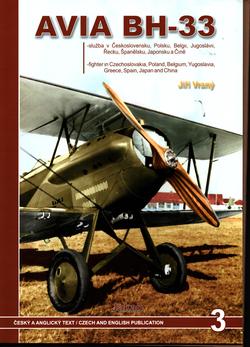
AVIA BH-33 BIPLANE FIGHTER CZECHOSLOVAKIA
POLAND BELGIUM GREECE SPAIN JAPAN CHINA YUGOSLAVIA
SOFTBOUND BOOK in ENGLISH & CZECH by JIRI
VRANY
-------------------------------------
Additional Information from Internet Encyclopedia
The Avia BH-33 was
a biplane fighter aircraft built in Czechoslovakia in 1927. It was based on the
BH-21J which demonstrated promising results by combining the original BH-21
airframe with a licence-built Bristol Jupiter radial engine. Other than the
peculiar Avia hallmark of having an upper wing with a shorter span than the
lower, it was utterly conventional, even featuring a tail fin for the first
time in a Pavel Beneš and Miroslav Hajn design (previous aircraft had a rudder
but no fin).
Design and
development
Initial tests of
the first prototype were disappointing, displaying performance only marginally
better than the BH-21, even when fitted with a more powerful version of the
Jupiter. Two further prototypes followed, both designated BH-33-1, each with an
increasingly powerful Jupiter variant – one a Jupiter VI, the other a Jupiter
VII. The performance of the latter example was finally acceptable for the
Czechoslovakian defence ministry to order a small production run of only five
aircraft.
Three examples
were sold to Belgium, where there were plans to build the type under licence,
but this did not occur. Licence production was undertaken, however, in Poland,
where a single example was sold, along with a licence to build 50 aircraft.
These were designated PWS-A and put into service with the Polish Air Force in
1930.
Development
continued with an almost total redesign of the fuselage, replacing the wooden,
slab-sided structure with one of oval cross-section, built up from welded steel
tubes. Designated BH-33E, this was a world-class fighter for its time.
Nevertheless, the response from the Czechoslovakian military was lukewarm
(although two were bought for the national aerobatics team), and Avia again
looked abroad for customers, this time selling 20 aircraft to the Kingdom of
Yugoslavia, along with a licence to produce another 24. Two or three examples
were also bought by Soviet Union for evaluation.
In late 1929, a
further development was flown as the BH-33L, featuring longer-span wings, and a
Škoda L W-block engine. This version finally brought the company the domestic
sales that it had been hoping for, with 80 aircraft ordered by the Czechoslovak
Air Force. These became standard equipment with some air regiments up to the
outbreak of World War II.
A single, final
variant with a BMW-built Pratt & Whitney Hornet engine was built as the
BH-33H (later redesignation BH-133) in 1930, but this did not lead to
production.
Operational
history
Czechoslovakian
BH-33s never saw combat, and Poland's examples had long been replaced in
service by the time of the German invasion. Two Yugoslavian machines did,
however see combat against Luftwaffe Messerschmitt Bf 109s, but were both
destroyed and their pilots killed.
Variants
BH-33
First prototype.
BH-33-1
Two prototypes
powered by Jupiter VI (second) and Jupiter VII (third) engines plus five serial
built aircraft with Jupiter VII engine.
BH-33E
Rebuilt fuselage
BH-33E-SHS
Yugoslav Version
powered by IAM K9 engine, 22 built.
BH-33L
Version with
longer-span wings, powered by a Škoda L engine, 80 built.
BH-33H (BH-133)
Version powered by
Pratt & Whitney Hornet engine, one built.
P.W.S.A
Polish
license-built variant of the BH-33 with minor modifications,[1] 50 built
between 1929 and 1932.
Operators
Belgium
Belgian Air Force
received three BH-33-1 aircraft.
Independent State
of Croatia
Air Force of the
Independent State of Croatia
Czechoslovakia
Czechoslovakian
Air Force
Czechoslovakian
National Security Guard
Greece
Hellenic Air Force
acquired five Yugoslav-produced BH-33s, during the 1935 coup, when Greece was a
republic.
Poland
Polish Air Force
received one BH-33 and 50 PWS-A license-built variant.
Slovakia
Slovak Air Force
(1939–45)
Soviet Union
Soviet Air Force
bought two or three BH-33Es for tests.
Spanish Republic
Spanish Republican
Air Force
Yugoslavia
Yugoslav Royal Air
Force