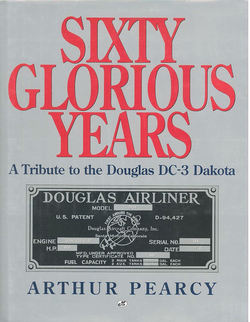
MOTORBOOKS SIXTY
GLORIOUS YEARS DOUGLAS DC-3 DAKOTA AIRLINER WW2 USAAF RAF RCAF RAAF KOREA
VIETNAM HBDJ
HARDBOUND with DUSTJACK ***BRAND NEW CONDITION***
BY ARTHUR PEARCY (1995) 158
PAGES
INTO SERVICE AND WAR CLOUDS
FACTORY PRODUCTION
SOUTH-WEST PACIFIC
MIDDLE EAST
ALASKA ALEUTIANS
CHINA-BURMA-INDIA CBI / SEAC
BOAC
TROOP CARRIER COMMAND TCS USAAF
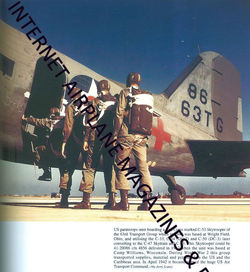
CASUALTY EVACUATION
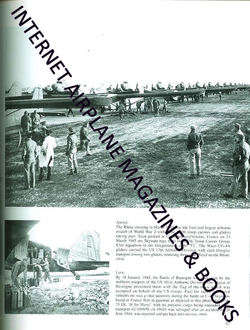
AIRBORNE FORCES
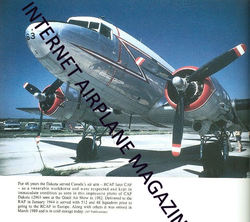
ROYAL CANADIAN AIR FORCES RCAF
SUPER DC-3
BERLIN AIRLIFT
KOREAN WAR
VIETNAM WAR
AIR CARGO
US ARMY
UNITED NATIONS
AMERICAN AIRLINES, TWA, BRANIFF, BEA BRITISH EUROPEAN AIRWAYS, AER
LINGUS, TRANS-CANADA, LUFTHANSA, AIR FRANCE, NORTHEAST AIRLINES, WESTERN
AIRLINES, MID-CONTINENT AIRLINES, PAN AMERICAN WORLD AIRWAYS, UNITED, DELTA,
CONTINENTAL, PIEDMONT, OZARK, SOUTHERN AIRWAYS, TRANS-TEXAS, FRONTIER, WEST
COAST, LAKE CENTRAL, NORTH CENTRAL, ALOHA AIRLINES, MOHAWK AIRLINES, HAWAIIAN
AIRLINES
WW2 C-47 SKYTRAIN TROOP CARRIER SQUADRON, C-47 SKI INSTALLATION, EDO
FLOAT INSTALLATION, GLIDER TUG PICKUP, BERLIN AIRLIFT
CLOSE-UP DETAIL PHOTOS: ENGINE, PROPELLER, SPEED PACK, LANDING GEAR,
TAIL WHEEL, JATO, FUSELAGE BOARDING LADDER, THROTTLE QUADRANT
WW2 USAAF PILOT TRAINING
------------------------------------------------------------------------------------------------------------------
Additional Information from
Internet Encyclopedia
The Douglas C-47 Skytrain or
Dakota (RAF designation) is a
military transport aircraft that was developed from the Douglas DC-3 airliner.
It was used extensively by the Allies during World War II and remained in front
line service with various military operators through the 1950s.
The C-47 differed from the civilian DC-3 in numerous modifications that
included being fitted with a cargo door and a strengthened floor.
During World War II, the armed forces of many countries used the C-47 and
modified DC-3s for the transport of troops, cargo, and wounded. The U.S. Naval
designation was R4D. More than 10,000 aircraft were produced in Long Beach and
Santa Monica, California and Oklahoma City, Oklahoma. The Oklahoma City plant
produced 5,354 C-47s from March 1943 until August 1945.
The C-47 was vital to the success of many Allied campaigns, in particular
those at Guadalcanal and in the jungles of New Guinea and Burma where the C-47
(and its naval version, the R4D) made it possible for Allied troops to counter
the mobility of the light-traveling Japanese army. Besides dropping large
formation of Allied Airborne Division in Normandy on D-day, in Holland during
Operation Market Garden (Arnhem) and Operation Varsity (Rhine Crossing), C-47s
were used to airlift supplies to the embattled American forces during the
Battle of Bastogne. Possibly its most influential role in military aviation,
however, was flying "The Hump" from India into China. The expertise
gained flying "The Hump" was later be used in the Berlin Airlift, in
which the C-47 played a major role, until the aircraft were replaced by Douglas
C-54 Skymasters.
In Europe, the C-47 and a specialized paratrooper variant, the C-53 Skytrooper, were used in vast
numbers in the later stages of the war, particularly to tow gliders and drop
paratroops. In the Pacific, with careful use of the island landing strips of
the Pacific Ocean, C-47s were even used for ferrying soldiers serving in the
Pacific theater back to the United States.
The United States Air Force's Strategic Air Command had Skytrains in
service from 1946 through 1967.
With all of the aircraft and pilots having been part of the Indian Air
Force prior to Independence, both the Indian Air Force and Pakistan Air Force
used C-47s to transport supplies to their soldiers fighting in the
Indo-Pakistan War of 1947.
Several C-47 variations were used in the Vietnam War by the United States
Air Force, including three advanced electronic warfare variations, which
sometimes were called "Electric Gooneys" designated EC-47N, EC-47P,
or EC-47Qs depending on the engine used. EC-47s were also operated by the
Vietnamese, Laotian and Cambodian Air Forces. A gunship variation, using three
7.62mm miniguns, designated AC-47 "Spooky" often nicknamed "Puff
the Magic Dragon" also was deployed.
The Royal Canadian Air Force and later, the Canadian Armed Forces employed
the C-47 for transportation, navigation, and radar training, as well as for
search and rescue operations from the 1940s to the 1980s.
The Lisunov Li-2, originally
designated PS-84 (NATO reporting
name "Cab"), was a
license-built version of the Douglas DC-3. It was produced by Factory #84 in
Moscow-Khimki and, after evacuation in 1941, at TAPO in Tashkent. The project
was directed by aeronautical engineer Boris Pavlovich Lisunov. The Soviet Union received its first DC-2 in
1935. Although a total of 18 DC-3s had been ordered on 11 April 1936, the
Soviets purchased 21 DC-3s for operation by Aeroflot before World War II. A
production license was awarded to the Soviets on 15 July 1936. Lisunov spent
two years at the Douglas Aircraft Company, between November 1936 and April 1939
translating the design. One of the engineers who accompanied him to Douglas was
Vladimir Mikhailovich Myasishchev. The Soviet version was given the designation
PS-84 - Passazhirskiy Samolyot
84, passenger airplane 84 (i.e. made in GAZ/State Plant No. 84). The design
incorporated 1,293 engineering change orders on the original Douglas drawings,
involving part design, dimensions, materials and processes. Some of the changes were substantial, such as
the use of the Russian Shvetsov ASh-62IR engines, a Soviet development of the
nine-cylinder Wright R-1820.
The Shôwa L2D and Nakajima L2D, given the designations: Shôwa Navy Type 0 Transport and Nakajima Navy Type 0 Transport, were
license-built versions of the Douglas DC-3. The L2D series, numerically, was
the most important Japanese transport in World War II. The L2D was given the
Allied code name Tabby.
Variants
C-47:
Initial military version of the DC-3 with seats for 27 troops, 965 built
including 12 to the United States Navy as R4D-1
C-47A:
C-47 with a 24-volt electrical system, 5,254 built including USN aircraft
designated R4D-5
RC-47A:
C-47A equipped for photographic reconnaissance and ELINT missions
SC-47A:
C-47A equipped for Search Air Rescue; redesignated HC-47A in 1962
VC-47A:
C-47A equipped for VIP transport role
C-47B:
Powered by R-1830-90 engines with superchargers and extra fuel capacity to
cover the China-Burma-India routes, 3,364 built
VC-47B:
C-47B equipped for VIP transport role
XC-47C:
C-47 tested with Edo Model 78 floats for possible use as a seaplane
C-47D:
C-47B with superchargers removed after the war
AC-47D:
Gunship aircraft with three side-firing .30 in (7.62 mm) Minigun
machine guns
EC-47D:
C-47D with equipment for the Electronics Calibration, of which 26 were so
converted by Hayes in 1953; prior to 1962 was designated AC-47D
NC-47D:
C-47D modified for test roles
RC-47D:
C-47D equipped for photographic reconnaissance and ELINT missions
SC-47D:
C-47D equipped for Search Air Rescue; redesignated HC-47D in 1962
VC-47D:
C-47D equipped for VIP transport role
C-47E:
Modified cargo variant with space for 27–28 passengers or 18–24 litters
C-47F:
YC-129 re-designated, Super DC-3 prototype for evaluation by USAF later passed
to USN as XR4D-8
C-47L/M:
C-47H/Js equipped for the support of American Legation United States Naval
Attache (ALUSNA) and Military Assistance Advisory Group (MAAG) missions
EC-47N/P/Q:
C-47A and D aircraft modified for ELINT/ARDF mission, N and P differ in radio
bands covered, while Q replaces analog equipment found on the N and P with a
digital suite, redesigned antenna equipment and uprated engines
C-53
Skytrooper: Troop transport version of the C-47
XC-53A
Skytrooper: One aircraft with full-span slotted flaps and hot-air leading edge
deicing
C-53B
Skytrooper: Winterised version of C-53 with extra fuel capacity and separate
navigator's station, eight built
C-53C
Skytrooper: C-53 with larger port-side door, 17 built
C-53D
Skytrooper: C-53C with 24V DC electrical system, 159 built
C-117A
Skytrooper: C-47B with 24-seat airline-type interior for staff transport use,
16 built
VC-117A:
Three redesignated C-117s used in the VIP role
SC-117A:
One C-117C converted for air-sea rescue
C-117B/VC-117B:
High-altitude superchargers removed, one built and conversions from C-117As all
later VC-117B
C-117D:
USN/USMC R4D-8 redesignated
LC-117D:
USN/USMC R4D-8L redesignated
TC-117D:
USN/USMC R4D-8T redesignated
VC-117D:
USN R4D-8Z redesignated
YC-129:
Super DC-3 prototype for evaluation by USAF redesignated C-47F and later passed
to USN as XR4D-8. Wright R-1820
engines uprated to 1425 hp.
CC-129:
Canadian Forces designation for the C-47 (post-1970)
XCG-17:
One C-47 tested as a 40-seat troop glider with engines removed and faired over
R4D-1
Skytrain: USN/USMC version of the C-47
R4D-3:
Twenty C-53Cs transferred to USN
R4D-5:
C-47A variant 24-volt electrical system replacing the 12-volt of the C-47;
redesignated C-47H in 1962, 238
transferred from USAF
R4D-5L:
R4D-5 for use in Antarctica. Redesignated LC-47H in 1962. Photos of this type show the removal of underslung
engine oil coolers typical of the R-1830 engine installation; apparently not
needed in the cold polar regions.
R4D-5Q:
R4D-5 for use as special ECM trainer. Redesignated EC-47H in 1962
R4D-5R:
R4D-5 for use as a personnel transport for 21 passengers and as a trainer
aircraft; redesignated TC-47H in
1962
R4D-5S:
R4D-5 for use as a special ASW trainer; redesignated SC-47H in 1962
R4D-5Z:
R4D-5 for use as a VIP transport; redesignated VC-47H in 1962
R4D-6:
157 C-47Bs transferred to USN; redesignated C-47J in 1962
R4D-6L,
Q, R, S, and Z: Variants as the R4D-5 series; redesignated LC-47J, EC-47J, TC-47J, SC-47J, and VC-47J respectively in 1962
R4D-7:
44 TC-47Bs transferred from USAF for use as a navigational trainer;
redesignated TC-47K in 1962
R4D-8:
R4D-5 and R4D-6 remanufactured aircraft with stretched fuselage, Wright R-1820
engines, fitted with modified wings and re-designed tail surfaces; redesignated
C-117D in 1962
R4D-8L:
R4D-8 converted for Antarctic use, redesignated LC-117D in 1962
R4D-8T:
R4D-8 converted as crew trainers, redesignated TC-117D in 1962
R4D-8Z:
R4D-8 converted as a staff transport, redesignated VC-117D in 1962
Dakota
I: RAF designation for the C-47 and R4D-1
Dakota
II: RAF designation for nine C-53 Skytroopers received under the lend lease
scheme. Unlike the majority of RAF Dakotas these aircraft were therefore
dedicated troop transports, lacking the wide cargo doors and reinforced floor
of the C-47.
Dakota
III: RAF designation for the C-47A.
Dakota
IV: RAF designation for the C-47B.
Airspeed
AS.61: Conversion of Dakota I aircraft
Airspeed
AS.62: Conversion of Dakota II aircraft
Airspeed AS.63: Conversion
of Dakota III aircraft