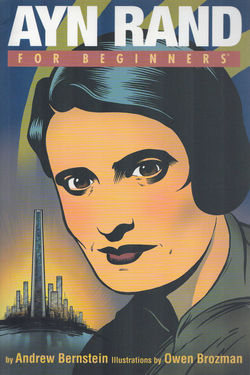
AYN
RAND for BEGINNERS – HER WORKS & REVOLUTIONARY PHILOSOPHY OF OBJECTIVISM
SOFTBOUND BOOK in ENGLISH by ANDREW
BERNSTEIN
Ayn Rand, author of the
best-selling novels, The Fountainhead and Atlas Shrugged, is beloved by
millions of readers, and equally despised by a significant number of
detractors. Her novels and her revolutionary philosophy of Objectivism have
acquired a world-wide following. They have also created legions of readers who
are hungry for a deeper understanding of her writings.
Despite her undeniably
significant contributions to the literary canon and the progression of
philosophy, there has been no simple, comprehensive introduction to Rand's
books and ideas, until now. Ayn Rand For Beginners sheds new light on Rand's
monumental works and robust philosophy. In clear, down-to-earth language, it
explains Rand to a new generation of readers in a manner that is entertaining,
and easy to read and comprehend.
-------------------------------
Additional Information from
Internet Encyclopedia
Alice O'Connor (born Alisa
Zinovyevna Rosenbaum; February 2 [O.S. January 20], 1905 – March 6, 1982),
better known by her pen name Ayn Rand, was a Russian-born American writer and
philosopher.[3] She is known for her fiction and for developing a philosophical
system she named Objectivism. Born and educated in Russia, she moved to the
United States in 1926. After two early novels that were initially unsuccessful
and two Broadway plays, she achieved fame with her 1943 novel, The
Fountainhead. In 1957, Rand published her best-selling work, the novel Atlas
Shrugged. Afterward, until her death in 1982, she turned to non-fiction to
promote her philosophy, publishing her own periodicals and releasing several
collections of essays.
Rand advocated reason as the
only means of acquiring knowledge; she rejected faith and religion. She
supported rational and ethical egoism as opposed to altruism. In politics, she
condemned the initiation of force as immoral and opposed collectivism, statism,
and anarchism. Instead, she supported laissez-faire capitalism, which she
defined as the system based on recognizing individual rights, including private
property rights. Although Rand opposed libertarianism, which she viewed as
anarchism, she is often associated with the modern libertarian movement in the
United States. In art, Rand promoted romantic realism. She was sharply critical
of most philosophers and philosophical traditions known to her, except for
Aristotle, Thomas Aquinas, and classical liberals.
Rand's books have sold over 37
million copies. Her fiction received mixed reviews from literary critics, with
reviews becoming more negative for her later work.[4] Although academic
interest in her ideas has grown since her death, academic philosophers have
generally ignored or rejected her philosophy, arguing that she has a polemical
approach and that her work lacks methodological rigor.[3] Her writings have
politically influenced some right-libertarians and conservatives. The
Objectivist movement circulates her ideas, both to the public and in academic
settings.
Life
Rand was born Alisa Zinovyevna
Rosenbaum on February 2, 1905, to a Russian-Jewish bourgeois family living in
Saint Petersburg. She was the eldest of three daughters of Zinovy Zakharovich
Rosenbaum, a pharmacist, and Anna Borisovna (née Kaplan). She was twelve when
the October Revolution and the rule of the Bolsheviks under Vladimir Lenin
disrupted the life the family had enjoyed previously. Her father's pharmacy was
nationalized,[8] and the family fled to the city of Yevpatoria in Crimea, which
was initially under the control of the White Army during the Russian Civil
War.[9] After graduating high school there in June 1921, she returned with her
family to Petrograd (as Saint Petersburg was then named),[d] where they faced
desperate conditions, occasionally nearly starving.
When Russian universities were
opened to women after the revolution, Rand was among the first to enroll at
Petrograd State University. At 16, she began her studies in the department of
social pedagogy, majoring in history. Along with many other bourgeois students,
she was purged from the university shortly before graduating. After complaints
from a group of visiting foreign scientists, many of the purged students were
reinstated in the university. Rand was among these reinstated students and she
completed her studies at the renamed Leningrad State University in October
1924. She then studied for a year at the State Technicum for Screen Arts in
Leningrad. For an assignment, Rand wrote an essay about the Polish actress Pola
Negri; it became her first published work. By this time, she had decided her
professional surname for writing would be Rand,[19] and she adopted the first
name Ayn.
In late 1925, Rand was granted a
visa to visit relatives in Chicago.[26] She departed on January 17, 1926, and
arrived in New York City on February 19, 1926.[28] Intent on staying in the
United States to become a screenwriter, she lived for a few months with her
relatives learning English before leaving for Hollywood, California.
In Hollywood, a chance meeting
with famed director Cecil B. DeMille led to work as an extra in his film The
King of Kings and a subsequent job as a junior screenwriter.[31] While working
on The King of Kings, she met an aspiring young actor, Frank O'Connor; the two
married on April 15, 1929. She became a permanent American resident in July
1929 and an American citizen on March 3, 1931. She made several attempts to
bring her parents and sisters to the United States, but they were unable to
obtain permission to emigrate.
Early fiction
Rand's first literary success
came with the sale of her screenplay Red Pawn to Universal Studios in 1932,
although it was never produced. Her courtroom drama Night of January 16th,
first staged in Hollywood in 1934, reopened successfully on Broadway in 1935.
Each night, a jury was selected from members of the audience; based on its
vote, one of two different endings would be performed. Rand and O'Connor moved
to New York City in December 1934 so she could handle revisions for the
Broadway production.
Her first novel, the
semi-autobiographical[i] We the Living, was published in 1936. Set in Soviet
Russia, it focused on the struggle between the individual and the state.
Initial sales were slow, and the American publisher let it go out of print,
although European editions continued to sell.mShe adapted the story as a stage
play, but the Broadway production was a failure and closed in less than a week.
After the success of her later novels, Rand was able to release a revised
version in 1959 that has since sold over three million copies.
Rand started her next major
novel, The Fountainhead, in December 1935, but took a break from it in 1937 to
write her novella Anthem. The novella presents a vision of a dystopian future
world in which totalitarian collectivism has triumphed to such an extent that
the word I has been forgotten and replaced with we. It was published in England
in 1938, but Rand could not find an American publisher at that time. As with We
the Living, Rand's later success allowed her to get a revised version published
in 1946, and this sold over 3.5 million copies.
The Fountainhead and political
activism
During the 1940s, Rand became
politically active. She and her husband were full-time volunteers for
Republican Wendell Willkie's 1940 presidential campaign. This work brought her
into contact with other intellectuals sympathetic to free-market capitalism.
She became friends with journalist Henry Hazlitt, who introduced her to the
Austrian School economist Ludwig von Mises. Despite philosophical differences
with them, Rand strongly endorsed the writings of both men throughout her
career, and they expressed admiration for her. Mises once referred to her as
"the most courageous man in America", a compliment that particularly
pleased her because he said "man" instead of "woman". Rand
became friends with libertarian writer Isabel Paterson. Rand questioned her
about American history and politics long into the night during their many
meetings, and gave Paterson ideas for her only non-fiction book, The God of the
Machine.
Rand's first major success as a
writer came in 1943 with The Fountainhead, a novel about an uncompromising
young architect named Howard Roark and his struggle against what Rand described
as "second-handers"—those who attempt to live through others, placing
others above themselves. Twelve publishers rejected it before Bobbs-Merrill
Company accepted it at the insistence of editor Archibald Ogden, who threatened
to quit if his employer did not publish it. While completing the novel, Rand
was prescribed the amphetamine Benzedrine to fight fatigue. The drug helped her
to work long hours to meet her deadline for delivering the novel, but
afterwards she was so exhausted that her doctor ordered two weeks' rest.[64]
Her use of the drug for approximately three decades may have contributed to
mood swings and outbursts described by some of her later associates.
The success of The Fountainhead
brought Rand fame and financial security. In 1943, she sold the film rights to
Warner Bros. and returned to Hollywood to write the screenplay. Producer Hal B.
Wallis hired her afterwards as a screenwriter and script-doctor. Her work for
him included the screenplays for Love Letters and You Came Along. Her contract
with Wallis also allowed time for other projects, including a never-completed
nonfiction treatment of her philosophy to be called The Moral Basis of
Individualism.
While working in Hollywood, Rand
became involved with the anti-Communist Motion Picture Alliance for the
Preservation of American Ideals and wrote articles on the group's behalf. She
also joined the anti-Communist American Writers Association. In 1947, during
the Second Red Scare, Rand testified as a "friendly witness" before
the United States House Un-American Activities Committee that the 1944 film
Song of Russia grossly misrepresented conditions in the Soviet Union,
portraying life there as much better and happier than it was. She also wanted
to criticize the lauded 1946 film The Best Years of Our Lives for what she
interpreted as its negative presentation of the business world, but was not
allowed to do so. When asked after the hearings about her feelings on the
investigations' effectiveness, Rand described the process as
"futile".
After several delays, the film
version of The Fountainhead was released in 1949. Although it used Rand's
screenplay with minimal alterations, she "disliked the movie from
beginning to end" and complained about its editing, the acting and other
elements.
Atlas Shrugged and Objectivism
Following the publication of The
Fountainhead, Rand received many letters from readers, some of whom the book
had influenced profoundly. In 1951, Rand moved from Los Angeles to New York
City, where she gathered a group of these admirers that included future chair
of the Federal Reserve Alan Greenspan, a young psychology student named Nathan
Blumenthal (later Nathaniel Branden) and his wife Barbara, and Barbara's cousin
Leonard Peikoff. Initially, the group was an informal gathering of friends who
met with Rand at her apartment on weekends to discuss philosophy. Later, Rand
began allowing them to read the manuscript drafts of her new novel, Atlas
Shrugged. In 1954, her close relationship with Nathaniel Branden turned into a
romantic affair, with the knowledge of their spouses.
Published in 1957, Atlas
Shrugged is considered Rand's magnum opus. She described the novel's theme as
"the role of the mind in man's existence—and, as a corollary, the
demonstration of a new moral philosophy: the morality of rational
self-interest". It advocates the core tenets of Rand's philosophy of
Objectivism and expresses her concept of human achievement. The plot involves a
dystopian United States in which the most creative industrialists, scientists,
and artists respond to a welfare state government by going on strike and retreating
to a hidden valley where they build an independent free economy. The novel's
hero and leader of the strike, John Galt, describes it as stopping "the
motor of the world" by withdrawing the minds of the individuals
contributing most to the nation's wealth and achievements. The novel contains
an exposition of Objectivism in a lengthy monologue delivered by Galt.
Despite many negative reviews,
Atlas Shrugged became an international bestseller, but the reaction of
intellectuals to the novel discouraged and depressed Rand. Atlas Shrugged was
her last completed work of fiction, marking the end of her career as a novelist
and the beginning of her role as a popular philosopher.
In 1958, Nathaniel Branden
established the Nathaniel Branden Lectures, later incorporated as the Nathaniel
Branden Institute (NBI), to promote Rand's philosophy through public lectures.
He and Rand co-founded The Objectivist Newsletter (later renamed The
Objectivist) in 1962 to circulate articles about her ideas; she later
republished some of these articles in book form. Rand was unimpressed by many
of the NBI students and held them to strict standards, sometimes reacting
coldly or angrily to those who disagreed with her. Critics, including some
former NBI students and Branden himself, later described the culture of the NBI
as one of intellectual conformity and excessive reverence for Rand. Some
described the NBI or the Objectivist movement as a cult or religion. Rand
expressed opinions on a wide range of topics, from literature and music to
sexuality and facial hair. Some of her followers mimicked her preferences,
wearing clothes to match characters from her novels and buying furniture like
hers. Some former NBI students believed the extent of these behaviors was
exaggerated, and the problem was concentrated among Rand's closest followers in
New York.
Later years
Throughout the 1960s and 1970s,
Rand developed and promoted her Objectivist philosophy through her nonfiction
works and by giving talks to students at colleges and universities. She began
delivering annual lectures at the Ford Hall Forum, responding to questions from
the audience. During these appearances, she often took controversial stances on
the political and social issues of the day. These included: supporting abortion
rights, opposing the Vietnam War and the military draft (but condemning many
draft dodgers as "bums"), supporting Israel in the Yom Kippur War of
1973 against a coalition of Arab nations as "civilized men fighting
savages", claiming European colonists had the right to invade and take
land inhabited by American Indians, and calling homosexuality
"immoral" and "disgusting", despite advocating the repeal
of all laws concerning it. She endorsed several Republican candidates for
president of the United States, most strongly Barry Goldwater in 1964, whose
candidacy she promoted in several articles for The Objectivist Newsletter.
In 1964, Nathaniel Branden began
an affair with the young actress Patrecia Scott, whom he later married.
Nathaniel and Barbara Branden kept the affair hidden from Rand. When she
learned of it in 1968, though her romantic involvement with Branden was already
over, Rand ended her relationship with both Brandens, and the NBI was closed. She
published an article in The Objectivist repudiating Nathaniel Branden for
dishonesty and other "irrational behavior in his private life". In
subsequent years, Rand and several more of her closest associates parted
company.
Rand underwent surgery for lung
cancer in 1974 after decades of heavy smoking. In 1976, she retired from
writing her newsletter and, after her initial objections, allowed a social
worker employed by her attorney to enroll her in Social Security and Medicare.
During the late 1970s, her activities within the Objectivist movement declined,
especially after the death of her husband on November 9, 1979. One of her final
projects was work on a never-completed television adaptation of Atlas Shrugged.
On March 6, 1982, Rand died of
heart failure at her home in New York City. At her funeral, a 6-foot (1.8 m)
floral arrangement in the shape of a dollar sign was placed near her casket. In
her will, Rand named Peikoff as her heir.
Literary approach and influences
Rand described her approach to
literature as "romantic realism". She wanted her fiction to present
the world "as it could be and should be", rather than as it was. This
approach led her to create highly stylized situations and characters. Her
fiction typically has protagonists who are heroic individualists, depicted as
fit and attractive. Her villains support duty and collectivist moral ideals.
Rand often describes them as unattractive, and some have names that suggest
negative traits, such as Wesley Mouch in Atlas Shrugged.
Rand considered plot a critical
element of literature,[126] and her stories typically have what biographer Anne
Heller described as "tight, elaborate, fast-paced plotting". Romantic
triangles are a common plot element in Rand's fiction; in most of her novels
and plays, the main female character is romantically involved with at least two
men.
Influences
In school Rand read works by
Fyodor Dostoevsky, Victor Hugo, Edmond Rostand, and Friedrich Schiller, who
became her favorites.[130] She considered them to be among the "top
rank" of Romantic writers because of their focus on moral themes and their
skill at constructing plots.[131] Hugo was an important influence on her
writing, especially her approach to plotting. In the introduction she wrote for
an English-language edition of his novel Ninety-Three, Rand called him
"the greatest novelist in world literature".
Although Rand disliked most
Russian literature, her depictions of her heroes show the influence of the
Russian Symbolists and other nineteenth-century Russian writing, most notably
the 1863 novel What Is to Be Done? by Nikolay Chernyshevsky. Rand's experience
of the Russian Revolution and early Communist Russia influenced the portrayal
of her villains. Beyond We the Living, which is set in Russia, this influence
can be seen in the ideas and rhetoric of Ellsworth Toohey in The Fountainhead,
and in the destruction of the economy in Atlas Shrugged.
Rand's descriptive style echoes
her early career writing scenarios and scripts for movies; her novels have many
narrative descriptions that resemble early Hollywood movie scenarios. They
often follow common film editing conventions, such as having a broad
establishing shot description of a scene followed by close-up details, and her
descriptions of women characters often take a "male gaze"
perspective.
Objectivism
Rand called her philosophy
"Objectivism", describing its essence as "the concept of man as
a heroic being, with his own happiness as the moral purpose of his life, with
productive achievement as his noblest activity, and reason as his only
absolute".[140] She considered Objectivism a systematic philosophy and
laid out positions on metaphysics, aesthetics, epistemology, ethics, and
political philosophy.
Metaphysics and epistemology
In metaphysics, Rand supported
philosophical realism and opposed anything she regarded as mysticism or
supernaturalism, including all forms of religion. Rand believed in free will as
a form of agent causation and rejected determinism.
In aesthetics, Rand defined art
as a "selective re-creation of reality according to an artist's
metaphysical value-judgments".[144] According to her, art allows
philosophical concepts to be presented in a concrete form that can be grasped
easily, thereby fulfilling a need of human consciousness.[145] As a writer, the
art form Rand focused on most closely was literature. She considered
romanticism to be the approach that most accurately reflected the existence of
human free will.
In epistemology, Rand considered
all knowledge to be based on sense perception, the validity of which she
considered axiomatic, and reason, which she described as "the faculty that
identifies and integrates the material provided by man's senses".[148]
Rand rejected all claims of non-perceptual knowledge, including
"'instinct,' 'intuition,' 'revelation,' or any form of 'just
knowing'". In her Introduction to Objectivist Epistemology, Rand presented
a theory of concept formation and rejected the analytic–synthetic dichotomy. She
believed epistemology was a foundational branch of philosophy and considered
the advocacy of reason to be the single most significant aspect of her
philosophy.
Commentators, including Hazel
Barnes, Nathaniel Branden, and Albert Ellis, have criticized Rand's focus on
the importance of reason. Barnes and Ellis said Rand was too dismissive of
emotion and failed to recognize its importance in human life. Branden said
Rand's emphasis on reason led her to denigrate emotions and create unrealistic
expectations of how consistently rational human beings should be.
Ethics and politics
In ethics, Rand argued for
rational and ethical egoism (rational self-interest), as the guiding moral
principle. She said the individual should "exist for his own sake, neither
sacrificing himself to others nor sacrificing others to himself". Rand
referred to egoism as "the virtue of selfishness" in her book of that
title. In it, she presented her solution to the is–ought problem by describing
a meta-ethical theory that based morality in the needs of "man's survival
qua man". She condemned ethical altruism as incompatible with the
requirements of human life and happiness, and held the initiation of force was
evil and irrational, writing in Atlas Shrugged that, "Force and mind are
opposites".
Rand's ethics and politics are
the most criticized areas of her philosophy. Several authors, including Robert
Nozick and William F. O'Neill in two of the earliest academic critiques of her
ideas,[160] said she failed in her attempt to solve the is–ought problem.[161] Critics
have called her definitions of egoism and altruism biased and inconsistent with
normal usage.[162] Critics from religious traditions oppose her atheism and her
rejection of altruism.
Rand's political philosophy
emphasized individual rights, including property rights. She considered
laissez-faire capitalism the only moral social system because in her view it
was the only system based on protecting those rights. Rand opposed collectivism
and statism, which she considered to include many specific forms of government,
such as communism, fascism, socialism, theocracy, and the welfare state. Her
preferred form of government was a constitutional republic that is limited to
the protection of individual rights. Although her political views are often
classified as conservative or libertarian, Rand preferred the term
"radical for capitalism". She worked with conservatives on political
projects, but disagreed with them over issues such as religion and ethics. Rand
denounced libertarianism, which she associated with anarchism. She rejected
anarchism as a naive theory based in subjectivism that would lead to
collectivism in practice.
Several critics, including
Nozick, have said her attempt to justify individual rights based on egoism
fails. Others, like libertarian philosopher Michael Huemer, have gone further,
saying that her support of egoism and her support of individual rights are
inconsistent positions. Some critics, like Roy Childs, have said that her
opposition to the initiation of force should lead to support of anarchism,
rather than limited government.
Relationship to other
philosophers
Except for Aristotle, Thomas
Aquinas and classical liberals, Rand was sharply critical of most philosophers
and philosophical traditions known to her. Acknowledging Aristotle as her
greatest influence,[84] Rand remarked that in the history of philosophy she
could only recommend "three A's"—Aristotle, Aquinas, and Ayn Rand. In
a 1959 interview with Mike Wallace, when asked where her philosophy came from,
she responded: "Out of my own mind, with the sole acknowledgement of a
debt to Aristotle, the only philosopher who ever influenced me."
In an article for the Claremont
Review of Books, political scientist Charles Murray criticized Rand's claim
that her only "philosophical debt" was to Aristotle. He asserted her
ideas were derivative of previous thinkers such as John Locke and Friedrich
Nietzsche. Rand took early inspiration from Nietzsche, and scholars have found
indications of this in Rand's private journals. In 1928, she alluded to his
idea of the "superman" in notes for an unwritten novel whose
protagonist was inspired by the murderer William Edward Hickman. There are
other indications of Nietzsche's influence in passages from the first edition
of We the Living (which Rand later revised), and in her overall writing style.
By the time she wrote The Fountainhead, Rand had turned against Nietzsche's
ideas, and the extent of his influence on her even during her early years is
disputed.
Rand considered her
philosophical opposite to be Immanuel Kant, whom she referred to as "the
most evil man in mankind's history"; she believed his epistemology
undermined reason and his ethics opposed self-interest. Philosophers George
Walsh and Fred Seddon have argued she misinterpreted Kant and exaggerated their
differences. She was also critical of Plato, and viewed his differences with
Aristotle on questions of metaphysics and epistemology as the primary conflict
in the history of philosophy.
Rand's relationship with
contemporary philosophers was mostly antagonistic. She was not an academic and
did not participate in academic discourse.[195][196] She was dismissive of
critics and wrote about ideas she disagreed with in a polemical manner without
in-depth analysis. She was in turn viewed very negatively by many academic
philosophers, who dismissed her as an unimportant figure who need not be given
serious consideration.
The first reviews Rand received
were for Night of January 16th. Reviews of the Broadway production were largely
positive, but Rand considered even positive reviews to be embarrassing because
of significant changes made to her script by the producer. Although Rand
believed that her novel We the Living was not widely reviewed, over 200
publications published approximately 125 different reviews. Overall, they were
more positive than those she received for her later work. Her novella Anthem
received little review attention, both for its first publication in England and
for subsequent re-issues.
Rand's first bestseller, The
Fountainhead, received far fewer reviews than We the Living, and reviewers'
opinions were mixed. Lorine Pruette's positive review in The New York Times,
which called the author "a writer of great power" who wrote
"brilliantly, beautifully and bitterly", was one that Rand greatly
appreciated. There were other positive reviews, but Rand dismissed most of them
for either misunderstanding her message or for being in unimportant
publications. Some negative reviews said the novel was too long; others called
the characters unsympathetic and Rand's style "offensively
pedestrian".
Atlas Shrugged was widely
reviewed, and many of the reviews were strongly negative. Atlas Shrugged
received positive reviews from a few publications, but Rand scholar Mimi Reisel
Gladstein later wrote that "reviewers seemed to vie with each other in a
contest to devise the cleverest put-downs", with reviews including
comments that it was "written out of hate" and showed
"remorseless hectoring and prolixity". Whittaker Chambers wrote what
was later called the novel's most "notorious" review for the
conservative magazine National Review. He accused Rand of supporting a godless
system (which he related to that of the Soviets), claiming, "From almost
any page of Atlas Shrugged, a voice can be heard ... commanding: 'To a gas
chamber—go!'".
Rand's nonfiction received far
fewer reviews than her novels. The tenor of the criticism for her first
nonfiction book, For the New Intellectual, was similar to that for Atlas
Shrugged. Philosopher Sidney Hook likened her certainty to "the way
philosophy is written in the Soviet Union", and author Gore Vidal called
her viewpoint "nearly perfect in its immorality". These reviews set
the pattern for reaction to her ideas among liberal critics. Her subsequent
books got progressively less review attention.
Popular interest
With over 37 million copies sold
as of 2020, Rand's books continue to be read widely. A survey conducted for the
Library of Congress and the Book-of-the-Month Club in 1991 asked club members
to name the most influential book in their lives. Rand's Atlas Shrugged was the
second most popular choice, after the Bible. Although Rand's influence has been
greatest in the United States, there has been international interest in her
work.
Rand's contemporary admirers
included fellow novelists, like Ira Levin, Kay Nolte Smith and L. Neil Smith;
she has influenced later writers like Erika Holzer, Terry Goodkind, and comic
book artist Steve Ditko. Rand provided a positive view of business and
subsequently many business executives and entrepreneurs have admired and
promoted her work. Businessmen such as John Allison of BB&T and Ed Snider
of Comcast Spectacor have funded the promotion of Rand's ideas.
Television shows, movies, songs,
and video games have referred to Rand and her works. Throughout her life she
was the subject of many articles in popular magazines, as well as book-length
critiques by authors such as the psychologist Albert Ellis and Trinity
Foundation president John W. Robbins. Rand or characters based on her figure
prominently in novels by American authors, including Kay Nolte Smith, Mary
Gaitskill, Matt Ruff, and Tobias Wolff. Nick Gillespie, former editor-in-chief
of Reason, remarked that, "Rand's is a tortured immortality, one in which
she's as likely to be a punch line as a protagonist. Jibes at Rand as cold and
inhuman run through the popular culture." Two movies have been made about
Rand's life. A 1997 documentary film, Ayn Rand: A Sense of Life, was nominated
for the Academy Award for Best Documentary Feature. The Passion of Ayn Rand, a
1999 television adaptation of the book of the same name, won several awards.
Rand's image also appears on a 1999 U.S. postage stamp illustrated by artist
Nick Gaetano.
Rand's works, most commonly
Anthem or The Fountainhead, are sometimes assigned as secondary school reading.
Since 2002, the Ayn Rand Institute has provided free copies of Rand's novels to
teachers who promise to include the books in their curriculum. The Institute
had distributed 4.5 million copies in the U.S. and Canada by the end of 2020.
In 2017, Rand was added to the required reading list for the A Level Politics
exam in the United Kingdom.
Although she rejected the labels
"conservative" and "libertarian", Rand has had a continuing
influence on right-wing politics and libertarianism. Rand is often considered
one of the three most important women (along with Rose Wilder Lane and Isabel
Paterson) in the early development of modern American libertarianism. David
Nolan, one founder of the Libertarian Party, said that "without Ayn Rand,
the libertarian movement would not exist".[245] In his history of that
movement, journalist Brian Doherty described her as "the most influential
libertarian of the twentieth century to the public at large". Political
scientist Andrew Koppelman called her "the most widely read
libertarian". Historian Jennifer Burns referred to her as "the
ultimate gateway drug to life on the right".
The political figures who cite
Rand as an influence are usually conservatives (often members of the Republican
Party), despite Rand taking some atypical positions for a conservative, like
being pro-choice and an atheist. She faced intense opposition from William F.
Buckley Jr. and other contributors to the conservative National Review
magazine, which published numerous criticisms of her writings and ideas.
Nevertheless, a 1987 article in The New York Times referred to her as the
Reagan administration's "novelist laureate".[250] Republican
congressmen and conservative pundits have acknowledged her influence on their
lives and have recommended her novels. She has influenced some conservative
politicians outside the U.S., such as Sajid Javid in the United Kingdom, Siv
Jensen in Norway, and Ayelet Shaked in Israel.
The financial crisis of
2007–2008 spurred renewed interest in her works, especially Atlas Shrugged,
which some saw as foreshadowing the crisis. Opinion articles compared
real-world events with the novel's plot. Signs mentioning Rand and her fictional
hero John Galt appeared at Tea Party protests. There was increased criticism of
her ideas, especially from the political left. Critics blamed the economic
crisis on her support of selfishness and free markets, particularly through her
influence on Alan Greenspan. In 2015, Adam Weiner said that through Greenspan,
"Rand had effectively chucked a ticking time bomb into the boiler room of
the US economy". Lisa Duggan said that Rand's novels had
"incalculable impact" in encouraging the spread of neoliberal
political ideas.[260] In 2021, Cass Sunstein said Rand's ideas could be seen in
the tax and regulatory policies of the Trump administration, which he
attributed to the "enduring influence" of Rand's fiction.
Academic reaction
During Rand's lifetime, her work
received little attention from academic scholars.[262] Since her death,
interest in her work has increased gradually. In 2009, historian Jennifer Burns
identified "three overlapping waves" of scholarly interest in Rand,
including "an explosion of scholarship" since 2000.[265] As of that
year, few universities included Rand or Objectivism as a philosophical
specialty or research area, with many literature and philosophy departments
dismissing her as a pop culture phenomenon rather than a subject for serious
study. From 2002 to 2012, over 60 colleges and universities accepted grants
from the charitable foundation of BB&T Corporation that required teaching
Rand's ideas or works; in some cases, the grants were controversial or even
rejected because of the requirement to teach about Rand.
In 2020, media critic Eric Burns
said that, "Rand is surely the most engaging philosopher of my
lifetime", but "nobody in the academe pays any attention to her,
neither as an author nor a philosopher". That same year, the editor of a
collection of critical essays about Rand said academics who disapproved of her
ideas had long held "a stubborn resolve to ignore or ridicule" her
work, but he believed more academic critics were engaging with her work in
recent years.
To her ideas
In 1967, John Hospers discussed
Rand's ethical ideas in the second edition of his textbook, An Introduction to
Philosophical Analysis. That same year, Hazel Barnes included a chapter
critiquing Objectivism in her book An Existentialist Ethics. When the first
full-length academic book about Rand's philosophy appeared in 1971, its author
declared writing about Rand "a treacherous undertaking" that could
lead to "guilt by association" for taking her seriously.[273] A few
articles about Rand's ideas appeared in academic journals before her death in
1982, many of them in The Personalist. One of these was "On the Randian
Argument" by libertarian philosopher Robert Nozick, who criticized her
meta-ethical arguments. Other philosophers, writing in the same publication,
argued that Nozick misstated Rand's case. In an article responding to Nozick,
Douglas Den Uyl and Douglas B. Rasmussen defended her positions, but described
her style as "literary, hyperbolic and emotional".
The Philosophic Thought of Ayn
Rand, a 1984 collection of essays about Objectivism edited by Den Uyl and
Rasmussen, was the first academic book about Rand's ideas published after her
death.[229] In one essay, political writer Jack Wheeler wrote that despite
"the incessant bombast and continuous venting of Randian rage",
Rand's ethics are "a most immense achievement, the study of which is
vastly more fruitful than any other in contemporary thought". In 1987, the
Ayn Rand Society was founded as an affiliate of the American Philosophical
Association.
In a 1995 entry about Rand in
Contemporary Women Philosophers, Jenny A. Heyl described a divergence in how
different academic specialties viewed Rand. She said that Rand's philosophy
"is regularly omitted from academic philosophy. Yet, throughout literary
academia, Ayn Rand is considered a philosopher."[278] Writing in the 1998
edition of the Routledge Encyclopedia of Philosophy, political theorist
Chandran Kukathas summarized the mainstream philosophical reception of her work
in two parts. He said most commentators view her ethical argument as an
unconvincing variant of Aristotle's ethics, and her political theory "is
of little interest" because it is marred by an "ill-thought out and
unsystematic" effort to reconcile her hostility to the state with her
rejection of anarchism.[156] The Journal of Ayn Rand Studies, a
multidisciplinary, peer-reviewed academic journal devoted to the study of Rand
and her ideas, was established in 1999.
In a 2010 essay for the Cato
Institute, Huemer argued very few people find Rand's ideas convincing,
especially her ethics. He attributed the attention she receives to her being a
"compelling writer", especially as a novelist, noting that Atlas
Shrugged outsells Rand's non-fiction works and the works of other philosophers
of classical liberalism. In 2012, the Pennsylvania State University Press
agreed to take over publication of The Journal of Ayn Rand Studies, and the
University of Pittsburgh Press launched an "Ayn Rand Society Philosophical
Studies" series based on the Society's proceedings.[282] The Fall 2012
update to the entry about Rand in the Stanford Encyclopedia of Philosophy said
that "only a few professional philosophers have taken her work
seriously". That same year, political scientist Alan Wolfe dismissed Rand
as a "nonperson" among academics, an attitude that writer Ben Murnane
later described as "the traditional academic view" of Rand.Philosopher
Skye C. Cleary wrote in a 2018 article for Aeon that, "Philosophers love
to hate Ayn Rand. It's trendy to scoff at any mention of her." However,
Cleary said that because many people take Rand's ideas seriously, philosophers
"need to treat the Ayn Rand phenomenon seriously" and provide
refutations rather than ignoring her.
To her fiction
Academic consideration of Rand
as a literary figure during her life was even more limited than the discussion
of her philosophy. Mimi Reisel Gladstein could not find any scholarly articles
about Rand's novels when she began researching her in 1973, and only three such
articles appeared during the rest of the 1970s.[285] Since her death, scholars
of English and American literature have continued largely to ignore her
work,[286] although attention to her literary work has increased since the
1990s. Several academic book series about important authors cover Rand and her
works, as do popular study guides like CliffsNotes and SparkNotes. In The
Literary Encyclopedia entry for Rand written in 2001, John David Lewis declared
that "Rand wrote the most intellectually challenging fiction of her
generation." In 2019, Duggan described Rand's fiction as popular and
influential on many readers, despite being easy to criticize for "her
cartoonish characters and melodramatic plots, her rigid moralizing, her middle-
to lowbrow aesthetic preferences ... and philosophical strivings".