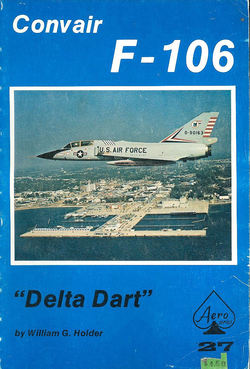
INTRODUCTION (F-106A PROTOTYPE)
DEVELOPMENTAL HISTORY (SECOND F-106A TEST FLIGHT
CONVAIR SAN DIEGO, AREA RULE COKE BOTTLE FUSELAGE, HUGHES MA-1 FIRE CONTROL
SYSTEM, WING NOTCH, LANDING PARACHUTE, PRODUCTION IR SEEKER, F-106B TWO-SEATER)
F-106 ADVANCED PROPOSALS (F-106X)
F-106 UPDATES (FUEL TANKS, ARRESTING HOOK, IR
SEEKER, OPTICAL SIGHT, IN-FLIGHT REFUELING MODIFICATION, MAIN GEAR WHEELS,
ROTATING BEACON, BUBBLE CANOPY)
PRATT & WHITNEY J-75 JET ENGINE
NOSE LANDING GEAR
MAIN LANDING GEAR
FUSELAGE GEAR WELL & DOORS
THE F-106A (438TH FIS, 48TH FIS, 318TH FIS, 49TH
FIS, CALIFORNIA ANG)
F-106A TECHNICAL DATA AND PERFORMANCE DATA
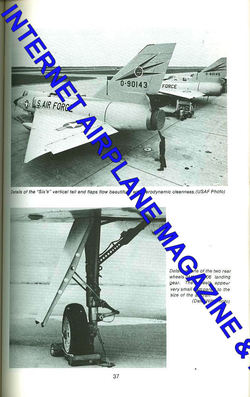
F-106A WALK AROUND CLOSE UP PHOTO DETAILS
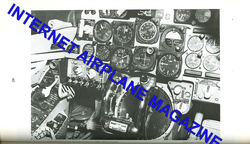
F-106A COCKPIT LAYOUT & INSTRUMENT PANELS
F-106A WEAPONS BAY AND GUN INSTALLATION
F-106 COLOR PHOTO GALLERY (CALIFORNIA ANG, 49TH
FIS, CITY OF JACKSONVILLE BICENTENNIAL MARKINGS, 460TH FIS GRAND FORKS AFB,
95TH FIS ANDREWS AFB, 48TH FIS LANGLEY AFB HOMESTEAD AFB, MICHIGAN ANG, 87TH
FIS RED BULLS, F-106 NASA, �CITY OF MARQUETTE�)
RADAR AND AVIONICS COLOR PHOTOS
F-106A COCKPIT COLOR PHOTOS
F-106B COCKPIT COLOR PHOTOS
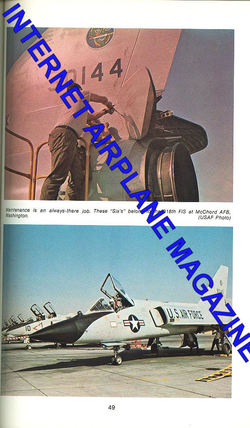
F-106 MAINTENANCE DETAILS COLOR PHOTO GALLERY
MISSILE ARMAMENT COLOR PHOTOS
ARMAMENT (5TH FIS AIR-2A GENIE MISSILE)
F-106A WEAPONS BAY DETAIL PHOTOS
WING PYLONS
SCALE DRAWINGS
DIMENSION DATA
PRODUCTION BLOCKS & SERIALS
F-106B (MONTANA AIR NATIONAL GUARD, MASSACHUSETTS
ANG, CALIFORNIA ANG)
F-106B TECHNICAL DATA & PERFORMANCE DATA
F-106B CANOPY DETAILS
F-106B �ROUND EYE� COCKPIT DETAILS
F-106B COCKPIT LAYOUTS
F-106B WEAPONS BAY DETAIL
------------------------------------------------------------------------------------------
Additional Information from Internet Encyclopedia
The Convair F-106 Delta Dart was the primary
all-weather interceptor aircraft of the United States Air Force from the 1960s through
to the 1980s. Designed as the so-called "Ultimate Interceptor", it
proved to be the last specialist interceptor in U.S. Air Force service to date.
It was gradually retired during the 1980s, with the QF-106 drone conversions of
the aircraft being used until 1998 under the Pacer Six program.
The F-106 was the ultimate development of the
USAF's 1954 interceptor program of the early 1950s. The initial winner of this
competition had been the F-102 Delta Dagger, but early versions of this
aircraft had demonstrated extremely poor performance, limited to subsonic
speeds and relatively low altitudes. During the testing program the F-102
underwent numerous changes to improve its performance, notably the application
of the area rule to the fuselage shaping and a change of engine, and the
dropping of the advanced MX-1179 fire control system and its replacement with a
slightly upgraded version of the MX-1 already in use on subsonic designs. The
resulting aircraft became the F-102A, and in spite of being considered barely
suitable for its mission, the Air Force sent out a production contract in March
1954, with the first deliveries expected in the following year.
By December 1951 the Air Force had already turned
its attention to a further improved version, the F-102B. Initially the main
planned change was the replacement of the A-model's Pratt & Whitney J57
(itself replacing the original J40) with the more powerful Bristol Olympus,
produced under license as the Wright J67. By the time this would be available,
the MX-1179 was expected to be available, and was selected as well. The result
would be the "ultimate interceptor" the Air Force wanted originally.
However, while initial work on the Olympus appeared to go well, by August 1953
Wright was already a full year behind schedule in development. Continued
development did not resolve problems with the engine, and in early 1955 the Air
Force approved the switch to the Pratt & Whitney J75.
The J75 was somewhat larger than the J57 in the
F-102A, and had greater mass flow. This demanded changes to the inlets to allow
more airflow, and this led to the further refinement of using a
variable-geometry inlet duct to allow the intakes to be tuned to best
performance across a wide range of supersonic speeds. This change also led to
the ducts being somewhat shorter. The fuselage grew slightly longer, and was
cleaned up and simplified in many ways. The wing was slightly enlarged in area,
and a redesigned vertical tail surface was used. The engine's 2-position
afterburner exhaust nozzle was also used for idle thrust control. The nozzle
was held open reducing idle thrust by 40% giving slower taxiing and less brake
wear.
The F-106 was envisaged as a specialized
all-weather missile-armed interceptor to shoot down bombers. It was
complemented by other Century Series fighters for other roles such as daylight
air superiority or fighter-bombing. To support its role, the F-106 was equipped
with the Hughes MA-1 integrated fire-control system, which could be linked to
the Semi-Automatic Ground Environment (SAGE) network for ground control
interception (GCI) missions, allowing the aircraft to be steered by
controllers. The MA-1 proved extremely troublesome and was eventually upgraded
more than 60 times in service.
Similar to the F-102, the F-106 was designed
without a gun, or provision for carrying bombs, but it carried its missiles in
an internal weapons bay for clean supersonic flight. It was armed with four
Hughes AIM-4 Falcon air-to-air missiles, along with a single GAR-11/AIM-26A
Falcon nuclear-tipped semi-active radar homing (SARH) missile (which detected
reflected radar signals), or a 1.5 kiloton-warhead AIR-2 (MB-2) Genie
air-to-air rocket intended to be fired into enemy bomber formations.[19] Like
its predecessor, the F-102 Delta Dagger, it could carry a drop tank under each
wing.[20] Later fighters such as the McDonnell Douglas F-4 Phantom II and
McDonnell Douglas F-15 Eagle carried missiles recessed in the fuselage or
externally, but stealth aircraft would re-adopt the idea of carrying missiles
or bombs internally for reduced radar signature.
Ejection seats
The first ejection seat fitted to early F-106s was
a variation of the seat used by the F-102 and was called the Weber interim
seat. It was a catapult seat which used an explosive charge to propel it clear
of the aircraft. This seat was not a zero-zero seat and was inadequate for
ejections at supersonic speeds as well as ground level ejections and ejections
at speeds below 120 knots (140 miles per hour; 220 kilometres per hour) and
2,000 feet (610 metres). The second seat that replaced the Weber interim seat
was the Convair/ICESC (Industry Crew Escape System Committee) Supersonic
Rotational B-seat, called the supersonic "bobsled", hence the B
designation.[21] It was designed with supersonic ejection as the primary
criterion since the F-106 was capable of Mach-2 performance. Fighter pilots
viewed high speed ejections as the most important. Seat designers viewed an
ejection at low altitude and slow speed as the most likely possibility. The
ejection sequence with the B-seat was quite complicated and there were some
unsuccessful ejections that resulted in pilot fatalities. The third seat, that
replaced the Convair B-seat, was the Weber Zero-Zero ROCAT (for Rocket
Catapult) seat. Weber Aircraft Corporation designed a "zero-zero"
seat to operate at up to 600 knots (690 miles per hour; 1,100 kilometres per
hour). High-altitude supersonic ejections were rare and ejections at relatively
low altitudes and low speeds were more likely. The Weber "zero-zero"
seat was satisfactory and was retrofitted to the F-106 after 1965.
The F-106 served in the contiguous US, Alaska, and
Iceland, as well as for brief periods in Germany and South Korea. The F-106 was
the second highest sequentially numbered P/F- aircraft to enter service under
the old number sequence (the F-111 was highest), before the system was reset
under the 1962 United States Tri-Service aircraft designation system. In
service, the F-106's official name, "Delta Dart," was rarely used, and
the aircraft was universally known simply as "The Six."
Although contemplated for use in the Vietnam War
the F-106 never saw combat, nor was it exported to foreign users. Following the
resolution of initial teething problems � in particular an ejection seat that
killed the first 12 pilots to eject from the aircraft [24] � its exceptional
performance made it very popular with its pilots. After the cancellation of
their own Avro Arrow, the Canadian government briefly considered purchasing the
F-106C/D.
To standardize aircraft types, the USAF was
directed to conduct Operation Highspeed, a flyoff competition between the USAF
F-106A and the U.S. Navy F4H-1 (F-4B) Phantom, which was not only as capable as
the F-106 as a missile-armed interceptor but could carry as large a bomb load
as the Republic F-105 Thunderchief fighter-bomber. The Phantom was the winner
but would first be used to escort and later replace the F-105 fighter-bomber in
the late 1960s before replacing older interceptors in Air Defense Command in
the 1970s.
The F-106 was progressively updated in service,
with improved avionics, a modified wing featuring a noticeable conical camber,
an infrared search and track system, streamlined supersonic wing tanks which
provided virtually no degradation to overall aircraft performance, better
instrumentation and features like an inflight refuelling receptacle and an
arrestor hook for landing emergencies.
Air-to-air combat testing suggested "The
Six" was a reasonable match for the F-4 Phantom II in a dogfight, with superior
high-altitude turn performance and overall maneuverability (aided by the
aircraft's lower wing loading). The Phantom had better radar � operated by an
additional crewman � and could carry a load of up to four radar-guided AIM-7
Sparrow and four infrared AIM-9 Sidewinder missiles, while the AIM-4 Falcon
missiles carried by the F-106 proved a disappointment for dogfighting over
Vietnam.[27] The F-4 had a higher thrust/weight ratio with superior climb,
better high speed/low-altitude maneuverability and could be used as a
fighter-bomber. Air combat experience over Vietnam showed the need for
increased pilot visibility and the utility of a built-in gun, which had been
added to the "E" variant of USAF Phantoms.
In 1972, some F-106As were upgraded in Project Six
Shooter that involved fitting the F-106 with a new canopy without metal bracing
which greatly improved pilot visibility. Also added was an optical gunsight and
provision for a M61 Vulcan 20 mm cannon. The M61 Vulcan had 650 rounds of
ammunition in the center weapons bay and it replaced the AIM-26 Super Falcon or
Genie. The F-15A Eagle started replacing the F-106 in 1981, with "The
Sixes" typically passed on to Air National Guard units. The F-106 remained
in service in various USAF and ANG units until 1988.
United States Air Force
Air Defense Command / Aerospace Defense Command-Tactical
Air Command
2nd Fighter-Interceptor Squadron � Wurtsmith AFB
(1971�1972)
5th Fighter-Interceptor Squadron � Minot AFB
(1960�1985)
11th Fighter-Interceptor Squadron � Duluth AFB
(1960�1968)
27th Fighter-Interceptor Squadron � Loring AFB
(1959�1971)
48th Fighter-Interceptor Squadron � Langley AFB
(1960�1982)
49th Fighter-Interceptor Squadron � Griffiss AFB
(1968�1987)
71st Fighter-Interceptor Squadron �
Richards-Gebaur AFB (1960�1971)
83rd Fighter-Interceptor Squadron � Loring AFB
(1971�1972)
84th Fighter-Interceptor Squadron � Hamilton AFB
(1968�1973); Castle AFB (1973�1981)
87th Fighter-Interceptor Squadron � Duluth AFB
(1968�1971); K.I. Sawyer AFB (1971�1985)
94th Fighter-Interceptor Squadron � Selfridge AFB
(1960�1971)
95th Fighter-Interceptor Squadron � Andrews AFB
(1959�1973)
318th Fighter Interceptor Squadron � McChord AFB
(1960�1983)
319th Fighter-Interceptor Squadron � Bunker Hill
AFB (1960�1963) / Grissom AFB (1971�1972)
329th Fighter-Interceptor Squadron � George AFB
(1960�1967)
437th Fighter-Interceptor Squadron � Oxnard AFB
(1968�1968)
438th Fighter-Interceptor Squadron � Kincheloe AFB
(1960�1968)
456th Fighter-Interceptor Squadron � Castle AFB
(1959�1968)
460th Fighter-Interceptor Squadron � Oxnard AFB
(1968�1974)
498th Fighter-Interceptor Squadron � Geiger Field
(1959�1968)
539th Fighter-Interceptor Squadron � McGuire AFB
(1959�1967)
Air National Guard
101st Fighter Interceptor Squadron, MA ANG � Otis
ANGB (1972�1988)
119th Fighter Interceptor Squadron, NJ ANG �
Atlantic City ANGB (1972�1988)
159th Fighter Interceptor Squadron, FL ANG �
Jacksonville ANGB (1974�1987)
171st Fighter Interceptor Squadron, MI ANG �
Selfridge ANGB (1972�1978)
186th Fighter Interceptor Squadron, MT ANG � Great
Falls ANGB (1972�1987)
194th Fighter Interceptor Squadron, CA ANG �
Fresno ANGB (1974�1984)