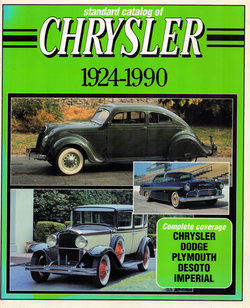
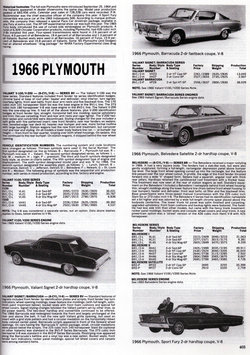
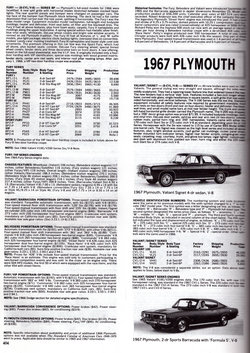
CHRYSLER
CARS 1924-1990 including DODGE, PLYMOUTH, DeSOTO AND IMPERIAL MOPAR
STANDARD CATALOUGE SOFTBOUND
BOOK in ENGLISH by JOHN LEE
-------------------------------------
Additional Information from
Internet Encyclopedia
The original Chrysler
Corporation was founded in 1925 by Walter Chrysler from the remains of the
Maxwell Motor Company. After founding the company, Walter Chrysler used the
General Motors brand diversification and hierarchy strategy that he had become
familiar with when he worked in the Buick division at General Motors. He then
acquired Fargo Trucks and the Dodge Brothers Company, and created the Plymouth
and DeSoto brands in 1928. Facing postwar declines in market share,
productivity, and profitability, as GM and Ford were growing, Chrysler borrowed
$250 million in 1954 from Prudential Insurance to pay for expansion and updated
car designs.
In January 1924, Walter Chrysler
launched the well-received Chrysler automobile. The Chrysler Six was designed
to provide customers with an advanced, well-engineered car, at an affordable
price. Elements of this car are traceable to a prototype which had been under
development at Willys during Chrysler's tenure. The original 1924 Chrysler
included a carburetor air filter, high compression engine, full pressure
lubrication, and an oil filter, features absent from most autos at the time.
Among the innovations in its early years were the first practical mass-produced
four-wheel hydraulic brakes, a system nearly completely engineered by Chrysler
with patents assigned to Lockheed, and rubber engine mounts, called
"Floating Power" to reduce vibration. Chrysler also developed a wheel
with a ridged rim, designed to keep a deflated tire from flying off the wheel.
This wheel was eventually adopted by the auto industry worldwide.
The Maxwell brand was dropped
after the 1925 model year, with the new, lower-priced four-cylinder Chryslers
introduced for the 1926 year being badge-engineered Maxwells. The advanced
engineering and testing that went into Chrysler Corporation cars helped to push
the company to the second-place position in U.S. sales by 1936, which it held
until 1949.
In 1928, the Chrysler
Corporation began dividing its vehicle offerings by price class and function.
The Plymouth brand was introduced at the low-priced end of the market (created
essentially by once again reworking and rebadging the Chrysler Series 50 four-cylinder
model). At the same time, the DeSoto brand was introduced in the medium-price
field. Also in 1928, Chrysler bought the Dodge Brothers automobile and truck
company and continued the successful Dodge line of automobiles and Fargo range
of trucks. By the mid-1930s, the DeSoto and Dodge divisions would trade places
in the corporate hierarchy.
The Imperial name had been used
since 1926 but was never a separate make, just the top-of-the-line Chrysler.
However, in 1955, the company decided to offer it as its own make/brand and
division to better compete with its rivals, Lincoln and Cadillac. This addition
changed the company's traditional four-make lineup to five (in order of price
from bottom to top): Plymouth, Dodge, DeSoto, Chrysler, and the now-separate
Imperial.
In 1954, Chrysler was the
exclusive provider of its Hemi engine in the Facel Vega, a Paris coachbuilder
that offered their own line of hand-built luxury performance cars, with the
PowerFlite and TorqueFlite transmissions offered. The Facel Vega Excellence was
a four-door hardtop with rear-hinged coach doors that listed for US$12,800
($135,175 in 2023 dollars.
On April 28, 1955, Chrysler and
Philco announced the development and production of the World's First
All-Transistor car radio. The all-transistor car radio, Mopar model 914HR,
developed and produced by Chrysler and Philco, was a $150 option on the 1956
Imperial automobile models. Philco began manufacturing this radio in the fall
of 1955 at its Sandusky Ohio plant.
On September 28, 1957, Chrysler
announced the first production electronic fuel injection (EFI), as an option on
some of its new 1958 car models (Chrysler 300D, Dodge D500, DeSoto Adventurer,
Plymouth Fury). The first attempt to use this system was by American Motors on
the 1957 Rambler Rebel. Bendix Corporation's Electrojector used a transistor
computer brain modulator box, but teething problems on pre-production cars
meant very few cars were made. The EFI system in the Rambler ran fine in warm
weather, but suffered hard starting in cooler temperatures and AMC decided not
to use this EFI system on its 1957 Rambler Rebel production cars that were sold
to the public. Chrysler also used the Bendix "Electrojector" fuel
injection system and only around 35 vehicles were built with this option, on
its 1958 production-built car models.[35] Owners of EFI Chryslers were so
dissatisfied that all but one were retrofitted with carburetors (while that one
has been completely restored, with original EFI electronic problems resolved).
The Valiant was also introduced
for the 1960 model year as a distinct brand. In the U.S. market, Valiant was
made a model in the Plymouth line for 1961 and the DeSoto make was discontinued
in 1961. With those exceptions per applicable year and market, Chrysler's range
from lowest to highest price from the 1940s through the 1970s was Valiant,
Plymouth, Dodge, DeSoto, Chrysler, and Imperial.
From 1963 through 1969, Chrysler
increased its existing stakes to take full control of the French Simca, British
Rootes, and Spanish Barreiros companies, merging them into Chrysler Europe in
1967. In the 1970s, an engineering partnership was established with Mitsubishi
Motors, and Chrysler began selling Mitsubishi vehicles branded as Dodge and
Plymouth in North America.
Chrysler struggled to adapt to
the changing environment of the 1970s. When consumer tastes shifted to smaller
cars in the early 1970s, particularly after the 1973 oil crisis, Chrysler could
not meet the demand, although their compact models on the "A" body
platform, the Dodge Dart and Plymouth Valiant, had proven economy and
reliability and sold very well. Additional burdens came from increased US
import competition, and tougher government regulation of car safety, fuel
economy, and emissions. As the smallest of the Big 3 US automakers, Chrysler
lacked the financial resources to meet all of these challenges. In 1976, with
the demise of the reliable Dart/Valiant, quality control declined. Their
replacements, the Dodge Aspen and Plymouth Volare, were comfortable and had
good roadability, but owners soon experienced major reliability problems which
crept into other models as well. Engines failed and/or did not run well, and
premature rust plagued bodies. In 1978, Lee Iacocca was brought in to turn the
company around, and in 1979 Iacocca sought US government help. Congress later
passed the Loan Guarantee Act providing $1.5 billion in loan guarantees. The
Loan Guarantee Act required that Chrysler also obtain $2 billion in concessions
or aid from sources outside the federal government, which included interest
rate reductions for $650 million of the savings, asset sales of $300 million,
local and state tax concessions of $250 million, and wage reductions of about
$590 million along with a $50 million stock offering. $180 million was to come
from concessions from dealers and suppliers. Also in 1978, Iacocca offloaded
the ailing European operation to PSA Peugeot Citroën for a nominal $1, taking
with it the group's substantial losses and debts which had been dragging the
rest of the business down.
After a period of plant closures
and salary cuts agreed to by both management and the auto unions, the loans
were repaid with interest in 1983. In November 1983, the Dodge Caravan/Plymouth
Voyager was introduced, establishing the minivan as a major category, and
initiating Chrysler's return to stability.
In 1985, Diamond-Star Motors was
created, further expanding the Chrysler-Mitsubishi relationship.
In 1985, Chrysler entered an
agreement with American Motors Corporation to produce Chrysler M platform
rear-drive, as well as Dodge Omnis front wheel drive cars, in AMC's Kenosha,
Wisconsin, plant. In 1987, Chrysler acquired the 47% ownership of AMC that was
held by Renault. The remaining outstanding shares of AMC were bought on the
NYSE by August 5, 1987, making the deal valued somewhere between US$1.7 billion
and US$2 billion, depending on how costs were counted. Chrysler CEO Lee Iacocca
wanted the Jeep brand, particularly the Jeep Grand Cherokee (ZJ) that was under
development, the new world-class manufacturing plant in Bramalea, Ontario, and
AMC's engineering and management talent that became critical for Chrysler's
future success.[40] Chrysler established the Jeep/Eagle division as a
"specialty" arm to market products distinctly different from the
K-car-based products with the Eagle cars targeting import buyers.[citation
needed] Former AMC dealers sold Jeep vehicles and various new Eagle models, as
well as Chrysler products, strengthening the automaker's retail distribution
system.