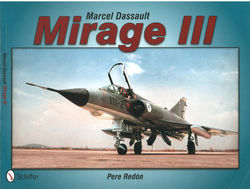
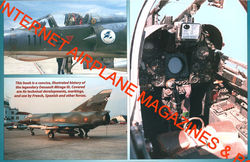
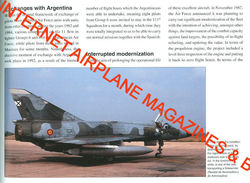
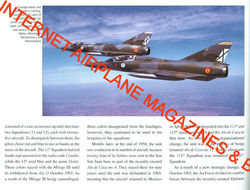
SCHIFFER MARCEL DASSAULT MIRAGE IIIEE IIIDE
EJERCITO DEL AIRE SPAIN Ala 11 MANISES
SOFTBOUND BOOK BY PERE REDON ***IN ENGLISH***
Mirage
IIIEE: Mirage IIIE for the Spanish Air Force, locally designated C.11. 24
delivered from 1970
Mirage
IIIDE: Two-seat trainer for Spanish Air Force. Six built with local designation
CE.11
--------------------------------------------------------------------------------------------------
Additional Information from Internet Encyclopedia
The Dassault Mirage III is a
family of single-seat, single-engine, fighter aircraft produced by Dassault
Aviation for the French Air Force and widely exported. Prominent operators
included Australia, Argentina, South Africa and Israel, as well as a number of
nonaligned nations. Though an older design, the second generation fighter is
still a fairly maneuverable aircraft and an effective opponent in close range
dogfighting. In French service it was armed with air-to-ground ordnance or
R.550 Magic air-to-air missiles.
The versatility of the design enabled production of trainer, reconnaissance
and ground-attack versions as well as the Dassault Mirage 5, Dassault Mirage
IIIV and Atlas Cheetah variants. A Mirage III was the first Western European
combat aircraft to exceed Mach 2 in horizontal flight.
The Mirage III family grew out of French government studies began in 1952
that led in early 1953 to a specification for a lightweight, all-weather
interceptor capable of climbing to 18,000 meters (59,100 ft) in six minutes
and able to reach Mach 1.3 in level flight. Dassault's response to the
specification was the Mystère-Delta 550, a diminutive and sleek jet that was to
be powered by twin Armstrong Siddeley MD30R Viper afterburning turbojets, each
with thrust of 9.61 kN (2,160 lbf). A SEPR liquid-fuel
rocket motor was to provide additional burst thrust of 14.7 kN
(3,300 lbf). The aircraft had a tailless delta configuration,
with a 5% chord (ratio of airfoil thickness to length) and 60° sweep.
The new fighter design was named the Mirage
III. It incorporated the new area ruling concept, where changes to the
cross section of an aircraft were made as gradual as possible, resulting in the
famous "wasp waist" configuration of many supersonic fighters. Like
the Mirage I, the Mirage III had provision for a SEPR rocket engine.
The prototype Mirage III flew on 17 November 1956, and attained a speed of
Mach 1.52 on its 10th flight. The prototype was then fitted with manually
operated intake half-cone shock diffusers, known as souris ("mice"), which were moved forward as speed
increased to reduce inlet turbulence. The Mirage III attained a speed of Mach
1.8 in September 1957.
The success of the Mirage III prototype resulted in an order for 10
pre-production Mirage IIIA fighters. These were almost two meters longer than
the Mirage III prototype, had a wing with 17.3% more area, a chord reduced to
4.5%, and an Atar 09B turbojet with afterburning thrust of 58.9 kN
(13,230 lbf). The SEPR rocket engine was retained, and the
aircraft were fitted with Thomson-CSF Cyrano Ibis air intercept radar,
operational avionics, and a drag chute to shorten landing roll.
The Mirage III was armed with twin 30 mm DEFA revolver-type cannon,
fitted in the belly with the gun ports under the air intakes. Early Mirage III
production had three stores pylons, one under the fuselage and one under each
wing, but another outboard pylon was quickly added to each wing, for a total of
five. It was also possible to carry bombs on a sleek supersonic tank that also
had bomb carrying capacity. The outboard pylon was intended to carry an AIM-9B
Sidewinder air-to-air missile, later replaced by the Matra R550 Magic and also
was armed with the radar guided R530 Missile on the center line pylon.
The Mirage IIIE differed from the IIIC interceptor most obviously in having
a 30 cm (11.8 in) forward fuselage extension to increase the size of
the avionics bay behind the cockpit. The stretch also helped increase fuel
capacity, as the Mirage IIIC had marginal range and improvements were needed.
The stretch was small and hard to notice, but the clue is that the bottom edge
of the canopy on a Mirage IIIE ends directly above the top lip of the air
intake, while on the IIIC it ends visibly back of the lip.
Many Mirage IIIE variants were also fitted with a Marconi continuous-wave
Doppler navigation radar radome on the bottom of the fuselage, under the
cockpit. However, while no IIICs had this feature, it was not universal on all
variants of the IIIE. A similar inconsistent variation in Mirage fighter
versions was the presence or absence of an HF antenna that was fitted as a
forward extension to the vertical tailplane. On some Mirages, the leading edge
of the tailplane was a straight line, while on those with the HF antenna the
leading edge had a sloping extension forward. The extension appears to have
been generally standard on production Mirage IIIAs and Mirage IIICs, but only
appeared in some of the export versions of the Mirage IIIE.
The IIIE featured Thomson-CSF Cyrano II dual mode air / ground radar; a
radar warning receiver (RWR) system with the antennas mounted in the vertical
tailplane; and an Atar 09C engine, with a petal-style variable exhaust.
Total production of the Mirage IIIE, including
exports, was substantially larger than that of the Mirage IIIC, including
exports, totaling 523 aircraft. In the mid-1960s one Mirage IIIE was fitted
with the improved SNECMA Atar 09K-6 turbojet for trials, and given the
confusing designation of Mirage IIIC2.