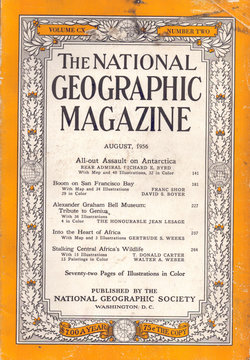
NATIONAL
GEOGRAPHIC AUG 1956 US NAVY ANTARCTICA SAN FRANCISCO ALEXANDER GRAHAM BELL
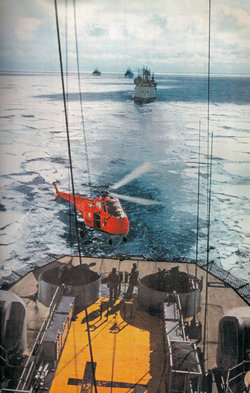
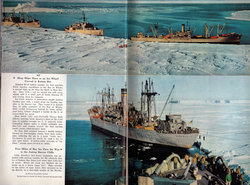
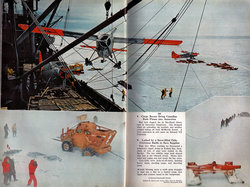
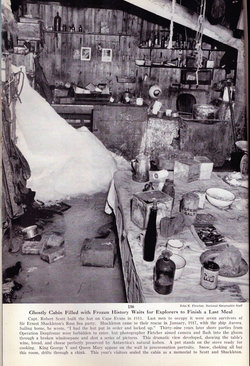
ALL OUT ASSAULT ON ANTARCTICA by
REAR ADMIRAL RICHARD E. BYRD (USS GLACIER, GREENVILLE VICTORY, NESPELEN, WYANDOT,
ARNEB, EDISTO AGB, LITTLE AMERICA, ROSS ICE SHELF, OPERATION DEEP FREEZE,
McMURDO SOUND, LOCKHEED P2V NEPTUNE on SKIS, ROBERT SCOTT�S CAMP AT CAPE EVANS,
SIKORSKY HELICOPTERS VXE, DE HAVILLAND CANADA DHC OTTER, USN SEABEES, SNOW
TRACTORS)
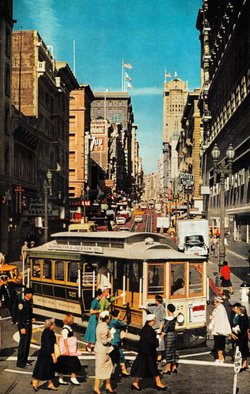
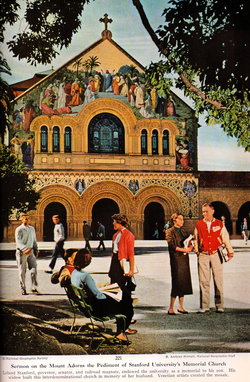
BOOM ON SAN FRANCISCO BAY � with
MAP AND 34 ILLUSTRATIONS (GOLDEN GATE BRIDGE, HEARST REGATTA, CABLE CARS,
DOWNTOWN, UNION SQUARE, PACIFIC BREAKS, SEAL ROCKS, CITY HALL, FISHERMAN�S
WHARF, CHINATOWN, UNIVERSITY OF CALIFORNIA BERKLEY, ALCATREZ, STANFORD
UNIVERSITY, COIT TOWER, OAKLAND BAY BRIDGE
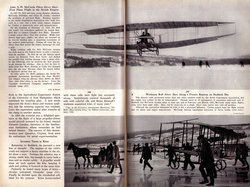
ALEXANDER GRAHAM BELL MUSEUM �
TRIBUTE TO A GENIUS (BEINN BHREAGH HALL)
INTO THE HEART OF AFRICA
STALKING CENTRAL AFRICA�s
WILDLIFE
UNITED AIRLINES FULL-PAGE COLOR
ADVERTISEMENT
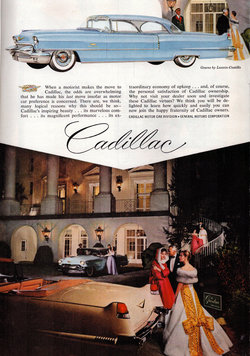
CADILLAC FULL-PAGE COLOR
ADVERTISEMENT
CHEVROLET FULL-PAGE COLOR
ADVERTISEMENT
---------------------------------
Additional Information from
Internet Encyclopedia
Alexander Graham Bell (March 3,
1847 � August 2, 1922) was a
Scottish-born Canadian-American inventor, scientist, and engineer who is
credited with patenting the first practical telephone. He also co-founded the
American Telephone and Telegraph Company (AT&T) in 1885.
Bell's father, grandfather, and
brother had all been associated with work on elocution and speech, and both his
mother and wife were deaf, profoundly influencing Bell's life's work. His
research on hearing and speech further led him to experiment with hearing
devices, which eventually culminated in his being awarded the first U.S. patent
for the telephone, on March 7, 1876. Bell considered his invention an intrusion
on his real work as a scientist and refused to have a telephone in his study.
Many other inventions marked
Bell's later life, including groundbreaking work in optical telecommunications,
hydrofoils, and aeronautics. Bell also had a strong influence on the National
Geographic Society and its magazine while serving as its second president from
1898 to 1903.
Beyond his work in engineering,
Bell had a deep interest in the emerging science of heredity. His work in this
area has been called "the soundest, and most useful study of human
heredity proposed in nineteenth-century America... Bell's most notable
contribution to basic science, as distinct from invention."