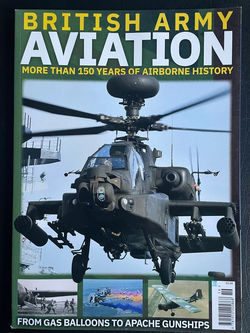
BRITISH
ARMY AVIATION WW1 BALLOONS WW2 LYSANDER GLIDERS AOP AUSTER SCOUT APACHE
HEAVILY ILLUSTRATED SOFTBOUND
BOOK in ENGLISH
FROM WW1 GAS BALLOONS TO AH-4
APACHE ATTACK HELICOPTERS
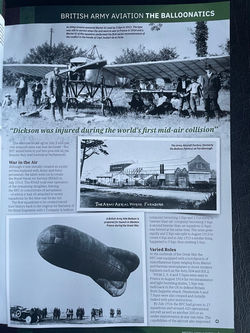
WW1 BALLOONATICS
HARRY TATE’S EYE IN THE SKY –
ROYAL AIRCRAFT FACTORY R.E.8
ARMY COOPERATION WESTLAND
LYSANDER
OPERATION CRUSADER WW2 NORTH
AFRICA – TACTICAL AIR SUPPORT FOR THE ARMY DEVELOPMENT
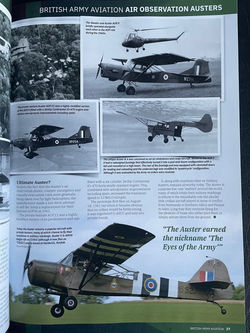
BEYOND THE HORIZON – THE AIR OBSERVATION
POST
THE EYES OF THE ARMY – AOP AUSTER
AUSTERS OVER KOREA
HISTORIC ARMY AIRCRAFT FLIGHT
DELIVERING TROOPS FROM THE AIR –
THE GLIDER PILOT REGIMENT IN WW2
ROTARY WINGS – DEVELOPING THE
BRITISH ARMY’S HELICOPTER FORCE
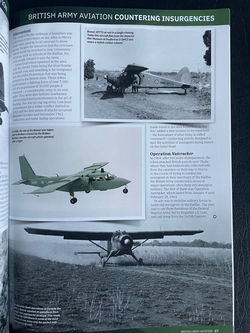
AUSTER TO APACHE – AAC COUNTER
INSURGENCY OPERATIONS
HELICOPTER WARS – COMBAT IN THE
GULF, THE BALKANS AND SIERRA LEONE
DANCING HELICOPTERS – THE ARMY’S
BLUE EAGLES DISPLAY TEAM
CLOCKWORK MICE – OPERATION BANNER
SIOUX HELICOPTERS
APACHES OVER LIBYA – OPERATION ELLAMY
PROJECT EAGLE – THE ARMY FLYING
MUSEUM IN THE 21ST CENTURY
---------------------
Additional Information from
Internet Encyclopedia
The Army Air Corps (AAC) is a
component of the British Army, first formed in 1942 during the Second World War
by grouping the various airborne units of the British Army. Today, there are
eight regiments (seven Regular Army and one Reserve) of the AAC as well as four
Independent Flights and two Independent Squadrons deployed in support of
British Army operations around the world. Regiments and flights are located in
the United Kingdom, Brunei, Canada, and Germany. Some AAC squadrons provide the
air assault elements of 16 Air Assault Brigade through Joint Helicopter
Command.
The British Army first took to
the sky during the 19th century with the use of observation balloons. In 1911
the Air Battalion of the Royal Engineers was the first heavier-than-air British
military aviation unit. The following year, the battalion was expanded into the
Military Wing of the Royal Flying Corps which saw action throughout most of the
First World War until 1 April 1918, when it was merged with the Royal Naval Air
Service to form the Royal Air Force. Between the wars, the army used RAF
co-operation squadrons. At the beginning of the Second World War, Royal
Artillery officers, with the assistance of RAF technicians, flew Auster
observation aircraft under RAF-owned Air Observation Post (AOP) Squadrons.
Twelve squadrons were raised, three of which belonged to the RCAF and each
performed vital duties in many theatres.
In 1942, Winston Churchill
announced the establishment of a new branch of army aviation, the Army Air
Corps. The corps initially comprised the Glider Pilot Regiment and the
Parachute Battalions (subsequently the Parachute Regiment), Air Landing
Regiments, and the Air Observation Post Squadrons. In March 1944, the SAS
Regiment was added to the corps.
One of their most successful
exploits during the war was the capture of the Caen canal and Orne river
bridges by coup de main, which occurred on 6 June 1944, prior to the Normandy
landings. Once the three gliders landed, some roughly which incurred
casualties, the pilots joined the glider-borne troops (Ox & Bucks Light
Infantry) to act as infantry. The bridge was taken within ten minutes of the
battle commencing and the men withstood numerous attempts by the Germans to
re-capture the location. They were soon reinforced and relieved by soldiers
from the 1 Special Service Brigade (Lord Lovat). The AAC was disbanded in 1949,
with the SAS regaining independent status, while the Parachute Regiment and
Glider Pilot Regiment came under the umbrella of the Glider Pilot and Parachute
Corps.
In 1957 the Glider Pilot and
Parachute Corps was split, with the Parachute Regiment becoming an independent
formation, while the Glider Pilot Regiment was merged with the Air Observation
Squadrons of the Royal Artillery into a new unit, the Army Air Corps.
In 1958 the Saunders-Roe Skeeter
7 was introduced as the AAC's first helicopter, it was replaced by the
Aérospatiale Alouette II and Westland Scout AH.1 during the early 1960s. The de
Havilland Canada DHC-2 Beaver AL.1 was introduced during the 1960s along with
the Agusta/Westland Sioux AH.1 in 1964.
From 1970, nearly every army
brigade had at least one Aviation Squadron that usually numbered twelve
aircraft. The main rotor aircraft during the 1970s were the Westland Scout and
Bell Sioux general purpose helicopters. The Sioux was replaced from 1973 by the
Westland Gazelle used for Airborne reconnaissance;[13] initially unarmed, they
were converted to carry 68mm SNEB rocket pods in 1982, during the Falklands
War. The Scout was replaced from 1978 by the Westland Lynx, which was capable
of carrying additional firepower in the form of door gunners.
Basic rotary flying training was
carried out on the Sioux in the 1970s, on the Gazelle in the 1980s and 1990s,
and is currently conducted on the Eurocopter H145 through the Defence
Helicopter Flying School.
Fixed-wing types in AAC service
have included the Auster AOP.6 and AOP.9 and DHC-2 Beaver AL.1 in observation
and liaison roles. In 1989, the AAC commenced operating a number of
Britten-Norman Islander aircraft for surveillance and light transport
duties.[16] The corps operated the DHC-1 Chipmunk T.10 in a training role until
its replacement by the Slingsby T67 Firefly in the 1990s. The Firefly was
replaced by the Grob Tutor in 2010.
Cold War
During the Cold War the majority
of Army Air Corps units were based in Germany and part of the British Army of
the Rhine. At the beginning of 1989 the Army Air Corps structure was as
follows:
Army Air Corps, AAC Middle
Wallop
Main article: NORTHAG wartime
structure in 1989
1 Wing AAC, Hobart Barracks in
Detmold, West Germany, under operational control of Commander Aviation 1st
British Corps (Wing disbanded during 1989)
1 Regiment AAC, Tofrek Barracks
in Hildesheim, supported 1st Armoured Division
651 Squadron AAC, (Anti-Tank, 4x
Gazelle AH.1, 12x Lynx AH.7 (TOW))
652 Squadron AAC, (Anti-Tank, 4x
Gazelle AH.1, 12x Lynx AH.7 (TOW))
661 Squadron AAC,
(Reconnaissance, 12x Gazelle AH.1)
3 Regiment AAC, Salamanca
Barracks in Soest, supported 3rd Armoured Division
653 Squadron AAC, (Anti-Tank, 4x
Gazelle AH.1, 12x Lynx AH.7 (TOW))
662 Squadron AAC, (Reconnaissance,
12x Gazelle AH.1)
663 Squadron AAC,
(Reconnaissance, 12x Gazelle AH.1)
4 Regiment AAC, Hobart Barracks
in Detmold, supported 4th Armoured Division
654 Squadron AAC, (Anti-Tank, 4x
Gazelle AH.1, 12x Lynx AH.7 (TOW))
659 Squadron AAC, (Anti-Tank, 4x
Gazelle AH.1, 12x Lynx AH.7 (TOW))
669 Squadron AAC,
(Reconnaissance, 12x Gazelle AH.1)
2 Wing AAC, AAC Netheravon (Wing
disbanded during 1989)
Northern Ireland Regiment AAC,
AAC Aldergrove (Later renamed 5 Regiment AAC)
655 Squadron AAC, AAC Ballykelly,
(Anti-Tank, 4x Gazelle AH.1, 12x Lynx AH.7), supported 2nd Infantry Division
665 Squadron AAC, (16x Gazelle
AH.1), supported HQ Northern Ireland
1 Flight AAC, (Reconnaissance,
4x DHC-2 Beaver AOP)
7 Regiment AAC, AAC Netheravon
656 Squadron AAC, (Anti-Tank, 4x
Gazelle AH.1, 12x Lynx AH.7), supported 1st Infantry Brigade
666 Squadron AAC (V),
(Territorial Army, Home Defence, 12x Gazelle AH.1)
2 Flight AAC, (4x Gazelle AH.1),
supported NATO's AMF(L)
657 Squadron AAC, Colchester
Garrison, (Anti-Tank, 4x Gazelle AH.1, 12x Lynx AH.7), supported 9th Infantry
Brigade; joined 9 Regiment AAC in July 1990.
9 Regiment AAC, RAF Topcliffe,
part of 24th Airmobile Brigade
672 Squadron AAC, (Lynx Light
Battlefield Helicopter Squadron, activated 1 January 1990, 12x Lynx AH.9)
3 Flight AAC, (4x Gazelle AH.1)
School of Army Aviation, AAC
Middle Wallop
670 Squadron AAC, Middle Wallop,
(Operational Training, 12x Gazelle AH.1, activated 1989)
671 Squadron AAC, Middle Wallop,
(Conversion to Type, 8x Gazelle AH.1, 8x Lynx AH.7)
Trade Training School (Ground
Crew & Maintenance Training)
660 Squadron AAC, RAF Sek Kong,
Hong Kong, (12x Scout AH.1), supported British Forces Hong Kong, two Scouts
detached to British Forces Brunei
C Flight, 660 Squadron AAC,
Anduki Airfield in Seria, Brunei, (2x Scout AH.1)
664 Squadron AAC, St George's
Barracks in Minden, West Germany, (Reconnaissance, 12x Gazelle AH.1), supported
1st British Corps
Development & Trials
Squadron, AAC Middle Wallop, (12x Gazelle AH.1, under Director Army Air Corps.
On 1 April 1990 renamed 667 (D&T) Squadron AAC)
7 Flight AAC, RAF Gatow, Berlin,
(4x Gazelle AH.1), supported the Berlin Infantry Brigade
8 Flight AAC, Stirling Lines,
Hereford, (4x A109A Hirundo), supported the Special Air Service
12 Flight AAC, RAF Wildenrath,
Germany, (4x Gazelle AH.1), supported British Army of the Rhine
16 Flight AAC, Kingsfield
Airfield in Dhekelia, Cyprus, (4x Gazelle AH.1) supported British Forces Cyprus
25 Flight AAC, Price Barracks,
Belize, (4x Gazelle AH.1), supported British Army Training and Support Unit
Belize
29 (BATUS) Flight AAC, CFB
Suffield, Canada, (4x Gazelle AH.1), supported British Army Training Unit
Suffield
UNFICYP Flight AAC, Nicosia
Airport, Cyprus, (4x Gazelle AH.1), supported United Nations Peacekeeping Force
in Cyprus
War on Terror
A further boost in the Army Air
Corps' capability came in the form of the Westland Apache AH.1 attack
helicopter, introduced in 2004. In 2006, British Apaches deployed to
Afghanistan as part of the NATO International Security Assistance Force. In
2004, Britten-Norman Defender fixed wing aircraft were purchased for
Afghanistan and Iraq.
End of fixed-wing flying,
2019–2021
In April 2019, 651 Squadron
personnel and aircraft, the Islander and Defender, were transferred from 5
Regiment to No. 1 Intelligence, Surveillance, and Reconnaissance Wing Royal Air
Force. 651 Squadron continued to operate the aircraft until they were retired
from service on 30 June 2021.
Current structure and deployment
Mascot
The Army Air Corps adopted their
first Corps Mascot – Zephyr, a bald eagle – in October 2011.
Training
The training of future Army Air
Corps aircrew is delivered by the joint service UK Military Flying Training
System. Elementary Flying Training was delivered at RAF Barkston Heath with 674
Squadron AAC, up until the Squadron’s standing down in April 2021.
Training Units, AAC Middle
Wallop
7 (Training) Regiment AAC
671 Squadron –
'Lynx/Gazelle/Bell 212'j (Future uncertain, given retirement of Gazelle and
Lynx fleets)
673 Squadron – Apache Conversion
to type
No. 1 Flying Training School
RAF, RAF Shawbury | Juno HT.1
660 Squadron
670 Squadron – Operational
Training
Personnel
The strength of the Army Air
Corps is about 2,000 Regular personnel, of which 500 are officers. However, the
AAC draws an additional 2,600 personnel from the Royal Logistic Corps, the
Royal Electrical and Mechanical Engineers and the Adjutant General Corps.
Therefore, total related Army Air Corps personnel is around 4,600.
Aircraft
Further information: List of
active United Kingdom military aircraft and List of aircraft of the Army Air
Corps (United Kingdom)
Since 2019, the AAC solely
operates rotary-wing aircraft in the operational environment. The AAC uses the
same designation system for aircraft as the Royal Air Force and the Fleet Air
Arm. The sole fixed-wing trainer is the Grob Tutor, used for Army Flying
Grading.
Today
AAC aviators fly five types of helicopter, and within each type there are
usually several marks/variants which carry out different roles. Pilots train
with No. 1 Flying Training School at RAF Shawbury. The School is a tri-Service
organisation consisting of civilian and military instructors that take the
student from basic flying through to more advanced flying such as instrument
flying, navigation, formation flying and captaincy. In service aircraft
include: the Bell 212HP AH1, the Eurocopter AS365N3 Dauphin II, the Airbus
Helicopters H135 Juno, the Westland Gazelle AH1, the Westland Wildcat AH.1 and
the AgustaWestland Apache AH1 which is being replaced by the Boeing AH-64E
Version 6 Apache.