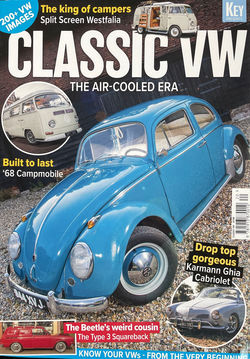
CLASSIC VW AIR-COOLED VOLKSWAGENS
BEETLE WESTFALIA CAMPMOBILE KARMANN GHIA CABRIOLET TYPE 3 SQUAREBACK
------------------------------------------------------------------------------------------------------
Additional
Information from Internet Encyclopedia
The
Volkswagen Beetle – officially the Volkswagen Type 1, informally in Germany the
Käfer (German, "beetle") and in parts of the English-speaking world
the Bug – is a two-door, five-passenger, rear-engine economy car that was
manufactured and marketed by German automaker Volkswagen (VW) from 1938 until
2003.
The
need for a people's car ("Volkswagen" in German), its concept and its
functional objectives, was formulated by the leader of Nazi Germany, Adolf
Hitler, who wanted a cheap, simple car to be mass-produced for his country's
new road network. Lead engineer Ferdinand Porsche and his team took until 1938
to finalise the design. The influence on Porsche's design of other contemporary
cars, such as the Tatra V570, and the work of Josef Ganz remains a subject of
dispute. The result was the first Volkswagen, and one of the first rear-engined
cars since the Brass Era. With 21,529,464 produced, the Beetle is the
longest-running and most-manufactured car of a single platform ever made.
Although
designed in the 1930s, the Beetle was only produced in significant numbers from
1945 on (mass production had been put on hold during the Second World War) when
the model was internally designated the Volkswagen Type 1, and marketed simply
as the Volkswagen (or "People's Car"). Later models were designated
Volkswagen 1200, 1300, 1500, 1302 or 1303, the former three indicating engine
displacement, the latter two derived from the type number. The model became
widely known in its home country as the Käfer (German for "beetle")
and was later marketed as such in Germany, and as the Volkswagen in other
countries. For example, in France it was known as the Coccinelle (French for
ladybug).
The
original 25 hp Beetle was designed for a top speed around 100 km/h (62 mph),
which would be a viable speed on the Reichsautobahn system. As Autobahn speeds
increased in the postwar years, its output was boosted to 36, then 40 hp, the
configuration that lasted through 1966 and became the "classic"
Volkswagen motor. The Beetle ultimately gave rise to variants, including the
Karmann Ghia, Type 2 and external coach builders. The Beetle marked a
significant trend, led by Volkswagen, Fiat, and Renault, whereby the
rear-engine, rear-wheel-drive layout increased from 2.6 percent of continental
Western Europe's car production in 1946 to 26.6 percent in 1956. The 1948
Citroën 2CV and other European models marked a later trend to front-wheel drive
in the European small-car market, a trend that would come to dominate that
market. In 1974, Volkswagen's own front-wheel drive Golf model succeeded the
Beetle. In 1994, Volkswagen unveiled the Concept One, a
"retro"-themed concept car with a resemblance to the original Beetle,
and in 1998 introduced the "New Beetle", built on the contemporary
Golf platform with styling recalling the original Type 1. It remained in
production through 2010, being succeeded in 2011 by the more aggressively
styled Beetle (A5), which was also more reminiscent of the original Beetle.
In
the 1999 Car of the Century competition, to determine the world's most
influential car in the 20th century, the Type 1 came fourth, after the Ford
Model T, the Mini, and the Citroën DS.
Volkswagen
had only just started small scale production, building about 210 Beetles,
before civilian production was halted at the start of the war. Except for two
military prototype units, these KdF sedans were allocated to military officers
as personal cars. Hitler was given the very first convertible Beetle built in
1938. Both 704cc and 984cc air-cooled engines were fitted in these early units.
The
first volume-produced versions of the car's running-gear and chassis were
military vehicles, the Type 82 Kübelwagen (approximately 52,000 built) and the
amphibious Type 128 and 166 Schwimmwagen (about 14,000 built).
A
handful of KdF-Wagens were produced, primarily for the Nazi elite from 1941 to
1944, as the Typ 60. The factory also built the Kübelwagen (Typ 82),
Schwimmwagen (Typ 166), and a handful of other variants, as Wehrmacht combat
vehicles. It produced small numbers of Kommandeurswagen (Typ 87), with a Typ 1
body mounted on a four-wheel drive Schwimmwagen chassis; the fenders were
widened to accommodate Kronprinz all-terrain tires (reminiscent of the later
Baja Bugs). Kommandeurswagen were produced up to 1944, when all production was
halted because of heavy damage to the factory from Allied air raids. Much of
the essential equipment had already been moved to underground bunkers for
protection, which let production resume quickly after hostilities ended. Due to
gasoline shortages late in the war, a few "Holzbrenner" Beetles were
built, powered by pyrolysis gas producers located under the front hood.
In
occupied Germany, the Allies followed the Morgenthau plan to remove all German
war potential by complete or partial pastoralization. As part of this, in the
Industrial plans for Germany, the rules for which industry Germany was to be
allowed to retain were set out. German car production was set at a maximum of
10% of the 1936 car production numbers.
Mass
production of civilian VW cars did not start until post-war occupation. The
Volkswagen factory was handed over by the Americans to British control in 1945;
it was to be dismantled and shipped to Britain. Thankfully for Volkswagen, no
British car manufacturer was interested in the factory; an official report
included the phrases "the vehicle does not meet the fundamental technical
requirement of a motor-car… it is quite unattractive to the average buyer… To
build the car commercially would be a completely uneconomic enterprise." The
factory survived by producing cars for the British Army instead. Allied
dismantling policy changed in late 1946 to mid-1947, although heavy industry
continued to be dismantled until 1951.
The
re-opening of the factory is largely accredited to British Army officer Major
Ivan Hirst. Hirst was ordered to take control of the heavily bombed factory,
which the Americans had captured. His first task was to remove an unexploded
bomb that had fallen through the roof and lodged itself between some pieces of
irreplaceable production equipment; if the bomb had exploded, the Beetle's fate
would have been sealed. Knowing Germany needed jobs and the British Army needed
vehicles,[41] Hirst persuaded the British military to order 20,000 cars, and by
March 1946 the factory was producing 1,000 cars a month (in Army khaki, under
the name Volkswagen Type 1), which Hirst said "was the limit set by the
availability of materials". During this period, the car reverted to its
original name of Volkswagen and the town was renamed Wolfsburg. The first 1,785
Type 1s were made in 1945.
The
Beetle featured a rear-located, rear-wheel drive, air-cooled four-cylinder,
boxer engine in a two-door bodywork featuring a flat front windscreen,
accommodating four passengers and providing luggage storage under the front
bonnet and behind the rear seat – and offering a coefficient of drag of 0.41;
to this relatively good CD, the also streamlined rear of car was of help. The
bodywork attached with eighteen bolts to its nearly flat chassis which featured
a central structural tunnel. Front and rear suspension featured torsion bars
along with front stabilizer bar – providing independent suspension at all
wheels. Certain initial features were subsequently revised, including
mechanical drum brakes, split-window rear windows, mechanical
direction-indicators and the non-synchronized gearbox. Other features,
including its distinctive overall shape, endured. In fact, the Beetle was
prized for its seemingly unchanged appearance and "marketed to American
consumers as the anti-GM and Ford: 'We do not believe in planned obsolescence.
We don't change a car for the sake of change.'"
Its
engine, transmission, and cylinder heads were constructed of light alloy. An
engine oil cooler (located in the engine fan's shroud) ensured optimal engine
operating temperature and long engine life, optimized by a thermostat that
bypassed the oil cooler when the engine was cold. Later models of the
carburetor featured an automatic choke. Engine intake air passed through a
metallic filter, while heavier particles were captured by an oil bath. After
1960, steering featured a hydraulic damper that absorbed steering
irregularities.
Indicative
of the car's utilitarian design, the interior featured painted metal surfaces,
a metal dash consolidating instruments in a single, circular binnacle,
adjustable front seats, a fold-down rear seat, optional swing-out rear windows,
front windows with pivoting vent windows, heating via air-to-air exchange
manifolds operating off the engine's heat, and a windshield washer system that
eschewed the complexity and cost of an additional electric pump and instead
received its pressurization from the car's spare tire (located in the front
luggage compartment) which was accordingly overinflated to accommodate the
washer function.
Throughout
its production, VW marketed the Beetle with a four-speed manual transmission.
From 1961 (and almost exclusively in Europe), VW offered an optional version of
the Saxomat semi-automatic transmission: a regular 4-speed manual transaxle
coupled to an electromagnetic clutch with a centrifugal clutch used for idle.
Subsequently, (beginning in 1967 in Europe and 1968 in the United States), VW
offered an optional semi-automatic transmission (marketed as Automatic Stick
Shift and also called AutoStick, which was a 3-speed manual coupled to an
electro-pneumatic clutch and torque converter.
While
the overall appearance of the Beetle changed little over its life span, it
received over 78,000 incremental changes during its production.
It
was in 1948 that Wilhelm Karmann first bought a VW Beetle sedan and converted
it into a four-seated convertible. The Beetle Cabriolet began production in
1949 by Karmann in Osnabrück. After successfully presenting it at VW in
Wolfsburg, production started in 1949.
The
convertible was more than a Beetle with a folding top. To compensate for the
strength lost in removing the roof, the sills were reinforced with welded
U-channel rails, a transverse beam was fitted below the front edge of the rear
seat cushion, and the side cowl-panels below the instrument panel were
double-wall. In addition, the lower corners of the door apertures had welded-in
curved gussets, and the doors had secondary alignment wedges at the B-pillar.
The
top was cabriolet-style with a full inner headliner hiding the folding
mechanism and crossbars. In between the two top layers was 1 in (25 mm) of
insulation. The rear window was tempered safety glass, and after 1968, heated.
Due to the thickness of the top, it remained quite tall when folded. To enable
the driver to see over the lowered top, the inside rearview was mounted on an
offset pivot. By twisting the mirror 180 degrees on a longitudinal axis, the
mirror glass would raise approximately 2 in (5.1 cm).
The
convertible was generally more lavishly equipped than the sedan with dual rear
ashtrays, twin map pockets, a visor vanity mirror on the passenger side, rear
stone shields, and through 1969, wheel trim rings. Many of these items did not
become available on other Beetles until the advent of the optional "L"
(Luxus) Package of 1970.
After
a number of stylistic and technical alterations made to the Karmann cabriolet,
(corresponding to the many changes VW made to the Beetle throughout its
history), the last of 331,847 cabriolets came off the production line on 10
January 1980.
During
this period, a myriad of changes were made throughout the vehicle beginning
with the availability of hydraulic brakes and a folding fabric sunroof in 1950.
The rear window of the VW Beetle evolved from a divided or "split"
oval, to a singular oval. The change occurred between October 1952 and March
1953. Beetles built during this time were known as a "Zwitter", or
"hybrid", as they used the split-window bodyshell with oval-model
chrome trim, vent windows and dashboard.
1953
models received a redesigned instrument panel. The one-piece “Pope's Nose”
combination license plate/brake light was replaced by a smaller flat-bottomed
license plate light. The brake light function was transferred to new
heart-shaped lamps located in the top of the taillight housings.
In
1954, Volkswagen added 2 mm to the cylinder bore, increasing the displacement
from 1,131 (1100) cc to 1,192 (1200) cc. This coincided with upgrades to
various key components including a redesign of the crankshaft. This increased
power from 30 hp (22 kW; 30 PS) to 36 hp (27 kW; 36 PS) and improved the
engine's free revving abilities without compromising torque at lower engine
speeds. At the same time, compression ratios were progressively raised as,
little by little, the octane ratings of available fuel was raised in major
markets during the 1950s and 1960s.
In
1955, the separate brake lights were discontinued and were combined into a new
larger taillight housing. The traditional VW semaphore turn signals were
replaced by conventional flashing directional indicator lamps for North
America.
For
1956, the Beetle received what would become one of its more distinctive
features, a set of twin chrome tailpipes. Models for North America gained
taller bumper guards and tubular overrider bars.
For
1958, the Beetle received a revised instrument panel, and a larger rectangular
rear window replaced the previous oval design.
1960
models received a front sway bar along with a hydraulic steering damper.
For
1961, significant technical advances occurred in the form of a new engine and
transmission. The engine remained at 1200cc but the power increased to 40 hp
(30 kW; 41 PS) primarily due to an increase in compression ratio to 7.1:1. The
carburetor received an electric automatic choke and the transmission was now
synchronized on all forward gears. The traditional semaphore turn signals were
replaced by conventional flashing directional indicators worldwide. The
standard model called the TYPE 111-112, continued to use the 36 hp 1200 engine
of the old architecture that dates back to Franz Reimspiess original design of
1937 all the way until the end of the 1965 model year. 1965 standard model in
1965 is called the "A" sedan.
For
1962, the Beetle received a mechanical fuel level gauge in place of the former
fuel tap. The Standard model continued without a gas gauge until the end of the
1965 model year. At the rear, larger tail lights were introduced incorporating
a separate amber turn signal section to meet new European standards (these turn
signals remained red in the US market until 1973). The former hand-pump style
windscreen washer was replaced by a new design using compressed air. A Schrader
valve located on the washer fluid tank allowed the system to be charged at a
filling station to the recommended 35 psi (2.4 bar).
1964
models could be identified by a widened light housing on the engine lid over
the rear license plate, however the standard model continued to use the old
teardrop style to the end of the 1965 model run.
The
largest change to date for the Beetle was in 1965: the majority of the body
stampings were revised, which allowed for significantly larger windows. The
windshield increased in area by 11% and was now slightly curved, rather than
flat. Door windows increased accordingly by 6% (and door vent window edges were
canted slightly back), rear side windows 17.5%, and the rear window 19.5%. The
result was a more open, airy, modern look.
For
1966, the big news was an optional new 1300cc 50 hp (37 kW; 51 PS) engine in
lieu of the previous 1200cc engine that had been the sole engine since 1954.
Models so equipped carried a "1300" badge on the engine lid. The
1300cc engine was standard for North America.
For
1967, a yet-again larger-displacement engine was made available: 1500cc, 53 hp
(40 kW; 54 PS) at 4,200 rpm. 1200 and 1300 engines continued to be available,
as many markets based their taxation on engine size.[10] 1500cc Beetles were
equipped with front disc brakes and were identified with a "VW 1500"
badge on the engine lid. North America received the 1500 engine as standard
equipment, but did not receive front disc brakes. These models were identified
by a "Volkswagen" badge on the engine lid.
The
rear suspension was significantly revised including a widened track, softer
torsion bars and the addition of a unique Z-configuration equalizing torsion
spring. On US, UK and Ireland models, the generator output was increased from
180 to 360 watts, and the entire electrical system was upgraded from 6 volts to
12 volts. The clutch disc also increased in size and changes were made to the
flywheel. New equipment included a driver's armrest on the door and locking
buttons on both doors. Safety improvements included two-speed windscreen
wipers, reversing lights (in some markets), and a driver's side mirror. In accord
with the newly enacted US Federal Motor Vehicle Safety Standard 108, North
American models received a dual-circuit brake system, the clear glass headlamp
covers were deleted; the headlamps were brought forward to the leading edge of
the front fenders, and the sealed-beam units were exposed and surrounded by
chrome bezels. (Throughout the rest of the world markets the 1967 model sold in
Europe et al. still retained the older headlights (including its counterparts
in Latin America – especially the Brazilian market model retaining the pre-1965
bodystyle). Another oddity of the 1967 North American market Beetle is the rear
bumper overriders (towel rails) – the overriders have a different shape unlike
the older models besides the one-year only engine decklid.
1968
was a year of major change. The most noticeable of which were the new larger,
higher mounted C-section bumpers. At the rear, new larger taillamps were
adopted and were able to accommodate reversing lamps, which were previously
separate bumper-mounted units. Beetles worldwide received the '67 North
American style vertical headlamp placement, but with replaceable-bulb headlamps
compliant with ECE regulations rather than the US sealed beams. Other
improvements were a new outside gas filler with spring-loaded flap, eliminating
the need to open the trunk to refuel. The fuel gauge was integrated with the
speedometer and was now electrically actuated rather than cable-operated. The
windscreen washer was now pressured by the spare tire, which was to be maintained
at a pressure of 42 psi (2.9 bar). A pressure valve in the connecting hose
closed airflow to the fluid reservoir if spare tire pressure fell below 30 psi
(2.1 bar), which was above the recommended pressures for the road tires. A
ventilation system was introduced, which drew fresh air into the cabin from
louvres on the front decklid. For improved shifting, the shift lever was
shortened, stiffened and moved rearward by 78 mm (3.1 in).
A
number of safety improvements were made in order to comply with new American
safety regulations: these included trigger-operated outside door handles, a
secondary front hood latch, collapsing steering column, soft vent window
latches, rotary glove compartment latch and instrument panel knobs labeled with
pictographs. US models received a padded instrument panel that was optional in
other markets. To meet North American head restraint requirements, VW developed
the industry's first high-back bucket seat. The Standard model 111-112, called
the 1200 "A" still used the 1200 engine but for the first time for
Europe it came with a 12-volt system.
A
new 3-speed semi-automatic gear box with torque converter and vacuum-operated
clutch became available mid-production year. The semi-automatic models received
a vastly improved semi-trailing-arm rear suspension (also known as
"independent rear suspension" although the earlier swing axle Beetles
were also independent) and eliminated the need for the equalizing torsion
spring. This new rear suspension layout would eventually become an option on
later models. Beetles equipped with the automatic were identified with a
"VW Automatic" badge on the engine lid and a matching decal in the
rear window. In North America, the badging and decal were later revised to
read, "Automatic Stick Shift".
For
1969, the only exterior change was the fuel filler flap no longer had a finger
indentation due to a new interior-mounted fuel door release. For North America,
the Beetle received a heated rear window, day/night mirror and the
semi-trailing, independent suspension with double jointed swing axles as
standard equipment. In other markets, manual transmission models retained a
swing axle independent suspension which would continue until the end of German
Beetle production.
In
1970, a new "L" (Luxus) Package was introduced including, among other
items, twin map pockets, dual rear ashtrays, full carpeting, a passenger-side
visor vanity mirror, and rubber bumper moldings. The optional 1500 cc engine
now came with an engine lid having two rows of cooling louvers, while the
convertible's engine lid gained two additional sets for a total of four. For
North America, the 1500 cc engine was enlarged to 1600 cc engine and produced
57 hp (43 kW; 58 PS)
There
were two Beetles for the first time in 1971, the familiar standard Beetle and a
new, larger version, different from the windscreen forward. All Beetles
received an engine upgrade: the optional 1500 cc engine was replaced by a 1600
cc with twin-port cylinder heads and a larger, relocated oil cooler. The new
engine produced 60 hp (45 kW; 61 PS). The ventilation system was improved with
the original dash-top vents augmented by a second pair aimed directly at the
driver and passenger. For the first time the system was a flow-through design
with crescent-shaped air exits fitted behind the rear quarter windows. Airflow
could be increased via an optional 2-speed fan. The standard Beetle was now
badged as the VW 1300; when equipped with the 1600 engine, it was badged 1300
S, to avoided confusion with the Type 3, which wore VW 1600 badges.
The
new, larger Beetle was sold as the 1302/1302 S, offering nearly 43% more
luggage capacity, up from 140 liters in front to 260 (remaining at 140 in back)
A new MacPherson strut front suspension was incorporated, similar to what was
used in the Type 4, and the front track was widened. The new suspension layout
allowed the spare tire to be positioned flat under the trunk floor. Although
the car had to be lengthened slightly to accomplish this, it allowed a
reduction in turning radius. To gain additional trunk volume, the under-dash
panel[clarification needed] was lowered, allowing the fuel tank to be shifted
rearward. From the windscreen back the big Beetle was identical to its smaller
progenitor, except for having the also new semi-trailing arm rear suspension as
standard equipment. Overall, the bigger Beetle was 50 mm (2.0 in) longer, 35 mm
(1.4 in) wider, and rode on a 20 mm (0.79 in)-longer wheelbase. Both Beetles
were available with or without the L Package. The convertible was now based on
the 1302 body. In North America, the 1302 was marketed as the Super Beetle and
came only with the L Package and 1600 cc engine. While it lacked the front disc
brakes that normally accompanied the larger motor, it was fitted with brake
drums that were slightly larger than the standard Beetle. With the Super Beetle
being sold as the premium model in North America, the standard Beetle, while
retaining the same 1600 cc engine, was stripped of many of its earlier features
in order to reduce the selling price. Bright window and running board moldings
disappeared, along with the day/night mirror, horn ring, map pocket, locking
glove box and miscellaneous other items.
1972
models had an 11% larger rear window (40 mm [1.6 in] taller), and the
convertible engine lid with four rows of louvres was now used on all Beetles.
Inside the vehicle, a four-spoke energy-absorbing steering wheel was
introduced, the windshield wiper/washer knob was replaced in favor of a
steering column stalk, and intermittent wipers were a new option available in
selected markets. An engine compartment socket for the proprietary VW Diagnosis
system was also introduced. The rear luggage area was fitted with a folding
parcel shelf. A limited-edition Commemorative model was launched in celebration
of the Beetle's passing the record of the Ford Model T as the world's
most-produced automobile. The Commemorative Beetle was a 1302 LS finished in a
special Marathon Blue Metallic paint and unique 4.5 x 15 styled steel wheels.
In the U.S., it was marketed as the Super Beetle Baja Champion SE.
1973
models featured significantly enlarged "elephant foot" taillamps
mounted in reshaped rear fenders. In the engine bay, the oil-bath air cleaner
gave way to a dry element filter, and the generator was replaced with an alternator.
The 1302/Super became the 1303 with a new taller wrap-around windscreen. The
changes to the cowl and windshield resulted in slight redesign of the front
hood. The instrument panel, formerly shared with the standard Beetle, was
all-new and incorporated a raised speedometer pod, rocker-style switches and
side-window defrosters. The limited-edition GSR (Gelb-Schwarzer Renner; German
for "Yellow-Black Racer") was a 1303 S available only in Saturn
Yellow paint equipped with special 5.5 in (140 mm) wide sport wheels fitted
with 175/70-15 Pirelli Cinturato CN36 high-performance radial tires. Front and
rear deck lids were finished in matte black, as was all exterior trim with the
exception of the chrome headlamp bezels. Inside were corduroy and leatherette high-bolstered
sport seats and a small diameter three-spoke steering wheel with padded leather
rim and a small red VW logo on the bottom spoke. In North America, the GSR was
sold as the Super Beetle Sports Bug. The North American model had body-color
deck lids and was available in Marathon Blue Metallic in addition to Saturn
Yellow. In some markets, the sport wheels (in both 4.5-inch and 5.5-inch
widths), sport steering wheel and sport seats became available as stand-alone
options.
For
1974, North American models received newly required 5 mph (8.0 km/h) impact
bumpers mounted on self-restoring energy absorbers, which added approximately
25 mm (0.98 in) to the car's overall length. On the Super Beetle, the steering
knuckle, and consequently the lower attachment point of the strut, was
redesigned to improve handling and stability in the event of a tire blowout. A
limited-edition Big Beetle was introduced based on the 1303 LS. Available in
unique metallic paint colors, the car featured styled-steel 5.5 in (140 mm)
wide sport wheels wrapped in 175/70-15 tires, corduroy seat inserts, upgraded
loop-pile carpet, wood-look instrument panel trim and a padded steering wheel
with bright accents. In the North American market, a limited-edition Sun Bug
was introduced as a standard Beetle or Super Beetle. Both were finished in
metallic gold and featured styled-steel 4.5 in (110 mm)-wide sport wheels.
Inside were brown corduroy and leatherette seats, loop-pile carpet, and padded
four-spoke deluxe steering wheel. The Super Beetle Sun Bug included a
sliding-steel sunroof.
In
1975, front turn indicators were moved from the top of the front fenders down
into the bumper. At the rear, the license plate light housing was now molded of
plastic with a ribbed top surface. To comply with tightening emission
standards, the 1600 cc engine in Japanese and North American markets received
Bosch L-Jetronic fuel injection, a derivative of the Bosch D-Jetronic system
formerly used in the VW Type 3 and Type 4. The injected engine received a new muffler
and in California a catalytic converter. This necessitated a bulge in the rear
apron under the rear bumper and replaced the distinctive twin "pea
shooter" tailpipes with a single offset pipe, making injected models
identifiable at a glance. 5 mph (8.0 km/h) bumper-equipped North American
models retained fender-top front indicators. The 1303 received rack and pinion
steering. In North America, the 1303/Super Beetle sedan was moved upmarket and
was now christened La Grande Bug. Similar to the Big Beetle of 1974, La Grande
Bug was available in blue or green metallic paint in the U.S. and blue, green
or gold metallic in Canada and was equipped with the same features as the 1974
Sun Bug. Mid-year, the Love Bug was introduced for North America: based on the standard
Beetle, it was available only in Phoenix Red or Ravenna Green (both colors
shared with the VW-Porsche 914) with all exterior trim finished in matte black.
A price leader, the Love Bug retailed for less than a standard Beetle. The
"Volkswagen" script on the engine lid of all North American Beetles
was replaced with a "Fuel Injection" badge.
In
1976, the 1303/La Grande Bug was discontinued, with the larger body continuing
only in convertible form. To make up for the loss in North American markets, the
standard Beetle was upgraded, regaining some of the features that were removed
in 1971. In addition, the 2-speed ventilation fan was included, previously
available in North America only on the larger Beetle. The automatic stickshift
option was discontinued as well.
1977
models received new front seats with separate head restraints. This was the
final model year for the Beetle sedan in North America. The convertible was
offered in a "triple white" Champagne Edition in Alpine White with
white top and interior with the padded deluxe steering wheel, tiger maple
wood-grain dash trim and 4.5 in (110 mm) wide sport wheels. Approximately 1,000
Champagne Editions were produced.
For
1978, a new Champagne 2nd Edition convertible was launched, available in blue
or red metallic paint with white leatherette interior. Features included the
4.5 in (110 mm) wide styled steel sport wheels, AM/FM radio, analog quartz
clock, padded deluxe steering wheel and rosewood-grain instrument panel trim.
Approximately 1,100 were produced.
In
1979, VW offered an Epilogue Edition of the convertible in triple black with
features similar to the 1978 Champagne Edition. This would be the last year of
convertible production worldwide as well as the final year for the Beetle in
the USA and Canada.