
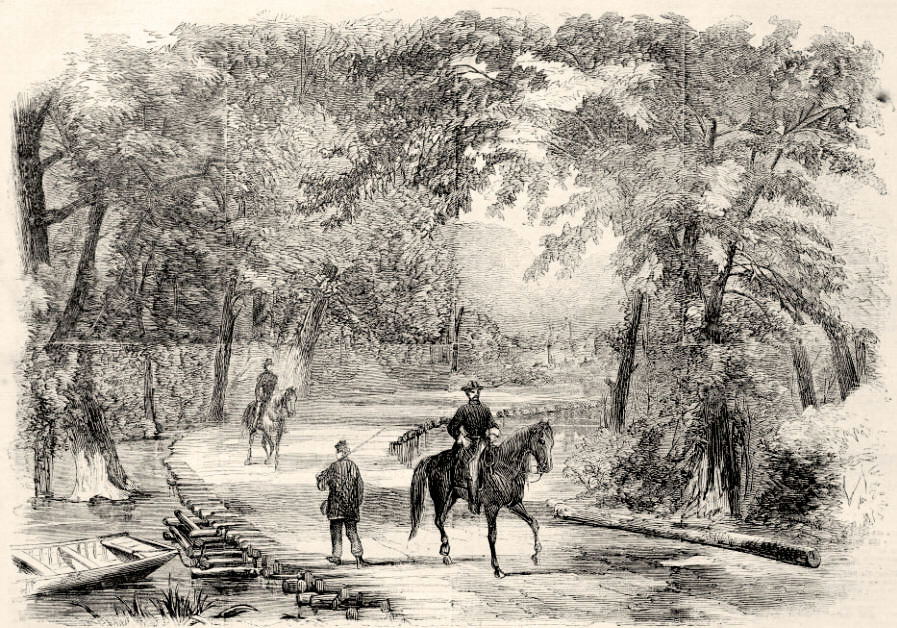
 | Antique Print Description This is an original engraved print titled, "Bridge Through The Chickahominy Swamp - Sketched By Mr. A. R. Waud." It was published in a Civil War era Harper's Weekly, July 19, 1862. Read a portion of the descriptive text below. You may be interested in our other listings on eBay.
| Title: | Bridge Through The Chickahominy Swamp - Sketched By Mr. A. R. Waud | | Artist/Photographer: | A R Waud | | Publisher: | Harper's Weekly | | Medium Used: | Wood Engraving | | Year: | July 19, 1862 | | Size: | Print Measures: 6.5" x 9" | | Condition: | Excellent | | Description: | Dated Original Authentic Civil War Era Antique Print | From the Harper's Weekly..."BRIDGE OVER THE CHICKAHOMINY" "Our brave army, toiling in the face of the enemy, ready to spring to arms at any moment, have done an immense amount of work, of which the construction of bridges has formed no inconsiderable portion. This has been necessary to secure our position in the face of the enemy. The picture presents a fair idea of the bridge - a solid work of logs, laid corduroy fashion, covered with a layer of earth, and winding through the otherwise impassable swamp."
Frequently Asked Questions
Are those odd lines on the image a defect in the print?
Antique prints often have faint vertical or horizontal lines visible. Rather than a defect, they are a fascinating historical artifact of the popular engraving process employed by newspapers at the time of the Civil War? During the war, newspaper publishers needed a method where they could get the illustrations produced by newspaper artists in the battlefield to the American public as quickly as possible.
To do this, the illustration was divided into sections usually two inches square. Double page prints were divided into as many as 40 sections. The section was traced onto a wood block. Engravers cut into the wood with various tools creating a mirror image of their section of the illustration. The blocks were then screwed together, recreating the original illustration. This would then be inked and stamped onto the newsprint. The lines on the image above are a result of where the blocks of wood were joined together.
Will my antique print deteriorate?
Before 1870, newspapers were not made from wood pulp as they are today. Instead, they were printed on a sturdy paper made by pulping linen rags. These rags came from clothing and ship sails. Because this kind of paper contains very little acid, your antique print could easily retain its appearance for many years into the future, if handled properly.
Why do people purchase antique prints and maps?
Antique prints and maps portray a moment in history. Because they represent a broad range of subjects, they are particularly useful when looking for a unique gift. Interior design has become a huge market for antique prints. From small framed botanicals to large Civil War maps, from large framed old city views to a collection of framed Harper's satirical cartoons, antique prints provide a world of design possibility. If properly framed, antique prints and maps can be preserved for many decades.
Is this item really authentic or just a reproduction?
You can have confidence that the item you purchase is guaranteed to be an original and not a modern day reproduction of any kind.
Can I return an item I purchase?
All purchases come with a 100% satisfaction guarantee.
| |