AIRMODEL
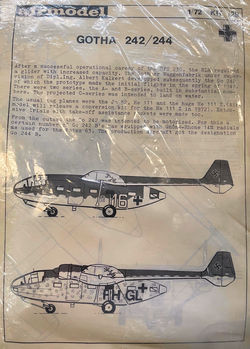
1/72-SCALE VAC FORM KIT WW2 GERMAN LUFTWAFFE GOTHA Go242/244 GLIDER TRANSPORT
ACFT
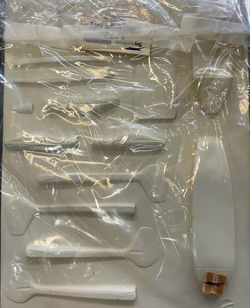
LIKE NEW OPEN UNBUILT MODEL KIT – INVENTORIED 100%
COMPLETE.
IF YOU HAVE ANY QUESTIONS OR CONCERNS, PLEASE ASK
ME BEFORE BIDDING / PURCHASING – I WANT EVERYONE TO BE 100% SATISFIED WITH NO
SURPRISES OR MIS-UNDERSTANDINGS
***IF YOU DESIRE TO PURCHASE MULTIPLE KITS AT THE
SAME TIME – I WILL COMBINE INTO A SINGLE SHIPMENT AND ADJUST THE INVOICE TO
REFLECT THE MOST ECONOMICAL POSTAGE CHARGE FOR ALL ITEMS SHIPPED TOGETHER***
--------------------------------------------
Additional Information from Internet Encyclopedia
The Gotha Go 242 was a transport glider
used by the Luftwaffe during
World War II. It was an upgrade over the DFS 230 in both cargo/troop capacity
and flight characteristics. Though it saw limited action, it appeared in
multiple variants.
The Go 242 was
designed by Albert Kalkert in response to a Reichsluftfahrtministerium (RLM) requirement for a heavy
transport glider to replace the DFS 230 then in service. The requirement was
for a glider capable of carrying 20 fully laden troops or the equivalent cargo.
The aircraft was a
high-wing monoplane with a simple square-section fuselage ending in clamshell
doors used to load cargo. The empennage was mounted on twin booms linked by a
tailplane. The fuselage was formed of steel tubing covered with doped fabric.
The flight characteristics of the design were better than those of the DFS 230.
Cargo versions of
the glider featured a hinged rear fuselage loading ramp that could accommodate
a small vehicle such as a Kübelwagen
or loads of similar size and weight.
The glider was
tested with rockets for overloaded take offs, a rack of four 48 kg
(106 lb) Rheinmetall 109-502 rockets mounted on the rear of the cargo
compartment. A second rocket called the "R Device" was also used with
the glider - it was a liquid-fuel Heinkel rocket engine R I-203 (HWK 109-500A)
which was mounted beneath the wing on either side of the body and was ejected
after takeoff, parachuting down to be recycled.
Two prototypes
flew in 1941 and the type quickly entered production. A total of 1,528 were
built, 133 of which were converted to the Go 244, with two 500 kW
(700 hp) Gnome-Rhone engines fitted to forward extensions of the tail
booms.
In service, Go
242s were towed into the air by Heinkel He 111s or Junkers Ju 52s, and were
occasionally fitted with RATO equipment. Most saw service in the Mediterranean,
North Africa and Aegean. Ju 87D-2s had strengthened rear fuselage and combined
tailwheel and hook for towing the Go 242.
A few gliders, the
Go 242 C-1 variant, were constructed with a flying boat-style hull allowing water
landings. It was proposed that some carry a small catamaran assault boat with a
1,200 kg (2,600 lb) explosive charge suspended between its hulls. The
proposed mission profile was for the pilot to land near an enemy ship and
transfer to the assault boat, setting off at high speed for the enemy ship and
locking the controls before bailing out.
The Go 244 was the
powered version of the Gotha Go 242 military glider transport. Studies for
powered versions of the Go 242 began early in the design of the glider, with
one early proposal being for modification to allow a single Argus As 10C engine
to be temporarily attached to the nose of the glider to allow recovery back to
base after use. This idea was rejected, but the alternative of a permanently
powered twin-engined version was taken forward.
Three Go 242s were
modified as prototypes of the powered Go 244, fitted with varying surplus
radial engines. The first prototype, the Go 244 V1 was powered by two
660 hp (492 kW) BMW 132 while the second prototype had 700 hp
(522 kW) Gnome-Rhône 14Ms and the third 750 hp (560 kW) Shvetsov
M-25A engines. Although only the third prototype offered adequate engine out
performance, the Luftwaffe had large stocks of captured Gnome engines, so this
was chosen as the basis for the production conversion, although a few more
aircraft were fitted with the BMW and Shvetsov engines.
The B series was
the main production model, being based on the Go 242B with a wheeled tricycle
undercarriage and with fuel and oil carried in the tailbooms. 133 were
converted from Go 242 Bs, while a further 41 were built from new before
production reverted to the glider Go 242. Plans were also created for
single-engined variants with a nose-mounted Argus A 10C or Junkers Jumo 211.
The first examples
of the Go 244 were delivered to operational units in Greece, based in Crete in
March 1942. Some were also assigned to transport Geschwader in North Africa and the Eastern Front but on the
former front they proved vulnerable to anti-aircraft fire and were withdrawn,
being replaced by Junkers Ju 52 or Messerschmitt Me 323 aircraft.