| MARSOC SPECIAL FORCES GROUP US ADVISORS SAS JTF vêlkrö PATCH: GHOST RECON | ||
This is an Original USMC MARSOC SPECIAL FORCES GROUP US ADVISORS SAS JTF vêlkrö PATCH: GHOST RECON. You will receive the item as shown in the first photo. Please note that there are color variations due to settings on different PCs/Monitors. The color shown on your screen may not be the true color. Personal check is welcomed.Force Reconnaissance (FORECON) are United States Marine Corps reconnaissance units[a] that provide deep ground and amphibious reconnaissance, surveillance, and limited-scale raids. They primarily support the Marine Expeditionary Force (MEF) and other Marine Air-Ground Task Forces (MAGTF).[5] Although FORECON companies are conventional forces they share many of the same tactics, techniques, procedures and equipment of special operations forces.[b] Though commonly misunderstood to refer to reconnaissance-in-force, the name "Force Recon" actually refers to the unit's relationship with the Marine Expeditionary Force or Marine Air-Ground Task Force.[7] Since the mid-1980s, a force recon detachment has formed part of a specialized sub-unit of Marine Expeditionary Units known as the Maritime Special Purpose Force (MSPF) or Maritime Raid Force (MRF). The mission of Force Reconnaissance is to conduct amphibious reconnaissance, deep ground reconnaissance, surveillance, battle-space shaping, and limited scale raids in support of the Marine Expeditionary Force (MEF), other Marine air-ground task forces, or a joint force.[5] Operational missions are categorized into two types: "green" operations, which focus on reconnaissance, and "black" operations, which involve direct action.[7] Force Recon remains a conventional asset under the direct control of the Marine Corps, distinct from the United States Special Operations Command (USSOCOM), and are not special operations forces. The Force Recon platoons operate farther inland than their Division Recon counterparts, penetrating deeper into enemy territory from their assigned littoral (coastal) region within a force commander's tactical area of responsibility (TAOR), often at ranges beyond the support of friendly artillery and/or naval gunfire support (NGFS).[9] Two mission sets emerged during the Vietnam War: Key Hole (deep reconnaissance) and Sting Ray (direct action).[citation needed] Key Hole patrols were designed purely around reconnaissance and surveillance. Usually lightly equipped and armed with defensive weapons, they employ evasive techniques to break away from the enemy should the need arise; avoiding enemy contact is paramount.[citation needed] Conversely, Sting Ray operations had goals more closely aligned with offensive strikes. In a Sting Ray operation, the FORECON operators were heavily armed and use artillery and/or naval gunfire support, if available.[citation needed] However, what began as a "keyhole" patrol could become a "stingray" patrol with little warning.[citation needed] The versatility of FORECON is demonstrated through switching between deep reconnaissance patrols to direct action engagements in certain situations.[10] Green operations are the principal mission of Force Recon to collect any pertinent intelligence of military importance, observe, identify, and report adversaries to MAGTF commanders.[11][7] Like Division Recon (also known as the Marine Recon Battalions), they employ a mixed element of amphibious reconnaissance and ground reconnaissance.[7] This practice fundamentally covers a wide spectrum of reconnaissance but primarily the FORECON operators conduct deep reconnaissance.[12] Their reconnaissance missions include preliminary (or "pre–D-Day") and post-assault reconnaissance. Some examples are: Battle damage assessment (BDA) missions – Witnessing and reporting damage to targets, either from heavy support fire measures (artillery and naval gunfire), air strikes, or thermonuclear weapons.[2] Remote sensors operations[13][2] – Placing remote sensors and beacons is vital for marking friendly/hostile boundaries and areas for helicopter assault and infantry transport. Initial terminal guidance (ITG)–setting up/preparing landing zones (LZ) and drop zones (DZ) for forward operating sites, Marine fixed or rotary-wing aircraft, or waterborne locations (landing force, ship-to-shore). Black operations are the missions that require direct action (DA).[7] They are the opposite of green operations missions, where the Force Recon operators "look for trouble."[7] Examples are the seizures and occupation of gas/oil platforms (GOPLAT) and the visit, board, search, and seizure (VBSS) of ships during Maritime Interdiction Operations (MIO).[2] They provide personal security detail (PSD) for critically important personnel within the MAGTF. They were formerly capable of performing In-Extremis Hostage Rescue (IHR), but this is no longer a Force Recon mission task. On September 9, 2010, the Force Reconnaissance platoon assigned to the 15th Marine Expeditionary Unit (special operations capable) (MEU(SOC)) on the USS Dubuque (LPD-8) conducting the USMC's first opposed Visit, Board, Search, and Seizure (VBSS) recapturing the MV Magellan Star from Somali pirates in the Gulf of Aden.[40][41] In 2010, a Force Reconnaissance team from the 24th MEU won the 2010 2nd Annual Warrior Competition against tactical units from all over the world. Tom Clancy's Ghost Recon is a series of military tactical shooter video games published by Ubisoft. In the series, the player is in charge of a fictional, newly conceived squad of U.S. Army Special Forces soldiers from Delta Company, 1st Battalion, 5th Special Forces Group (5th SFG) stationed at Fort Bragg, North Carolina. Except for the "1st Battalion, 5th SFG" designation, this unit is entirely fictional, as Special Forces Battalions currently only support three Companies (A, B and C). They are often referred to as "the Ghosts". Their role is not unlike other real world special operations forces, in that their operations are kept highly classified. In Tom Clancy's Ghost Recon: Future Soldier, it is shown that the Ghost's unit has multiple designations and is part of JSOC and is also known as the Group for Specialized Tactics (or GST - where the term "Ghost" comes from) much like real JSOC units like Delta Force (1st SFOD-D or CAG) and SEAL Team Six (or DEVGRU). Tom Clancy's Ghost Recon has also been novelized by Grant Blackwood under the pseudonym David Michaels. Other items in other pictures are available from my eBay Store. They will make a great addition to your SSI Shoulder Sleeve Insignia collection. You find only US Made items here, with the same LIFETIME warranty. **eBay REQUIRES ORDER BE SENT WITH TRACKING, PLEASE SELECT USPS GROUND ADVANTAGE SERVICE w/TRACKING** 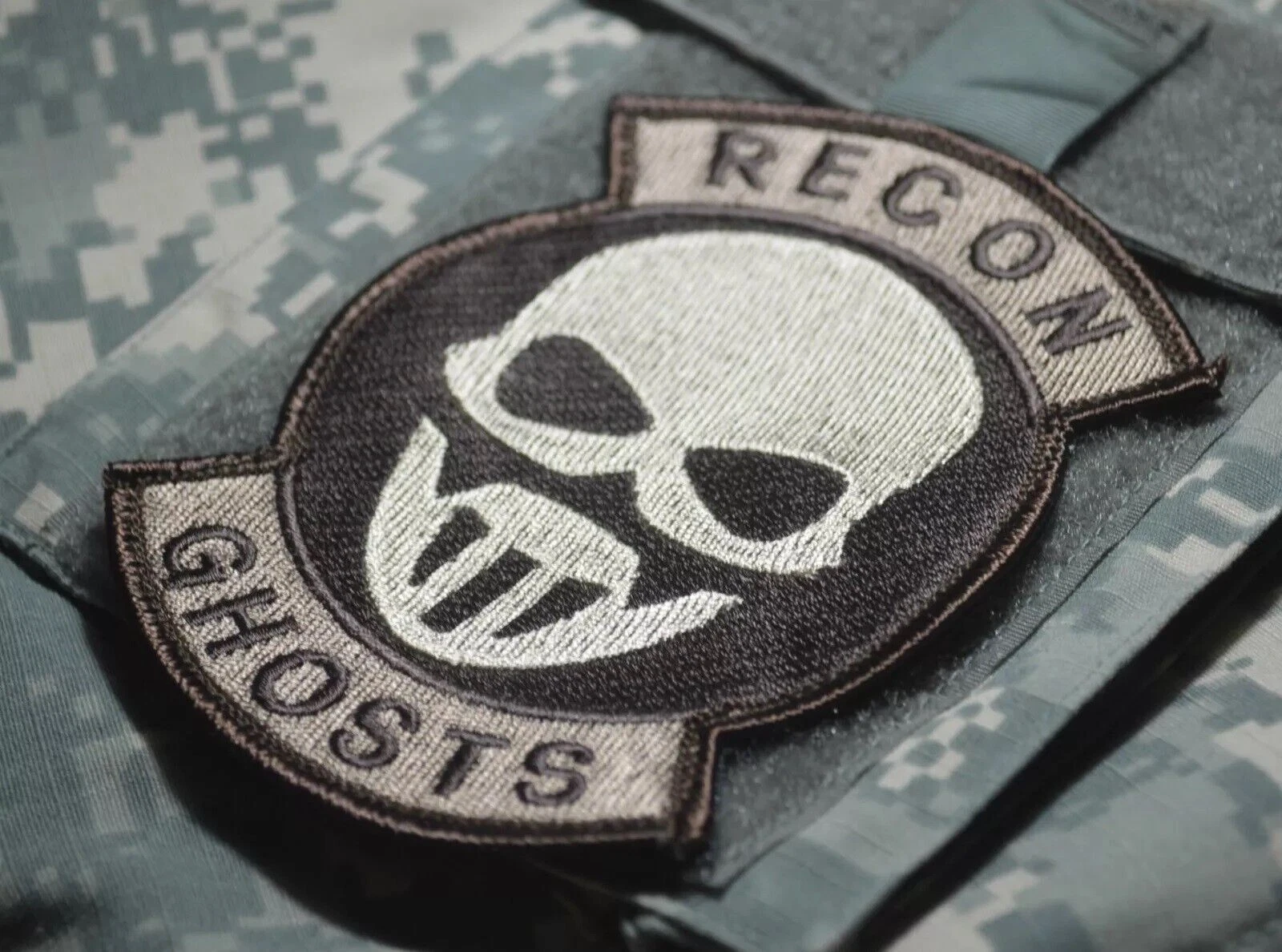  ALL US-MADE PATCHES HAVE LIFETIME WARRANTY **eBay REQUIRES ORDER BE SENT WITH TRACKING, PLEASE SELECT USPS GROUND ADVANTAGE SERVICE w/TRACKING** 
FREE 30-day No-Question return ALL US-MADE PATCHES HAVE LIFETIME WARRANTY We do not compete price with cheap import copies. Watch out for cheap import copies with cut-throat price; We beat cheap copies with Original design, US-Made Quality and customer services. Once a customer, a LIFETIME of services   |
