

To contact our Customer Service Team, simply click the button here and our Customer Service team will be happy to assist.
© Belfield Music Pty Ltd - ABN 99-160-283-258

Behringer Crave Analog Synthesizer - Belfield Music - Brand New
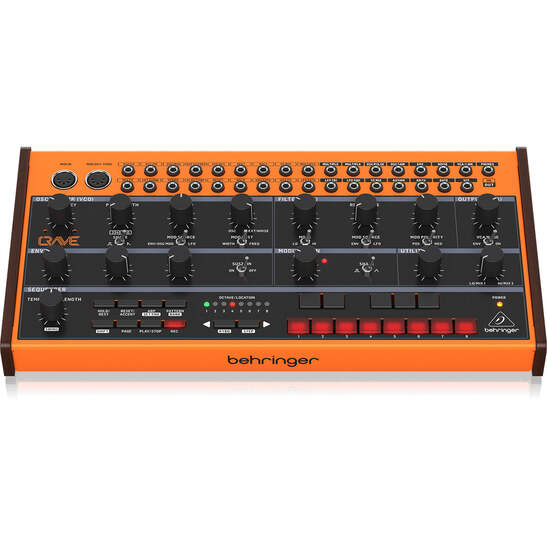
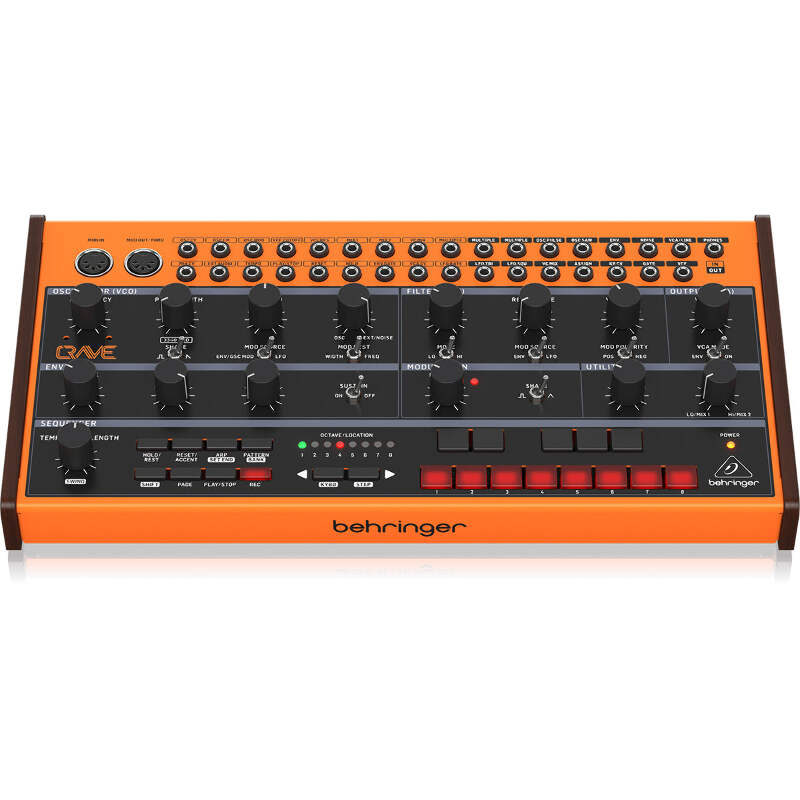
The 1980s and ’90s spawned a new “wave” of synth users including Michael Jackson, Madonna, Dr. Dre, Radiohead, film-maker John Carpenter and a host of others, all empowered by sounds emanating from the legendary Prophet-5*. An ultra-affordable homage to that iconic synthesizer with all the features of the original and then some, such as a 32-step sequencer and arpeggiator, the CRAVE lets you conjure up virtually any sound with incredible finesse and ease. With its pure analog signal path, authentic 3340 VCO with pulse and sawtooth wave outputs, plus extremely flexible VCF and VCA filters, the CRAVE is sure to become your favorite keyboard. Owning the CRAVE is like having your own personal time machine, enabling you to embrace the past – or make your imprint on the future!
Great care has been taken in engineering the CRAVE, including the true to the original analog circuitry, legendary VCO, VCF and VCA designs, all of which combine to make it easy to recreate the classic sound performance. This highly-focuséd attention to detail is what gives the CRAVE its ultra-flexible sound shaping capability, which covers everything from super-fat bass and lead tones to stunning effects – and all the way out to the otherworldly sounds of your imagination.
The inspired synthesizer tracks laid down in the 1980s and ’90s are etched in the annals of progressive rock, wave, EDM and synth-pop music forever, making them truly classic in every sense of the word. The CRAVE lets you recreate all of that magic – or design incredibly fat and original sounds that will make you a legend in your own right!
CRAVE’s 3340 Voltage Controlled Oscillator (VCO) provides your choice of pulse or reverse-sawtooth waveforms. When pulse is selected, the width can be varied using the Shape switch for narrow, squarewave or wide pulse – with a tuning range of ± one full octave. The VCO can be modulated via the envelope or the low frequency oscillator (LFO). Performance is further enhanced by the Mix control, which balances the levels of the internal VCO and noise generator. This amazing flexibility gives you the tools to be your creative best.
The very heart of CRAVE’s sound is its Classic Moog* 24 dB ladder filter, which lets you freely experiment with the Cutoff Frequency, Resonance and Modulation to dial in the perfect sound. CRAVE’s filter Mode switch can be set to either Lo- or Hi-pass for selecting the range of your choice.
While it is a monophonic instrument (one note at a time), CRAVE’s 16-note Poly Chain function lets you combine multiple synthesizers for up to 16-voice polyphony – plus provides vastly improved reliability and stability over its 1970s and '80s predecessors.
Your CRAVE comes ready to rock, thanks to its default signal routing that doesn’t require lifting a single patch cable to instantly create amazing sounds. The semi-modular architecture lets you easily tap into the inspired sounds of 1980s and ’90s progressive rock, wave, EDM and synth-pop music synthesizer tracks that made rock and roll history – or to design incredibly fat and original sounds that will make you a legend in your own right!
CRAVE’s Envelope generator features Attack, Decay and Sustain knobs that help you craft incredible sounds, plus a Sustain On/Off switch, which can either sustain the note for as long as the key is held, or start the decay as soon as the attack setting times out.
CRAVE’s sequencer allows you to program up to 32 steps of notes and rests and save them as a pattern. You can record, save and recall up to 64 patterns, all of which can be stored in the 8 banks, each holding up to 8 patterns. Your sequences can be played either in Keyboard mode, where you create and store the pattern, or Step mode, which allows you to interact while composing a pattern. The onboard Arpeggiator features 8 patterns (you can use just by playing a chord, which the arpeggiator then sequences through your selected pattern. Both the sequencer and arpeggiator in the CRAVE are fun, mesmerizing and totally addictive...
Thanks to its dedicated and fully-analog Low Frequency Oscillator (LFO), CRAVE lets you choose from either triangle or square waveforms, and features an LED that provides visual feedback of the adjustable LFO Rate.
In addition to the great sound-sculpting features already mentioned, the CRAVE has still more to offer. The noise generator can also be uséd as modulation source to create distortion-like effects, which will send your solo soaring into the stratosphere. Glide (portamento) lets you sweep seamlessly over time from one note to the next, creating smooth-as-silk transitions that few other instruments can emulate. You can even modulate the pulse wave via the LFO, envelope or manually – for sounds ranging from mild to wild!
We just can’t help ourselves – like you, we're gear-heads, too. For those who want the numbers, CRAVE has 47 controls, all laid out in a highly-intuitive format that puts the joy back into your music creation. And you can expand CRAVE’s tone-sculpting capabilities beyond your wildest dreams by utilizing the 18 x 14 I/O matrix for incredibly vast and flexible patching options!
When it comes to not just pushing envelopes but creating them, CRAVE gives your imagination its voice – and it’s so very affordable. When modern performance calls for classic analog sound – it calls for the Behringer CRAVE!
Visit your dealer to experience the stunning CRAVE or get yours online today. MUSIC never felt this good!
The modern synthesizer’s evolution began in 1919, when a Russian physicist named Lev Termen (also known as Léon Theremin) invented one of the first electronic musical instruments – the Theremin. It was a simple oscillator that was played by moving the performer’s hand in the vicinity of the instrument’s antenna. An outstanding example of the Theremin’s use can be heard on the Beach Boys iconic smash hit “Good Vibrations”.
In the late 1930s, French musician Georges Jenny invented what he called the Ondioline, a monophonic electronic keyboard capable of generating a wide range of sounds. The keyboard even allowed the player to produce natural-sounding vibrato by depressing a key and using side-to-side finger movements. You can hear the Ondioline on Del Shannon’s “Runaway”.
Designed by famous piano manufacturer Story & Clark in association with RCA, the Storytone piano debuted at the 1939 New York World’s Fair. Hailed as the world’s first electric piano, the Storytone is prized by musicians and collectors alike for its realistic piano sound – only 500 or so were ever built.
Finding a high level of acceptance in the 1960s, Harry Chamberlin’s Mellotron was an electro-mechanical keyboard that generated sounds by playing back pre-recorded tape loops. Although tempermental and prone to pitch and mechanical issues, the Mellotron was uséd extensively by many U.K. artists. Classic tracks from the Moody Blues “Days of Future Passed”, the Beatles “Strawberry Fields Forever”, and the Rolling Stones “She’s a Rainbow” are prime examples. Attribute author: By Buzz Andersen from San Francisco, California, United States Mellotron | NAMM 2007
Manufactured by ARP Instruments, Inc., the Arp 2600 was one of the most successful synthesizers to come out of the 1970s. They were ideal for players new to the synth world, and allowed patches to be changed via switches or 1/8" audio cables. The list of recordings and artists that uséd the venerable Arp 2600 reads like a veritable Who's Who of rock, pop and jazz, and includes The Who, David Bowie, John Lennon, Depeche Mode, Edgar Winter, Frank Zappa and Herbie Hancock – to name just a few. An Arp 2600 was even uséd to create the voice of the Star Wars character R2-D2. Attribute author: The original uploader was Kimi95 at Italian Wikipedia
Designed to replace the large, modular synths being uséd in pop music at the time, Bill Hemsath and Robert Moog developed the Minimoog in 1971. The monophonic instrument became the first truly all-in-one, portable analog synthesizer. Thanks to its 3 oscillators and 24 dB/octave filter, the Minimoog produces an extremely rich and powerful bass sound and is still in high demand today. Yes keyboardist Rick Wakeman said the instrument “absolutely changed the face of music.” Attribute author: glacial23 - Early Minimoog Uploaded by clusternote, CC BY-SA 2.0
In 1976, Yamaha released their CS-80 8-voice polyphonic synthesizer, which provided velocity-sensitive keys and aftertouch that worked on individual voices. The analog instrument featured a ribbon controller, which allowed the user to perform polyphonic pitch bends and smooth glissandos. Composer Vangelis uséd the CS-80 extensively in the Blade Runner and Chariots of Fire soundtracks. The CS-80 also provided the bass line heard in the BBC 1980 series Doctor Who theme song. Image attribution: Pete Brown from Gambrills, MD, USA (DSC00539) [CC BY 2.0], via Wikimedia Commons
Sequential Circuits introduced the Prophet 5, which was the first analog 5-voice polyphonic synthesizers to provide onboard memory storage of all patch settings for instant recall. The great-sounding Prophet 5 revolutionized the synthesizer world and, in spite of its rather expensive price tag, became one of the most successful synths of all time. Designed by Dave Smith and J owen, the Prophet 5 was the keyboard of choice by a very long list of performers that includes Peter Gabriel, Philip Glass, Journey, The Cars, Thomas Dolby, Duran Duran, Gary Numan, Pink Floyd, and countless others. Image attribution: original uploader was Felix2036 at Dutch Wikipedia derivative work: Clusternote (Sequential_Circuits_Prophet_5.jpg) [Public domain], via Wikimedia Commons Which brings us to 1977...
Our founder, Uli Behringer has a deep passion for keyboards. Born in the small town of Baden, Switzerland in 1961, Uli grew up in a musical family where his mother taught him to play the piano at the tender age of four. His father was a scientist who built a massive organ in the family home and taught the young lad all about electronics. So at the age of 17, Behringer built his first synthesizer – the UB-1. Later, while attending college to seek a degree in audio engineering, Uli put his electronics knowledge to use, building his own equalizers and signal processors to fill the gap left by the university's inability to provide enough proper studio gear. Word soon spread about how good his products were, and he began building gear for his friends – the Behringer legacy had begun. The rest, as they say, is history...
Analog synthesizer with legendary Prophet 5* VCO design allows for insanely fat music creation
Pure analog signal path based on authentic VCO, VCF and VCA designs
Super-rich oscillator with pulse and sawtooth wave outputs for ultimate sounds
Classic Moog* 24 dB ladder filter with resonance for legendary sound performance
Switchable low/high pass filter mode for enhanced sound creation
Modern and easy-to-use 32-step sequencer with 64 onboard storage slots
Advanced Arpeggiator with wide patterns for great sound effects
Dedicated and fully analog triangle/square wave LFO
16-voice Poly Chain allows combining multiple synthesizers for up to 16 voice polyphony
Semi-modular design with default routings requires no patching for immediate performance
18 x 14 I/O matrix for incredibly vast and flexible patching options
Noise generator dramatically expands waveform generation
47 controls give you direct and real-time access to all important parameters
External audio input for processing external sound sources
Comprehensive MIDI implementation with MIDI channel and Voice Priority selection
Click the Postage tab above the listing description for more info
 Additional delivery notes
Click the Postage tab above the listing description for all postage info. If we can't dispatch your item via your selected option, for whatever restriction, we will then dispatch with the nearest replacement carrier.
PICK UP OPTION
Our items are available for pick-up. Pick up procedure is as follows:

|
PAYING VIA PAYPAL |
We accept PayPal on our all our items so you can shop with confidence.
Simple choose the PayPal option when proceeding through the checkout.
 Additional Information
At Belfield Music we try to answer every query we receive as quick as possible. With email sent after hours EST and weekends we will do our best to ensure these are answered the next business day. We appreciate your understanding and patience in this matter.
To contact our Customer Service Team, simply click the button here and our Customer Service team will be happy to assist.
© Belfield Music Pty Ltd - ABN 99-160-283-258
Click the Postage tab above the listing description for more info
Accepted Payment Methods
Returns are accepted
We sincerely thank you and appreciate your business. Our primary goal is the make you a satisfied customer. We understand that in some cases you may wish to return the item for a refund.
