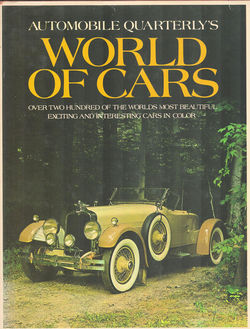
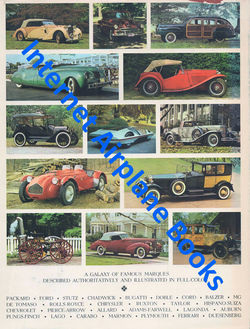
WORLD
OF CARS HBDJ BUGATTI FERRARI ROLLS-ROYCE STUTZ MG PACKARD PLYMOUTH
AUTOMOBILE QUARTERLY HARDBOUND
BOOK with DUSTJACKET in ENGLISH
THE SAGA OF THE STUTZ (BOAT
TAILS, BEARCATS & BLACK HAWK)
CANADAS FIRST AUTOMOBILE –
MISTER TAYLOR’S BUGGY The Henry Seth Taylor steam buggy is the first known car
built in Canada. It was built by Henry Seth Taylor, a watchmaker and jeweller
in Stanstead, Quebec in 1867. It was unveiled at the Stanstead Fall Fair that
year. The vehicle was crashed into a creek shortly thereafter. The Buggy was
modeled after a US-built steam car Taylor had seen in 1864. It was designed by
Taylor to have a coal-fired boiler for the carriage. Fully pressurized, the
steam was used to move a piston attached to the rear axle, producing forward
motion. The vehicle does not have a reverse gear or brakes. It was able to
travel at a sustained 20 km/h (12 mph). The vehicle features thin strips of
metal bent around the edge of the wheels in place of rubber tires. It is
powered by a two-cylinder boiler mounted behind the driver. Steam is generated
in the vertical coal-fired boiler, which is connected by rubber hoses to a
six-gallon water tank located between the front wheels. The vehicle lacks a coal box, but has a
storage nook for lump coal or wood under the driver’s perch. The vehicle weighs
500 pounds (230 kg). The boiler (as designed) can withstand 60 pounds (27 kg)
of pressure. It was the only example built, not having been meant for mass
production; rather, it was exhibited as a curiosity at fairs around the area.
HISPANO-SUIZA TULIPWOOD-BODIED
ROADSTER
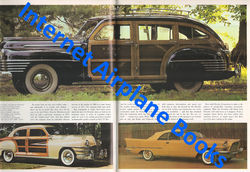
CHRYSLER – A HISTORY OF MIXED
BLESSINGS
DE TOMASO MANGUSTA
ADAMS-FARWELL About 1895,
Farwell began experimenting with an internal combustion engined automobile, for
which he conceived a horizontally mounted rotary engine with three cylinders.
The vertically standing crank shaft was fixed in the chassis. Farwell felt this
configuration was lighter than conventional engines as it used neither a
flywheel — since the spinning engine crankcase and cylinders acted as their own
flywheel when running — nor radiator, because of its air cooled design. Farwell
completed the first prototype in 1898. Basically a horse-drawn carriage, he
mounted his engine between the front wheels. This proved impractical, so his
second car, appropriately named number 2, had the engine installed in the rear
as all Adams-Farwells would thereafter. This car used bicycle wheels; the next
had wooden artillery wheels. Little is known about car number 4, which probably
was similar to number 3, and which was sold to a Dubuque resident. Number 5 was
shown at the Chicago Auto Show in February 1905. Now, first orders were taken.
With only minor modifications, the car went into - very limited - production as
the Model 6 20/25 hp. Referring to its engine, Adams-Farwell frequently used
the slogan: It spins like a top.
CORD L-29
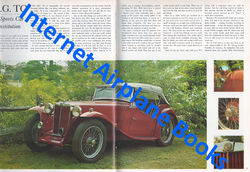
M.G. TC BRITISH SPORTS CAR
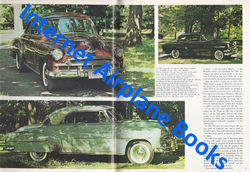
THE UBIQUITOUS CHEVROLET
THE CARABO
1894 BALZER Stephen Balzer
immigrated in the 1870s from the Kingdom of Hungary to the United States. He
apprenticed as a watchmaker at Tiffany's. When he started his own business in
1894, a machine shop, he already held several patents for mechanical devices,
among them a device for making milling cutters and his rotary engine. In the
same year, he completed his first prototype automobile, a motorized quadricycle
with a tube chassis, less than 6 feet (1.8 m) long and 3 feet (0.91 m) wide. It
had a rotary, air-cooled, 3-cylinder engine, mounted vertically in the rear and
revolving around a fixed crankshaft. Turning with the crankcase was a stub
shaft. It further had a 3-speed manual transmission with no reverse. One lever
engaged speeds and clutch. Each front wheel had its own bicycle fork axle which
was connected by a bar which was operated by a tiller) By 1897, he had built
three cars.
PACKARD
THE DOBLE STEAM CAR The Doble
steam car was an American steam car maker from 1909 to 1931. Its latter models
of steam car, with fast-firing boiler and electric start, were considered the
pinnacle of steam car development. The term "Doble steam car"
comprises any of several makes of steam-powered automobile in the early 20th
century, including Doble Detroit, Doble Steam Car, and Doble Automobile,
severally called a Doble because of their founding by Abner Doble.
PLYMOUTH – GENERATIONS AS ONE OF
AMERICA’S FAVORITES
BUGATTI MASTERPIECES
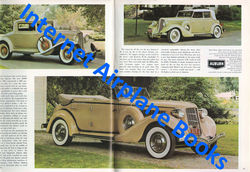
AUBURN
PUNGS-FINCH The Pungs-Finch was
an American automobile manufactured in Detroit, Michigan from 1904 to 1910.
They were powerful touring cars built by a factory which primarily made marine
gas engines
ROLLS-ROYCE
CHADWICK
DUESENBERG
LAGO-TALBOT Talbot-Lago was a
French automobile manufacturer based in Suresnes, Hauts de Seine, outside
Paris. The company was owned and managed by Antonio Lago, an Italian engineer
that acquired rights to the Talbot brand name after the demise of Darracq
London's subsidiary Automobiles Talbot France in 1936. Under Lago's managing,
the company produced a range of automobiles that included sport and racing
cars; in some cases, the bodies of the vehicles were designed by coachbuilding
companies such as Figoni et Falaschi. Talbot-Lago faced financial problems; as
a result, Lago sold the company to Simca in 1959.
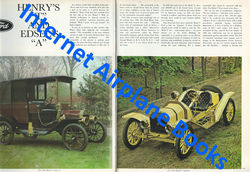
FORD MODEL T AND MODEL A
LAGONDA LG6 The Lagonda LG6 is a
large car produced by the British Lagonda company from 1937 until 1940. It was
announced at the 1937 London Motor Show. The LG6 chassis is based on the one
used on the V12 model lengthened by 3.5 in (89 mm) to cater for the longer
engine fitted. Suspension is independent torsion bar front suspension and live
rear axle with Spiral bevel gear final drive. The braking system is Lockheed
hydraulic. The 4453 cc Straight-six
engine with pushrod operated overhead valves was bought in from Henry Meadows
of Wolverhampton and previously used in the LG45 model Drive is to the rear
wheels through a single dry plate clutch and four-speed gearbox. Standard coachwork included saloon, tourer,
coupé and sedanca styles. The tourer was also available in Rapide version and
had a higher compression ratio engine but only two were sold.
MODULO by PININFARINA
RUXTON The Ruxton was a
front-wheel drive automobile produced by the New Era Motors Company of New
York, New York, United States, during 1929 and 1930. The car was the brainchild
of William Muller and was built in the Board Machine plant in Philadelphia,
Moon Motor Car factory in St. Louis, Missouri, and Kissel Motors of Hartford,
Wisconsin, who also produced the car's transmission unit.
MARMON Marmon Motor Car Company
was an American luxury automobile manufacturer founded by Howard Carpenter
Marmon and owned by Nordyke Marmon & Company of Indianapolis, Indiana,
U.S., and active from 1902 to 1933. It
was established in 1902 but not incorporated as the successor of Nordyke Marmon
& Company until 1926. In 1933 it was succeeded by Marmon-Herrington, and in
1964 the Marmon brand name was sold to the Marmon Motor Company of Denton,
Texas. Marmon-Herrington became the Marmon Group of Chicago, in 1964. Marmon was notable for its various pioneering
works in automotive manufacturing, introducing the rear-view mirror, pioneering
the V16 engine, and the use of aluminum in auto manufacturing. The historic
open wheel Marmon Wasp race car of the early 20th century was the first to use
a single-seater "monoposto" construction layout.
SYDNEY ALLARD’s FABULOUS J2X
PIERCE-ARROW