ATHEARN
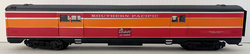
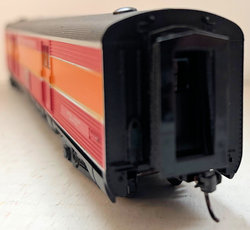
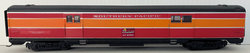
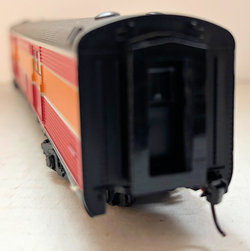
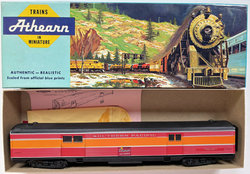
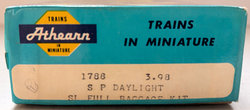
1788 HO SOUTHERN PACIFIC DAYLIGHT BAGGAGE CAR RTR KD SP 6599 OVP REA RAILWAY
EXPRESS AGENCY
ORIGINAL VENDOR BLUE BOX OVP
RED, ORANGE, AND BLACK COLOR
SCHEME
BUILT & READY-TO-RUN WITH
KAYDEE COUPLERS INSTALLED
NOT LIGHTED
-----------------------------------
Additional Information from
Internet Encyclopedia
The Coast Daylight, originally
known as the Daylight Limited, was a passenger train on the Southern Pacific
Railroad (SP) between Los Angeles and San Francisco, California, via SP's Coast
Line. It was advertised as the "most beautiful passenger train in the
world," carrying a particular red, orange, and black color scheme. The
train operated from 1937 until 1974
By the mid-1920s, increased
population of automobiles and state highways had begun to erode the Southern
Pacific's (SP) local patronage. Despite this, SP's long-distance services were
less affected, and their ridership remained strong. On April 28, 1922, SP
introduced the Daylight Limited, a luxury train service which operated on a
13-hour schedule between the Third and Townsend Depot in San Francisco and
Central Station in Los Angeles, running on Fridays and Saturdays only.
Additionally, the train ran seasonally from April to November. The Daylight
Limited resumed operation in April 1923 and was gradually expanded by mid-July
on a daily schedule. In 1924, SP shortened the train's running time to 12 hours
for the season. By 1927, the Daylight Limited became the world's longest
non-stop run, although it only stopped twice for refueling service. By this
time, the Daylight Limited was advertised as the "fastest train in the
West". In 1928, the Limited word was dropped from the train's name due to
a few intermediate stops being added to the Daylight's schedule.
The streamlined Daylight began
on March 21, 1937, on a 9+3⁄4-hour schedule. It was the first of the Daylight
series that later included the San Joaquin Daylight, Shasta Daylight,
Sacramento Daylight, and Sunbeam. The one-way fare while boarding coach class
from San Francisco to Los Angeles is $9.47, while the round trip fare is $14.
By June 30, 1939, the
streamlined Daylights had carried 268.6 million passenger miles (432.3 million
kilometres) on 781,141 train miles (1,257,125 kilometres) for an average
occupancy of 344 passengers. A second train, the Noon Daylight, was introduced
on the same route on March 30, 1940; the Coast Daylight became the Morning
Daylight. The Noon Daylight was suspended on January 6, 1942, to allow for
equipment overhaul. The cut was originally planned to last just several months,
but continued due to World War II. The Noon Daylight resumed on April 14, 1946,
with timed bus connections serving Santa Cruz and Monterey.
On October 2, 1949, the Noon
Daylight was replaced by the overnight Starlight using the same equipment. The
Morning Daylight reverted to the Coast Daylight name. The Coast Daylight ran
behind steam until January 7, 1955, long after most streamliners had changed to
diesel. In 1956 coaches from the Starlight were added to the all-Pullman Lark;
the Starlight was discontinued in 1957. Amtrak later revived the name for its
Los Angeles to Seattle service known as the Coast Starlight.
A 1966 study by the Stanford
Research Institute found that it cost the Southern Pacific $18.41 to transport
a passenger on the Coast Daylight between Los Angeles and San Francisco
(equivalent to $178 in 2024), roughly twice that of air or bus service. Reasons
given included the labor-intensiveness of rail service, and the fact that a
single consist could make only one trip per day.
The heavyweight Daylight Limited
debuted in 1922 with five 60-foot Harriman steel coaches and a dining car.
American Car and Foundry delivered new 90-seat coaches in 1923; the SP also
added a 32-seat parlor-observation car.[2] The initial main motive powers were
the 4-6-2 Heavy Pacific steam locomotives, which were later replaced by the
4-8-2 "Mountain" locomotives in the early 1930s. The Southern Pacific
removed the observation cars in 1931.
Pullman-Standard delivered two
complete sets of equipment (consists) for the 1937 Coast Daylight. Each
consisted of a 44-seat baggage-coach; a 48-seat coach; three pairs of
articulated coaches, with 50 seats in each of the six coaches; a lunch
counter-tavern car, a dining car, a 29-seat parlor car; and a 23-seat
parlor-observation car.[26] Each consist cost $1 million (equivalent to $21.9
million in 2024 adjusted for inflation), the most expensive passenger trains
built in the United States to date.
In the articulated coaches
restrooms were split, with the men's restroom in the odd-numbered car and the
women's restroom in the even-numbered car. Seating was 2�2, with a center aisle
down the middle. Luggage storage was located adjacent to the vestibule. The
coffee shop-tavern had two seating areas. At one end of the car was the coffee
shop, with 24 individual stools arrayed around a counter. At the other end was
the tavern, with booth seating for 18. Between the two areas was a kitchen. The
dining car could seat 40 patrons at 10 tables. The parlor-observation car
seated 10 in the rear, rounded-off observation area and a further 23 in the
adjoining parlor section.
Prior to the full reequipping in
1940 the Southern Pacific made several changes to augment capacity. In 1938 it
replaced the coffee shop-tavern cars with individual tavern and coffee shop
cars. The original cars were rebuilt as full taverns and assigned to the Los
Angeles�New Orleans Argonaut. The following year the Southern Pacific swapped
the individual 48-seat coaches with an additional articulated coach pair from
the Houston�Dallas Sunbeam.
The 1937�1939 equipment ran as
the Noon Daylight with the inauguration of the Morning Daylight in 1940. For
the Morning Daylight, the Southern Pacific ordered two new sets of equipment
from Pullman-Standard. These included a 44-seat coach-baggage car; three pairs
of articulated coaches, with 46 seats in each of the six coaches; a triple-unit
coffee shop-kitchen-dining car; a 44-seat coach; a tavern car; a 27-seat parlor
car; and a 22-seat parlor-observation car.
The Morning Daylight would be
completely reequipped just a year later. The 1940 baggage-coach, tavern, and
parlor were retained. It was assigned new articulated coach pairs (with the
number increased from three to four), triple-unit coffee shop-kitchen-dining
car, 44-seat coach, and parlor-observation car. Effectively it was the same
train as in 1940, but a year newer, with an additional articulated coach. The
Noon Daylight mixed old and new equipment:
the baggage-coaches from the
1937 train
the articulated coaches from the
1940 Morning Daylight
the triple-unit coffee
shop-kitchen-dining cars from the 1940 Morning Daylight
a new articulated coach pair,
seating 46 like all the others
the 44-seat coach from the 1940
Morning Daylight
the parlor car from the 1937
train
the parlor-observation car from
the 1940 Morning Daylight
With the discontinuance of the
Noon Daylight in 1949 its cars were reassigned to the San Joaquin Daylight and
Starlight. The Coast Daylight gained new 48-seat coaches from Pullman-Standard
in 1954, three per train.
Dining cars were eliminated in
the 1960s, replaced by Automat cars that offered food from vending machines
instead of made-to-order meals in the dining cars, cutting the cost of the
train's dining crew.