ATHEARN
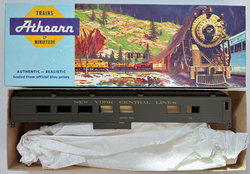
1892 HO-scale NEW YORK CENTRAL STD DINING CAR KIT NYC 105 *NOS* NEW OLD STOCK -
ORIGINAL VENDOR BLUE BOX OVP DARK GREEN with GOLD LETTERING 1892-style CLERESTORY
ROOF PULLMAN DINER SIX-WHEEL TRUCKS
------------------------------
Additional Information from
Internet Encyclopedia
Steam locomotives of the New
York Central Railroad were optimized for speed on that flat raceway of a main
line, rather than slow mountain lugging. Famous locomotives of the system
included the well-known 4-6-4 Hudsons, particularly the 1937�38 J-3a's; 4-8-2
World War II�era 1940 L-3 and 1942 L-4 Mohawks; and the 1945�46 S-class
Niagaras: fast 4-8-4 locomotives often considered the epitome of their breed by
steam locomotive aficionados (railfans).
For the first two-thirds of the
20th century, New York Central Railroad had some of the most famous trains in
the United States. The 20th Century Limited (Century), begun in 1902, ran
between Grand Central Terminal in New York City and LaSalle Street Station in
Chicago, and was its most famous train, known for its red-carpet treatment and
first-class service. Its last run was made on December 2�3, 1967.
In the mid-1930s, many railroad
companies were introducing streamlined locomotives; until the New York Central
introduced the Commodore Vanderbilt, all were diesel-electric. The Vanderbilt
was the NYC's first streamlined steam locomotive.
The railroad hosted the
streamlined steam-powered Rexall Train of 1936, which toured 47 states to
promote the Rexall chain of drug stores and to provide space for company
conventions. The steam-powered Century, which followed the Water Level Route,
could complete the 960.7-mile trip in 16 hours after its June 15, 1938
streamlining (and did it in 151⁄2 hours for a short period after World War II).
Also famous were the NYC's Empire State Express, which traveled from New York
City through upstate New York to Buffalo and Cleveland, and the Ohio State
Limited, which ran between New York City and Cincinnati.
At various times, beginning in
1946 and continuing into the mid-1950s, the Century and other NYC trains
exchanged sleeping cars in Chicago with western trains such as the Super Chief
and the City of San Francisco. The cars, which contained roomettes, double
bedrooms and drawing rooms, provided through sleeper service between New York
City and Los Angeles or San Francisco (Oakland Pier).
Despite having some of the most
modern steam locomotives anywhere, NYC's difficult financial position caused it
to convert to more-economical diesel-electric power rapidly. The Boston and
Albany line was completely dieselized by 1951. All lines east of Cleveland,
Ohio were dieselized between August 7, 1953 (east of Buffalo) and September
1953 (Cleveland-Buffalo). Niagaras were all retired by July 1956. On May 3,
1957, H7e class 2-8-2 Mikado type steam locomotive No. 1977 is reported to have
been the last steam locomotive to retire from service on the railroad. But, the
economics of northeastern railroading became so dire that not even this switch
could change things for the better.
Prominent New York Central
trains:
New York to Chicago
20th Century Limited: New York
to Chicago (limited stops) via the Water Level Route 1902�1967
Chicagoan: New York�Chicago
Commodore Vanderbilt: New
York�Chicago (a few more stops) via the Water Level Route
Fast Mail: New York�Chicago
Fifth Avenue Special: New
York�Chicago
Iroquois: New York-Chicago
Lake Shore Limited: New
York�Chicago via Cleveland with branch service to Boston and St. Louis
1896�1956, 1971�present (Reinstated and combined with New England States by
Amtrak in 1971)
North Shore Limited: New
York�Chicago
Pacemaker: New York�Chicago
all-coach train via Cleveland
Water Level Limited: New
York�Chicago
Wolverine: New York-Chicago via
southern Ontario and Detroit
The Mercuries
Chicago Mercury: Chicago-Detroit
Cincinnati Mercury:
Cleveland-Cincinnati
Cleveland Mercury:
Detroit�Cleveland
Detroit Mercury:
Cleveland-Detroit
New York to St. Louis
Knickerbocker: New York�St.
Louis
Southwestern Limited: New
York�St. Louis, from 1889 to 1966
Other trains
Empire State Express: New
York�Buffalo and Cleveland via the Empire Corridor 1891�present (as far as
Niagara Falls, New York as Empire Service).
Cleveland Limited: New
York�Cleveland
Detroit Special: Chicago-Detroit
Detroiter: New York�Detroit
Great Lakes Aerotrain:
Chicago-Detroit/Cleveland 1956 (Special experimental lightweight train)
James Whitcomb Riley:
Chicago-Cincinnati
Michigan: Chicago-Detroit
Motor City Special:
Chicago�Detroit
New England States:
Boston-Chicago via the Water Level Route 1938�1971 (Retained by Penn Central
and, for Amtrak, combined with reinstated Lake Shore Limited)
Niagara: New York-Niagara Falls
North Star: New York-Cleveland,
branches to Toronto and Lake Placid
Ohio State Limited: New
York-Cincinnati via Empire Corridor
Ontarian: New York-Toronto
Seneca: New York-Syracuse
Ohio Xplorer:
Cleveland-Cincinnati 1956�1957 (Special experimental lightweight train)
Twilight Limited:
Chicago�Detroit
Trains left from Grand Central
Terminal in New York, Weehawken Terminal in Weehawken, New Jersey, South
Station in Boston, Cincinnati Union Terminal in Cincinnati, Michigan Central
Station in Detroit, St. Louis Union Station, and LaSalle Street Station and
Central Station (for some Detroit and CincinnatI trains) in Chicago.
The New York Central had a
network of commuter lines in New York and Massachusetts. Westchester County,
New York had the railroad's Hudson, Harlem, and Putnam lines into Grand Central
Terminal in Manhattan (Putnam Division trains required a change at High Bridge,
New York), while New Jersey and Rockland County, New York were serviced by the
West Shore Line between Weehawken and Kingston, New York, on the west side of
the Hudson River.