ATHEARN
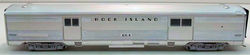
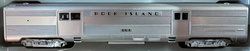
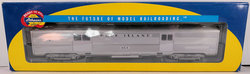
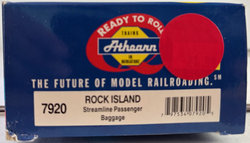
7920 HO ROCK ISLAND LINE STREAMLINED SILVER BAGGAGE CAR RI #854 IN A
DISTINCTIVE CHICAGO ROCK ISLAND & PACIFIC RAILROAD COLOR SCHEME. RTR OVP KD
NOS NIB READY-TO-RUN ORIGINAL VENDOR PACKAGING NEW OLD STOCK
FULLY ASSEMBLED AND READY FOR
YOUR LAYOUT.
FEATURES A HIGHLY-DETAILED
DURABLE PLASTIC INJECTION MOLDED PLASTIC BODY WITH A DETAILED INTERIOR, CLEAR
WINDOWS, 4-WHEEL PASSENGER CAR PLASTIC TRUCKS, WEIGHTED FOR TROUBLE-FREE
OPERATION, RP25 MACHINED METAL WHEELS AND AXLES AND BODY-MOUNTED MCHENRY (KAY-DEE
STYLE) OPERATING SCALE COUPLERS.
----------------------------------------------
Additional Information from
Internet Encyclopedia
In competition with the Santa Fe
Chiefs, the Rock Island jointly operated the Golden State Limited
(Chicago—Kansas City—Tucumcari—El Paso—Los Angeles) with the Southern Pacific
Railroad (SP) from 1902 to 1968. On this route, the Rock Island's train was marketed
as a "low-altitude" crossing of the Continental Divide. The Rock
Island did not concede to the Santa Fe's dominance in the Chicago–Los Angeles
travel market and re-equipped the train with new streamlined equipment in 1948.
At the same time, the Limited was dropped from the train's name and the train
was thereafter known as the Golden State. The local run on this line was known
as the Imperial, which had a branch operating through the northwestern edge of
Mexico.
The 1948 modernization of the
Golden State occurred with some controversy. In 1947, both the Rock Island and
Southern Pacific jointly advertised the coming of a new entry in the
Chicago-Los Angeles travel market. The Golden Rocket was scheduled to closely
match the Santa Fe's transit time end-to-end and was to have its own dedicated
trainsets, one purchased by the Rock Island, the other by Southern Pacific. As
the Rock Island's set of streamlined passenger cars was being finished, the
Southern Pacific abruptly withdrew its purchase. The Rock Island's cars were
delivered and found their way into the Golden State's fleet soon after
delivery.
The Golden State was the last
first-class train on the Rock Island, retaining its dining cars and sleeping
cars until its last run on February 21, 1968.
The Rock Island also competed
with the Chicago, Burlington and Quincy railroad in the Chicago-to-Denver
market. While the Q fielded its Zephyrs on the route, the Rock Island ran the
Rocky Mountain Rocket. The RMR split at Limon, Colorado, with half the train
diverting to Colorado Springs, an operation known as the "Limon
Shuffle". The Rock Island conceded nothing to its rival, even installing
ABS signaling on the route west of Lincoln in an effort to maintain transit
speed. The train was also re-equipped with streamlined equipment in 1948.
As the Rocky Mountain Rocket was
downgraded due to nonrail competition, the route traveled by the train was
gradually shortened from 1966 onward. Its western terminus was cut back first
to Omaha, then to Council Bluffs. After briefly running without a name, it was
renamed The Cornhusker. Finally, in 1970, the train was cut back to a
Chicago-Rock Island run entirely within the confines of the state of Illinois
and renamed the Quad Cities Rocket.
Other trains operated by the
Rock Island as part of its Rocket fleet included the Corn Belt Rocket
(Chicago—Des Moines—Omaha), the Des Moines-Omaha Limited (Chicago-Des
Moines-Omaha), the Twin Star Rocket (Minneapolis—St. Paul—Des Moines—Kansas
City—Oklahoma City—Fort Worth—Dallas—Houston), the Zephyr Rocket
(Minneapolis—St. Paul—Burlington—St. Louis), the Choctaw Rocket (Memphis—Little
Rock—Oklahoma City—Amarillo) and the Cherokee (a local counterpart to the
Choctaw Rocket, Memphis-Little Rock-Oklahoma City-Amarillo-Tucumcari-Los
Angeles).