305W x 330D (mm)
Dual processor, 7nm technology
Up to 64-core, 128 threads per processor
CPU TDP up to 280W
Socket SP3
DDR4 memory supported only
8-Channel memory architecture
RDIMM modules up to 128GB supported
LRDIMM modules up to 128GB supported
Memory speed: Up to 3200 MHz
1 x 10/100/1000 management LAN
2D Video Graphic Adapter with PCIe bus interface
1920x1200@60Hz 32bpp
*3 x SlimSAS with 12 x SATA 6Gb/s or 3 x U.2 PCIe Gen4 x4 ports
* NOTE:
Default setting is SATA, please go to BIOS Setup section, Advances>PCI Subsystem setting for advanced configuration manually.
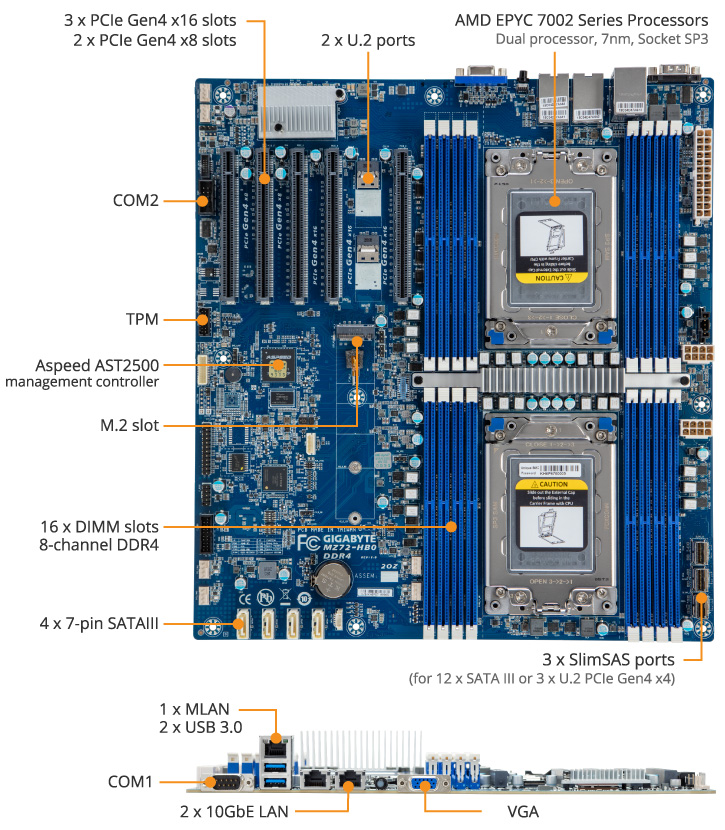
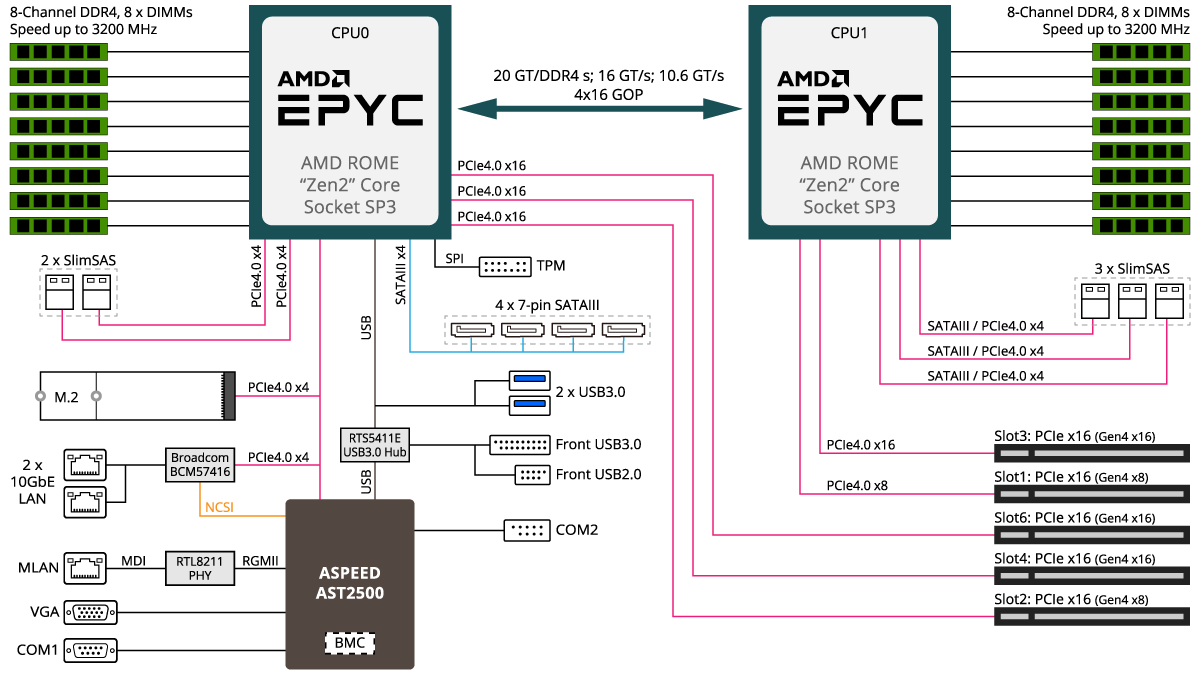
Slot_4: 1 x PCIe x16 (Gen4 x16 bus) slot, from CPU_0
Slot_3: 1 x PCIe x16 (Gen4 x16 bus) slot, from CPU_1
Slot_2: 1 x PCIe x16 (Gen4 x8 bus) slot, from CPU_0
Slot_1: 1 x PCIe x16 (Gen4 x8 bus) slot, from CPU_1
2 x U.2 ports:
- SlimSAS 4i type
- PCIe Gen4 x4, from CPU_0
1 x M.2 slot:
- M-key
- PCIe Gen4 x4, from CPU_0
- Supports 2280/22110 cards
2 x 8-pin ATX 12V power connectors
5 x SlimSAS connectors
4 x SATA 7-pin connectors
1 x M.2 slot
2 x CPU fan headers
4 x System fan headers
1 x USB 3.0 header
1 x USB 2.0 header
1 x COM_2 header
1 x TPM header
1 x Front panel header
1 x PMBus connector
1 x IPMB connector
1 x Clear CMOS jumper
1 x BIOS recovery jumper
1 x VGA
1 x COM_1
2 x RJ45
1 x MLAN
1 x ID button with LED
Optional TPM2.0 kit: CTM010
Windows Server 2019
Red Hat Enterprise Linux 7.6 (x64) or later
Red Hat Enterprise Linux 8.0 (x64) or later
Red Hat Enterprise Linux 9.0 (x64) or later
SUSE Linux Enterprise Server 12 SP4 (x64) or later
SUSE Linux Enterprise Server 15 SP1 (x64) or later
Ubuntu 16.04.6 LTS (x64) or later
Ubuntu 18.04.3 LTS (x64) or later
Ubuntu 20.04 LTS (x64) or later
VMware ESXi 6.5 EP15 or later
VMware ESXi 6.7 Update3 or later
VMware ESXi 7.0 or later
VMware ESXi 8.0 or later
Citrix Hypervisor 8.1.0 or later
GIGABYTE Management Console (AMI MegaRAC SP-X) web interface
- Dashboard
- HTML5 KVM
- Sensor Monitor (Voltage, RPM, Temperature, CPU Status …etc.)
- Sensor Reading History Data
- FRU Information
- SEL Log in Linear Storage / Circular Storage Policy
- Hardware Inventory
- Fan Profile
- System Firewall
- Power Consumption
- Power Control
- LDAP / AD / RADIUS Support
- Backup & Restore Configuration
- Remote BIOS/BMC/CPLD Update
- Event Log Filter
- User Management
- Media Redirection Settings
- PAM Order Settings
- SSL Settings
- SMTP Settings
2 x 8-pin ATX 12V power connectors
Operating humidity: 8-80% (non-condensing)
Non-operating temperature: -40°C to 60°C
Non-operating humidity: 20%-95% (non-condensing)
1 x I/O shield
1 x Quick start guide
2 x SATA 6Gb/s cables
Single Box dimensions: 409 x 355 x 78 mm
Carton dimensions: 729 x 415 x 432 mm
Quantity: 10 x single boxes in one carton
10 x I/O shields
Carton dimensions: 600 x 473 x 495 mm
Bulk: 9MZ72HB0NR-00
Part Numbers:
- I/O shield: 12AIO-MZ72H0-00R
- SATA 6Gb/s cable: 25CF4-500541-K1R
AMD EPYC™ 7002 Series Processor (Rome)
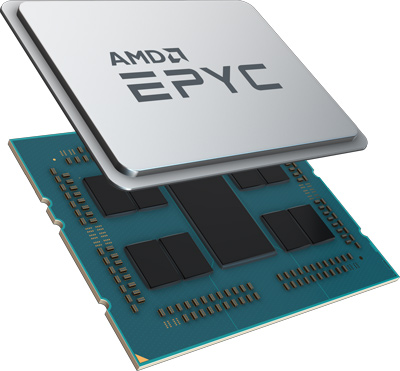
The next generation of AMD EPYC has arrived, providing incredible compute, IO and bandwidth capability – designed to meet the huge demand for more compute in big data analytics, HPC and cloud computing.
- Built on 7nm advanced process technology, allowing for denser compute capabilities with lower power consumption
- Up to 64 core per CPU, built using Zen 2 high performance cores and AMD’s innovative chiplet architecture
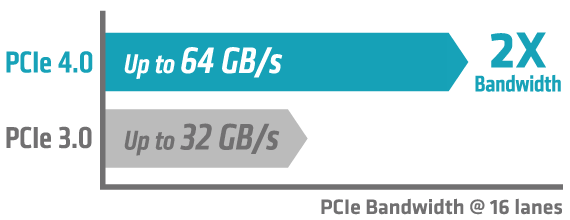
- Supporting PCIe® 4.0 with a bandwidth of up to 64GB/s, twice of PCIe 3.0
- Embedded security protection to help defend your CPU, applications, and data
2X PerformancePer Socket & IO Bandwidth
vs AMD EPYC Naples4X Floating PointPer Socket
vs AMD EPYC NaplesMZ72-HB0 Product Overview
MZ72-HB0 Motherboard Block Diagram
PCIe® 4.0 Ready
AMD EPYC Rome is ready to support PCIe® 4.0 with a bandwidth of 64GB/s, twice that of PCIe 3.0. This doubles the bandwidth available from the CPU to peripheral devices such as graphics cards, storage devices and high speed network cards. GIGABYTE’s AMD EPYC 7002 Series server platforms are ready to be used with a new generation of PCIe 4.0 devices such as AMD’s Radeon MI50 GPGPU.
* The PCIe 4.0 standard supports a 16 GT/s bit rate, (roughly 2GB/s per single lane) as opposed to 8GT/s bit rate for PCIe 3.0 (1GB/s).
Higher Memory Speed
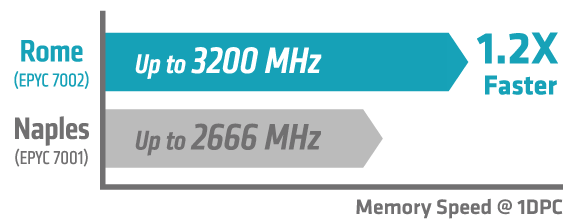
AMD EPYC’s Rome 7002 Series processors feature faster 8 channel DDR4 memory lanes, supporting RDIMM or LRDIMM memory modules with a speed of up to 3200MHz (1 DIMM per channel)
Max TDP Support
GIGABYTE’s AMD EPYC server platforms come ready to support the full list of AMD EPYC 7002 Series processors: up to 225W (standard TDP) / 280W (cTDP)

Data Security
TPM 2.0 Module
GIGABYTE’s AMD EPYC Server is designed to support Trusted Platform Modules (TPM - discrete cryptographic on-board processors).

Carefully Selected Components
GIGABYTE’s passive components are carefully selected to guarantee a stable operating environment and allow the processors and the memory to deliver their maximum performance. GIGABYTE’s server motherboards are built with long lasting components for a high degree of reliability and durability.

GIGABYTE Management Console
GIGABYTE server utilizes the AMI MegaRAC SP-X solution for BMC server management, has a browser-based graphical user interface, and is feature-rich and easy to use.
- RESTful API support includes the latest DMTF standard of Redfish. Allows integration with 3rd party applications for server management
- Including HTML5 based iKVM remote management client, no need to purchase other additional licenses
- Detailed FRU information from SMBIOS
- 10 to 30 seconds pre-event automatic recording function
- SAS / RAID controller monitoring function
GIGABYTE Server Management (GSM)

GIGABYTE Server Management (GSM) is GIGABYTE’s proprietary multiple server remote management software platform, available as a free download from each GIGABYTE server product page. GSM is compatible with either IPMI or Redfish connection interfaces, and comprises the following sub-programs:
- GSM Server
A software program with an easy to use browser-based GUI to enable global remote monitoring and management of multiple GIGABYTE servers via each server node’s BMC. - GSM CLI (GBT Utility)
A command-line interface program to enable global remote monitoring and management of multiple GIGABYTE servers via each server node’s BMC. - GSM Agent
A software program installed locally on each GIGABYTE server node that retrieves additional node information (CPU/Mem/HDD/PCI/…) from the OS and passes it to the BMC. This information can then be utilized by GSM Server or GSM CLI. - GSM Mobile
A remote server management mobile APP, available for both Android and iOS. - GSM Plugin
A plugin that allows the user to manage and monitor GIGABYTE server nodes within VMware’s vCenter.