BACHMANN
Ready - To - Run
HO Scale
NEW in the box

Out-Of-Production
Discontinued by Manufacturer
A cable car (usually known as a cable tram outside North America) is a type of cable railway used for mass transit in which rail cars are hauled by a continuously moving cable running at a constant speed. Individual cars stop and start by releasing and gripping this cable as required. Cable cars are distinct from funiculars, where the cars are permanently attached to the cable.
History
The first cable-operated railway, employing a moving rope that could be picked up or released by a grip on the cars was the Fawdon Wagonway in 1826, a colliery railway line. The London and Blackwall Railway, which opened for passengers in east London, England, in 1840 used such a system. The rope available at the time proved too susceptible to wear and the system was abandoned in Favor of steam locomotives after eight years. In America, the first cable car installation in operation probably was the West Side and Yonkers Patent Railway in New York City, as its first-ever elevated railway which ran from 1 July 1868 to 1870. The cable technology used in this elevated railway involved collar-equipped cables and claw-equipped cars, proving cumbersome. The line was closed and rebuilt, reopening with steam locomotives.
Other cable cars to use grips were those of the Clay Street Hill Railroad, which later became part of the San Francisco cable car system. The building of this line was promoted by Andrew Smith Hallidie with design work by William Eppelsheimer, and it was first tested in 1873. The success of these grips ensured that this line became the model for other cable car transit systems, and this model is often known as the Hallidie Cable Car.
In 1881 the Dunedin cable tramway system opened in Dunedin, New Zealand and became the first such system outside San Francisco. For Dunedin, George Smith Duncan further developed the Hallidie model, introducing the pull curve and the slot brake; the former was a way to pull cars through a curve, since Dunedin's curves were too sharp to allow coasting, while the latter forced a wedge down into the cable slot to stop the car. Both of these innovations were generally adopted by other cities, including San Francisco.
In Australia, the Melbourne cable tramway system operated from 1885 to 1940. It was one of the most extensive in the world with 1200 trams and trailers operating over 15 routes with 103 km (64 miles) of track. Sydney also had a couple of cable tram routes.
Cable cars rapidly spread to other cities, although the major attraction for most was the ability to displace horsecar (or mule-drawn) systems rather than the ability to climb hills. Many people at the time viewed horse-drawn transit as unnecessarily cruel, and the fact that a typical horse could work only four or five hours per day necessitated the maintenance of large stables of draft animals that had to be fed, housed, groomed, medicated and rested. Thus, for a period, economics worked in favor of cable cars even in relatively flat cities.
For example, the Chicago City Railway, also designed by Eppelsheimer, opened in Chicago in 1882 and went on to become the largest and most profitable cable car system. As with many cities, the problem in flat Chicago was not one of incline, but of transportation capacity. This caused a different approach to the combination of grip car and trailer. Rather than using a grip car and single trailer, as many cities did, or combining the grip and trailer into a single car, like San Francisco's California Cars, Chicago used grip cars to pull trains of up to three trailers.
In 1883 the New York and Brooklyn Bridge Railway was opened, which had a most curious feature: though it was a cable car system, it used steam locomotives to get the cars into and out of the terminals. After 1896 the system was changed to one on which a motor car was added to each train to maneuver at the terminals, while en route, the trains were still propelled by the cable.
CITY SAN FRANCISCO STYLE CABLE CAR
Units are Lighted
Units have interiors
With Cable Grip Man Figurine
Stock photo from Manufacturer
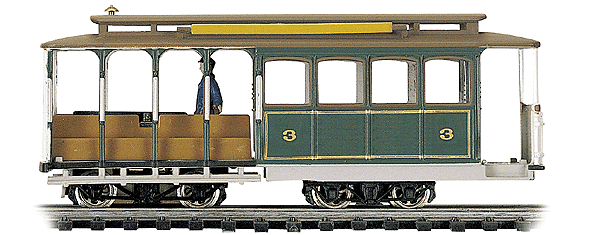
CITY SAN FRANCISCO STYLE CABLE CAR
Motive powered – runs on HO scale track
Popular Cable car look & design
Improved Drivetrain with metal wheels
Performs best on 15" Radius curves or greater.
Ho scale 1: 87
Cable cars were a staple mode of transportation in the late 1800's and early 1900's. Cable cars have stood the test of time and are currently running today…..the most famous cable cars can be found in San Francisco CA. The iconic cable car returns to Bachmann product line with an improved drivetrain, and colorful paint schemes. Features include; Motive powered – runs on HO scale track, popular Cable car look & design, improved drivetrain, performs best on 15" Radius curves or greater, HO scale 1: 87.
check out the Automatic 5 Stop Reversing unit (sold in separate listing) and let your Cable car make 5 stops going across your layout and automatically reverse to make 5 stops on the return trip an eye popping addition to a downtown scene.
Cable Car with Grip Man - GREEN & Tan - HO Scale
Item Specification
Product Dimensions 4.1 x 1.4 x 1.7 inches
We do combine shipping on
multiple purchases. If you do a Buy It
Now the transaction requires immediate payment for each item separately.
What you need to do is put it in the shopping cart and then
when you go to checkout it will recalculate the shipping and combine the items
for you.
If you pay first I am unable to make any adjustment because
ebay has then taken its fees on the shipping as well. If you have a concern message me and I can
work something out for you.
THIS IS AN ASSEMBLED Item
The item is NEW in the original box from old stock
PERSONAL INVENTORY:
Many of these unique items are from my personal inventory
which was accumulated over the years.
They are hard to part with but due to downsizing in retirement they too
are looking for a good home which can appreciate and enjoy them.
STORE INVENTORY:
Having discontinued my Hobby Store and left frigid
“Minne-Snow-Da” I have relocated and retired to the warmer part of the country,
Down to Sunny TEXAS.
I will be Liquidating the remaining stock.
I will be listing items over the next year or so clearing
them out.
Please see the photos we take actual photos of each item
Most of these items are New in the box removed only to take
photos of them.