ROUNDHOUSE
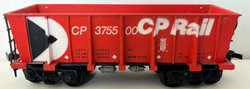
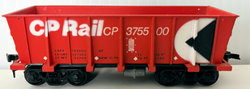
1714 HO-scale CP RAIL RED 26-ft HIGH SIDE ORE CAR #375500 RTR with DIECAST
METAL FRAME BUILT READY-TO-RUN
-------------------------------------------
Additional Information from
Internet Encyclopedia
The Canadian National Railway
Company[a] (French: Compagnie des chemins de fer nationaux du Canada)
(reporting mark CN) is a Canadian Class I freight railway headquartered in
Montreal, Quebec, which serves Canada and the Midwestern and Southern United States.
It is one of Canada's two main freight rail companies, along with Canadian
Pacific Kansas City.
CN is Canada's largest railway,
in terms of both revenue and the physical size of its rail network, spanning
Canada from the Atlantic coast in Nova Scotia to the Pacific coast in British
Columbia across approximately 20,000 route miles (32,000 km) of track. In the
late 20th century, CN gained extensive capacity in the United States by taking
over such railroads as the Illinois Central.
The Canadian National Railways
(CNR) was incorporated on June 6, 1919, comprising several railways that had
become bankrupt and fallen into Government of Canada hands, along with some
railways already owned by the government. Primarily a freight railway, CN also
operated passenger services until 1978, when they were assumed by Via Rail. The
only passenger services run by CN after 1978 were several mixed trains (freight
and passenger) in Newfoundland, and several commuter trains both on CN's
electrified routes and towards the South Shore in the Montreal area (the latter
lasted without any public subsidy until 1986). The Newfoundland mixed trains
lasted until 1988, while the Montreal commuter trains are now operated by
Montreal's Exo.
Canadian National Railways was
born out of both wartime and domestic urgency. Until the rise of the personal
automobile and creation of taxpayer-funded all-weather highways, railways were
the only viable long-distance land transportation available in Canada. As such,
their operation consumed a great deal of public and political attention. Canada
was one of many nations to engage in railway nationalization in order to
safeguard critical transportation infrastructure during the First World War.
In
the early 20th century, many governments were taking a more interventionist
role in the economy, foreshadowing the influence of economists like John
Maynard Keynes. This political trend, combined with broader geo-political
events, made nationalization an appealing choice for Canada. The Winnipeg
General Strike of 1919 and allied involvement in the Russian Revolution seemed
to validate the continuing process. The need for a viable rail system was
paramount in a time of civil unrest and foreign military action.