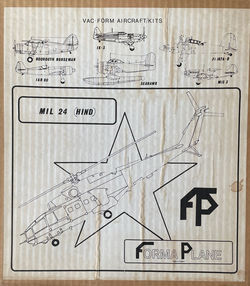
FORMA PLANE 1/72-SCALE VACUFORM MIL Mi-24 HIND ATTACK
HELICOPTER KIT SOVIET AF
OPEN UNBUILT VACUFORM MODEL KIT – INVENTORIED 100%
COMPLETE
IF YOU HAVE ANY QUESTIONS OR CONCERNS, PLEASE ASK
ME BEFORE BIDDING / PURCHASING – I WANT EVERYONE TO BE 100% SATISFIED WITH NO
SURPRISES OR MIS-UNDERSTANDINGS
IF YOU ARE BUYING MULTIPLE KITS FROM ME AT THE
SAME TIME (OR EXPECT TO IN THE NEAR TERM) THEN LET ME KNOW AND I WILL COMBINE
ALL INTO A SINGLE SHIPMENT AND ADJUST THE FINAL INVOICE TO REFLECT THE MOST
ECONOMICAL SHIPPING METHOD AVAILABLE TO YOUR ADDRESS
----------------------------
Additional Information from
Internet Encyclopedia
The Mil Mi-24 (Russian: Миль
Ми-24; NATO reporting name: Hind) is a large helicopter gunship, attack
helicopter and low-capacity troop transport with room for eight passengers.[1]
It is produced by Mil Moscow Helicopter Plant and has been operated since 1972
by the Soviet Air Force and its successors, along with 48 other nations.
In NATO circles, the export
versions, Mi-25 and Mi-35, are denoted with a letter suffix as "Hind
D" and "Hind E". Soviet pilots called the Mi-24 the "flying
tank" (Russian: летающий танк, romanized: letayushchiy tank), a term used
historically with the famous World War II Soviet Il-2 Shturmovik armored ground
attack aircraft. More common unofficial nicknames were "Galina" (or
"Galya"), "Crocodile" (Russian: Крокодил, romanized:
Krokodil), due to the helicopter's camouflage scheme, and "Drinking
Glass" (Russian: Стакан, romanized: Stakan), because of the flat glass
plates that surround earlier Mi-24 variants' cockpits.
Development
During the early 1960s, it became
apparent to Soviet designer Mikhail Mil that the trend towards ever-increasing
battlefield mobility would result in the creation of flying infantry fighting
vehicles, which could be used to perform both fire support and infantry
transport missions. The first expression of this concept was a mock-up unveiled
in 1966 in the experimental shop of the Ministry of Aircraft's factory number
329, where Mil was head designer. The mock-up designated V-24 was based on
another project, the V-22 utility helicopter, which never flew. The V-24 had a
central infantry compartment that could hold eight troops sitting back to back,
and a set of small wings positioned to the top rear of the passenger cabin,
capable of holding up to six missiles or rockets and a twin-barreled GSh-23L
cannon fixed to the landing skid.
Mil Mi-24A
Mil proposed the design to the
heads of the Soviet armed forces. While he had the support of a number of
strategists, he was opposed by several more senior members of the armed forces,
who believed that conventional weapons were a better use of resources. Despite
the opposition, Mil managed to persuade the defence minister's first deputy,
Marshal Andrey A. Grechko, to convene an expert panel to look into the matter.
While the panel's opinions were mixed, supporters of the project eventually
held sway and a request for design proposals for a battlefield support
helicopter was issued. The development and use of gunships and attack
helicopters by the US Army during the Vietnam War convinced the Soviets of the
advantages of armed helicopter ground support, and fostered support for the
development of the Mi-24.
Mil engineers prepared two basic
designs: a 7-ton single-engine design and a 10.5-ton twin-engine design, both
based on the 1,700 hp Izotov TV3-177A turboshaft. Later, three complete
mock-ups were produced, along with five cockpit mock-ups to allow the pilot and
weapon station operator positions to be fine-tuned.
The Kamov design bureau
suggested an army version of their Ka-25 ASW helicopter as a low-cost option.
This was considered but later dropped in favor of the new Mil twin-engine
design. A number of changes were made at the insistence of the military,
including the replacement of the 23 mm cannon with a rapid-fire heavy machine
gun mounted in a chin turret, and the use of the 9K114 Shturm (AT-6 Spiral)
anti-tank missile.
A directive was issued on 6 May
1968 to proceed with the development of the twin-engine design. Work proceeded
under Mil until his death in 1970. Detailed design work began in August 1968
under the codename Yellow 24. A full-scale mock-up of the design was reviewed
and approved in February 1969. Flight tests with a prototype began on 15
September 1969 with a tethered hover, and four days later the first free flight
was conducted. A second prototype was built, followed by a test batch of ten
helicopters.
Acceptance testing for the
design began in June 1970, continuing for 18 months. Changes made in the design
addressed structural strength, fatigue problems and vibration levels. Also, a
12-degree anhedral was introduced to the wings to address the aircraft's
tendency to Dutch roll at speeds in excess of 200 km/h (124 mph), and the
Falanga missile pylons were moved from the fuselage to the wingtips. The tail
rotor was moved from the right to the left side of the tail, and the rotation
direction reversed. The tail rotor now rotated up on the side towards the front
of the aircraft, into the downwash of the rotor, which increased the efficiency
of the tail rotor. A number of other design changes were made until the
production version Mi-24A (izdeliye 245) entered production in 1970, obtaining
its initial operating capability in 1971 and was officially accepted into the
state arsenal in 1972.
In 1972, following completion of
the Mi-24, development began on a unique attack helicopter with transport
capability. The new design had a reduced transport capability (three troops
instead of eight) and was called the Mi-28, and that of the Ka-50 attack
helicopter, which is smaller and more maneuverable and does not have the large
cabin for carrying troops. In October 2007, the Russian Air Force announced it
would replace its Mi-24 fleet with Mi-28Ns and Ka-52s by 2015.[5][6] However,
after the successful operation of the type in Syria it was decided to keep it
in service and upgrade it with new electronics, sights, arms and night vision
goggles.
Design
The core of the aircraft was
derived from the Mil Mi-8 (NATO reporting name "Hip") with two
top-mounted turboshaft engines driving a mid-mounted 17.3 m five-blade main
rotor and a three-blade tail rotor. The engine configuration gave the aircraft
its distinctive double air intake. Original versions have an angular greenhouse-style
cockpit; Model D and later have a characteristic tandem cockpit with a
"double bubble" canopy. Other airframe components came from the Mi-14
"Haze". Two mid-mounted stub wings provide weapon hardpoints, each
offering three stations, in addition to providing lift. The loadout mix is
mission dependent; Mi-24s can be tasked with close air support, anti-tank
operations, or aerial combat.
The Mi-24's titanium rotor
blades are resistant to 12.7 mm rounds. The cockpit is protected by
ballistic-resistant windscreens and a titanium-armored tub. The cockpit and
crew compartment are overpressurized to protect the crew in NBC conditions.
Flight characteristics
Considerable attention was given
to making the Mi-24 fast. The airframe was streamlined, and fitted with
retractable tricycle undercarriage landing gear to reduce drag. At high speed,
the wings provide considerable lift (up to a quarter of total lift). The main
rotor was tilted 2.5° to the right from the fuselage to compensate for
translating tendency at a hover. The landing gear was also tilted to the left
so that the rotor would still be level when the aircraft was on the ground,
making the rest of the airframe tilt to the left. The tail was also
asymmetrical to give a side force at speed, thus unloading the tail rotor.
A modified Mi-24B, named A-10,
was used in several speed and time-to-climb world record attempts. The
helicopter had been modified to reduce weight as much as possible—one measure
was the removal of the stub wings.[4] The previous official speed record was
set on 13 August 1975 over a closed 1000 km course of 332.65 km/h (206.7 mph);
many of the female-specific records were set by the all-female crew of Galina
Rastorguyeva and Lyudmila Polyanskaya.[11] On 21 September 1978, the A-10 set
the absolute speed record for helicopters with 368.4 km/h (228.9 mph) over a
15/25 km course. The record stood until 1986, when it was broken by the current
official record holder, a modified British Westland Lynx.
Comparison to Western
helicopters
As a combination of armoured
gunship and troop transport, the Mi-24 has no direct NATO counterpart. While
the UH-1 ("Huey") helicopters were used in the Vietnam War either to
ferry troops, or as gunships, they were not able to do both at the same time.
Converting a UH-1 into a gunship meant stripping the entire passenger area to
accommodate extra fuel and ammunition, and removing its troop transport
capability. The Mi-24 was designed to do both, and this was greatly exploited
by airborne units of the Soviet Army during the 1980–89 Soviet–Afghan War. The
closest Western equivalent was the Sikorsky S-67 Blackhawk, which used many of
the same design principles and was also built as a high-speed, high-agility
attack helicopter with limited troop transport capability using many components
from the existing Sikorsky S-61. The S-67, however, was never adopted for
service.[1] Other Western equivalents are the Romanian Army's IAR 330, which is
a licence-built armed version of the Aérospatiale SA 330 Puma, and the MH-60
Direct Action Penetrator, a special purpose armed variant of the Sikorsky UH-60
Black Hawk. The Hind has been called the world's only "assault
helicopter" due to its combination of firepower and troop-carrying
capability.
Operational history
Ogaden War (1977–1978)
The first combat use of the
Mi-24 was with the Ethiopian forces during the Ogaden War against Somalia. The
helicopters formed part of a massive airlift of military equipment from the
Soviet Union, after the Soviets switched sides towards the end of 1977. The
helicopters were instrumental in the combined air and ground assault that
allowed the Ethiopians to retake the Ogaden by the beginning of 1978.
Chadian–Libyan conflict
(1978–1987)
The Libyan air force used Mi-24A
and Mi-25 units during their numerous interventions in Chad's civil war. The
Mi-24s were first used in October 1980 in the battle of N'Djamena, where they
helped the People's Armed Forces seize the capital.
In March 1987, the Armed Forces
of the North, which were backed by the US and France, captured a Libyan air
force base at Ouadi-Doum in Northern Chad. Among the aircraft captured during
this raid were three Mi-25s. These were supplied to France, which in turn sent
one to the United Kingdom and one to the USA.
Soviet war in Afghanistan
(1979–1989)
The aircraft was operated
extensively during the Soviet–Afghan War, mainly for bombing Mujahideen
fighters. When the U.S. supplied heat-seeking Stinger missiles to the
Mujahideen, the Soviet Mi-8 and Mi-24 helicopters proved to be favorite targets
of the rebels.
It is difficult to find the
total number of Mi-24s used in Afghanistan.[14] At the end of 1990, the whole
Soviet Army had 1,420 Mi-24s.[15] During the Afghan war, sources estimated the
helicopter strength to be as much as 600 machines, with up to 250 being
Mi-24s.[16] Whereas a (formerly secret) 1987 CIA report says that the number of
Mi-24s in theatre increased from 85 in 1980 to 120 in 1985.
First deployment and combat
In April 1979, Mi-24s were
supplied to the Afghan government to deal with Mujahideen guerrillas.[18] The
Afghan pilots were well-trained and made effective use of their machines, but
the Mujahideen were not easy targets. The first Mi-24 to be lost in action was
shot down by guerrillas on 18 July 1979.
Soviet
"Helicopter-tank" operation in Afghanistan
Despite facing strong resistance
from Afghan rebels, the Mi-24 proved to be very destructive. The rebels called
the Mi-24 "Shaitan-Arba" (Satan's Chariot)".[18] In one case, an
Mi-24 pilot who was out of ammunition managed to rescue a company of infantry
by maneuvering aggressively towards Mujahideen guerrillas and scaring them off.
The Mi-24 was popular with ground troops, since it could stay on the
battlefield and provide fire as needed, while "fast mover" strike
jets could only stay for a short time before heading back to base to refuel.
The Mi-24's favoured munition
was the 80-millimetre (3.1 in) S-8 rocket, the 57 mm (2.2 in) S-5 having proven
too light to be effective. The 23 mm (0.91 in) gun pod was also popular. Extra
rounds of rocket ammunition were often carried internally so that the crew
could land and self-reload in the field. The Mi-24 could carry ten 100-kilogram
(220 lb) iron bombs for attacks on camps or strongpoints, while harder targets
could be dealt with a load of four 250-kilogram (550 lb) or two 500-kilogram
(1,100 lb) iron bombs. Some Mi-24 crews became experts at dropping bombs
precisely on targets. Fuel-air explosive bombs were also used in a few
instances, though crews initially underestimated the sheer blast force of such
weapons and were caught by the shock waves. The 9K114 Shturm was used
infrequently, largely due to a lack of targets early in the war that required
the precision and range the missile offered and a need to keep to stocks of
anti tank missiles in Europe. After the Mujahideen got access to more advanced
anti aircraft weapons later in the war the Shturm was used more often by Mi-24
units.
Combat experience quickly
demonstrated the disadvantages of having an Mi-24 carrying troops. Gunship
crews found the soldiers a concern and a distraction while being shot at, and
preferred to fly lightly loaded anyway, especially given their operations from
high ground altitudes in Afghanistan. Mi-24 troop compartment armour was often
removed to reduce weight. Troops would be carried in Mi-8 helicopters while the
Mi-24s provided fire support.
Mil Mi-24/25
It proved useful to carry a
technician in the Mi-24's crew compartment to handle a light machine gun in a
window port. This gave the Mi-24 some ability to "watch its back"
while leaving a target area. In some cases, a light machine gun was fitted on
both sides to allow the technician to move from one side to the other without
having to take the machine gun with him.
This weapon configuration still
left the gunship blind to the direct rear, and Mil experimented with fitting a
machine gun in the back of the fuselage, accessible to the gunner through a
narrow crawl-way. The experiment was highly unsuccessful, as the space was
cramped, full of engine exhaust fumes, and otherwise unbearable. During a
demonstration, an overweight Soviet Air Force general got stuck in the
crawl-way. Operational Mi-24s were retrofitted with rear-view mirrors to help
the pilot spot threats and take evasive action.
Besides protecting helicopter
troop assaults and supporting ground actions, the Mi-24 also protected convoys,
using rockets with flechette warheads to drive off ambushes; performed strikes
on predesignated targets; and engaged in "hunter-killer" sweeps.
Hunter-killer Mi-24s operated at a minimum in pairs, but were more often in
groups of four or eight, to provide mutual fire support. The Mujahideen learned
to move mostly at night to avoid the gunships, and in response the Soviets
trained their Mi-24 crews in night-fighting, dropping parachute flares to
illuminate potential targets for attack. The Mujahideen quickly caught on and
scattered as quickly as possible when Soviet target designation flares were lit
nearby.
Attrition in Afghanistan
The war in Afghanistan brought
with it losses by attrition. The environment itself, dusty and often hot, was
rough on the machines; dusty conditions led to the development of the PZU air
intake filters. The rebels' primary air-defense weapons early in the war were
heavy machine guns and anti-aircraft cannons, though anything smaller than a 23
millimetre shell generally did not do much damage to an Mi-24. The cockpit
glass panels were resistant to 12.7 mm (.50 in caliber) rounds.
The rebels also quickly began to
use Soviet-made and US shoulder-launched, man-portable air defense MANPADS
missiles such as the Strela and Redeye which had either been captured from the
Soviets or their Afghan allies or were supplied from Western sources. Many of
them came from stocks that the Israelis had captured during wars with Soviet
backed states in the Middle East. Owing to a combination of the limited
capabilities of these early types of missiles, poor training and poor material
condition of the missiles, they were not particularly effective. Instead, the
RPG-7, originally developed as an antitank weapon, was the first effective
countermeasure to the Hind. The RPG-7, not designed for air defense, had
inherent shortcomings in this role. When fired at the angles needed to hit
aerial targets, the backblast could easily wound the shooter, and the
inevitable cloud of smoke and dust made it easy for gunners to spot the
shooter's position.
From 1986, the CIA began
supplying the Afghan rebels with newer Stinger shoulder-launched, heat-seeking
SAMs.[23] These were a marked improvement over earlier weapons. Unlike the
Redeye and SA-7, which only locked on onto infrared emissions, the Stinger
could lock onto both infrared and ultraviolet emissions. This enabled the
operator to engage an aircraft from all angles rather than just the tail and
made it significantly more resistant to countermeasures like flares. In
addition the Mil helicopters, particularly the Mi-24, suffered from a design
flaw in the configuration of their engines that made them highly vulnerable to
the Stinger. The Mi-24, along with the related Mi-8 and Mi-17 helicopters, had
its engines placed in an inline configuration in an attempt to streamline the
helicopter to increase speed and minimize the aircraft's overall frontal
profile to incoming fire in a head on attack. However this had the opposite
effect of leaking all the exhaust gasses from the Mi-24's engines directly out
the side of the aircraft and away from the helicopter's rotor wash, creating
two massive sources of heat and ultraviolet radiation for the Stinger to lock
onto.[24] The inline placement of the engines was seen as so problematic in
this regard that Mil designers abandoned the configuration on the planned
successor to the Mi-24, the Mil Mi-28, in favor of an engine placement more
akin to Western attack helicopters which vents the exhaust gasses into the
helicopter's main rotor wash to dissipate heat.
Initially, the attack doctrine
of the Mi-24 was to approach its target from high altitude and dive downwards.
After the introduction of the Stinger, doctrine changed to "nap of the
earth" flying, where they approached very low to the ground and engaged
more laterally, popping up to only about 200 ft (61 m) in order to aim rockets
or cannons.[25] Countermeasure flares and missile warning systems would be
installed in all Soviet Mil Mi-2, Mi-8, and Mi-24 helicopters, giving pilots a
chance to evade missiles fired at them. Heat dissipation devices were also
fitted to exhausts to decrease the Mi-24's heat signature. Tactical and
doctrinal changes were introduced to make it harder for the enemy to deploy
these weapons effectively. These reduced the Stinger threat, but did not
eliminate it.
Mi-24s were also used to shield
jet transports flying in and out of Kabul from Stingers. The gunships carried
flares to blind the heat-seeking missiles. The crews called themselves
"Mandatory Matrosovs", after a Soviet hero of World War II who threw
himself across a German machine gun to let his comrades break through.
According to Russian sources, 74
helicopters were lost, including 27 shot down by Stinger and two by Redeye. In
many cases, the helicopters with their armor and durable construction could
withstand significant damage and able to return to base.