ATHEARN
Ready-To-Run
HO Scale
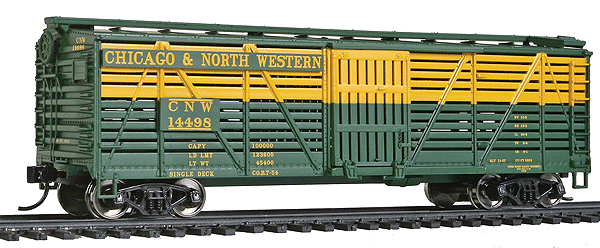
40 ft LIVESTOCK / CATTLE Car
w/Dreadnaught Ends 6-Pack -
Ready to Run --
with SLIDING DOORS
Chicago & North Western(TM) (green, yellow)
This is a set of 6 LIVESTOCK Cars
Package of 6 cars
Lettered for:
CHICAGO NORTHWESTERN
Featuring the " CNW " Logo and paint scheme
Out - Of - Production
HISTORY
In railroad terminology, a stock car or cattle car is a type of rolling stock used for carrying livestock (not carcasses) to market. A traditional stock car resembles a boxcar with louvered instead of solid car sides (and sometimes ends) for the purpose of providing ventilation; stock cars can be single-level for large animals such as cattle or horses, or they can have two or three levels for smaller animals such as goats, sheep, pigs, and poultry. Specialized types of stock cars have been built to haul live fish and shellfish and circus animals such as camels and elephants. Until the 1880s, when the Mather Stock Car Company and others introduced "more humane" stock cars, death rates could be quite high as the animals were hauled over long distances. Improved technology and faster shipping times have greatly reduced deaths.
Initial use and development
Rail cars have been used to transport livestock since the 1830s. The first shipments in the United States were made via the Baltimore and Ohio Railroad in general purpose, open-topped cars with semi-open sides. Thereafter, and until 1860, the majority of shipments were made in conventional boxcars that had been fitted with open-structured iron-barred doors for ventilation. Some railroads constructed "combination" cars that could be utilized for carrying both live animals as well as conventional freight loads.
Getting food animals to market required herds to be driven hundreds of miles to railheads in the Midwest, where they were loaded into stock cars and transported eastward to regional processing centers. Driving cattle across the plains led to tremendous weight loss, and a number of animals were typically lost along the way. Upon arrival at the local processing plant, livestock were either slaughtered by wholesalers and delivered fresh to nearby butcher shops for retail sale, smoked, or packed for shipment in barrels of salt.
The suffering of animals in transit as a result of hunger, thirst, and injury, was considered by many to be inherent to the shipping process, as was the loss in weight during shipment. A certain percentage of animal deaths on the way to market was even considered normal (6% for cattle and 9% for sheep on average, according to a congressional inquiry, and carcasses of dead animals were often disposed of along the tracks to be devoured by scavengers, though some were sold to glue factories or unscrupulous butchers. Increased train speeds reduced overall transit times, though not enough to offset the deleterious conditions the animals were forced to endure.
Some of the early railroad companies attempted to alleviate the problems by adding passenger cars to the trains that hauled early stock cars. The New Jersey Railroad and Transportation Company followed this practice as early as 1839, and the Erie Railroad advertised that livestock handlers could ride with their herds in special cabooses. These early passenger accommodations were the predecessors of the later "drovers caboose" designs that were used until the mid-20th century. Railroad operating rules for livestock and handlers that rode the trains were very limited, as the handlers were private contractors or employees of the shippers, not employed by the railroads. A 1948 rulebook for the Atchison, Topeka and Santa Fe Railway, for example, lists only one rule regarding livestock:
... Wishes of attendants regarding care of livestock should be ascertained and assistance rendered in caring for such shipments. ... In absence of special instructions, hog shipments should be watered as necessary. Particular attention must be given to stock unaccompanied by attendants."
However, even with livestock handlers and faster schedules, many stock cars were still listed on company rosters with open roofs and very little in the way of improved conditions for the livestock themselves. Most railroads resisted the call for as long as possible from shippers for improvements to cars specifically designed to carry livestock. The railroads generally preferred to use standard boxcars because that type of car proved much more versatile in the number of different types of loads it could carry.
When the railroads and cattle industry failed to act quickly enough to correct these perceived deficiencies, the government and even the general public went into action. Claims were made that the meat of neglected animals was unfit for human consumption. In 1869, Illinois passed the first laws to limit the animals' time on board and required them to be given 5 hours' rest for every 28 in transit. Some railroads stepped in with their own new designs at this time, such as the Pennsylvania Railroad's class KA stock car, a design first published in 1869 which featured a removable second deck for transporting pigs or sheep. However, double-deck stock cars had been experimented with as early as the 1830s on the Liverpool and Manchester Railway in England. Other states such as Ohio and Massachusetts soon followed with similar legislation, though effective federal laws were not enacted until the passing of the Federal Meat Inspection Act of 1906.
The first patented stock car designs that actually saw use on American railroads were created by Zadok Street. Street's designs (U.S. patent 106,887 and U.S. patent 106,888, both issued on August 30, 1870) were first used in 1870 on shipments between Chicago and New York City. They were designed for trips to take 90 hours between the two cities and included water troughs fed from tanks under the floor, and food troughs fed from hoppers in the roof. Street's design proved impractical as each car could carry only 6 steers. Alonzo Mather, a Chicago clothing merchant who founded the Mather Stock Car Company, designed a new stock car in 1880 that was among the first practical designs to include amenities for feeding and watering the animals while en route. Mather was awarded a gold medal in 1883 by the American Humane Association for the humane treatment afforded to animals in his stock cars. Minneapolis' Henry C. Hicks patented a convertible boxcar/stock car in 1881, which was improved in 1890 with features that included a removable double deck. George D. Burton of Boston introduced his version of the humane stock car in 1882, which was placed into service the following year. The Burton Stock Car Company's design provided sufficient space so as to allow the animals to lie down in transit on a bed of straw.
In 1880, American railroads rostered around 28,600 stock cars. With the innovations developed by Mather, Hicks and others, this number nearly doubled in 1890 to 57,300, and was nearly tripled in 1910 to 78,800. During this period, the cars' capacities also increased. In the 1870s few stock cars were built longer than 28 ft (8.53 m), and could carry about 10 short tons (9.1 t; 8.9 long tons) of stock. Car lengths increased to an average of 34 ft (10.36 m) in the 1880s and stock cars of this period regularly carried 20 short tons (18.1 t; 17.9 long tons) of stock.
Certain costly inefficiencies were inherent in the process of transporting live animals by rail, particularly because some sixty percent of the animal's mass is composed of inedible matter. Even after the humane advances cited above were put into common practice, many animals weakened by the long drive died in transit, further increasing the per-unit shipping cost. The ultimate solution to these problems was to devise a method to ship dressed meats from regional packing plants to the East Coast markets in the form of a refrigerated boxcar.
Refrigerated cars
A number of attempts were made during the mid-19th century to ship agricultural products via rail car. In 1857, the first consignment of dressed beef was carried in ordinary boxcars retrofitted with bins filled with ice. Detroit's William Davis patented a refrigerator car that employed metal racks to suspend the carcasses above a frozen mixture of ice and salt. He sold the design in 1868 to George Hammond, a Chicago meatpacker, who built a set of cars to transport his products to Boston.
In 1878, meat packer Gustavus Swift hired engineer Andrew Chase to design a ventilated car, one that proved to be a practical solution to providing temperature-controlled carriage of dressed meats and allowed Swift & Company to ship their products all over the United States, and even internationally. The refrigerator car radically altered the meat business. Swift's attempts to sell Chase's design to the major railroads were unanimously rebuffed, as the companies feared that they would jeopardize their considerable investments in stock cars, animal pens, and feedlots if refrigerated meat transport gained wide acceptance.
In response, Swift financed the initial production run on his own, then—when the American railroads refused his business—he contracted with the Grand Trunk Railway (who derived little income from transporting live cattle) to haul the cars into Michigan and then eastward through Canada. In 1880 the Peninsular Car Company (subsequently purchased by ACF) delivered to Swift the first of these units, and the Swift Refrigerator Line (SRL) was created. Within a year the Line's roster had risen to nearly 200 units, and Swift was transporting an average of 3,000 carcasses a week to Boston. Competing firms such as Armour and Company quickly followed suit.
FEATURES:
Sliding Doors
Roof Walkways
Grab Irons
Ladders
Underbody Detail
Crisp, Detailed, realistic lettering
RALISTIC Satin paint finish
Trucks with Finely Molded side frames
Standard Draft gear box
Needle Point axles
Magnetically operated, body mounted couplers
Added Weight for optimum tracking
SHIPPING:
We do combine shipping on
multiple purchases. If you do a Buy It
Now the transaction requires immediate payment for each item separately.
What you need to do is put it in the shopping cart and then
when you go to checkout it will recalculate the shipping and combine the items
for you.
If you pay first I am unable to make any adjustment because
ebay has then taken its fees on the shipping as well. If you have a concern message me and I can
work something out for you.
THIS IS AN ASSEMBLED Item
The item is NEW in the original box from old stock
PERSONAL INVENTORY:
Many of these unique items are from my personal inventory
which was accumulated over the years.
They are hard to part with but due to downsizing in retirement they too
are looking for a good home which can appreciate and enjoy them.
STORE INVENTORY:
Having discontinued my Hobby Store and left frigid
“Minne-Snow-Da” I have relocated and retired to the warmer part of the country,
Down to Sunny TEXAS.
I will be Liquidating the remaining stock.
I will be listing items over the next year or so clearing
them out.
Please see the photos we take actual photos of each item
Most of these items are New in the box removed only to take
photos of them.