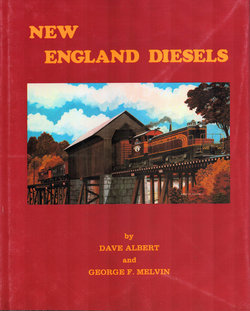
NEW
ENGLAND DIESEL LOCOMOTIVES HBDJ B&M GT CN MC CP B&A PC NY&NH
RUTLAND
HARDBOUND BOOK with DUSTJACKET
in ENGLISH by DAVE ALBERT & GEORGE F. MELVIN
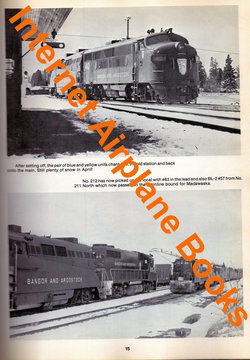
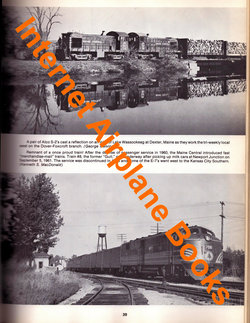
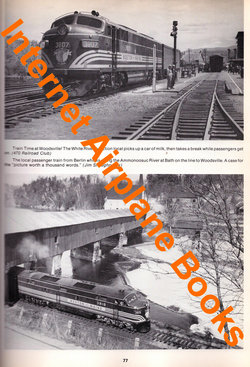
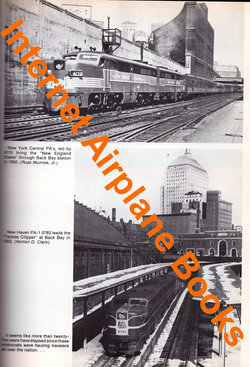
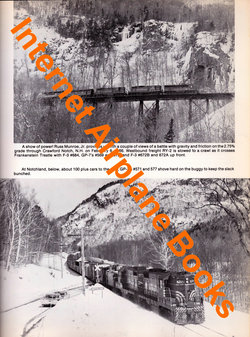
Black and white pictorial
showcasing the first generation of diesels on the Bangor & Aroostook,
Boston & Maine, Grand Trunk, Canadian National, Belfast & Moosehead
Lake, Aroostook Valley, Sanford & Eastern, Portland Terminal, Maine Central,
Suncook Valley, Claremont & Concord, East Branch & Lincoln, Wolfboro,
Vermont, Green Mountain, Central Vermont, Canadian Pacific, St. Johnsbury &
Lamoille County, Delaware & Hudson, Boston & Albany, Penn Central, New
Haven, and numerous shortlines. Photos show not only locomotives and trains but
also work trains, plow extras, helper engines and branch line mixed trains. 232
pages with index.
MAINE
NEW HAMPSHIRE
VERMONT
MASSACHUSETTS
CONNECTICUT
RHODE ISLAND
NEW ENGLAND NEIGHBORS
WORK TRAINS, PLOW EXTRAS, HELPER
ENGINES and BRANCH LINE MIXED TRAINS
-----------------------------------------
Additional Information from
Internet Encyclopedia
The Bangor and Aroostook
Railroad (reporting mark BAR) was a United States railroad company that brought
rail service to Aroostook County in northern Maine. Brightly-painted BAR
boxcars attracted national attention in the 1950s. First-generation diesel
locomotives operated on BAR until they were museum pieces. The economic
downturn of the 1980s, coupled with the departure of heavy industry from
northern Maine, forced the railroad to seek a buyer and end operations in 2003.
It was succeeded by the Montreal, Maine and Atlantic Railway.
-------------------------------------
The Boston and Maine Railroad
(reporting mark BM) was a U.S. Class I railroad in northern New England. It was
chartered in 1835, and became part of what was the Pan Am Railways network in
1983 (most of which was purchased by CSX in 2022).
At the end of 1970, B&M
operated 1,515 route-miles (2,438 km) on 2,481 miles (3,993 km) of track, not
including Springfield Terminal. That year it reported 2,744 million ton-miles
of revenue freight and 92 million passenger-miles.
-----------------------------------------
The Grand Trunk Railway
(reporting mark GT); French: Grand Tronc) was a railway system that operated in
the Canadian provinces of Quebec and Ontario and in the American states of
Connecticut, Maine, Michigan, Massachusetts, New Hampshire, and Vermont. The
railway was operated from headquarters in Montreal, Quebec, with corporate
headquarters in London, United Kingdom (4 Warwick House Street). It cost an
estimated $160 million to build.[citation needed] The Grand Trunk system and
the Canadian Government Railways were precursors of today's Canadian National
Railway.
The original charter was for a
line running from Montreal to Toronto mostly along the north shore of the St.
Lawrence River. It quickly expanded its charter eastward to Portland, Maine,
and westward to Sarnia, Ontario. Over time it added many subsidiary lines and
branches, including four important subsidiaries:
Grand Trunk Eastern which
operated in Quebec, Vermont, New Hampshire and Maine.
Central Vermont Railway which
operated in Quebec, Vermont, Massachusetts, and Connecticut.
Grand Trunk Pacific Railway
which operated in Northwestern Ontario, Manitoba, Saskatchewan, Alberta, and
British Columbia.
Grand Trunk Western Railroad
which operated in Michigan, Indiana, and Illinois.
A fifth subsidiary was the
never-completed Southern New England Railway, chartered in 1910, which would
have run from a connection with the Central Vermont at Palmer, Massachusetts,
to the deep-water, all-weather port of Providence, Rhode Island.
--------------------------------------
The Canadian National Railway
Compan (French: Compagnie des chemins de fer nationaux du Canada) (reporting
mark CN) is a Canadian Class I freight railway headquartered in Montreal,
Quebec, which serves Canada and the Midwestern and Southern United States. It
is one of Canada's two main freight rail companies, along with Canadian Pacific
Kansas City.
CN is Canada's largest railway,
in terms of both revenue and the physical size of its rail network, spanning
Canada from the Atlantic coast in Nova Scotia to the Pacific coast in British
Columbia across approximately 20,000 route miles (32,000 km) of track. In the
late 20th century, CN gained extensive capacity in the United States by taking
over such railroads as the Illinois Central.
CN is a public company with
24,671 employees and, as of July 2024, a market cap of approximately US$75
billion. CN was government-owned, as a Canadian Crown corporation, from its
founding in 1919 until being privatized in 1995. As of 2019, Bill Gates was the
largest single shareholder of CN stock, owning a 14.2% interest through Cascade
Investment and his own Gates Foundation.
From 1919 to 1978, the railway
was known as "Canadian National Railways" (CNR).
---------------------------------
The Maine Central Railroad
(reporting mark MEC) was a U. S. class 1 railroad in central and southern
Maine. It was chartered in 1856 and began operations in 1862. By 1884, Maine
Central was the longest railroad in New England. Maine Central had expanded to
1,358 miles (2,185 km) when the United States Railroad Administration assumed
control in 1917. The main line extended from South Portland, Maine, east to the
Canada–United States border with New Brunswick, and a Mountain Division
extended west from Portland to St. Johnsbury, Vermont, and north into Quebec.
The main line was double track from South Portland to Royal Junction, where it
split into a "lower road" through Brunswick and Augusta and a
"back road" through Lewiston, which converged at Waterville into
single track to Bangor and points east. Branch lines served the industrial
center of Rumford, a resort hotel on Moosehead Lake and coastal communities
from Bath to Eastport.
At the end of 1970, it operated
921 miles (1,482 km) of road on 1,183 miles (1,904 km) of track; that year, it
reported 950 million ton-miles of revenue freight. The Maine Central remained
independent until 1981, when it was purchased by Guilford Transportation
Industries and became part of what is now CSX Corporation.
----------------------------
The Central Vermont Railway
(reporting mark CV) was a railroad that operated in the U.S. states of
Connecticut, Massachusetts, New Hampshire, New York, and Vermont, as well as
the Canadian province of Quebec.
It connected Montreal, Quebec,
with New London, Connecticut, using a route along the shores of Lake Champlain,
through the Green Mountains and along the Connecticut River valley. It also
connected Montreal to Boston, in eastern Massachusetts, through a junction with
the Boston and Maine Railroad at White River Junction, Vermont.
---------------------------------
The Canadian Pacific Railway
(French: Chemin de fer Canadien Pacifique) (reporting marks CP, CPAA, MILW,
SOO), also known simply as CPR or Canadian Pacific and formerly as CP Rail
(1968–1996), was a Canadian Class I railway incorporated in 1881. The railway
is owned by Canadian Pacific Kansas City Limited, known until 2023 as Canadian
Pacific Railway Limited, which began operations as legal owner in a corporate
restructuring in 2001.
The railway is headquartered in
Calgary, Alberta. In 2023, the railway owned approximately 20,100 kilometres
(12,500 mi) of track in seven provinces of Canada and into the United States,
stretching from Montreal to Vancouver, and as far north as Edmonton. Its rail
network also served Minneapolis–St. Paul, Milwaukee, Detroit, Chicago, and
Albany, New York, in the United States.
The railway was first built
between eastern Canada and British Columbia between 1875 and 1885 (connecting
with Ottawa Valley and Georgian Bay area lines built earlier), fulfilling a
commitment extended to British Columbia[4] when it entered Confederation in
1871; the CPR was Canada's first transcontinental railway. Primarily a freight
railway, the CPR was for decades the only practical means of long-distance
passenger transport in most regions of Canada and was instrumental in the
colonization and development of Western Canada. The CPR became one of the
largest and most powerful companies in Canada, a position it held as late as
1975.[5] The company acquired two American lines in 2009: the Dakota, Minnesota
and Eastern Railroad (DM&E) and the Iowa, Chicago and Eastern Railroad
(IC&E). Also, the company owns the Indiana Harbor Belt Railroad, a Hammond,
Indiana-based terminal railroad along with Conrail Shared Assets Operations.
CPR purchased the Kansas City Southern Railway in December 2021 for US$31
billion. On April 14, 2023, KCS became a wholly owned subsidiary of CPR, and
both CPR and its subsidiaries began doing business under the name of its parent
company, CPKC.
The CPR is publicly traded on
both the Toronto Stock Exchange and the New York Stock Exchange under the
ticker CP. Its U.S. headquarters are in Minneapolis.[6] As of March 30, 2023,
the largest shareholder of Canadian Pacific stock exchange is TCI Fund Management
Limited, a London-based hedge fund that owns 6% of the company.
---------------------------------------
The Delaware and Hudson Railway
(D&H) (reporting mark DH) is a railroad that operates in the Northeastern
United States. In 1991, after more than 150 years as an independent railroad,
the D&H was purchased by the Canadian Pacific Railway (CP). CP, which would
itself become part of Canadian Pacific Kansas City in 2023, operated D&H
under its subsidiary Soo Line Corporation, which also operates Soo Line
Railroad.
D&H's name originates from
the 1823 New York state corporation charter listing "The President,
Managers and Company of the Delaware & Hudson Canal Co." authorizing
an establishment of "water communication" between the Delaware River
and the Hudson River.
Nicknamed "The Bridge Line
to New England and Canada," D&H connected New York with Montreal and
New England. D&H has also been known as "North America's oldest
continually operated transportation company."
On September 19, 2015, the
Norfolk Southern Railway completed acquisition of the D&H South Line from
CP. The D&H South Line is 282 miles (454 kilometers) long and connects
Schenectady, New York, to Sunbury, Pennsylvania.[1] The D&H South Line
consists of two rail lines, the Sunbury Line and the Freight Line. The
Nicholson Cutoff is located on the Sunbury Line, which was the former mainline
of the Delaware, Lackawanna and Western Railroad.
-------------------------------
The Boston and Albany Railroad
(reporting mark B&A)[1] was a railroad connecting Boston, Massachusetts to
Albany, New York, later becoming part of the New York Central Railroad system,
Conrail, and CSX Transportation. The mainline is currently used by CSX for
freight as the Berkshire Subdivision and Boston Subdivision. Passenger service
is provided on the line by Amtrak, as part of their Lake Shore Limited service,
and by the MBTA Commuter Rail system, which owns the section east of Worcester
and operates it as its Framingham/Worcester Line.
-------------------------------------
The New York, New Haven and
Hartford Railroad (reporting mark NH), commonly known as The Consolidated, or
simply as the New Haven, was a railroad that operated principally in the New
England region of the United States from 1872 to 1968. Founded by the merger of
the New York and New Haven and Hartford and New Haven railroads, the company
had near-total dominance of railroad traffic in Southern New England for the
first half of the 20th century.
Beginning in the 1890s and
accelerating in 1903, New York banker J. P. Morgan sought to monopolize New
England transportation by arranging the NH's acquisition of 50 companies,
including other railroads and steamship lines, and building a network of electrified
trolley lines that provided interurban transportation for all of southern New
England. By 1912, the New Haven operated more than 2,000 miles (3,200 km) of
track, with 120,000 employees, and practically monopolized traffic in a wide
swath from Boston to New York City.
This quest for monopoly angered
Progressive Era reformers, alienated public opinion, raised the cost of
acquiring other companies and increased the railroad's construction costs. The
company's debt soared from $14 million in 1903 to $242 million in 1913, while
the advent of automobiles, trucks and buses reduced its profits. Also in 1914,
the federal government filed an antitrust lawsuit that forced the NH to divest
its trolley systems, however, in practice this did not ultimately occur.
The
line became bankrupt in 1935. It emerged from bankruptcy, albeit reduced in
scope, in 1947, only to go bankrupt again in 1961. In 1969, its rail assets
were merged with the Penn Central system,[4] formed a year earlier by the
merger of the New York Central Railroad and Pennsylvania Railroad. Already a
poorly conceived merger, Penn Central went bankrupt in 1970, becoming the
largest U.S. bankruptcy until the Enron Corporation superseded it in 2001. The
remnants of the system now comprise Metro-North Railroad's New Haven Line, much
of the northern leg of Amtrak's Northeast Corridor, Connecticut's Shore Line
East and Hartford Line, parts of the MBTA, and numerous freight operators such
as CSX and the Providence and Worcester Railroad. The majority of the surviving
system is now owned publicly by the states of Connecticut, Rhode Island, and
Massachusetts, with other surviving segments owned by freight railroads; many
abandoned lines have been converted into rail trails.