AEROMASTER
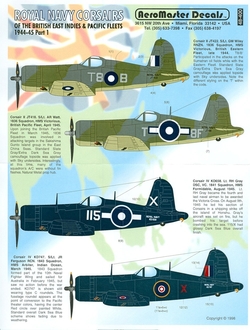
DECALS 48-400 RN CORSAIRS BRITISH EAST INDIES & PACIFIC FLEETS 1944-45 Pt 1
ROYAL NAVY
---------------------------
Additional Information from
Internet Encyclopedia
In the early days of World War
II, Royal Navy fighter requirements had been based on cumbersome two-seat
designs, such as the fighter/dive-bomber Blackburn Skua (and its turreted
derivative the Blackburn Roc) and the fighter/reconnaissance Fairey Fulmar,
since it was expected that they would encounter only long-range bombers or
flying boats and that navigation over featureless seas required the assistance
of a radio operator/navigator. The Royal Navy hurriedly adopted
higher-performance single-seat aircraft such as the Hawker Sea Hurricane and
the less robust Supermarine Seafire alongside, but neither aircraft had
sufficient range to operate at a distance from a carrier task force. The
Corsair was welcomed as a more robust and versatile alternative.
In November 1943, the Royal Navy
received its first batch of 95 Vought F4U-1s, which were given the designation
"Corsair [Mark] I". The first squadrons were assembled and trained on
the U.S. East Coast and then shipped across the Atlantic. The Royal Navy put
the Corsair into carrier operations immediately. They found its landing
characteristics dangerous, suffering a number of fatal crashes, but considered
the Corsair to be the best option they had.
In Royal Navy service, because
of the limited hangar deck height in several classes of British carrier, many
Corsairs had their outer wings "clipped" by 8 in (200 mm) to clear
the deckhead. The change in span brought about the added benefit of improving
the sink rate, reducing the F4U's propensity to "float" in the final
stages of landing.
The Royal Navy developed a
number of modifications to the Corsair that made carrier landings more
practical. Among these were a bulged canopy (similar to the Malcolm Hood),
raising the pilot's seat 7 in (180 mm),and wiring shut the cowl flaps across
the top of the engine compartment, diverting oil and hydraulic fluid spray
around the sides of the fuselage.The curved approach used with the Seafire was
also adopted for landing Corsairs, ensuring the flight deck was kept in sight
as long as possible.
Deployment
The Royal Navy initially
received 95 "birdcage" F4U-1s from Vought which were designated
Corsair Mk I in Fleet Air Arm service. Next from Vought came 510
"blown-canopy" F4U-1A/-1Ds, which were designated Corsair Mk II (the
final 150 equivalent to the F4U-1D, but not separately designated in British
use).[68] 430 Brewster Corsairs (334 F3A-1 and 96 F3A-1D), more than half of
Brewster's total production, were delivered to Britain as the Corsair Mk III.
857 Goodyear Corsairs (400 FG-1/-1A and 457 FG-1D) were delivered and
designated Corsair Mk IV. The Mk IIs and Mk IVs were the only versions to be
used in combat.
The Royal Navy cleared the F4U
for carrier operations well before the U.S. Navy and showed that the Corsair Mk
II could be operated with reasonable success even from escort carriers. It was
not without problems; one was excessive wear of the arrester wires, due both to
the weight of the Corsair and the understandable tendency of the pilots to stay
well above the stalling speed. A total of 2,012 Corsairs were supplied to the
United Kingdom.
Fleet Air Arm (FAA) units were
created and equipped in the United States, at Quonset Point or Brunswick and
then shipped to war theaters aboard escort carriers. The first FAA Corsair unit
was 1830 NAS, created on the first of June 1943, and soon operating from HMS
Illustrious. At the end of the war, 18 FAA squadrons were operating the
Corsair. British Corsairs served both in Europe and in the Pacific. The first,
and also most important, European operations were the series of attacks
(Operation Tungsten) in April, July, and August 1944 on the German battleship
Tirpitz, for which Corsairs from HMS Victorious and HMS Formidable provided
fighter cover. It appears the Corsairs did not encounter aerial opposition on
these raids.
From April 1944, Corsairs from
the British Pacific Fleet took part in several major air raids in South East
Asia beginning with Operation Cockpit, an attack on Japanese targets at Sabang
island, in the Dutch East Indies.
In July and August 1945, Corsair
naval squadrons 1834, 1836, 1841, and 1842 took part in a series of strikes on
the Japanese mainland, near Tokyo. These squadrons operated from Victorious and
Formidable. On 9 August 1945, days before the end of the war, Corsairs from
Formidable attacked Shiogama harbor on the northeast coast of Japan. Royal
Canadian Navy Volunteer Reserve pilot, Lieutenant Robert Hampton Gray, of 1841
Squadron was hit by flak but pressed home his attack on the Japanese destroyer
escort Amakusa, sinking it with a 1,000 lb (450 kg) bomb but crashing into the
sea. He was posthumously awarded Canada's last Victoria Cross, becoming the
second fighter pilot of the war to earn a Victoria Cross as well as the final
Canadian casualty of World War II.
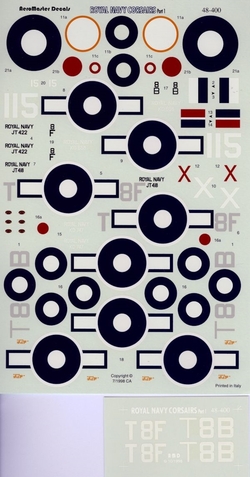
FAA Corsairs originally fought
in a camouflage scheme with a Dark Slate Grey/Extra Dark Sea Grey disruptive
pattern on top and Sky undersides, but were later painted overall dark blue. As
it had become imperative for all Allied aircraft in the Pacific Theater of
World War II to abandon all use of any "red devices" in their
national insignia — to prevent any chance of misidentification with Japanese
military aircraft, all of which bore the circular, all-red Hinomaru insignia
(nicknamed a "meatball" by Allied aircrew) that is still in use to
this day, the United States removed all areas of red color (specifically
removing the red center to the roundel) and removed any sort of national
fin/rudder markings, which at that time had seven horizontal red stripes, from
the American national aircraft insignia scheme by 6 May 1942. The British did
likewise, starting with a simple paintover with white paint, of their
"Type C" roundel's red center, at about the time the U.S. Navy
removed the red-center from their roundel. Later, a shade of slate gray center
color replaced the white color on the earlier roundel. When the Americans
starting using the added white bars to either side of their blue/white star
roundel on 28 June 1943; SEAC British Corsairs, most all of which still used
the earlier blue/white Type C roundel with the red center removed, added
similar white bars to either side of their blue-white roundels to emulate the
Americans.
In all, out of 18 carrier-based
squadrons, eight saw combat, flying intensive ground attack/interdiction
operations and claiming 47.5 aircraft shot down.
At
the end of World War II, under the terms of the Lend-Lease agreement, the
aircraft had to be paid for or to be returned to the U.S. As the UK did not
have the means to pay for them, the Royal Navy Corsairs were pushed overboard
into the sea in Moreton Bay off Brisbane, Australia.