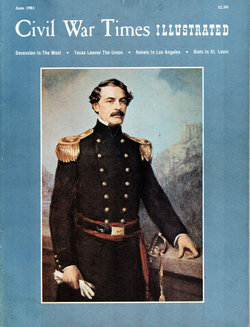
CIVIL
WAR TIMES JUN 81 BRICES CROSS ROADS ALBERT SYDNEY JOHNSON TEXAS
BRICE CROSS ROADS NATIONA
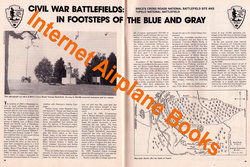
BATTLEFIELD SITE AND TUPELO NATIONAL BATTLEFIELD - The Battle of Brice's Cross
Roads, also known as the Battle of Tishomingo Creek or the Battle of Guntown,
was fought on Friday, June 10, 1864, near Baldwyn, Mississippi, then part of
the Confederate States of America. A Federal expedition from Memphis, Tennessee,
of 4,800 infantry and 3,300 cavalry, under the command of Brigadier-General
Samuel D. Sturgis, was defeated by a Confederate force of 3,500 cavalry under
the command of Major-General Nathan B. Forrest. The battle was a victory for
the Confederates. Forrest inflicted heavy casualties on the Federal force and
captured more than 1,600 prisoners of war, 18 artillery pieces, and wagons
loaded with supplies. Once Sturgis reached Memphis, he asked to be relieved of
his command.
SECESSION IN THE WEST
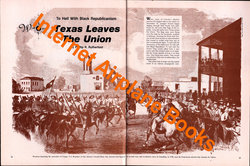
TEXAS LEAVES THE UNION - The
history of Texas in the Civil War has distinctions from the rest of the South,
in part because of its history of being independent previously. Much of Texas's
dissatisfaction was not only tied to opposition to Lincoln and his view of
states' rights (which they also viewed as a transgression of the annexation
agreement), but also because they did not feel that Washington had lived up to
promises of inclusion into the country as part of annexation. In 1861, Sam
Houston still strongly supported remaining in the United States primarily for
economic and military reasons. However, those promoting secession used not only
elements from U.S. history such as the American Revolution and the
Constitution, but also the Texas Revolution and elements from the history of
the Republic of Texas. On February 1, 1861, delegates to a special convention
to consider secession voted 166 to 8 to adopt an ordinance of secession which
cited the institution of slavery as the primary cause of secession. The
ordinance was ratified by a popular referendum on February 23, making Texas the
seventh and last state of the Lower South to do so.
REBELS IN LOS ANGELES,
CALIFORNIA
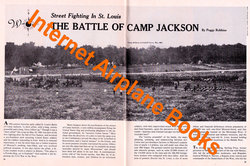
RIOTS IN ST. LOUIS, MISSOURI –
THE BATTLE OF CAMP JACKSON: The Camp Jackson affair, also known as the Camp
Jackson massacre, occurred during the American Civil War on May 10, 1861, when
a volunteer Union Army regiment captured a unit of secessionists at Camp
Jackson, outside the city of St. Louis, in the divided slave state of Missouri. The newly appointed Union commander in
Missouri, Brigadier General Nathaniel Lyon, had learned that the
ostensibly-neutral state militia training in Camp Jackson was planning to raid
the federal arsenal in St. Louis. That led to him and his regiments, consisting
mostly of pro-Union German immigrants, marching into St. Louis and capturing
the rebels. After capturing the entire unit, Lyon marched the captives into
town to parole them. En route, hostile secessionist crowds gathered and began
throwing rocks and shouting ethnic slurs at Lyon's regiments, and after an
accidental gunshot, Lyon's men fired into the mob, killed at least 28
civilians, and injured dozens of others. Several days of rioting throughout St.
Louis followed. The violence ended only after martial law had been imposed and
Union regulars dispatched to the city. Lyon's
actions ensured Union control of St. Louis and Missouri for the rest of the war
but also deepened the ideological divisions within a state that had initially
sought to remain neutral in the larger conflict.
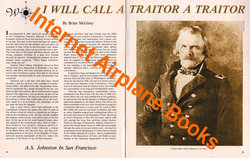
ALBERT SIDNEY JOHNSON’S EASTWARD
TREK - At the outbreak of the American Civil War, Johnston was the commander of
the U.S. Army Department of the Pacific in California. Like many regular army
officers from the Southern United States, he opposed secession. Nevertheless,
Johnston resigned his commission soon after he heard of the Confederate states'
declarations of secession. The War Department accepted it on May 6, 1861,
effective May 3. On April 28, he moved to Los Angeles, the home of his wife's
brother John Griffin. Considering staying in California with his wife and five
children, Johnston remained there until May. A sixth child was born in the
family home in Los Angeles. His eldest son, Capt. Albert S. Johnston, Jr. was
later killed in an accidental explosion on a steamer ship while on liberty in
Los Angeles in 1863.M Soon, Johnston enlisted in the Los Angeles Mounted Rifles
(a pro-Southern militia unit) as a private, leaving Warner's Ranch on May 27.
He participated in their trek across the Southwestern deserts to Texas,
crossing the Colorado River into the Confederate Territory of Arizona on July
4, 1861. His escort was commanded by Alonzo Ridley, Undersheriff of Los
Angeles, who remained at Johnston's side until he was killed. Early in the
Civil War, Confederate President Jefferson Davis decided that the Confederacy
would attempt to hold as much territory as possible, distributing military
forces around its borders and coasts. In the summer of 1861, Davis appointed
several generals to defend Confederate lines from the Mississippi River east to
the Allegheny Mountains. Aged 58 when the war began, Johnston was old by Army
standards. He came east to offer his service for the Confederacy without having
been promised anything, merely hoping for an assignment.
MAJOR
LONGSTREET GOES HOME TO THE DEFENSE OF HIS NATIVE ALABAMA - At
the beginning of the American Civil War, Longstreet was paymaster for the
United States Army and stationed in Albuquerque. After news of the Battle of
Fort Sumter, he joined his fellow Southerners in leaving the post. In his
memoirs, Longstreet calls it a "sad day", and records that a number
of Northern officers attempted to persuade him not to go. He writes that he
asked one of them "what course he would pursue if his State should pass
ordinances of secession and call him to its defence. He confessed that he would
obey the call." Longstreet was not enthusiastic about secession from the
Union, but he had long been infused with the concept of states' rights and felt
he could not go against his homeland.[41] Although he was born in South
Carolina and brought up in Georgia, he offered his services to Alabama, which
had appointed him to West Point and where his mother still lived. He was the
senior West Point graduate from that state, which meant that he could
potentially be placed in command of that state's soldiers. After settling his
accounts, he submitted his resignation letter from the United States Army on
May 9, 1861, intending to join the Confederacy. He had already accepted a
commission as a lieutenant colonel in the Confederate States Army on May 1. His
resignation from the United States Army was accepted on June 1.