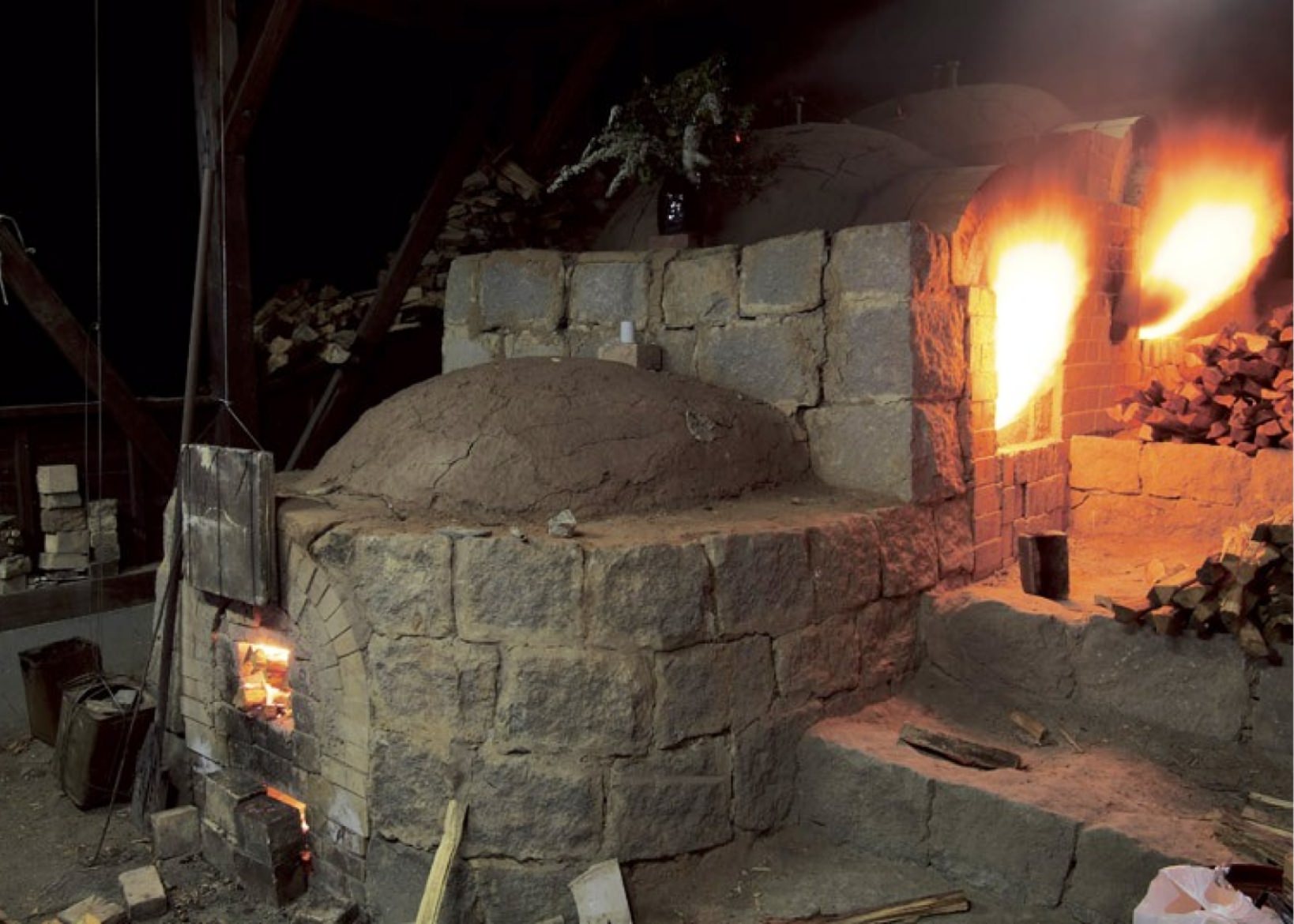
Kutani ware is said to have been first produced in 1655 by Toshiharu Maeda, feudal lord of the Daishojiji domain, who ordered Saijiro Goto to produce Kutani ware in Enuma County, Kaga Prefecture, in the early Edo period.
The pieces fired in Goto Saijiro's kiln over the next 50 years or so are now called "Koya Kutani" and are considered to be the origin of Kutani-yaki.
The Kutani kilns were closed for a time, but about 80 years later, the Kasugayama Kiln was opened in Kanazawa under the management of the Kaga Clan, and an attempt was made to reproduce the Kutani style, thus ushering in the era of the revival of Kutani ware.
Over the next few decades, a number of kilns emerged, including the Kigome Kiln at Kasugayama, the Yoshidaya Kiln, which aimed to revive Koya Kutani, the Miyamoto Kiln (Iidaya) for fine red painting, the Shozo Kiln, and the Eiraku Kiln for gold brocade, each creating a wonderful style of painting.
His works are dynamic, colorful, and uniquely attractive, and along with Kakiemon, Iro-Nabeshima, and Ninsei, they are representative of Japanese overglaze enameled porcelain.
Today, they are used as gifts by the Imperial Household Agency, presented as a wedding gift to Prince Charles of the United Kingdom, and widely patronized by prominent foreign figures, and are now greatly appreciated as a form of Japanese beauty.