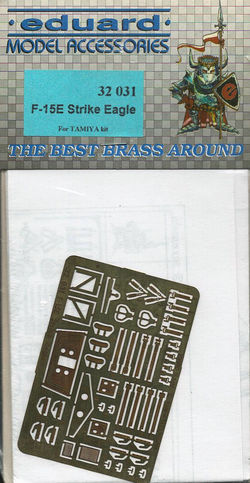
EDUARD #32031
BRASS PHOTOETCH DETAIL SET McD F-15E STRIKE EAGLE for TAMIYA KIT USAF TFW
-------------------------------
Additional Information from Internet
Encyclopedia
The F-15E was deployed in response to Iraq's
invasion of Kuwait in August 1990 for Operation Desert Shield. The 336th
Tactical Fighter Squadron flew to Seeb Air Base in Oman to begin training
exercises in anticipation of an Iraqi attack on Saudi Arabia; in December, the
335th and 336th squadrons relocated to Prince Sultan Air Base in Saudi Arabia,
closer to Iraq's border.[48] At the start of Operation Desert Storm, 24 F-15Es
launched an attack on five fixed Scud installations in western Iraq on 17
January 1991. Missions against Scud sites continued through that night with a
second strike of 21 F-15Es. At night-time, F-15Es flew hunter missions over
western Iraq, searching for mobile SCUD launchers. By conducting random
bombings in suspected areas, it was hoped to deter the Iraqis from setting up
for a Scud launch.
On the opening night of the war, an F-15E fired a
AIM-9 Sidewinder at a MiG-29, which failed to hit its target. Other F-15Es
simultaneously and unsuccessfully engaged the lone MiG-29, which was eventually
brought down by a missile of unknown source.[50][51] On 18 January, during a
strike against a petrol oil and lubricant plant near Basrah, an F-15E was lost
to enemy fire, the pilot and WSO were killed. F-15E crews described this
mission as the most difficult and dangerous of the war as it was heavily
defended by SA-3s, SA-6s, SA-8s and Rolands as well as by anti-aircraft
artillery. Two nights later, a second and final F-15E was downed by an Iraqi
SA-2; the crew survived and evaded capture for several days and made contact
with coalition aircraft, but a rescue was not launched due to security issues,
one airman having failed to identify himself with proper codes. The two airmen
were later captured by the Iraqis.
F-15Es were able to destroy 18 Iraqi jets on the ground
at Tallil air base using GBU-12s and CBU-87s. On 14 February, an F-15E scored
its only air-to-air kill of the war: a Mil Mi-24 helicopter. While responding
to a request for help by US Special Forces, five Iraqi helicopters were
spotted. The lead F-15E of two, via its FLIR, acquired a helicopter in the
process of unloading Iraqi soldiers, and released a GBU-10 bomb. The F-15E crew
thought the bomb had missed its target and were preparing to use a Sidewinder
when the helicopter was destroyed. The Special Forces team estimated that the
Hind was roughly 800 feet (240 m) over the ground when the 2,000 lb (910 kg)
bomb hit its target.[53] As another Coalition bombing operation had commenced,
the F-15Es disengaged from combat with the remaining helicopters.
F-15Es attacked various heavily defended targets
throughout Iraq, prioritizing SCUD missile sites. Missions with the objective
of killing Iraqi President Saddam Hussein were undertaken with several
suspected locations bombed by F-15Es. Prior to the operation's ground war
phase, F-15Es conducted tank plinking missions against Iraqi vehicles in
Kuwait. Following 42 days of heavy combat, a cease fire came into effect on 1
March 1991, leading to the establishment of Northern and Southern no-fly zones
over Iraq.
Operations Southern Watch and Northern Watch
Following Desert Storm, two no-fly zones over Iraq
were set up, and enforced typically by US and UK aircraft. In one incident, an
attack on up to 600 Kurdish refugees by Iraqi helicopters at Chamchamal,
northern Iraq, was observed by a flight of F-15Es. As they were not allowed to
open fire, the F-15Es instead conducted several high speed passes as close as
possible to the Iraqi helicopters to create severe wake-turbulence, while
aiming lasers at the helicopter's cockpits to attempt to blind their crews;
this caused the crash of one Hind. Afterwards, USAF leadership ordered F-15Es
not to fly below 10,000 feet (3,000 m) to deter a repetition.
F-15Es of the 391st Fighter Squadron, 492d Fighter
Squadron, and 494th Fighter Squadron regularly deployed to Turkey throughout
the 1990s. In January 1993, in breach of the ceasefire agreement, Iraqi targets
below the 32nd parallel north were attacked; 10 F-15Es conducted a punitive
strike days later.[55] Most missions were of a defensive nature, the Strike
Eagles carried a flexible range of weapons on a typical mission. AWACS aircraft
were in close contact with F-15E crews, who would receive new taskings while
airborne and thus could fly unplanned attacks on Iraqi targets.[55] After 1993,
violations of the no-fly zones were minimal as Iraq staged a minor withdrawal;
in 1997 Turkey approved the creation of Operation Northern Watch (ONW) and
permitted US forces to use the Incirlik air base.
In December 1998, Operation Desert Fox was
conducted when Iraq refused UNSCOM inspections. On 28 December 1998, three
F-15Es each dropped two GBU-12 500-pound precision-guided munitions (PGMs) to
successfully strike an SA-3 tracking radar and optical guidance unit.[56] After
Desert Fox, Iraq stepped up its violations of the no-fly zones, thus a number
of retaliatory and pre-planned strikes were conducted by F-15Es; in ONW alone,
weapons were expended on at least 105 days.[57] Between 24 and 26 January 1999,
F-15Es expended several AGM-130s and GBU-12s against SAM sites in northern Iraq
near Mosul.[58] Several F-15Es also flew in support of Operation Provide
Comfort and Operation Provide Comfort II.
Operations in the Balkans
Operation Deny Flight was a United
Nations-enforced no-fly zone over Bosnia and Herzegovina due to the
deteriorating situation in the Balkans. In August 1993, F-15Es from 492d and
494th FS deployed to Aviano, Italy. In late 1993, NATO ordered a limited F-15E
strike at Udbina airfield, targeting Serbian forces in neighboring Croatia.
Eight F-15Es armed with GBU-12s took off to attack an SA-6 anti-aircraft
vehicle; the mission was cancelled mid-flight over the application of stringent
Rules of Engagement.[59] In December 1993, F-15Es launched to destroy a pair of
SA-2 sites which had fired upon two Royal Navy Sea Harrier FRS 1s.[60] In
August 1995, F-15Es of 90th Fighter Squadron joined the two other squadrons.
The 492d and 494th flew over 2,500 sorties since Deny Flight had begun, 2,000
of these were by 492d. In August 1995, in support of NATO's Operation
Deliberate Force, F-15Es flew strike missions against Serbian armor and
logistics around the Bosnian capital, Sarajevo. On 9 September, an F-15E
deployed the first GBU-15 bomb for the type; a total of nine were dropped
against Bosnian-Serb ground forces and air defense targets around Banja Luka.
In response to the displacement of Kosovars and
the Serbian government's rejection of a NATO ultimatum, Operation Allied Force
was launched in March 1999. A total of 26 F-15Es flew the first strikes of
Allied Force against Serb surface-to-air-missile sites, anti-aircraft batteries
and early warning radar stations.[61] Strike Eagles were deployed to Aviano as
well as RAF Lakenheath in the UK. In-theater, F-15Es conducted close air
support missions, a new idea in the late 1990s which has since become a popular
concept within the USAF.[62] Missions typically lasted around 7.5 hours,
included two aerial refuelings; F-15Es would carry a mix of air-to-air and
air-to-ground munitions to perform both combat air patrol duties as well as
strike missions in the same mission.[62] Mobile SAM launchers posed a
considerable threat to NATO aircraft and had made successful shoot-downs, most
notably of a Lockheed F-117 Nighthawk. In order to strike from increased
distances, the F-15E was equipped with the AGM-130, which provided a stand-off
strike capability.
Operation Enduring Freedom
Weeks after the September 11 attacks in 2001, the
391st Fighter Squadron deployed to Ahmad al-Jaber air base, Kuwait, to support
Operation Enduring Freedom in Afghanistan. F-15Es met little resistance during
initial missions. On the first night, the main targets were Taliban military
structures, supply depots, and al-Qaeda training camps and caves. Both the
AGM-130 and GBU-15 2,000 lb (910 kg) bombs were expended; this was the GBU-15's
first combat usage.[64] GBU-24s and GBU-28s were used against reinforced
targets, command and control centers and cave entrances. F-15Es often operated
in pairs alongside pairs of F-16Cs. Within weeks of the start of combat
operations, there was a lack of targets to strike as nearly all targets had
been already destroyed. The Taliban had access to SA-7 and FIM-92 Stinger
portable surface-to-air missiles, posing no threat to most aircraft flying above
7,000 feet (2,100 m). Additionally, fixed SAM sites near cities as
Mazar-i-Sharif and Bagram were struck early on; Afghanistan had rapidly became
a low-threat environment for air operations.
Aircraft commonly flew on-call support missions
for allied ground forces, F-15Es usually carried MK-82 and GBU-12 bombs in this
role, other weapons were sometimes carried, during one mission a GBU-28, two
GBU-24s and six GBU-12s were released.[65] Frequent targets during the rest of
the war were individual insurgents, light vehicles and supply convoys; cannon
fire was often expended as well as bombs from F-15Es.[66] It was during combat
over Afghanistan that four 391st crews conducted the longest fighter mission in
history; lasting a total of 15.5 hours, nine of those hours spent flying over
the target area. Two F-15Es attacked two Taliban command and control
facilities, two buildings suspected of being used by Taliban fighters, and a
road block; the F-15Es refueled 12 times during the mission.
On 4 March, another incident now known as the
Battle of Roberts’ Ridge involved several F-15Es that had embarked on a close
air support mission for ground forces. Aircraft destroyed a Taliban observation
post and responded to nearby enemy mortar fire upon Navy SEAL forces on a search
for an ambushed MH-47E Chinook in the Shah-i-Kot Valley.[68] Several bombs were
dropped as the SEAL team still took fire, however one bomb missed due to the
wrong coordinates being entered by the aircrew.[68] An MH-47 carrying a rescue
team was downed by an RPG while attempting to support the SEALs.[69] Following
refueling, the F-15Es dropped a further 11 GBU-12s in coordination with ground
forces, and fired their cannons on Taliban forces in close proximity to the
survivors of the downed MH-47.[69] A section of F-16s from 18th Fighter
Squadron made strafing passes as well until cannon ammunition was depleted,
before resorting to further bomb drops. The F-15Es were affected by technical
problems involving both radios and weapons that had failed, several GBU-12's
were dropped before returning to Al Jaber in Kuwait.
Years later, several incidents have occurred. On
23 August 2007, a friendly fire incident involved an F-15E mistakenly dropping
a 500 lb (230 kg) bomb on British forces; three soldiers were killed.[71] The
stated cause was confusion between the air controller and the F-15E crew on the
bombing coordinates.[72] On 13 September 2009, an F-15E shot down a
non-responsive MQ-9 Reaper drone over Northern Afghanistan to prevent it
entering foreign airspace.
Operation Iraqi Freedom
In late 2002, during tension over suspected Iraqi
possession of weapons of mass destruction, the 4th Fighter Wing at Seymour
Johnson Air Force Base was ordered to maintain at least one squadron ready to
deploy to the Persian Gulf. During January 2003, the 336th was deployed to Al
Udeid Air Base, Qatar, a total of 24 aircraft being deployed in coordination
with planners of the Combined Air Operations Center at Prince Sultan Air Base,
Saudi Arabia.[74] In late January, the F-15Es began flying in support of
Operation Southern Watch, typically performing surveillance and reconnaissance
missions. Additional missions included simulated combat against potential Iraqi
targets and regional familiarization with local procedures and rules of engagement.[74]
During OSW, F-15Es attacked a number of targets in southern and western Iraq,
including radars, radio communications and relay stations, command and control
sites, and air defences. On one night, four F-15Es released multiple GBU-24s on
the Iraqi Republican Guard/Baath Party HQ in Basrah while another flight of
four destroyed a nearby Air Defense Sector HQ with six GBU-10s.
Towards the end of February, the 336th received
additional aircrews, many of which being drafted from the two non-deployable
squadrons at Seymour Johnson (the 333d and 334th Fighter Squadrons) and 391st
Fighter Squadron at Mountain Home Air Force Base, for a total of four aircrews
per F-15E.[75] In early March, the 335th Fighter Squadron's personnel and
aircraft joined the 336th at Al Udeid. One objective was the destruction of
Iraq's air defenses and Early Warning radar network near the border with
Jordan, allowing F-16s and Special Forces helicopters to operate from Jordan at
the outset of the war. Several radar sites and radio relay stations were hit in
western Iraq near the "H3" airfield, during these missions coalition
jets met with heavy anti-aircraft fire.
On 19 March, as F-117 Nighthawks dropped bombs
over Baghdad, targeting a house where Saddam Hussein was believed to be; F-15Es
dropped GBU-28s around the H3 airfield. On 20 March, when the war effectively
began, F-15Es fired AGM-130s against key communication, command and control
buildings, and other key targets in Baghdad; a few of the weapons missed
intended targets, possibly caused by the jamming operations of EA-6B Prowlers
in the vicinity.
On 3 April 2003 an F-15E pilot mistook a M270
Multiple Launch Rocket System (MLRS) for an Iraqi surface-to-air missile site
and dropped a 500 lb (230 kg) laser-guided bomb, killing three and wounding
five others.[78] On 7 April 2003, an F-15E (88–1694), crewed by Captain Eric
Das and Major William Watkins performed a critical interdiction mission in
support of special forces. Das and Watkins crashed while bombing targets around
Tikrit[80] probably shot down by AAA fire. The crew were posthumously awarded
the Distinguished Flying Cross and the Purple Heart for their actions.
During the war, F-15Es were credited with
destroying 60% of the total force of the Iraqi Medina Republican Guard. They
also scored hits on 65 MiGs on the ground,[76] and destroyed key air defense
and command buildings in Baghdad. During the war F-15Es worked closely with
other jets that were deployed to Al Udeid, including RAAF F/A-18s, USAF F-16s and
F-117s, RAF Panavia Tornado fighters and a detachment of US Navy F-14s from
VF-154