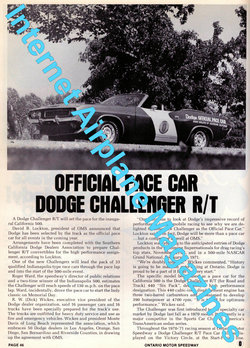
RACE
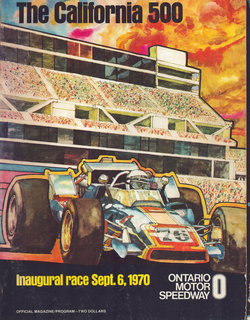
PROGRAM INAUGARAL 1970 CALIFORNIA 500 ONTARIO MOTOR SPEEDWAY
VINTAGE & AUTHENTIC
SOFTBOUND BOOK in ENGLISH
The California 500 was a USAC,
and later CART, race held at Ontario Motor Speedway in Ontario, California. The
event represented a continuous lineage of open wheel oval racing in Southern
California that dates back to 1970.
Open wheel oval racing in
southern California dated back to the USAC California 500 at Ontario Motor
Speedway in Ontario, California, held from 1970 to 1978. The race was part of
IndyCar racing's "triple crown," and at its inception, was held in
high prestige. The inaugural running was considered a huge success, with
187,000 in attendance. However, it became a CART event in 1979 and the track
fell into financial troubles in 1980, closing at the end of that year.
Subsequent runnings were never able to match the success of the 1970 event.
Indy car races were also held at
nearby Riverside, but only from 1967–1969 (prior to the opening of Ontario) in
1970 and again from 1981–1983 (after Ontario closed in 1980).
The 1970 California 500, the
inaugural running of the event, was held at the Ontario Motor Speedway in
Ontario, California, on Sunday, September 6, 1970. The event was race number 12
of 18 in the 1970 USAC Championship Car season. The race was won by Jim
McElreath, his final Indy Car victory. The race commenced an 11-year history of
the California 500 being a part of IndyCar racing's Triple Crown.
Plans for Ontario Motor Speedway
were announced on February 16, 1966. Its primary financial backers were the
Stolte Construction Company and Filmways Inc., a film production company that
produced television shows such as The Beverly Hillbillies, Petticoat Junction,
Green Acres, and The Addams Family. Upon the announcement, USAC agreed to
sanction a pair of 500-mile races for Indy cars and stock cars. The inaugural
race was scheduled for December 1, 1968.
Advertised as the
"Indianapolis of the West", the track was similar in design to the
Indianapolis Motor Speedway as a 2.5-mile oval with four distinct turns. In
addition, the track would feature a 3.1-mile road course in the infield and a
quarter-mile drag strip on the frontstretch. The track would have seating for
over 150,000 spectators, standing room for 100,000 additional people, parking
for 68,000 cars, and a control tower in the infield that stood 14 stories high.
The economy and bond market
slowed in mid-1966 when funding was being raised, leading to delays in
construction. Filmways withdrew from the project. In early 1967, Ontario
informed USAC that construction would not be completed by the December 1968
target date. USAC responded by holding races at the nearby Riverside
International Raceway between 1967 and 1969.
Once funding was secured through
the selling of bonds, groundbreaking on the track officially took place on
September 25, 1968. Dignitaries attending the ceremony included local officials
and actor Kirk Douglas. Construction costs were anticipated to cost $25.5
million.
In 1969, USAC announced the
California 500 would be held on the Sunday of Labor Day weekend for the next 10
years, beginning on September 6, 1970. USAC President, Charlie Brockman,
declared "Ontario Motor Speedway is the most exciting and promising development
in automobile racing since Tony Hulman bought the Indianapolis Speedway in
1946."
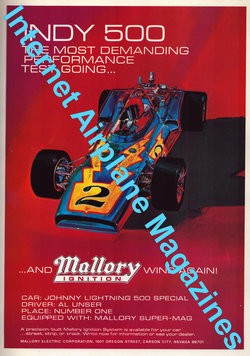
In May 1970, Al Unser won the
Indianapolis 500.
Opening ceremonies for the track
occurred on Sunday, August 9, 1970. Exhibitions of drag racing, stock car
racing, and Indy car racing were done, followed by a Pro-Am celebrity race.
Celebrities were teamed with pro drivers in new Porsches, with the pro driving
three laps, the celebrity driving three laps, the pro again driving three laps,
and the celebrities driving the final three laps. Professional drivers included
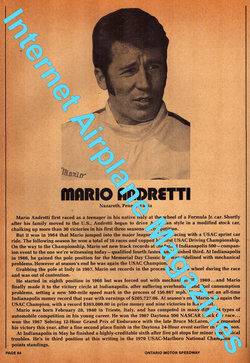
Bobby Unser, Dan Gurney, Al Unser, Parnelli Jones, Mario Andretti, and Mark
Donohue. Celebrities included Dick Smothers, Hugh Downs, Pancho Gonzalez, Paul
Newman, James Garner, Pete Conrad, Dino Martin, and Ken Venturi. Unser and
Smothers teamed to win the race followed by Donohue and Conrad.
Practice for the California 500
officially opened on Saturday, August 22. 27,852 spectators attended the
practice session, attracted by free admission. Only seven cars made practice
runs. Mark Donohue posted the fastest speed at 165.14 mph. The six-hour practice
session was delayed over an hour due to faulty caution lights on the
backstretch. Kevin Bartlett was the first driver to go on track when practice
began. Bartlett was also responsible for the only incident of the day when he
spun in turn one but avoided any damage.
Donohue upped his speed to
169.81 mph on day two. On Monday, Donohue posted a speed of 171.4 mph. On
Tuesday, the Vel's Parnelli Jones Racing teammates of Joe Leonard and Al Unser
began practicing. Leonard posted the fastest speed at 172.41 mph. Practice
ended one hour early as a dust storm covered the track.
On Wednesday, Leonard ran a
speed of 175.10 mph. At speed, Mario Andretti's car lost a nose cone on the
frontstretch. "It just popped off and flew right over my head. Otherwise
it was no problem." For the second straight day, practice ended an hour
early due to dust storms.
Leonard upped his speed to 177.2
mph on Thursday. Unser was second at 175.8 mph, followed by Johnny Rutherford
at 175.4 mph. The first crash at the track occurred when Greg Weld spun in turn
two and hit the wall broadside. The car was repaired. A $1 million lawsuit
filed by George Follmer against USAC was settled. Follmer had been suspended
for running two unauthorized Trans-Am races but was allowed to begin practicing
on Friday.
Friday's practice saw Al Unser
fastest at 176.8 mph. Dan Gurney was second at 176.1 mph. Joe Leonard suffered
a fire when a fuel coupling broke on track. When he returned to the pits, the
car ignited and he quickly jumped from the vehicle. Fire crews quickly
extinguished the flames and Leonard suffered no burns, only singed hair on his
legs. Jack Brabham practiced at 171.76 mph and left to run the Italian Grand
Prix. He turned his car over to NASCAR racer Lee Roy Yarbrough, who was at the
track as a spectator. Yarbrough's entry into the race forced him to withdraw
from NASCAR's Southern 500.
Race
Indianapolis Motor Speedway
owner Tony Hulman delivered the command to start engines. 180,223 spectators
attended the inaugural California 500. It was the largest crowd ever to see a
sports event in California and the third-largest sports event in American
sports history, behind only Indianapolis 500s and Indy 500 qualifying sessions.
For the first time, the cars
used an electronic timing and scoring system. Developed by Conrac, transponders
were placed on the cars which transmitted to antennas buried beneath the track.
A. J. Foyt told officials he thought the transponder electrical signals would
interfere with his car but USAC officials forced him to use it. Pitting with
mechanical problems early in the race, Foyt got out of his car and knocked the
transponder off his car with a hammer. He was manually scored for the rest of
the race.
From his starting spot on the
pole, Lloyd Ruby led the opening lap. Indianapolis champion, Al Unser, moved
from fourth to take the lead on lap two. As Ruby retook the lead, at the rear
of the field, Jim Hurtubise blew an engine and crashed in turn three. After
being checked and released from the infield hospital, Hurtubise complained of
head and rib pain and was taken to a local hospital, where he was treated
overnight and released the next morning.
On the restart for Hurtubise's
crash, Unser took the lead. From there, he was untouchable. Dan Gurney led for
four laps when Unser made a pit stop on lap 47. Peter Revson led eight laps
when Unser pitted on lap 139. At the halfway point, Gurney cut a tire in turn
three and spun 360 degrees, impacting the wall with the right-rear wheel.
As the race entered the final
hundred miles, Unser was in a lap of his own. Peter Revson in second and LeeRoy
Yarbrough in third were Unser's closest competition a lap behind.
On lap 174, Joe Leonard spun
into the infield in turn four and brought out a caution. Unser, Revson, and
Yarbrough pitted for fuel. While stopped, Revson's engine shut off and wouldn't
restart. His McLaren team took nine minutes to diagnose the problem as a bad
coil. He recovered to finish fifth.
After leading 166 laps, Unser's
car slowed to a stop with 14 laps remaining. Yarbrough inherited the lead. With
a margin of two laps over second place, it appeared the stock car driver would
score an unlikely victory. With eight laps remaining, Yarbrough suffered a
broken piston and blew an engine, coasting to a stop in turn four. Yarbrough
drew cheers from the crowd as he pushed his car back to the pits.
After starting 32nd, Art Pollard
inherited the lead upon Yarbrough's retirement with eight laps to go. Jim
McElreath was in second. Almost at the same time as Yarbrough's failure,
McElreath's car-owner, A.J. Foyt, crashed in turn four. Uninjured, Foyt helped
safety crews push his car off the track to ensure a green flag finish.
When the green flag was waved
with five laps to go, McElreath pulled to the inside of Pollard entering turn
one and took the lead. With three laps remaining, McElreath bobbled in turn
three and allowed Pollard to take the lead. One turn later, Pollard overdrove
the turn and drifted high, allowing McElreath to retake the lead. McElreath led
the rest of the way and won by two seconds over Pollard.
McElreath earned $146,850 for
the victory. Governor of California, Ronald Reagan presented the trophy in
victory lane to McElreath. Pollard's team protested the finish, claiming they
were a lap ahead of McElreath but USAC's scoring confirmed McElreath as the
winner. Pre-race concerns about tire wear were unfounded, with McElreath
changing only one tire during the race and Pollard running all 500 miles
without ever changing tires.
President Richard Nixon flew
over the track in a helicopter during the race. Nixon had been staying at his
California home, dubbed the Western White House for the past 18 days. That
afternoon, he took a helicopter to visit his 90-year-old aunt at a nursing home
and surveyed two potential sites for his Presidential Library. The President
made a few circles over the race before returning to his home and back to
Washington D.C. later that evening. The sights encouraged the President to
invite auto racing participants to the White House on September 21, 1971.