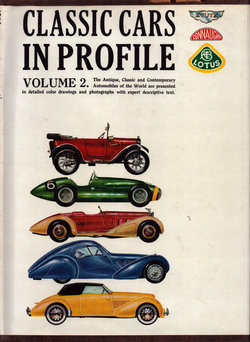
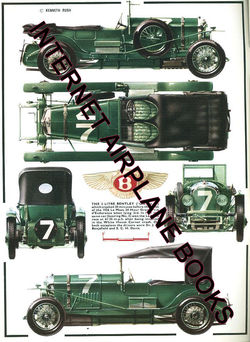
CLASSIC
CARS IN PROFILE V2 HBDJ AUTOMOBILE PROFILES V25-V48 LANCIA LOTUS AUSTIN PHOTO
HISTORY DEVELOPMENT TECHNICAL DETAILS
DOUBLEDAY HARD BOUND BOOK with
DUSTJACKET in ENGLISH by ANTHONY HARDING
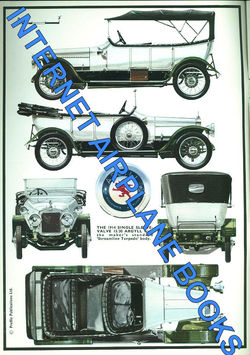
SINGLE CYLINDER DE DION BOUTON: De
Dion-Bouton was a French automobile manufacturer and railcar manufacturer
operating from 1883 to 1953. The company was founded by the Marquis
Jules-Albert de Dion, Georges Bouton, and Bouton's brother-in-law Charles
Tr�pardoux. The company was formed
after de Dion in 1881 saw a toy locomotive in a store window and asked the
toymakers to build another. Engineers Bouton and Tr�pardoux had been eking
out a living with scientific toys at a shop in the Passage de L�on, near "rue
de la Chapelle" in Paris. Tr�pardoux had long dreamed of building a
steam car, but neither could afford it. De Dion, already inspired by steam (in
the form of rail locomotives) and with ample money agreed, and De Dion, Bouton
et Tr�pardoux was formed in Paris in 1883. This became the De Dion-Bouton
automobile company, the world's largest automobile manufacturer for a time,
becoming well known for their quality, reliability, and durability. The same year, the tricar was joined by a
four-wheeler and in 1900 by a vis a vis voiturette, the Model D, with its 3�
CV (2.8 kW) 402 cc (24.5 cu in) single-cylinder engine under the seat and drive
to the rear wheels through a two-speed gearbox. This curious design had the
passenger facing the driver, who sat in the rear seat. The voiturette had one
inestimable advantage: the expanding clutches of the gearbox were operated by a
lever on the steering column. The Model D was developed through Models E, G, I,
and J, with 6 CV (4.5 kW) by 1902, when the 8 CV (6 kW) Model K rear-entry
phaeton appeared, with front-end styling resembling the contemporary Renault.
Until World War I, De Dion-Boutons had an unusual decelerator pedal which
reduced engine speed and ultimately applied a transmission brake. In 1902, the
Model O introduced three speeds, which was standard for all De Dion-Boutons in
1904.
LEYLAND EIGHT
TALBOTS 14/15-110: The Talbot
14-45 also known as Talbot 65 is a luxury car designed by Georges Roesch and
made by Cl�ment Talbot Limited in their North Kensington factory and usually
bodied by fellow subsidiary of S T D Limited, Darracq Motor Engineering in
Fulham. The six-cylinder engine is just over 1� litres at 1665 cc. The inlet
and exhaust manifolds are bolted together and fitted to the left hand side of
the block with the 5-jet carburettor bolted to the front end of the inlet
manifold. Petrol is delivered from a vacuum tank on the dash supplied from a
14-gallon tank at the back of the car. The overhead valves are operated by
pushrods with double valve springs. The rockers must be kept in position if the
detachable cylinder head is to be removed. There is forced lubrication
throughout the engine. All six cylinders are cast in one piece along with the
top half of the crankcase. Sparking plugs, distributor and contacts are on the
right side of the engine block. Ignition advance and retard is entirely
automatic. A dynamotor (combined dynamo and starter motor) is fitted at the
front end of the crankshaft. Engine timing (camshaft) is turned by gear from
the crankshaft Cooling water passes through a honeycomb radiator and the
airflow is assisted by a fan embodied in the engine's flywheel. Circulation is
by thermo-siphon there is no water-pump. Clutch and gearbox are bolted firmly
to the engine block, gears are changed by a lever beside the driver's right
hand operating in a gate. The clutch is not fully enclosed. Drive is carried to
the rear axle by an enclosed propellor shaft. Spherical and universal joints
are automatically oiled, there is a central bearing in the torque tube. Final
drive is by spiral bevel and the axle is of the half-floating design. Steering is by a worm and nut system, its box
raised to give a comfortable rake to the steering wheel. There are just the
four brakes, one on each wheel. They are not compensated. The brakes are
operated by rods. There is a hand lever by the driver's right which controls
the rear brakes alone. The aluminium brake shoes are adjusted for wear by a
wedge which opens or closes a fulcrum on one end of the shoe. The brake drums
are enclosed. The springs are
quarter-elliptical each with a shackle at its rear. At the front of the car
they are set without camber, held out of centre and slightly inclined to the
rear and are fitted with snubber leaves. Shock absorbers are fitted all round. When trying out this relatively expensive
5-seater tourer the correspondent of The Times reported he thought the car's
design had much to recommend it but could be improved. A four-door five-seat
car it is comfortable but the front cushion tends to obstruct the front door.
The seat is adjustable. He noted the test car had already travelled 8,000
miles. Its high-speed type engine with only four bearings, he said, is
remarkably smooth, it runs sweetly up to 4,000 rpm yet picks up easily in top
from almost a standstill. Over 55 mph increased speed takes time to build. The
indirect gears were noisy. Except for some clutch slip when climbing hills
under a heavy load all controls worked well and smoothly. He also reported that
the suspension let the car bounce too much suggesting slacker tyres and softer
shock absorbers might be a useful improvement.
The 14-45 was designed and put into production at short notice.
Cl�ment-Talbot was no longer profitable, their cars were not selling. The
board of directors established a one-model policy. In the autumn of 1925 Roesch
began to contemplate suitable designs. His difficulties included the outmoded
plant and machinery at his disposal so he involved all employees right to the
shop floor.
1933 24-litre NAPIER-RAILTON: The
Napier-Railton is an aero-engined race car built in 1933, designed by Reid
Railton to a commission by John Cobb, and built by Thomson & Taylor. It was
driven by Cobb, mainly at the Brooklands race track where it holds the all-time
lap record (143.44 mph (230.84 km/h)) which was set in 1935. This stands in
perpetuity as the circuit was appropriated for military purposes during the
Second World War and was never used as a racing track again. Between 1933 and
1937 the Napier-Railton broke 47 World speed records at Brooklands, Montlh�ry
and Bonneville Salt Flats in Utah. The car is powered by the high compression
version (6.1:1) (RAF specification) of the naturally aspirated Napier Lion, a
W12 of 23.944 litres (1,461 cu in) capacity, producing 580 brake horse power at
2585 revolutions per minute (recorded at 5, 000ft - performance at ground level
may be different).[citation needed] The 12 cylinders are in three banks of four
(broad-arrow configuration), hence the triple exhaust system, and the engine
has standard aerospace features such as dual ignition (magneto type) . The
non-syncromesh crash gearbox (aptly named for the horrible noises caused by a
mis-shift) has 3 ratios. The fuel tank, located in the boat-tail behind the
driver, has a capacity of 65 gallons and fuel consumption was approximately 5
mpg. Although capable of 168 mph (270 km/h) the car has rear-wheel braking
only.
4 ½-litre LAGONDAS:
ALFA ROMEO TYPE 158/159: The
Alfa Romeo 158/159, also known as the Alfetta (Little Alfa in Italian[1]), is
one of the most successful racing cars ever produced. The 158 and its
derivative, the 159, took 47 wins from 54 Grands Prix entered. It was
originally developed for the pre-World War II voiturette formula (1937) and has
a 1.5-litre straight-8 supercharged engine. Following World War II, the car was
eligible for the new Formula One introduced in 1947. In the hands of drivers
such as Nino Farina, Juan-Manuel Fangio and Luigi Fagioli, it dominated the
first two seasons of the World Championship of Drivers. The first version of this successful racing
car, the 158, was made during 1937/1938. The main responsibility for
engineering was given to Gioacchino Colombo.
The car's name refers to its 1.5-litre engine and eight cylinders.[4]
The voiturette class was for racing cars with 1.5-litre engines, standing in
the same relation to the top 'Grand Prix' formula (usually for 3-litre engines)
as the GP2 series does to Formula One today. Alfa's 3-litre racing cars in 1938
and 1939 were the Tipo 308, 312 and 316.
The 158 debuted with the works Alfa Corse team at the Coppa Ciano Junior
in August 1938 at Livorno, Italy, where Emilio Villoresi took the car's first
victory. At that time the 1479.56 cc
(58.0 x 70.0 mm) engine produced around 200 bhp (150 kW) at 7000 rpm with the
help of a single-stage Roots blower. More success came at the Coppa Acerbo,
Coppa Ciano and Tripoli Grand Prix in May 1940. Soon World War II stopped
development of the car for six years. After the war the engine was developed
further to push out 254 bhp (189 kW) in 1946. In 1947, the Alfetta was put back
into service. The new rules allowed 1500 cc supercharged and 4500 cc naturally
aspirated engines. The 158 was modified again, this time to produce over 300
bhp (220 kW) and was denoted as Tipo 158/47. The car made a tragic debut in the
1948 Swiss Grand in practice for the
1949 Buenos Aires Grand Prix, where Jean-Pierre Wimille was killed in an
accident (driving with Simca-Gordini). In
1950, the 158 was eligible for the new World Championship of Drivers. The car
won every race in which it competed during that first season of Formula One; it
was incredible that a car which had originated in 1938 was so victorious, most
likely because all the other constructors (as few as there were) had less money
to build and develop their cars and the Alfa had so much development time. The
Alfa Romeo team included talented drivers such as Giuseppe Farina and Juan
Manuel Fangio, the latter of whom later won the World Drivers' Championship
five times.
SIX-CYLINDER DELAUNAY-BELLEVILLE
1908-1914
30-98 hp VAUXHALL:
ASTON MARTIN 1 1/2-litre
INTERNATIONAL: The Aston Martin Le Mans was a two or four seat sports car made
by Aston Martin between 1932 and 1934.
Aston Martin�s
single-overhead-cam engine with a Bore/Stroke of 69.3 mm x 99 mm, had first
been seen in the 1927 models, was highly efficient and now had an output of 70
brake horsepower (52 kW) at 4750 rpm from 1.5 litres, an outstanding
development by early 1930s standards. Twin Horizontal SU carburettors were
fitted. The aluminium body was mounted on a separate steel chassis which had
beam axles front and rear with semi-elliptic leaf springs. 4-Wheel drum brakes,
mechanically operated at the rear, and by cable at the front were used. During 1932 the Aston Martin International Le
Mans had slowly sold at �650; the 1933 Aston Martin Le Mans model retailed at
�595, thereby increasing the chance of the car selling faster. Aston Martin, encouraged by the car�s
reception, began to offer alternative wheelbase lengths: 102 inches/2591 mm or
120 inches/3048 mm and a choice of open two-seater or four-seater bodywork. The
cars were long, low and immediately recognisable by their unique radiator style
and had great character making all the appropriate mechanical noises that
characterised Aston Martin. Aston Martin made the cars exclusive; between 1932
and 1933, only 130 were produced. According
to the standards of the early 1930s, Aston Le Mans were speedy cars �
compared to the pace of the MG and Singer- with a top speed in the region of 85
mph (137 km/h) and acceleration from 0�50 mph (0�80 km/h) in 16 seconds.
DELAGE D8 SERIES: Delage was a
French luxury automobile and racecar company founded in 1905 by Louis Delage in
Levallois-Perret near Paris; it was acquired by Delahaye in 1935 and ceased
operation in 1953. The Delage D8 was an
eight-cylinder luxury car produced by Delage between 1929 and 1940. The 4061 cc engine of the original D8 placed
it in the 23CV car tax band which, for many contemporaries, would also have
defined its position high up in the market hierarchy. Delage took a traditional view of its role as
a car producer, providing cars in bare chassis form to be bodied and fitted out
by prestigious bespoke builders such as Letourneur et Marchand and Chapron
operating (in most cases) in the Paris area. The D8 therefore appeared,
throughout its life, in a wide variety of (frequently) elegant shapes. The D8 was introduced late in 1929 as a
replacement for the opulent Delage GLS, but in view of the range of body types
(and, subsequently, of engine sizes) with which it was offered it can also be
seen as a replacement for the some versions of the Delage DM. The timing of the D8�s launch, with the
European economy still reeling from the aftermath of the 1929 stock market
crashes appears unfortunate, but cars at this level were never intended to sell
in large numbers, and by taking sales from other top end auto-makers such as,
in particular, Bugatti the D8 held its own and justified its manufacturer�s
aspirations for it, becoming one of the best known products of what
subsequently came to be known as a golden age for low-volume expensive and
luxurious cars in France. At launch
there were two versions of the D8 : the �D8 Normale� and the �D8 S�.
For the �D8 Normale� there were three different wheelbase lengths: these
were 3,167 mm (124.7 in), 3,467 mm (136.5 in) and 4,066 mm (160.1 in), the
third of which would accommodate body lengths of more than 5 meters. The �D8
S� was intended for sports car applications, and the shortened wheelbase was
intended to optimize manoeuvrability and handling. The "Delage D8" was powered by a
straight 8 engine which was a first both for Delage and for the French
auto-industry. The 4061cc engine featured an overhead centrally positioned
camshaft and a listed maximum output of 102 hp (76 kW) at 3,500 rpm for the
�D8 Normale� and 120 hp (89 kW) in the �D8 S� version. Power was
delivered to the rear wheels through a four speed manual gear-box featuring
synchromesh on the upper two ratios. Performance
will have varied according to the weight of the body specified but the top
speed listed for the "D8 Normale" was 120 km/h (75 mph) with 130 km/h
(82 mph) listed for the "D8 S".
In 1933 Delage introduced the �D8-15� in which the size of the
8-cylinder engine had been reduced to 2668 cc. The �-15� suffix referred to
the 15CV car tax band in which the smaller engine placed the car. The lesser
performance of this version of the Delage D8 moved the model downmarket in the
direction of volume automakers such as Citroen who were already working on a 16
CV 6-cylinder version of their newly introduced Traction model (although the
project seems to have been a low priority for Citro�n and the car in question
would only appear in the market, initially very cautiously, in June 1938).
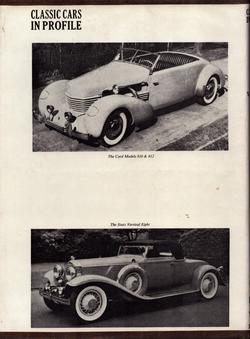
CORD MODELS 810 and 812: The
Cord 810, and later Cord 812, was an luxury automobile produced by the Cord
Automobile division of the Auburn Automobile Company in 1936 and 1937. It was
the first American-designed and built front wheel drive car with independent
front suspension. It followed the 1934 Citro�n Traction Avant and the Cord
L-29, both of which also had front wheel drive. Both models were also the first
to offer hidden headlights. The styling
of the Cord 810 was the work of designer Gordon M. Buehrig and his team of
stylists, which included young Vince Gardner and Alex Tremulis. While the first
American front-wheel-drive car with independent front suspension, it had an
archaic tube rear axle with semi-elliptic rear springs. Power came from a 4,739
cc (289 cu in)[1] Lycoming V8 of the same 125 hp (93 kW) as the L-29. The
semi-automatic four-speed transmission (three plus overdrive)[3] extended in
front of the engine, like on a Traction Avant. This allowed Buehrig to dispense
with the driveshaft and transmission tunnel; as a result, the new car was so
low it required no running boards.[1] It had a 125 in (3,175 mm) wheelbase. Reportedly conceived as a Duesenberg and
nearly devoid of chrome, the 810 had hidden door hinges and rear-hinged hood,
rather than the side-opening type more usual at the time, both new items. It
featured pontoon fenders with hidden headlamps (modified Stinson landing
lights) (E. L. Cord owned a majority of Stinson stock) that disappeared into
the fenders via dashboard hand cranks. This car was first and one of the few
ever to include this feature. It also
featured a concealed fuel filler door and variable-speed windshield wipers (at
a time when wipers were often operated by intake vacuum, and so tended to stop
when the driver stepped on the gas pedal). Its engine-turned dashboard included
complete instrumentation, a tachometer, and standard radio (which would not
become an industry standard offering until well into the 1950s). The most
famous feature was the "coffin nose", a louvered wraparound grille,
from which its nickname derived, a product of Buehrig's desire not to have a
conventional grille. The car caused a
sensation at its debut at the New York Auto Show in November 1935. The crowds
were so dense, attendees stood on the bumpers of nearby cars to get a look.
Cord had rushed to build the 100 cars needed to qualify for the show, and the
transmission was not ready. Even so, Cord took many orders at the show,
promising Christmas delivery, expecting production of 1,000 per month, but the
semi-automatic transmission was more troublesome than expected, and 25 December
came and went with no cars built. The first production cars were not ready to
deliver until February, and did not reach New York City until April 1936.[8] In
all, Cord managed to sell only 1,174 of the new 810 in its first model year, as
the result of mechanical troubles. Supercharging
was made available on the 1937 812 model, with a mechanically driven
Schwitzer-Cummins unit. Supercharged 812 models were distinguished from the
normally aspirated 812s by the brilliant chrome-plated external exhaust pipes
mounted on each side of the hood and grill. With supercharging, horsepower was
raised to 170.
JAGUAR C-TYPE: The Jaguar C-Type
(also called the Jaguar XK120-C) is a racing sports car built by Jaguar and
sold from 1951 to 1953. The "C" stands for "competition". The car used the XK 120 running gear of the
contemporary road proven XK120 in a lightweight tubular frame designed by
William Heynes and an aerodynamic aluminium body jointly developed by Heynes, R
J (Bob) Knight and later Malcolm Sayer. A total of 53 C-Types were built, 43 of
which were sold to private owners mainly in the US. The road-going XK120�s 3.4-litre twin-cam,
straight-6 engine produces between 160 and 180 bhp (134 kW). The C-Type version
was originally tuned to around 205 bhp (153 kW). The early C-Types were fitted
with SU carburetors and drum brakes. Later C-Types (mid 1953) are more
powerful, using triple twin-choke Weber carburettors and high-lift camshafts.
They are also lighter, and from mid 1953 braking performance was improved by
disc brakes on all four wheels. The lightweight, multi-tubular, triangulated frame
was designed by William Heynes. Heynes, Knight and Sayer together developed the
aerodynamic body. Made of aluminium in the barchetta style, it is devoid of
road-going items such as carpets, weather equipment and exterior door handles.
According to the Jaguar Heritage Registry the cars were produced between May
1952 starting with XKC001 and ending August 1953 XK054. The original alloy body
was marked with the prefix K (e.g. K1037).
The C-Type was successful in racing, most notably at the Le Mans 24
hours race, which it won twice. In 1951
the car won at its first attempt. The factory entered three, whose driver
pairings were Stirling Moss and Jack Fairman, Leslie Johnson and triple Mille
Miglia winner Clemente Biondetti, and the eventual winners, Peter Walker and
Peter Whitehead. The Walker-Whitehead car was the only factory entry to finish,
the other two retiring with lack of oil pressure. A privately entered XK120,
owned by Robert Lawrie, co-driven by Ivan Waller, also completed the race,
finishing 11th. In 1952 Jaguar, worried
by a report about the speed of the Mercedes-Benz 300SLs that would run at Le
Mans, modified the C-Type�s aerodynamics to increase the top speed. However,
the consequent rearrangement of the cooling system made the cars vulnerable to
overheating,[1] and all three retired from the race. The Peter Whitehead-Ian
Stewart and Tony Rolt/Duncan Hamilton cars blew head gaskets, and the Stirling
Moss-Peter Walker car, the only one not overheating having had a full-sized
radiator hurriedly fitted, lost oil pressure after a mechanical breakage.[2]
Testing by Norman Dewis at MIRA after the race proved that the overheating was
caused more by the revisions to the cooling system than by the altered
aerodynamics: the water pump pulley was undersized, so it was spinning too fast
and causing cavitation; also the header tank was in front of the passenger-side
bulkhead, far from the radiator, and the tubing diameter was too small at 7/8
inch. With the pump pulley enlarged, and the tubing increased to 1 1/4 inch,
the problem was eliminated. The main drawback of the new body shape was that it
reduced downforce on the tail to the extent that it caused lift and directional
instability at speeds over 120 mph (193 km/h) on the Mulsanne Straight. These
cars had chassis numbers XKC 001, 002 and 011. The first two were dismantled at
the factory, and the third survives in normal C-type form. In 1953 C-Types won again, and also placed
second and fourth. This time the body was in thinner, lighter aluminium and the
original twin H8 sand cast SU carburettors were replaced by three DCO3 40mm
Webers, which helped boost power to 220 bhp (164 kW).
COUPE DE L’AUTO SUNBEAMS
1911-1913:
SIX-CYLINDER O.M.:
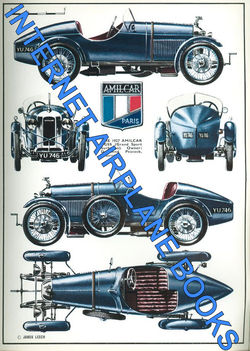
AUSTIN SEVEN: The Austin 7 is an
economy car that was produced from 1922 until 1939 in the United Kingdom by
Austin. It was nicknamed the "Baby Austin" and was at that time one
of the most popular cars produced for the British market and sold well abroad.
Its effect on the British market was similar to that of the Model T Ford in the
US, replacing most other British economy cars and cyclecars of the early 1920s.
It was also licensed and copied by companies all over the world. The very first
BMW car, the BMW Dixi, was a licensed Austin 7, as were the original American
Austins. In France they were made and sold as Rosengarts. In Japan, Nissan also
used the 7 design as the basis for their first cars, although not under
licence. This eventually led to a 1952 agreement for Nissan to build and sell
Austins in Japan under the Austin name. Until
the First World War Austin built mainly large cars, but in 1909 they sold a
single-cylinder small car built by Swift of Coventry called the Austin 7 hp.
After this they returned to bigger cars.
In 1920 Sir Herbert Austin commenced working on the concept of a smaller
car, mainly to meet the needs of young families aspiring to own an affordable
motor car. This idea was spurred on by the introduction of the Horsepower Tax
in 1921. His design concept marked a departure from his company's conservative
motoring past and Austin received considerable opposition from his board of
directors and creditors. Because the company was in receivership Austin decided
to carry out the project himself on his own account and in 1921 hired an
18-year-old draughtsman, Stanley Edge, from the Austin factory at Longbridge,
Birmingham to aid in the drawing of detailed plans. This work was carried out
in the billiard room of Austin's Lickey Grange home. Edge convinced Austin to use a small
four-cylinder engine. The original side valve engine design featured a capacity
of 696cc ( 55mm x 77mm ) giving a RAC rating of 7.2 hp, the cast cylinder block
featured a detachable head and was mounted on an aluminium crankcase. The
crankshaft used one roller and two ball bearings and the big-ends were splash
lubricated.[8] Edge also carried out the design of other mechanical components
such as the three speed gearbox and clutch assembly. Austin was largely
responsible for styling the Seven's design, which was reportedly influenced by
the design of the Peugeot Quadrilette. The "A" frame chassis design
was believed to have been influenced by the design of an American truck used in
the Longbridge factory in the early 1920s.
The design was completed in 1922 and three prototypes were constructed
in a special area of the Longbridge factory, and announced to the public in
July 1922.[8] Austin had put a large amount of his own money into the design
and patented many of its innovations in his own name. In return for his
investment he was paid a royalty of two guineas (2, 2s), (2.10) on every car
sold. Nearly 2,500 cars were made in the first year of production (1923), not
as many as hoped, but within a few years the "big car in miniature"
had wiped out the cyclecar industry and transformed the fortunes of the Austin
Motor Co. By 1939 when production finally ended, 290,000 cars and vans had been
made. The Austin 7 was considerably smaller than the Ford Model T. The
wheelbase was only 6 ft 3 inches (1.905 m), and the track only 40 inches (1.016
m). Equally it was lighter � less than half the Ford's weight at 794 pounds
(360 kg). The engine required for adequate performance was therefore equally
reduced and the 747 cc sidevalve was quite capable with a modest 10 hp output.
DAIMLER DOUBLE-SIXES:
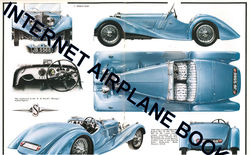
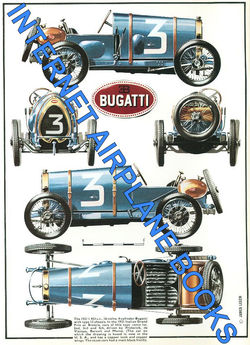
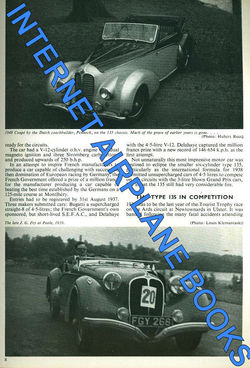
TYPE 57 BUGATTI: The Bugatti
Type 57 and later variants (including the famous Atlantic and Atalante) was an
entirely new design created by Jean Bugatti, son of founder Ettore. Type 57s
were built from 1934 through 1940, with a total of 710 examples produced. Type 57s used a twin-cam 3,257cc engine based
on that of the Type 49 but heavily modified by Jean Bugatti, unlike the single
cam engines of the Type 49 and earlier models. The engines of the Type 50, 51
used bevel gears at the front of the engine to transmit power from the
crankshaft, whereas the Type 57 used a train of spur gears at the rear of the
engine, with fiber gear wheels on the camshafts to achieve more silence in
operation. A rediscovered Type 57 sold
for 3.4 million euros at auction on 7 February 2009 at a motor show in Paris. The original Type 57 was a touring car model
produced from 1934 through 1940. It used the 3.3 L (3,257 cc; 198 cu in) engine
from the Type 59 Grand Prix cars, producing 135 hp (100 kW). Top speed was 153
kilometres per hour (95 mph). It rode on
a 3,302 mm (130 in) wheelbase and had a 1,349 mm (53 in) wide track. Road-going
versions weighed about 950 kg (2,090 lb). Hydraulic brakes replaced the
cable-operated units in 1938, a modification Ettore Bugatti hotly contested.
630 examples were produced. The original
road-going Type 57 included a smaller version of the Royale's square-bottom
horseshoe grille. The sides of the engine compartment were covered with
thermostatically-controlled shutters. It was a tall car, contrary to the tastes
of the time.
A-SERIES & L-SERIES
CONNAUGHTS: Connaught Engineering, often
referred to simply as Connaught, was a Formula One and sports car constructor
from the United Kingdom. Their cars participated in 18 Grands Prix, entering a
total of 52 races with their A, B, and C Type Formula 2 and Formula 1 Grand
Prix Cars. They achieved 1 podium and scored 17 championship points. The name
Connaught is a pun on Continental Autos, the garage in Send, Surrey, which
specialised in sales and repair of European sports cars such as Bugatti, and
where the cars were built. In 1950 the
first single-seaters, the Formula 2 "A" types, used an engine that
was developed by Connaught from the Lea-Francis engine used in their
"L" type sports cars. The engine was extensively re-engineered and
therefore is truly a Connaught engine. The cars were of conventional
construction for the time with drive through a preselector gearbox to a de Dion
rear axle. In 1952 and 1953 the races counting towards the World Championship
were to Formula 2 rules so drivers of these cars could take part in those
events as the table below shows. Prior
to the single-seat racing cars they built a small number of road going sports
cars developed on the Lea-Francis Sports Chassis, which achieved considerable
competition success. These were of types L2 and L3, and three examples of the
stark Cycle Winged L3/SR Sports Racer.
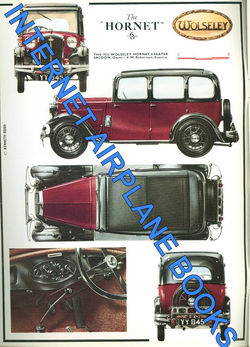
HORIZONTAL-ENGINED WOLSELEYS
1900-1905: The Wolseley Tool and Motor Car Company of Adderley Park Birmingham
was incorporated in March 1901 with a capital of �40,000 by Vickers, Sons and
Maxim to manufacture motor cars and machine tools. The managing director was
Herbert Austin. The cars and the Wolseley name came from Austin's exploratory
venture for The Wolseley Sheep Shearing Machine Company Limited, run since the
early 1890s by the now 33-year-old Austin. Wolseley's board had decided not to
enter the business and Maxim and the Vickers brothers picked it up. After his
five-year contract with The Wolseley Tool and Motor Car Company ended Austin
founded The Austin Motor Company Limited. Austin had been searching for other
products for WSSMC because sale of sheep-shearing machinery was a highly
seasonal trade. About 1895�96 he became interested in engines and
automobiles. During the winter of 1895�96, working in his own time at nights
and weekends, he made his own version of a design by L�on Boll�e that he
had seen in Paris. Later he found that another British group had bought the
rights and he had to come up with a design of his own, having persuaded the
directors of WSSMC to invest in the necessary machinery. In 1897 Austin's second Wolseley car, the
Wolseley Autocar No. 1 was revealed. It was a three-wheeled design (one front,
two rear) featuring independent rear suspension, mid-engine and back to back
seating for two adults. It was not successful and although advertised for sale,
none were sold. The third Wolseley car, the four-wheeled Wolseley
"Voiturette" followed in 1899. A further four-wheeled car was made in
1900. The 1901 Wolseley Gasoline Carriage featured a steering wheel instead of
a tiller. The first Wolseley cars sold to the public were based on the
"Voiturette", but production did not get under way until 1901, by
which time the board of WSSMC had lost interest in the nascent motor industry. Thomas and Albert Vickers, directors of
Vickers and Maxim Britain's largest armaments manufacturer had much earlier
decided to enter the industry at the right moment and impressed by Austin's
achievements at WSSMC they took on his enterprise. When Austin's five-year
contract officially ended in 1906 they had made more than 1,500 cars, Wolseley
was the largest British motor manufacturer and Austin's reputation was made. The company had been formed in March 1901. By
1 May 1901 Austin had issued his first catalogue. There were to be two models,
5 hp and 10 hp. They were both available with either a Tonneau or a Phaeton
body with either pneumatic or solid tyres. For an additional outlay of thirty
shillings (�1.50) the 10 hp model would be fitted with a sprag to prevent it
running backwards. "We recommend pneumatic tyres for all cars required to
run over twenty miles an hour. Austin then provided a paragraph as to why his
horizontal engines were better lubricated (than vertical engines) and that 750
rpm, the speed of his Wolseley engines, avoided the short life of competing
engines that ran between 1,000 and 2,000 rpm." Engines were horizontal which kept the centre
of gravity low. Cylinders were cast individually and arranged either singly, in
a pair or in two pairs which were horizontally opposed. The crankshaft lay
across the car allowing a simple belt or chain-drive to the rear axle. Austin's resolute refusal to countenance new
vertical engines for his Wolseleys, whatever his directors might wish, led to
Austin handing in his resignation the year before his contract ended. Curiously
in his new Austin enterprise all the engines proved vertical but there he had
to suffer a new financial master. Vickers replaced Austin by promoting
Wolseley's London sales manager, John Davenport Siddeley to general manager. As
Austin was aware Vickers had earlier built, in association with Siddeley, Siddeley's
vertical-engined cars at their Crayford Kent factory. The new Siddeley cars
began to overtake Wolseley's sales of "old-fashioned"
horizontal-engined cars. In early 1905 they hired Siddeley for their London
sales manager and purchased the goodwill and patent rights of his Siddeley
car. Siddeley, on his appointment to
Austin's former position, promptly replaced Austin's horizontal engines with
the now conventional upright engines.
LANCIA LAMBDA: The Lancia Lambda
is an innovative automobile produced from 1922 through 1931. It was the first
car to feature a load-bearing unitary body, (but without a stressed roof) and
it also pioneered the use of an independent suspension (the front sliding
pillar with coil springs). Vincenzo Lancia even invented a shock absorber for
the car and it had excellent four wheel brakes. Approximately 11,200 Lambdas
were produced. The narrow-angle
aluminium Lancia V4 engine was also notable. All three displacements shared the
same long 120 mm (4.7 in) stroke, and all were SOHC designs with a single
camshaft serving both banks of cylinders. First engine had 13� V angle,
second 14� and 3rd 13� 40'.
M.G. MIDGET M TYPE: The MG
M-type is a sports car that was produced by the MG Cars from April 1929 to
1932. It was sometimes referred to as the 8/33. Launched at the 1928 London
Motor Show when the sales of the larger MG saloons was faltering because of the
economic climate, the small car brought MG ownership to a new sector of the
market and probably saved the company. Early cars were made in the Cowley
factory, but from 1930 production had transferred to Abingdon. The M-Type was one of the first genuinely
affordable sports cars to be offered by an established manufacturer, as opposed
to modified versions of factory-built saloon cars and tourers. By offering a
car with excellent road manners and an entertaining driving experience at a low
price (the new MG cost less than double the cheapest version of the Morris
Minor on which it was based) despite relatively low overall performance the
M-type set the template for many of the MG products that were to follow, as well
as many of the other famous British sports cars of the 20th century. The M-type
was also the first MG to wear the Midget name that would be used on a
succession of small sports cars until 1980.
This 2-door sports car used an updated version of the four-cylinder
bevel-gear driven overhead camshaft engine used in the 1928 Morris Minor and
Wolseley 10 with a single SU carburettor giving 20 bhp (15 kW) at 4000 rpm.<
Drive was to the rear wheels through a three-speed non-synchromesh gearbox. The
chassis was based on the one used in the 1928 Morris Minor with lowered
suspension using half-elliptic springs and Hartford friction disk shock
absorbers with rigid front and rear axles and bolt on wire wheels. The car had
a wheelbase of 78 inches (1980 mm) and a track of 42 inches (1067 mm). 1930 brought a series of improvements to the
car. The Morris rod brake system, with the handbrake working on the
transmission, was replaced a cable system with cross shaft coupled to the
handbrake and the transmission brake deleted. Engine output was increased to 27
bhp (20 kW) by improving the camshaft and a four-speed gearbox was offered as
an option. The doors became front-hinged. A supercharged version could be
ordered from 1932, raising the top speed to 80 mph (130 km/h). Early bodies were fabric-covered using a wood
frame; this changed to all-metal in 1931. Most cars had bodies made by
Carbodies of Coventry and fitted by MG in either open two-seat or closed
two-door "Sportsmans" coup� versions, but some chassis were
supplied to external coachbuilders such as Jarvis. The factory even made a van
version as a service vehicle. The car could reach 65 mph (105 km/h) and return
40 miles per gallon. The open version cost �175 at launch, soon rising to
�185, and the coup� cost �245. The 1932 supercharged car cost �250. The M-type had considerable sporting success,
both privately and with official teams winning gold medals in the 1929 Land's
End Trial and class wins in the 1930 "Double Twelve" race at
Brooklands. An entry was also made in the 1930 Le Mans 24 hour, but neither of
the two cars finished.
STUTZ VERTICAL EIGHT:
SIX-CYLINDER HOTCHKISS 1929-1954:
Hotchkiss were luxury cars made between 1903 and 1955 by the French company
Hotchkiss et Cie in Saint-Denis, Paris. The badge for the marque showed a pair
of crossed cannons, evoking the company's history as an arms manufacturer. The company's first entry into car making
came from orders for engine components such as crankshafts which were supplied
to Panhard et Levassor, De Dion-Bouton and other pioneering companies and in
1903 they went on to make complete engines. Encouraged by two major car
distributors, Mann & Overton of London and Fournier of Paris, Hotchkiss
decided to start making their own range of cars and purchased a Mercedes
Simplex for inspiration and Georges Terasse, previously of Mors, was taken on
as designer. In 1926 construction of the
new factory in the Boulevard Ornano was completed and in 1929 Hotchkiss got
hold of a steel press allowing in-house manufacture of steel bodies. The one
model policy lasted until 1929 when the six-cylinder AM73 and AM80 models were
announced. "73" and "80" stood for the bore of the engines
used, a naming theme picked up again later in 1936 after a brief hiatus. Although most cars had bodies that were
factory built, Hotchkiss still was a luxury car brand, and so coachbuilder Veth
and Sons built a small number of bodies for the AM80. The AM models were replaced by a new range in
1933 with a new naming system. The 411 was an 11CV model with four-cylinder
engine, the 413 a 13CV four and the 615, 617 and 620 were similar six-cylinder
types. The 1936 686, which replaced the 620, was available as the
high-performance Grand Sport and 1937 Paris-Nice with twin carburettors and
these allowed Hotchkiss to win the Monte Carlo Rally in 1932, 1933, 1934, 1939,
1949 and 1950. The new naming scheme introduced in 1936 consisted of the number
of cylinders, followed by the bore of the engine (in millimetres).
LOTUS ELITE: The first Elite or
Lotus Type 14 was an ultra light two-seater coup�, produced from 1958 to
1963. Making its debut at the 1957
London Motor Car Show, Earls Court, as chassis #1008 , the Elite had spent a
year in development, aided by "carefully selected racing customers",
before going on sale. The Elite's most
distinctive feature was its highly innovative fibreglass monocoque
construction, in which a stressed skin GRP unibody replaced the previously
separate chassis and body components. Unlike the contemporary Chevrolet
Corvette, which used fibreglass for only exterior bodywork, the Elite also used
this glass-reinforced plastic material for the entire load-bearing structure of
the car, although the front of the monocoque incorporated a steel subframe
supporting the engine and front suspension, and there was a hoop at the
windscreen for mounting door hinges and jacking the car up. The first 250 body
units were made by Maximar Mouldings at Pulborough, Sussex. The body
construction caused numerous early problems, until manufacture was handed over
to Bristol Aeroplane Company. The
resultant body was both lighter, stiffer, and provided better driver protection
in the event of a crash. Sadly, the full understanding of the engineering
qualities of fibreglass reinforced plastic was still several years off and the
suspension attachment points were regularly observed to pull out of the
fibreglass structure. The weight savings allowed the Elite to achieve sports
car performance from a 75 hp (55 kW) 1216 cc Coventry Climax FWE all-aluminium
straight-4 engine with fuel consumption at 35 mpg‑imp (8.1 L/100 km; 29 mpg‑US). All production Lotus Elites were powered by the FWE
engine. (Popular mythology says that cars left the factory with a variety of
engines, but this is incorrect.) The FWE engine, derived from a water pump
engine usually found bolted to a fire truck, was used by Lucas Electric for
electrical component life testing in the presence of intense vibration. The car had independent suspension all round
with transverse wishbones at the front and Chapman struts at the rear. The rear
struts were so long, that they poked up in the back and the tops could be seen
through the rear window. The Series 2 cars, with Bristol-built bodies, had
triangulated trailing radius arms for improved toe in control. Girling disc
brakes, usually without servo assistance, of 9.5 in (241 mm) diameter were
used, inboard at the rear. When leaving the factory the Elite originally fitted
Pirelli Cinturato 155HR15 tyres (CA67) Advanced
aerodynamics also made a contribution, giving the car a very low drag
coefficient of 0.29 � quite low even for modern cars. This accomplishment is
all the more remarkable considering the engineers did not enjoy the benefits of
computer-aided design or wind tunnel testing. The original Elite drawings were
by Peter Kirwan-Taylor. Frank Costin (brother of Mike, one of the co founders
of Cosworth), at that time Chief Aerodynamic Engineer for the de Havilland
Aircraft Company, contributed to the final design. The SE was introduced in 1960 as a higher
performance variant, featuring twin SU carburettors and fabricated exhaust
manifold resulting in 85 bhp, ZF gearboxes in place of the standard "cheap
and nasty" MG ones, Lucas PL700 headlamps, and a silver coloured roof. The
Super 95 spec, with more power, from a higher tuned engine with raised
compression and a fiercer camshaft with five bearings. A very few Super 100 and
Super 105 cars were made with Weber carburettors, for racing use. Among its few faults was a resonant vibration
at 4000 rpm (where few drivers remained, on either street or track) and poor
quality control, handicapped by overly low price (thus losing money on every
car produced) and, "perhaps the greatest mistake of all", offering it
as a kit, exactly the opposite of the ideal for a quality manufacturer. Many
drivetrain parts were highly stressed and required regreasing at frequent
intervals. When production ended in
1963, 1030 had been built. Other sources indicate 1,047 were produced. A road car tested by The Motor magazine in
1960 had a top speed of 111.8 mph (179.9 km/h) and could accelerate from 0�60
mph (97 km/h) in 11.4 seconds. A fuel consumption of 40.5 mpg‑imp (6.97 L/100 km; 33.7 mpg‑US) was recorded. The test car cost �1966 including taxes. Like its siblings, the Elite was run in
numerous formulae, with particular success at Le Mans and the N�rburgring.
Elites won their class six times at the 24 hour Le Mans race as well as two
Index of Thermal Efficiency wins. Les Leston, driving DAD10, and Graham Warner,
driving LOV1, were noted UK Elite racers. In 1961, David Hobbs fitted a Hobbs
Mecha-Matic 4-speed automatic transmission to an Elite, and became almost
unbeatable in two years' racing � he won 15 times from 18 starts. New South
Wales driver Leo Geoghegan won the 1960 Australian GT Championship at the wheel
of a Lotus Elite. After winning Index of Thermal Efficiency prize, Lotus
decided to go for an outright win at Le Mans in 1960. They built a one off
Elite, called the LX, with a 1,964 cc FPF engine, larger wheels, and other
modifications. In testing, it proved capable of going 174 mph. Unfortunately,
the lead driver withdrew the night before the race, so the car did not have a
chance to prove itself.