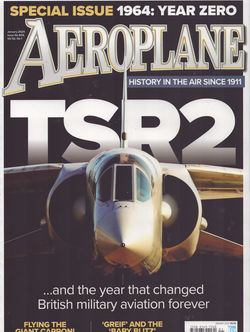
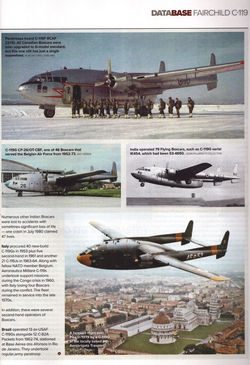
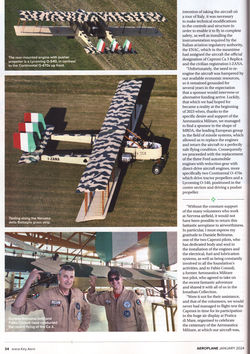
AEROPLANE JAN 2024 FAIRCHILD
C-119 FLYING BOX CAR C-82 PACKET BAC TSR.2 RAF COLD WAR STRIKE / RECONNAISSANCE
AIRCRAFT RNZAF NEW ZEALAND P-51 MUSTANG WW1 ITALIAN CAPRONI Ca3 WW2 GERMAN
LUFTWAFFE HEINKEL He177 GREIF BABY BLITZ AVRO TRANSPORT COMPANY RAF VICKERS
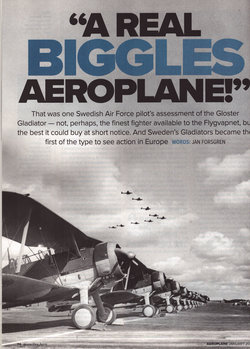
WELLINGTON TRAINING SWEDISH AIR FORCE SVENSA FLYGVAPENT GLOSTER GLADIATOR
BIPLANE FIGHTER WW2 AIR MAIL BY De HAVILLAND RAF GERMANY RAFG PHANTOMS
KEY PUBLISHING SOFTBOUND BOOK in ENGLISH
---------------------------------------
Additional Information from Internet Encyclopedia
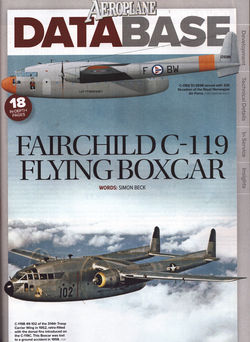
The Fairchild C-119 Flying Boxcar (Navy and Marine Corps
designation R4Q) was an American military transport aircraft developed from the
World War II-era Fairchild C-82 Packet, designed to carry cargo, personnel,
litter patients, and mechanized equipment, and to drop cargo and troops by
parachute. The first C-119 made its initial flight in November 1947, and by the
time production ceased in 1955, more than 1,100 had been built.
Development
The Air Force C-119 and Navy R4Q was initially a redesign
of the earlier C-82 Packet, built between 1945 and 1948. The Packet had
provided limited service to the Air Force's Tactical Air Command and Military
Air Transport Service before its design was found to have several serious
problems. Though it continued in service till replaced, all of these were
addressed in the C-119, which had its first test flight already in 1947.
To improve pilot visibility, enlarge the cargo area, and
streamline aerodynamics, the C-119 cockpit was moved forward to fit flush with
the nose, rather than over the cargo compartment. The correspondingly longer
fuselage resulted in more usable cargo space and larger loads than the C-82
could accommodate. The C-119 also got new engines, with 60% more power,
four-bladed props to three, and a wider and stronger airframe. The first C-119
prototype (called the XC-82B) made its initial flight in November 1947, with
deliveries of C-119Bs from Fairchild's Hagerstown, Maryland factory beginning
in December 1949.
The AC-119G Shadow gunship variant was fitted with four
six-barrel 7.62 mm (0.300 in) NATO miniguns, armor plating, flare launchers,
and night-capable infrared equipment. Like the AC-130 that recently preceded
it, the AC-119 proved to be a potent weapon. The AC-119 was made more deadly by
the introduction of the AC-119K Stinger version, which featured the addition of
two General Electric M61 Vulcan 20 mm (0.79 in) cannon, improved avionics, and
two underwing-mounted General Electric J85-GE-17 turbojet engines, adding
nearly 6,000 lbf (27 kN) of thrust.
Other major variants included the EC-119J, used for
satellite tracking, and the YC-119H Skyvan prototype, with larger wings and
tail.
In civilian use, many C-119s feature the
"Jet-Pack" modification, which incorporates a 3,400 lbf (15,000 N)
Westinghouse J34 turbojet engine in a nacelle above the fuselage.
In December 1950, after People's Republic of China
Expeditionary People's Volunteer Army troops blew up a bridge [N 1]at a narrow
point on the evacuation route between Koto-ri and Hungnam, blocking the
withdrawal of U.N. forces, eight U.S. Air Force C-119 Flying Boxcars flown by
the 314th Troop Carrier Group [6][N 2] were used to drop portable bridge
sections by parachute. The bridge, consisting of eight separate sixteen-foot
long, 2,900-pound sections, was dropped one section at a time, using two parachutes
on each section. Four of these sections, together with additional wooden
extensions were successfully reassembled into a replacement bridge by Marine
Corps combat engineers and the US Army 58th Engineer Treadway Bridge Company,
enabling U.N. forces to reach Hungnam.
From 1951 to 1962, C-119C, F and G models served with
U.S. Air Forces in Europe (USAFE) and Far East Air Forces (FEAF) as the
first-line Combat Cargo units, and did yeoman work as freight haulers with the
60th Troop Carrier Wing, the 317th Troop Carrier Wing and the 465th Troop
Carrier Wing in Europe, based first in Germany and then in France with roughly
150 aircraft operating anywhere from Greenland to India. A similar number of
aircraft served in the Pacific and the Far East. In 1958, the 317th absorbed the
465th, and transitioned to the C-130s, but the units of the former 60th Troop
Carrier Wing, the 10th, 11th and 12th Troop Carrier Squadrons, continued to fly
C-119s until 1962, the last non-Air Force Reserve and non-Air National Guard
operational units to fly the "Boxcars."
Perhaps the most remarkable use of the C-119 was the
aerial recovery of balloons, UAVs, and even satellites. The first use of this
technique was in 1955, when C-119s were used to recover Ryan AQM-34 Firebee
unmanned targets.[7] The 456th Troop Carrier Wing, which was attached to the
Strategic Air Command (SAC) from 25 April 1955 – 26 May 1956, used C-119s to
retrieve instrument packages from high-altitude reconnaissance balloons. C-119s
from the 6593rd Test Squadron based at Hickam Air Force Base, Hawaii performed
several aerial recoveries of film-return capsules during the early years of the
Corona spy satellite program. On 19 August 1960, the recovery by a C-119 of
film from the Corona mission code-named Discoverer 14 was the first successful
recovery of film from an orbiting satellite and the first aerial recovery of an
object returning from Earth orbit.
The C-119 went on to see extensive service in French
Indochina, beginning in 1953 with aircraft secretly loaned by the CIA to French
forces for troop support. These aircraft were generally flown in French
markings by American CIA pilots often accompanied by French officers and
support staff. The C-119 was to play a major role during the siege at Dien Bien
Phu, where they flew into increasingly heavy fire while dropping supplies to
the besieged French forces.[9] The only two American pilot casualties of the siege
at Dien Bien Phu were James B. McGovern Jr. and Wallace A. Buford. Both pilots,
together with a French crew member, were killed in early June, 1954, when their
C-119, while making an artillery drop, was hit and crippled by Viet Minh
anti-aircraft fire; the aircraft then flew an additional 75 miles (121 km) into
Laos before it crashed.
During the Vietnam War, the incredible success of the
Douglas AC-47 Spooky continued, but limitations of the size and carrying
capacity of the plane led the USAF to develop a larger plane to carry more
surveillance gear, weaponry, and ammunition, the AC-130 Spectre. However, due
to the strong demands of C-130s for cargo use there were not enough Hercules
frames to provide Spectres for operations against the enemy. The USAF filled
the gap by converting C-119s into AC-119s each equipped with four 7.62 minigun
pods, a Xenon searchlight, night observation sight, flare launcher, fire
control computer and TRW fire control safety display to prevent incidents of
friendly fire. The new AC-119 squadron was given the call-sign
"Creep" that launched a wave of indignation that led the Air Force to
change the name to "Shadow" on 1 December 1968.[10] C-119Gs were
modified as AC-119G Shadows and AC-119K Stingers. They were used successfully
in both close air support missions in South Vietnam and interdiction missions
against trucks and supplies along the Ho Chi Minh Trail. All the AC-119G
Gunships were transferred to the Republic of Vietnam Air Force starting in 1970
as the American forces began to be withdrawn.
During the late 1960s and early 1970s, Air National Guard
and USAF Reserve pilots flew C-119's to drop parachutist students for the US
Army Parachute School at Ft. Benning, Georgia.
After retirement from USAF active duty, substantial
numbers of C-119s and R4Qs soldiered on in the U.S. Navy, U.S. Marine Corps,
the Air Force Reserve and the Air National Guard until the mid-1970s, the R4Qs
also being redesignated as C-119s in 1962. The last military use of the C-119
by the United States ended in 1974 when a single squadron of Navy Reserve
C-119s based at Naval Air Facility Detroit/Selfridge Air National Guard Base
near Detroit, Michigan, and two squadrons based at Naval Air Station Los Alamitos,
California replaced their C-119s with newer aircraft.
Many C-119s were provided to other nations as part of the
Military Assistance Program, including Belgium, Brazil, Ethiopia, India, Italy,
Jordan, Taiwan, and (as previously mentioned) South Vietnam. The type was also
used by the Royal Canadian Air Force, and by the United States Navy and United
States Marine Corps under the designation R4Q until 1962 when they were also
redesignated as C-119.
Variants
C-119B
Production variant with two P&W R-4360-30 engines, 55
built.
C-119F
Production variant, (71 produced by Henry Kaiser with
Wright R-3350 engines), 256 built for the USAF and RCAF.
C-119G
As C-119F with different propellers, 480 built, some
converted from Fairchild or Kaiser built C-119F.
AC-119G Shadow
C-119G modified as gunships, 26 conversions.
R4Q-1
United States Navy & United States Marine Corps
version of the C-119C, 39 built.
R4Q-2
United States Navy and United States Marine Corps version
of the C-119F, later re-designated C-119F, 58 built.
Operators
C-119 Flying Boxcars from the 403rd Troop Carrier Wing
Belgium
Belgian Air Force received 40 new aircraft using Mutual
Defense Air Program (MDAP) funds delivered from 1952, 18 x C-119F and 22
C-119Gs. Six surplus Kaiser-built USAF C-119G were acquired in 1960. All C-119F
were retired in 1955 shortly after the arrival of last C-119G, eight were sold
to Royal Norwegian Air Force after being rebuilt to C-119G specs by Sabena
technicians, the remaining ten were sent to Spain but proved unsuccessful and
were ultimately re-acquired by Belgian Air Force in 1960–1961, rebuilt as
C-119G.[12][13]
Brazil
Brazilian Air Force received 11 former USAF C-119Gs using
Military Aid Program funding in 1962. An additional USAF C-119G was acquired in
1962 as an attrition replacement.
Canada
Royal Canadian Air Force received 35 new C-119Fs
delivered from 1953, later upgraded to C-119G standard.
Taiwan
Republic of China Air Force received 114 former USAF
aircraft, they were in service from 1958 to 1997.
Ethiopia
Ethiopian Air Force received eight former USAF aircraft
using Military Aid Program funding, after modification to C-119K standard with
underwing auxiliary jets they were delivered in two batched, five in 1970 and
three in 1971. Two former Belgian Air Force C-119Gs were acquired in 1972 as
spares source.
France
French Air Force operated in Indochina nine aircraft
loaned from USAF.
India
Indian Air Force received 79 aircraft. Italy
Italian Air Force operated 40 C-119G new aircraft as
Mutual Defence Assistance Program, five C-119G former USAF and transferred to
United Nations in December 1960 and 25 C-119J surplus USAF / ANG aircraft.[14]
The last one flew in 1979.[15]
Jordan
Royal Jordanian Air Force received four former USAF
aircraft.
Morocco
Royal Moroccan Air Force received 12 former USAF aircraft
and six former Canadian aircraft.
Norway
Royal Norwegian Air Force received 8 surplus Belgian
aircraft.
Spain
Spanish Air Force received 10 former Belgian C-119F
delivered by USAF but rejected all.
South Vietnam
Republic of Vietnam Air Force received 91 aircraft
transferred from USAF.
United Nations
Five former USAF aircraft donated, operated by the Indian
Air Force then passed to the Italian Air Force. United States
---------------------------------------
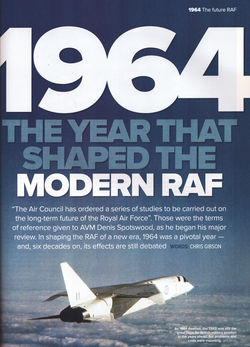
The British Aircraft Corporation TSR-2 is a cancelled
Cold War strike and reconnaissance aircraft developed by the British Aircraft
Corporation (BAC), for the Royal Air Force (RAF) in the late 1950s and early
1960s. The TSR-2 was designed around both conventional and nuclear weapons
delivery: it was to penetrate well-defended frontline areas at low altitudes
and very high speeds, and then attack high-value targets in rear areas. Another
intended combat role was to provide high-altitude, high-speed stand-off,
side-looking radar and photographic imagery and signals intelligence, aerial
reconnaissance. Only one airframe flew and test flights and weight-rise during
design indicated that the aircraft would be unable to meet its original
stringent design specifications. The design specifications were reduced as the
result of flight testing.
The TSR-2 was the victim of ever-rising costs and
inter-service squabbling over Britain's future defence needs, which together
led to the controversial decision in 1965 to scrap the programme. It was
decided to order an adapted version of the General Dynamics F-111 instead, but
that decision was later rescinded as costs and development times increased. The
replacements included the Blackburn Buccaneer and McDonnell Douglas F-4 Phantom
II, both of which had previously been considered and rejected early in the
TSR-2 procurement process. Eventually, the smaller swing-wing Panavia Tornado
was developed and adopted by a European consortium to fulfil broadly similar
requirements to the TSR-2.
Development
The introduction of the first jet engines in the
late-World War II period led to calls for new jet-powered versions of
practically every aircraft then flying. Among these was the design of a
replacement for the de Havilland Mosquito, at that time among the world's
leading medium bombers. The Mosquito had been designed with the express intent
of reducing the weight of the aircraft in order to improve its speed as much as
possible. This process led to the removal of all defensive armament, improving
performance to the point where it was unnecessary anyway. This high-speed
approach was extremely successful, and a jet-powered version would be even more
difficult to intercept.
Mission
The envisioned "standard mission" for the TSR-2
was to carry a 2,000 lb (910 kg) weapon internally for a combat radius of 1,000
nautical miles (1,200 mi; 1,900 km). Of that mission 100 nautical miles (120
mi; 190 km) was to be flown at higher altitudes at Mach 1.7 and the 200 nmi
(230 mi; 370 km) into and out of the target area was to be flown as low as 200
ft at a speed of Mach 0.95. The remainder of the mission was to be flown at
Mach 0.92. If the entire mission were to be flown at the low 200 ft altitude,
the mission radius was reduced to 700 nmi (810 mi; 1,300 km). Heavier weapons
loads could be carried with further reductions in range.[3] Plans for
increasing the TSR-2's range included fitting external tanks: one
450-imperial-gallon (540 US gal; 2,000 L) tank under each wing or one 1,000 imp
gal (1,200 US gal; 4,500 L) tank carried centrally below the fuselage. If no
internal weapons were carried, a further 570 imp gal (680 US gal; 2,600 L)
could be carried in a tank in the weapons bay.[3] Later variants would have
been fitted with variable-geometry wings.
The TSR-2 was also to be equipped with a reconnaissance
pack in the weapons bay which included an optical linescan unit built by EMI,
three cameras and a sideways-looking radar (SLR) in order to carry out the
majority of its reconnaissance tasks. Unlike modern linescan units that use
infrared imaging, the TSR-2's linescan would use daylight imaging or an
artificial light source to illuminate the ground for night reconnaissance.
Tactical nuclear weapons
Carriage of the existing Red Beard tactical nuclear bomb
had been specified at the beginning of the TSR-2 project, but it was quickly
realised that Red Beard was unsuited to external carriage at supersonic speeds,
had safety and handling limitations, and its 15 kt yield was considered
inadequate for the targets assigned. Instead, in 1959, a successor to Red
Beard, an "Improved Kiloton Bomb" to a specification known as
Operational Requirement 1177 (OR.1177), was specified for the TSR-2. In the
tactical strike role, the TSR-2 was expected to attack targets beyond the
forward edge of the battlefield assigned to the RAF by NATO, during day or
night and in all weathers. These targets comprised missile sites, both hardened
and soft, aircraft on airfields, runways, airfield buildings, airfield fuel
installations and bomb stores, tank concentrations, ammunition and supply
dumps, railways and railway tunnels, and bridges. OR.1177 specified 50, 100,
200 and 300 kt yields, assuming a circular error probable of 1,200 ft (370 m)
and a damage probability of 0.8, and laydown delivery capability, with burst
heights for targets from 0 to 10,000 ft (3,000 m) above sea level. Other
requirements were a weight of up to 1,000 lb (450 kg), a length of up to 144 in
(3.7 m), and a diameter up to 28 in (710 mm) (the same as Red Beard).
Design
TSR-2 XR222 engine exhaust nozzles photographed at
Duxford, 2009. The hinged panel in the centre above the engine nozzles contains
the braking parachute
Throughout 1959, English Electric (EE) and Vickers worked
on combining the best of both designs in order to put forward a joint design
with a view to having an aircraft flying by 1963, while also working on merging
the companies under the umbrella of the British Aircraft Corporation. EE had
put forward a delta winged design and Vickers, a swept wing on a long fuselage.
The EE wing, born of their greater supersonic experience, was judged superior
to Vickers, while the Vickers fuselage was preferred. In effect, the aircraft
would be built 50/50: Vickers the front half, EE the rear.
The TSR-2 was to be powered by two Bristol-Siddeley
Olympus reheated turbojets, advanced variants of those used in the Avro Vulcan.
The Olympus would be further developed and would power the supersonic Concorde.
The design featured a small shoulder-mounted delta wing with down-turned tips,
an all-moving swept tailplane and a large all-moving fin. Blown flaps were
fitted across the entire trailing edge of the wing to achieve the short takeoff
and landing requirement, something that later designs would achieve with the
technically more complex swing-wing approach. No ailerons were fitted, control
in roll instead being implemented by differential movement of the slab
tailplanes. The wing loading was high for its time, enabling the aircraft to
fly at very high speed and low level with great stability without being
constantly upset by thermals and other ground-related weather phenomena. The EE
Chief Test Pilot, Wing Commander Roland Beamont, favourably compared the
TSR-2's supersonic flying characteristics to the Canberra's own subsonic flight
characteristics, stating that the Canberra was more troublesome.
According to the Flight Envelope diagram, TSR2 was
capable of sustained cruise at Mach 2.05 at altitudes between 37,000 ft (11,000
m) and 51,000 ft (16,000 m) and had a dash speed of Mach 2.35 (with a limiting
leading edge temperature of 140 °C).
The aircraft featured some extremely sophisticated
avionics for navigation and mission delivery, which would also prove to be one
of the reasons for the spiralling costs of the project. Some features, such as
forward looking radar (FLR) and side-looking radar for navigational fixing,
only became commonplace on military aircraft years later. These features
allowed for an innovative autopilot system which, in turn, enabled long
distance terrain-following sorties as crew workload and pilot input had been
greatly reduced.
There were considerable problems with realising the
design. Some contributing manufacturers were employed directly by the Ministry
rather than through BAC, leading to communication difficulties and further cost
overruns. Equipment, an area in which BAC had autonomy, would be supplied by
the Ministry from "associate contractors", although the equipment
would be designed and provided by BAC, subject to ministry approval. The
overall outlay of funds made it the largest aircraft project in Britain to
date.
Operational history
Testing
Serial number XR222 was one of only three "flight
ready" TSR-2s completed, photographed at the Supermarine Spitfire 60th
Anniversary Airshow, Duxford, 1996.
Despite the increasing costs the first two of the
development batch aircraft were completed. Engine development and undercarriage
problems led to delays for the first flight which meant that the TSR-2 missed
the opportunity to be displayed to the public at 1964's Farnborough Airshow. In
the days leading up to the testing, Denis Healey, the Opposition shadow
secretary for defence, had criticised the aircraft saying that by the time it
was introduced it would face "new anti-aircraft" missiles that would
shoot it down making it prohibitively expensive at £16 million per aircraft (on
the basis of only 30 ordered).
Test pilot Roland Beamont finally made the first flight
from the Aeroplane and Armament Experimental Establishment (A&AEE) at
Boscombe Down, Wiltshire, on 27 September 1964. Initial flight tests were all
performed with the undercarriage down and engine power strictly controlled—with
limits of 250 kn (290 mph; 460 km/h) and 10,000 ft (3,000 m) on the first
(15-minute) flight. Shortly after takeoff on XR219's second flight, vibration
from a fuel pump at the resonant frequency of the human eyeball caused the
pilot to throttle back one engine to avoid momentary loss of vision.
Only on the 10th test flight was the landing gear
successfully retracted—problems preventing this on previous occasions, but
serious vibration problems on landing persisted throughout the flight testing
programme. The first supersonic test flight (Flight 14) was achieved on the
transfer from A&AEE, Boscombe Down, to BAC Warton. During the flight, the
aircraft achieved Mach 1 on dry power only (supercruise). Following this,
Beamont lit a single reheat unit as the other engine's reheat fuel pump was
unserviceable, with the result that the aircraft accelerated away from the
chase English Electric Lightning (a high speed interceptor) flown by Wing
Commander James "Jimmy" Dell, who had to catch up using reheat on
both engines. On flying the TSR-2 himself, Dell described the prototype as
handling "like a big Lightning".
Over a period of six months, a total of 24 test flights
were conducted. Most of the complex electronics were not fitted to the first
aircraft, so these flights were all concerned with the basic flying qualities
of the aircraft which, according to the test pilots involved, were outstanding.
Speeds of Mach 1.12 and sustained low-level flights down to 200 ft were
achieved above the Pennines. Undercarriage vibration problems continued,
however, and only in the final few flights, when XR219 was fitted with
additional tie-struts on the already complex landing gear, was there a
significant reduction in them. The last test flight took place on 31 March
1965.
Although the test flying programme was not completed and
the TSR-2 was undergoing typical design and systems modifications reflective of
its sophisticated configuration, "[T]here was no doubt that the airframe
would be capable of accomplishing the tasks set for it and that it represented
a major advance on any other type."
Costs continued to rise, which led to concerns at both
company and government upper management levels, and the aircraft was also
falling short of many of the requirements laid out in OR.343, such as takeoff
distance and combat radius. As a cost-saving measure, a reduced specification
was agreed upon, notably reductions in combat radius to 650 nmi (750 mi; 1,200
km), the top speed to Mach 1.75 and takeoff run up increased from 1,800 to
3,000 feet (550 to 915 m).
Project cancellation
XR220 at the RAF Museum, Cosford, 2007. The two cockpit
canopies are coated with a thin film of gold to protect the occupant's eyes
from a nuclear flash
By the 1960s, the United States military was developing
the swing-wing F-111 project as a follow-on to the Republic F-105 Thunderchief,
a fast low-level fighter-bomber designed in the 1950s with an internal bay for
a nuclear weapon. There had been some interest in the TSR-2 from Australia for
the Royal Australian Air Force (RAAF), but in 1963, the RAAF chose to buy the
F-111 instead, having been offered a better price and delivery schedule by the
American manufacturer. Nonetheless, the RAAF had to wait 10 years before the
F-111 was ready to enter service, by which time the anticipated programme cost
had tripled. The RAF was also asked to consider the F-111 as an alternative
cost-saving measure. In response to suggestions of cancellation, BAC employees
held a protest march, and the new Labour government, which had come to power in
1964, issued strong denials. However, at two Cabinet meetings held on 1 April
1965, it was decided to cancel the TSR-2 on the grounds of projected cost, and
instead to obtain an option agreement to acquire up to 110 F-111 aircraft with
no immediate commitment to buy. This decision was announced in the budget
speech of 6 April 1965. The maiden flight of the second development batch
aircraft, XR220, was due on the day of the announcement, but following an
accident in conveying the airframe to Boscombe Down, coupled with the
announcement of the project cancellation, it never happened. Ultimately, only
the first prototype, XR219, ever took to the air. A week later, the Chancellor
defended the decision in a debate in the House of Commons, saying that the
F-111 would prove cheaper.
All airframes were then ordered to be destroyed and
burned.
"The trouble with the TSR-2 was that it tried to
combine the most advanced state of every art in every field. The aircraft firms
and the RAF were trying to get the Government on the hook and understated the
cost. But TSR-2 cost far more than even their private estimates, and so I have
no doubt about the decision to cancel."
Denis Healey, then Minister of Defence.
Aeronautical engineer and designer of the Hawker
Hurricane Sir Sydney Camm said of the TSR-2: "All modern aircraft have
four dimensions: span, length, height and politics. TSR-2 simply got the first
three right."
TSR-2 replacements
To replace the TSR-2, the Air Ministry initially placed
an option for the F-111K (a modified F-111A with F-111C enhancements) but also
considered two other choices: a Rolls-Royce Spey (RB.168 Spey 25R) conversion
of a Dassault Mirage IV (the Dassault/BAC Spey-Mirage IV) and an enhanced
Blackburn Buccaneer S.2 with a new nav-attack system and reconnaissance
capability, referred to as the "Buccaneer 2-Double-Star". Neither
proposal was pursued as a TSR-2 replacement although a final decision was
reserved until the 1966 Defence Review. Defence Minister Healey's memo about
the F-111 and the Cabinet minutes regarding the final cancellation of the TSR-2
indicate that the F-111 was preferred.
Following the 1966 Defence White Paper, the Air Ministry
decided on two aircraft: the F-111K, with a longer-term replacement being a
joint Anglo-French project for a variable geometry strike aircraft – the Anglo
French Variable Geometry Aircraft (AFVG). A censure debate followed on 1 May
1967, in which Healey claimed the cost of the TSR-2 would have been £1,700
million over 15 years including running costs, compared with £1,000 million for
the F-111K/AFVG combination. Although 10 F-111Ks were ordered in April 1966
with an additional order for 40 in April 1967, the F-111 programme suffered
enormous cost escalation coupled with the devaluation of the pound, far
exceeding that of the TSR-2 projection. Many technical problems were still
unresolved before successful operational deployment and, faced with
poorer-than-projected performance estimates, the order for 50 F-111Ks for the
RAF was eventually cancelled in January 1968.
To provide a suitable alternative to the TSR-2, the RAF
settled on a combination of the F-4 Phantom II and the Blackburn Buccaneer,
some of which were transferred from the Royal Navy. These were the same
aircraft that the RAF had derided in order to get the TSR-2 go-ahead, but the
Buccaneer proved capable and remained in service until 1994. The RN and RAF
versions of the Phantom II were given the designation F-4K and F-4M
respectively, and entered service as the Phantom FG.1 (fighter/ground attack)
and Phantom FGR.2 (fighter/ground attack/reconnaissance), remaining in service
(in the air-to-air role) until 1992.
The RAF's Phantoms were replaced in the
strike/reconnaissance role by the SEPECAT Jaguar in the mid-1970s. In the
1980s, both the Jaguar and Buccaneer were eventually replaced in this role by
the variable-geometry Panavia Tornado, a much smaller design than either the
F-111 or the TSR-2. Experience in the design and development of the avionics,
particularly the terrain-following capabilities, were used on the later Tornado
programme. In the late 1970s, as the Tornado was nearing full production, an
aviation businessman, Christopher de Vere, initiated a highly speculative
feasibility study into resurrecting and updating the TSR-2 project. However,
despite persistent lobbying of the UK government of the time, his proposal was
not taken seriously and came to nothing.
Survivors
TSR-2 XR222 photographed at Duxford, 2009
TSR-2 XR220 at RAF Museum Cosford, UK
Forward fuselage used for testing seen on display at
Brooklands Museum
The TSR-2 tooling, jigs and many of the part completed
aircraft were all scrapped at Brooklands within six months of the cancellation.
Two airframes eventually survived: the complete XR220 at the RAF Museum,
Cosford, and the much less complete. XR222 at the Imperial War Museum Duxford. The
only airframe ever to fly, XR219, along with the completed XR221 and part
completed XR223 were taken to Shoeburyness and used as targets to test the
vulnerability of a modern airframe and systems to gunfire and shrapnel. Four
additional completed airframes, XR224, XR225, XR226 and one incomplete airframe
XR227 (X-06,07,08 and 09) were scrapped by R. J. Coley and Son, Hounslow
Middlesex. Four further airframe serials XR228 to XR231 were allocated but
these aircraft were allegedly not built. Construction of a further 10 aircraft
(X-10 to 19) allocated serials XS660 to 669 was started but all partly built
airframes were again scrapped by R. J. Coley. The last serial of that batch,
XS670 is listed as "cancelled", as are those of another batch of 50
projected aircraft, XS944 to 995. By coincidence, the projected batch of 46
General Dynamics F-111Ks (of which the first four were the trainer variant
TF-111K) were allocated RAF serials XV884-887 and 902–947,[124] but these again
were cancelled when the first two were still incomplete.
The haste with which the project was scrapped has been
the source of much argument and bitterness since and is comparable to the
cancellation and destruction of the American Northrop Flying Wing bombers in
1950,[125] and the Avro Canada CF-105 Arrow interceptor that was scrapped in
1959.