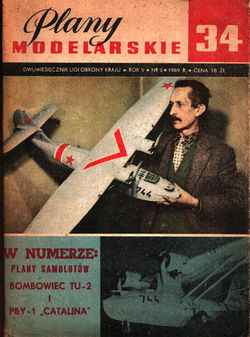
PLANY MODELARSKI 34 TUPOLEV Tu-2 / CONSOLIDATED PBY WW2
SOVIET UNION VVS & NAVY
SOFTBOUND PACKAGE
OF SCALE PLANS FOR BUILDING OF FLYING SCALE MODEL AIRCRAFT in POLISH
-----------------------------------------------------------------------------------------------------
Additional
Information from Internet Encyclopedia
The Tupolev Tu-2
(development names ANT-58 and 103; NATO reporting name Bat) was a twin-engine
Soviet high-speed daylight and frontline (SDB and FB) bomber aircraft of World
War II vintage. The Tu-2 was tailored to meet a requirement for a high-speed
bomber or dive-bomber, with a large internal bombload, and speed similar to
that of a single-seat fighter. Designed to challenge the German Junkers Ju 88,
the Tu-2 proved comparable, and was produced in torpedo, interceptor, and
reconnaissance versions. The Tu-2 was one of the outstanding combat aircraft of
World War II and it played a key role in the Red Army's final offensives.
Design and
development
In 1937, Andrei
Tupolev, along with many Soviet designers at the time, was arrested on
trumped-up charges of activities against the State. Despite the actions of the
Soviet government, he was considered important to the war effort and following
his imprisonment, he was placed in charge of a team that was to design military
aircraft. Designed as Samolyot (Russian: "aircraft") 103, the Tu-2
was based on earlier ANT-58, ANT-59 and ANT-60 light bomber prototypes.[2]
Essentially an upscaled and more powerful ANT-60 powered by AM-37 engines, the
first prototype was completed at Factory N156, and made its first test flight
on 29 January 1941, piloted by Mikhail Nukhtinov.[2] Mass production began in
September 1941, at Omsk Aircraft Factory Number 166, with the first aircraft
reaching combat units in March 1942. Modifications were made based on combat
experience, and Plant Number 166 built a total of 80 aircraft. The AM-37 engine
was abandoned to concentrate efforts on the AM-38F for the Il-2, which required
Tupolev to redesign the aircraft for an available engine. Modifications of this
bomber took ANT-58 through ANT-69 variants. A further 2527 aircraft were built
at Kazan, with these modifications. Production ceased in 1951 after a total of
some 3,000 aircraft were delivered to various Soviet Bloc air forces.
Operational
history
Built from 1941 to
1948, the Tu-2 was the USSR's second most important twin-engine bomber (the
first being the Pe-2). The design brought Andrei Tupolev back into favour after
a period of detention. Crews were universally happy with their Tupolevs. Pilots
could maneuver the aircraft like a fighter, it could survive heavy damage, and
it was fast.[3] The first Soviet unit to be equipped with the Tu-2 was 132 BAP
of 3 VA (Vozdushnaya Armiya, Air Army). The aircraft had its baptism of fire over
Velikiye Luki. There, in November-December 1942, this Tupolev bomber flew 46
sorties. On February 11, 1943, 132 BAP was transferred to 17 VA to support the
drive toward River Dnepr and it flew another 47 sorties - attacking airfields
and rail junctions - until April 13, when the unit was removed from frontline.
By that time only three Tu-2s were lost in action, while seven were damaged.
[4] The Tu-2 remained in service in the USSR until 1950.
Some surplus Tu-2s
were provided to the Chinese People's Liberation Army Air Force for use in the
Chinese Civil War. Some Chinese Tu-2s were shot down by United Nations airmen
during the Korean War. In the 1958–1962 'counter-riot actions' in the 1959
Tibetan uprising in Qinghai-Tibet Plateau covering Qinghai, Tibet, southern
Gansu, and western Sichuan, Chinese PLAAF Tu-2s took on the roles of
ground-attack, reconnaissance and liaison. The Chinese Tu-2s were retired at
the end of the 1970s.
After World War
II, the Tu-2 proved to be an ideal test aircraft for various powerplants,
including the first generation of Soviet jet engines.
-----------------------------------------------------------------------------------------------------
Additional
Information from Internet Encyclopedia
The Consolidated
PBY Catalina was an American flying boat, and later an amphibious aircraft of the 1930s and 1940s produced by Consolidated
Aircraft. It was one of the most
widely used seaplanes of World War II. Catalinas served with every branch of the United
States Armed Forces and in the
air forces and navies of many other nations.
During World War II, PBYs were used in anti-submarine
warfare, patrol bombing, convoy escort, search and rescue missions (especially air-sea
rescue), and cargo
transport. The PBY was the most
numerous aircraft of its kind and the last active military PBYs were not
retired from service until the 1980s. Even today, nearly 80 years after its
first flight, the aircraft continues to fly as a waterbomber (or airtanker) in aerial
firefighting operations all over
the world.
The designation "PBY" was determined in
accordance with the U.S. Navy aircraft designation
system of 1922; PB representing "Patrol Bomber"
and Y being the code assigned
to Consolidated Aircraft
as its manufacturer. Catalinas built by other manufacturers for the US Navy
were designated according to different manufacturer codes, thus Canadian
Vickers-built examples were
designated PBV, Boeing-Canada
examples PB2B (there already
being a Boeing PBB) and Naval
Aircraft Factory examples were
designated PBN. Canadian
examples were named Canso by the
Royal Canadian Air Force.
The United States Army Air Forces and later the United States Air Force used the designation OA-10.
Although slow and ungainly, Catalinas distinguished
themselves in World War II. Allied forces used them successfully in a wide variety of roles
that the aircraft was never intended for. They are remembered for their role in
rescuing downed airmen, in which they saved the lives of thousands of aircrew
downed over water. Catalina airmen called their aircraft the "cat" on
combat missions and "Dumbo" in air-sea rescue service Navy Catalinas
used in the Pacific against the Japanese for night operations were painted
black overall, and as a result were sometimes referred to locally as "Black Cats". In their role as patrol aircraft, Catalinas
participated in some of the most notable naval engagements of World War II. The
aircraft's parasol wing and large waist blisters provided excellent visibility
and combined with its long range and endurance, made it well suited for the
task.
The Naval Aircraft Factory made significant modifications to the
PBY design, many of which would have significantly interrupted deliveries had
they been incorporated on the Consolidated production lines. The new aircraft,
officially known as the PBN-1 Nomad,
had several differences from the basic PBY. The most obvious upgrades were to
the bow, which was sharpened and extended by two feet, and to the tail, which
was enlarged and featured a new shape. Other improvements included larger fuel
tanks, increasing range by 50%, and stronger wings permitting a 2,000 lb
(908 kg) increase in gross takeoff weight. An auxiliary power unit was
installed, along with an improved electrical system, and the weapons were
upgraded with continuous-feed mechanisms.
138 of the 156 PBN-1s produced served with the Soviet
Navy. The remaining 18 were assigned to training units at NAS Whidbey Island and the Naval Air Facility in Newport,
Rhode Island. Later,
improvements found in the PBN such as the larger tail were incorporated into
the amphibious PBY-6A.
The Soviet Union had shown an interest, resulting in an
order for three aircraft and the negotiation of a licence to build the type in
USSR. When these three machines were delivered they were accompanied by a team
of Consolidated engineers who assisted in establishment of the Soviet
production facilities. This aircraft model, designated GST, was powered by two
Wright R-1820-derived, nine-cylinder Shvetsov M-62 or ASh-62IR single-row
radial engines of 900 to 1,000 hp (671 to 746 kW). The first GST entered
service towards the end of 1939. It is estimated hundreds more served with the
Soviet Navy. Soviet Union also received 138 PBN-1 Nomad variant of the Catalina
built by the Naval Aircraft Factory in Philadelphia along with 48 PBY-6As under
the Lend-Lease Act.