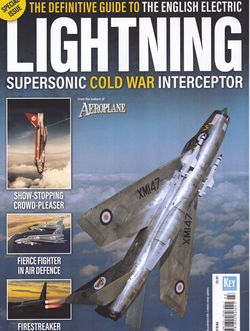
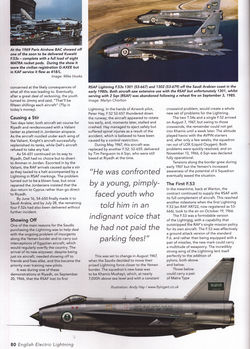
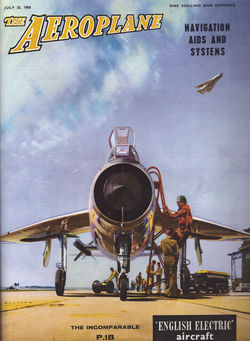
LIGHTNING SUPERSONIC
COLD WAR JET INTERCEPTOR RAF ROYAL SAUDI AF KUWAIT RAFG
KEY PUBLISHING SOFTBOUND BOOK in ENGLISH
---------------------------------------
Additional Information from Internet Encyclopedia
The English Electric Lightning is a British fighter
aircraft that served as an interceptor during the 1960s, the 1970s and into the
late 1980s. It was capable of a top speed of above Mach 2. The Lightning was
designed, developed, and manufactured by English Electric. After EE merged with
other aircraft manufacturers to form the British Aircraft Corporation it was
marketed as the BAC Lightning. It was operated by the Royal Air Force (RAF),
the Kuwait Air Force (KAF), and the Royal Saudi Air Force (RSAF).
A unique feature of the Lightning's design is the
vertical, staggered configuration of its two Rolls-Royce Avon turbojet engines
within the fuselage. The Lightning was designed and developed as an interceptor
to defend the airfields of the British "V bomber" strategic nuclear
force[4] from attack by anticipated future nuclear-armed supersonic Soviet
bombers such as what emerged as the Tupolev Tu-22 "Blinder", but it
was subsequently also required to intercept other bomber aircraft such as the
Tupolev Tu-16 ("Badger") and the Tupolev Tu-95 ("Bear").
The Lightning has exceptional rate of climb, ceiling, and
speed; pilots have described flying it as "being saddled to a
skyrocket".[1] This performance and the initially limited fuel supply
meant that its missions are dictated to a high degree by its limited range.[5]
Later developments provided greater range and speed along with aerial
reconnaissance and ground-attack capability. Overwing fuel tank fittings were
installed in the F6 variant and gave an extended range, but limited maximum
speed to a reported 1,000 miles per hour (1,600 km/h).
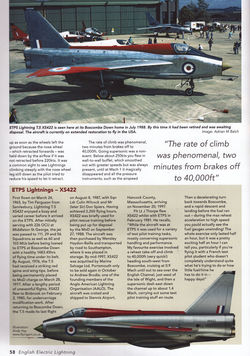
Following retirement by the RAF on 30 April 1988,[3] many
of the remaining aircraft became museum exhibits. Until 2009, three Lightnings
were kept flying at Thunder City in Cape Town, South Africa. In September 2008,
the Institution of Mechanical Engineers conferred on the Lightning its
Engineering Heritage Award at a ceremony at BAE Systems (the successor to BAC)
Warton Aerodrome.
Development
Origins
The specification for the aircraft followed the
cancellation of the Air Ministry's 1942 specification E.24/43 supersonic
research aircraft which had resulted in the Miles M.52 programme.[8] Teddy
Petter, formerly chief designer at Westland Aircraft, who had been taken on by
English Electric in 1944 to head an office to develop aircraft rather than just
make other manufacturers' designs, was a keen early proponent of Britain's need
to develop a supersonic fighter aircraft. In 1947, Petter approached the Ministry
of Supply (MoS) with his proposal, and in response Specification ER.103 was
issued for a single research aircraft, which was to be capable of flight at
Mach 1.5 (1,593 km/h; 990 mph) and 50,000 ft (15,000 m).
Petter initiated a design proposal with Frederick Page[a]
leading the design and Ray Creasey[b] responsible for the aerodynamics.[10] By
July 1948 their proposal incorporated the stacked engine configuration and a
high-mounted tailplane. As it was designed for Mach 1.5, the wing leading edge
was swept back 40° to keep it clear of the Mach cone.[11] This proposal was
submitted in November 1948,[citation needed] and in January 1949 the project
was designated P.1 by English Electric.[citation needed] On 29 March 1949 the
MoS granted approval to start the detailed design, develop wind tunnel models
and build a full-size mockup.
The design that had developed during 1948 evolved further
during 1949 to further improve performance, taking many design cues from the
CAC CA-23. [10] To achieve Mach 2 the wing sweep was increased to 60° with the
ailerons moved to the wingtips.[12] In late 1949, low-speed wind tunnel tests
showed that a vortex was generated by the wing which caused a large downwash on
the tailplane; this issue was solved by lowering the tail below the wing.[12]
Following the resignation of Petter from English Electric, Page took over as
design team leader for the P.1[13] and the running of EE design office. In
1949, the Ministry of Supply had issued Specification F23/49, which expanded
upon the scope of ER103 to include fighter-level manoeuvring. On 1 April 1950,
English Electric received a contract for two flying airframes, as well as one
static airframe, designated P.1.
The Royal Aircraft Establishment disagreed with Petter's
choice of sweep angle (60 degrees) and tailplane position (low) considering it
to be dangerous. To assess the effects of wing sweep and tailplane position on
the stability and control of Petter's design Short Brothers were issued a
contract by the Ministry of Supply to produce the Short SB.5 in mid-1950.[15]
This was a low-speed research aircraft that could test sweep angles from 50 to
69 degrees and high or low tailplane positions. Testing with the wings and tail
set to the P.1 configuration started in January 1954 and confirmed this
combination as the correct one.
Prototypes
P1A
From 1953 onward, the first three prototype aircraft were
hand-built at Samlesbury Aerodrome, where all Lightnings were built. These
aircraft were given the aircraft serials WG760, WG763, and WG765 (the
structural test airframe). The prototypes were powered by un-reheated Armstrong
Siddeley Sapphire turbojets, as the selected Rolls-Royce Avon engines had
fallen behind schedule due to their own development problems.[19] Since there
was no space in the fuselage for fuel the thin wings were the fuel tanks and since
they also provided space for the stowed main undercarriage the fuel capacity
was relatively small, giving the prototypes an extremely limited endurance, and
the narrow tyres housed in the thin wings rapidly wore out if there was any
crosswind component during take-off or landing. Outwardly, the prototypes
looked very much like the production series, but they were distinguished by the
rounded-triangular air intake with no centre-body at the nose, short fin, and
lack of operational equipment.
On 9 June 1952, it was decided that there would be a
second phase of prototypes built to develop the aircraft toward achieving Mach
2.0 (2,450 km/h; 1,522 mph); these were designated P.1B while the initial three
prototypes were retroactively reclassified as P.1A.[21] P.1B was a significant
improvement on P.1A. While it was similar in aerodynamics, structure and
control systems, it incorporated extensive alterations to the forward fuselage,
reheated Rolls-Royce Avon R24R engines, a conical centre body inlet cone,
variable nozzle reheat and provision for weapons systems integrated with the
ADC and AI.23 radar. Three P.1B prototypes were built, assigned serials XA847,
XA853 and XA856.
In May 1954, WG760 and its support equipment were moved
to RAF Boscombe Down for pre-flight ground taxi trials; on the morning of 4
August 1954, WG760, piloted by Roland Beamont, flew for the first time from
Boscombe Down. One week later, WG760 officially achieved supersonic flight for
the first time, having exceeded the speed of sound during its third flight.
During its first flight, WG760 had unknowingly exceeded Mach 1 (1,225 km/h; 761
mph), but due to position error the Mach meter only showed a maximum of Mach
0.95 (1,164 km/h; 723 mph). The occurrence was noticed during flight data
analysis a few days later.[26] While WG760 had proven the P.1 design to be
viable, it was limited to Mach 1.51 (1,850 km/h; 1,149 mph) due to directional
stability limits. In May 1956, the P.1 received the "Lightning" name,
which was said to have been partially selected to reflect the aircraft's
supersonic capabilities.
OR.155 and project selection
In 1955, the Air Ministry learned of the Tupolev Tu-22,
expected to enter service in 1962. It could cruise for relatively long periods
at Mach 1.2 (1,470 km/h; 913 mph) and had a dash speed of Mach 1.5. Against a
target flying at these speeds, the existing Gloster Javelin interceptors would
be useless; its primary de Havilland Firestreak armament could only attack from
the rear and the Tu-22 would run away from the Javelin in that approach. A
faster version, the "thin-wing Javelin", would offer limited supersonic
performance and make it marginally useful against the Tu-22, while a new
missile, "Red Dean" would allow head-on attacks. This combination
would be somewhat useful against Tu-22, but of marginal use if faster bombers
were introduced. In January 1955, the Air Ministry issued Operational
Requirement F.155 calling for a faster design to be armed with either an
improved Firestreak known as "Blue Vesta", or an improved Red Dean
known as "Red Hebe". The thin-wing Javelin was cancelled in May 1956.
In March 1957, Duncan Sandys released the 1957 Defence
White Paper which outlined the changing strategic environment due to the
introduction of ballistic missiles with nuclear warheads. Although missiles of
the era had relatively low accuracy compared to a manned bomber, any loss of
effectiveness could be addressed by the ever-increasing yield of the warhead.
This suggested that there was no targeting of the UK that could not be carried
out by missiles, and Sandys felt it was unlikely that the Soviets would use
bombers as their primary method of attack beyond the mid-to-late 1960s.
This left only a brief period, from 1957 to some time in
the 1960s, in which bombers remained a threat. Sandys felt that the imminent
introduction of the Bloodhound Mk. II surface-to-air missile would offer enough
protection against bombers. The Air Ministry disagreed; they pointed out that
the Tu-22 would enter service before Bloodhound II, leaving the UK open to
sneak attack. Sandys eventually agreed this was a problem, but pointed out that
F.155 would enter service after Bloodhound, as would a further improved SAM,
"Blue Envoy". F.155 was cancelled on 29 March 1957 and Blue Envoy in
April.
To fill the immediate need for a supersonic interceptor,
Lightning was selected for production. The aircraft was already flying, and the
improved P.1B was only weeks away from its first flight. Lightnings mounting
Firestreak could be operational years before Bloodhound II, and the aircraft's
speed would make it a potent threat against the Tu-22 even in a tail-chase. To
further improve its capability, in July 1957 the Blue Vesta program was
reactivated in a slightly simplified form, allowing head-on attacks against an
aircraft whose fuselage was heated through skin friction while flying
supersonically. In November 1957, the missile was renamed "Red Top".
This would allow Lightning to attack even faster bombers through a
collision-course approach. Thus, what had originally been an aircraft without a
mission beyond testing was now selected as the UK's next front-line fighter.
Further testing
On 4 April 1957 Beamont made the first flight of the P.1B
XA847, exceeding Mach 1 during this flight. During the early flight trials of
the P.1B speeds in excess of 1,000 mph were achieved daily. During this period
the Fairey Delta 2 (FD2) held the world speed record of 1,132 miles per hour
(1,822 km/h) achieved on 10 March 1956 and held till December 1957. While the
P.1B was potentially faster than the FD2, it lacked the fuel capacity to
provide one run in each direction at maximum speed to claim the record in
accordance with international rules.
In 1958 two test pilots from the USAF Air Force Flight
Test Center, Andy Anderson and Deke Slayton, were given the opportunity to
familiarise themselves with the P.1B. Slayton, who was subsequently selected as
one of the Mercury astronauts, commented:
The P.1 was a terrific plane, with the easy handling of
the F-86 and the performance of an F-104. Its only drawback was that it had no
range at all... Looking back, however, I'd have to say that the P.1 was my
favourite all-time plane.
In late October 1958, the plane was officially and
formally named "Lightning".[33] The event was celebrated in
traditional style in a hangar at RAE Farnborough, with the prototype XA847
having the name 'Lightning' freshly painted on the nose in front of the RAF
Roundel, which almost covered it. A bottle of champagne was put beside the nose
on a special smashing rig which allowed the bottle to safely be smashed against
the side of the aircraft. The honor of smashing the bottle went to the Chief of
the Air Staff, Sir Dermot Boyle.
On 25 November 1958 the P.1B XA847, piloted by Roland
Beamont, reached Mach 2 for the first time[34][35] in a British aircraft.[1]
This made it the second Western European aircraft to reach Mach 2, the first
one being the French Dassault Mirage III just over a month earlier on 24
October 1958.
Production
The first operational Lightning, designated Lightning
F.1, was designed as an interceptor to defend the V Force airfields in
conjunction with the "last ditch" Bristol Bloodhound missiles located
either at the bomber airfield, e.g. at RAF Marham, or at dedicated missile
sites near to the airfield, e.g. at RAF Woodhall Spa near the 3-squadron Vulcan
station RAF Coningsby. The bomber airfields along with the dispersal airfields,
would be the highest priority targets in the UK for enemy nuclear weapons. To
best perform this intercept mission, emphasis was placed on rate-of-climb,
acceleration, and speed, rather than range – originally a radius of operation
of 150 miles (240 km) from the V bomber airfields was specified – and
endurance. It was equipped with two 30 mm ADEN cannon in front of the cockpit
windscreen and an interchangeable fuselage weapons pack containing either an
additional two ADEN cannon, 48 two-inch (51 mm) unguided air-to-air rockets, or
two de Havilland Firestreak air-to-air missiles. The Ferranti AI.23 onboard
radar provided missile guidance and ranging, as well as search and track
functions.
The next two Lightning variants, the Lightning F.1A and
F.2, incorporated relatively minor design changes; for the next variant, the
Lightning F.3, they were more extensive. The F.3 had higher thrust Rolls-Royce
Avon 301R engines, a larger squared-off fin and strengthened inlet cone
allowing a service clearance to Mach 2.0 (2,450 km/h; 1,522 mph) (the F.1, F.1A
and F.2 were limited to Mach 1.7 (2,083 km/h; 1,294 mph)). The A.I.23B radar
and Red Top missile offered a forward hemisphere attack capability and deletion
of the nose cannon. The new engines and fin made the F.3 the highest
performance Lightning yet, but with an even higher fuel consumption and
resulting shorter range. The next variant, the Lightning F.6, was already in
development, but there was a need for an interim solution to partially address
the F.3's shortcomings, the Interim F.Mk6.
The Interim F.Mk6 introduced two improvements: a new,
non-jettisonable, 610-imperial-gallon (2,800 L) ventral fuel tank,[40] and a
new, kinked, conically cambered wing leading edge, incorporating a slightly
larger leading edge fuel tank, raising the total usable internal fuel by 716
imperial gallons (3,260 L). The conically cambered wing improved
manoeuvrability, especially at higher altitudes, and the ventral tank nearly
doubled available fuel. The increased fuel was welcome, but the lack of cannon
armament was felt to be a deficiency. It was thought that cannon would be
useful in a peacetime interception for firing warning shots to encourage an
aircraft to change course or to land.
The Lightning F.6 was originally nearly identical to the
F.3A with the exception that it could carry two 260-imperial-gallon (1,200 L)
ferry tanks on pylons over the wings. These tanks were jettisonable in an
emergency, and gave the F.6 a substantially improved deployment capability.
There remained one glaring shortcoming: the lack of cannon. This was finally
rectified in the form of a modified ventral tank with two ADEN cannon mounted
in the front. The addition of the cannon and their ammunition decreased the
tank's fuel capacity from 610 to 535 imperial gallons (2,770 to 2,430 L).
The Lightning F.2A was an F.2 upgraded with the cambered
wing, the squared fin, and the 610 imperial gallons (2,800 L) ventral tank. The
F.2A retained the A.I.23 and Firestreak missile, the nose cannon, and the
earlier Avon 211R engines.[42] Although the F.2A lacked the thrust of the later
Lightnings, it had the longest tactical range of all Lightning variants, and
was used for low-altitude interception over West Germany.
Export and further developments
The Lightning F.53, otherwise known as the Export
Lightning, was developed as a private venture by BAC. While the Lightning had
originated as an interception aircraft, this version was to have a multirole
capability for quickly interchanging between interception, reconnaissance, and
ground-attack duties.[43] The F.53 was based on the F.6 airframe and avionics,
including the large ventral fuel tank, cambered wing and overwing pylons for
drop tanks of the F.6, but incorporated an additional pair of hardpoints under
the outer wing. These hardpoints could be fitted with pylons for air-to-ground
weaponry, including two 1,000 lb (450 kg) bombs or four SNEB rocket pods each
carrying eighteen 68 mm rockets. A gun pack carrying two ADEN cannons and 120
rounds each could replace the forward part of the ventral fuel tank.
Alternative, interchangeable packs in the forward fuselage carried two
Firestreak missiles, two Red Top missiles, twin retractable launchers for 44×
2-inch (50 mm) rockets, or a reconnaissance pod fitted with five 70 mm Type 360
Vinten cameras.
Royal Air Force
The first aircraft to enter service with the RAF, three
pre-production P.1Bs, arrived at RAF Coltishall in Norfolk on 23 December 1959,
joining the Air Fighting Development Squadron (AFDS) of the Central Fighter
Establishment, where they were used to clear the Lightning for entry into
service.[98][99] The production Lightning F.1 entered service with the AFDS in
May 1960, allowing the unit to take part in the air defence exercise
"Yeoman" later that month. The Lightning F.1 entered frontline squadron
service with 74 Squadron under the command of Squadron Leader John
"Johnny" Howe at Coltishall from 11 July 1960.[2] This made the
Lightning the second Western European-built combat aircraft with true
supersonic capability to enter service and the second fully supersonic aircraft
to be deployed in Western Europe, the first one in both categories being the
Swedish Saab 35 Draken on 8 March 1960 four months earlier.
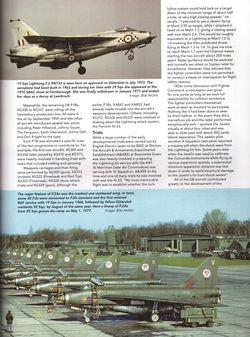
A Lightning was tasked with shooting down a pilot-less
Hawker Siddley Harrier over West Germany in 1972. The pilot had abandoned the
Harrier which continued flying toward the East German border; it was shot down
to avoid a diplomatic incident.[114] During British Airways trials in April
1985, Concorde was offered as a target to NATO fighters including F-15 Eagles,
F-16 Fighting Falcons, Grumman F-14 Tomcats, Dassault Mirages, and F-104
Starfighters – but only Lightning XR749, flown by Mike Hale and described by
him as "a very hot ship, even for a Lightning", managed to overtake
Concorde on a stern conversion intercept.
During the 1960s, as strategic awareness increased and a
multitude of alternative fighter designs were developed by Warsaw Pact and NATO
members, the Lightning's range and firepower shortcomings became increasingly
apparent. The transfer of McDonnell Douglas F-4 Phantom IIs from Royal Navy
service enabled these much longer-ranged aircraft to be added to the RAF's
interceptor force alongside those withdrawn from Germany as they were replaced
by SEPECAT Jaguars in the ground attack role.[115] The Lightning's direct
replacement was the Panavia Tornado F3, an interceptor variant of the Panavia
Tornado multi-role aircraft. The Tornado featured several advantages over the
Lightning, including a far larger weapons load and considerably more advanced
avionics.[116] Lightnings were slowly phased out of service between 1974 and
1988. In their final years the airframes required considerable maintenance to
keep them airworthy due to the sheer number of accumulated flight
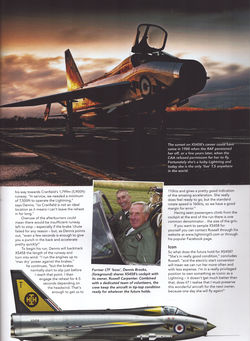
hours.[citation needed] The last flight by RAF Lightnings was on 30 June 1988
with 2 aircraft flying to Cranfield Airport from RAF Binbrook.
Fighter Command and Strike Command
The main Lightning role was the air defence of the United
Kingdom and was operated at first as part of Fighter Command and then from 1968
with No. 11 Group of Strike Command. At the formation of Strike Command nine
Lightning squadrons were operational in the United Kingdom.
Far East Air Force
In 1967 No. 74 Squadron was moved to RAF Tengah,
Singapore to take over the air defence role from the Gloster Javelin equipped
60 Squadron.[118] The squadron was disbanded in 1971 following the withdrawal
of British forces from Singapore.
Near East Air Force
The Royal Air Force had detached Lightnings to RAF
Akrotiri, Cyprus to support the Near East Air Force and in 1967 No. 56 Squadron
RAF moved from RAF Wattisham with the Lightning F.3 to provide a permanent air
defence force, it converted to the F.6 in 1971 and returned to the United
Kingdom in 1975.
Royal Air Force Germany
In the early 1960s No. 19 Squadron and No. 92 Squadron
with Lightning F.2s, moved from RAF Leconfield to RAF Gütersloh in West Germany
as part of Royal Air Force Germany and operated in the low-level air defence
role until disbanded in 1977 when the role was taken over by the Phantom FGR2
Saudi Arabia and Kuwait
On 21 December 1965, Saudi Arabia, keen to improve its
air defences owing to the Saudi involvement in the North Yemen Civil War and
the resultant air incursions into Saudi airspace by Egyptian forces supporting
the Yemeni Republicans, placed a series of orders with Britain and the US to
build a new integrated air defence system. BAC received orders for 34 multirole
single-seat Lightning F.53s that could still retain very high performance and
reasonable endurance, and six two-seat T.55 trainers, together with 25 BAC
Strikemaster trainers, while the contract also included new radar systems,
American Hawk surface-to-air missiles and training and support services.
To provide an urgent counter to air incursions, with
Saudi towns near the border being bombed by Egyptian aircraft, an additional
interim contract, called "Magic Carpet", was placed in March 1966 for
the supply of six ex-RAF Lightnings (four F.2s and two T.4 trainers,
redesignated F.52 and T.54 respectively[m]), six Hawker Hunters, two air
defence radars and a number of Thunderbird surface-to-air missiles.[49][119]
The "Magic Carpet" Lightnings were delivered to Saudi Arabia in July 1966.
One lost in an accident was later replaced in May 1967. The Lightnings and
Hunters, flown by mercenary pilots, were deployed to Khamis Mushait airfield
near the Yemeni border, resulting in the curtailing of operations by the
Egyptian Air Force over the Yemeni-Saudi border. Afterwards during the
Al-Wadiah War RSAF Lightnings flown by Saudi and Pakistan Air Force pilots
participated in the airstrikes on Yemeni militias after they captured a town in
Saudi Arabia in 1969.
Kuwait ordered 14 Lightnings in December 1966; 12 F.53Ks
and two T.55Ks. The first Kuwait aircraft, a T.55K first flew on 24 May 1968
and deliveries to Kuwait started in December 1968.[121] The Kuwaitis somewhat
overestimated their ability to maintain such a complex aircraft, not adopting
the extensive support from BAC and Airwork Services that the Saudis used to
keep their Lightnings operational, so serviceability was poor.
Saudi Arabia officially received F.53 Lightnings in
December 1967, although they were kept at Warton while trials and development
continued and the first Saudi Lightnings to leave Warton were four T.55s
delivered in early 1968 to the Royal Air Force 226 Operational Conversion Unit
at RAF Coltishall, the four T.55s were used to train Saudi aircrew for the next
18 months.[123] The new-build Lightnings were delivered under Operation
"Magic Palm" between July 1968 and August 1969. Two Lightnings, a
F.53 and a T.55 were destroyed in accidents prior to delivery, and were
replaced by two additional aircraft, the last of which was delivered in June
1972.[120][124] The multirole F.53s served in the ground-attack and
reconnaissance roles as well as an air defence fighter, with Lightnings of No 6
Squadron RSAF carrying out ground-attack missions using rockets and bombs
during a border dispute with South Yemen between December 1969 and May 1970.
One F.53 (53–697) was shot down by Yemeni ground fire on 3 May 1970 during a
reconnaissance mission, with the pilot ejecting successfully and being rescued
by Saudi forces.[124][125] Saudi Arabia received Northrop F-5E fighters from
1971, which resulted in the Lightnings relinquishing the ground-attack mission,
concentrating on air defence, and to a lesser extent, reconnaissance.
Kuwait's Lightnings did not have a long service career.
After an unsuccessful attempt by the regime to sell them to Egypt in 1973, the
last Lightnings were replaced by Dassault Mirage F1s in 1977.[127] The
remaining aircraft were stored at Kuwait International Airport, and many were
destroyed during the Invasion of Kuwait by Iraq in August 1990.
Until 1982, Saudi Arabia's Lightnings were mainly
operated by 2 and 6 Squadron RSAF (although a few were also used by 13 Squadron
RSAF), but when 6 Squadron re-equipped with the F-15 Eagle then all the
remaining aircraft were operated by 2 Squadron at Tabuk.[129][130] In 1985 as
part of the agreement to sell the Panavia Tornado to the RSAF, the 22 flyable
Lightnings were traded in to British Aerospace and returned to Warton in
January 1986.[129] While BAe offered the ex-Saudi Lightnings to Austria and Nigeria,
no sales were made, and the aircraft were eventually disposed of to museums.
Variants
Lightning T.4 at Farnborough Airshow, England, in 1964
A USAF Sikorsky HH-53C helicopter of the 67th Aerospace
Rescue and Recovery Squadron lifts a Lightning at RAF Woodbridge, Suffolk, 18
December 1987.
The "Sea Lightning" concept
English Electric P.1A
Single-seat supersonic research aircraft, two prototypes
built and one static test airframe.
English Electric P.1B
Single-seat operational prototypes to meet Specification
F23/49, three prototypes built, further 20 development aircraft ordered in
February 1954. Type was officially named 'Lightning' in October 1958.
Lightning F.1
Development batch aircraft, single-seat fighters
delivered from 1959, a total of 19 built (and one static test airframe).
Nose-mounted twin 30 mm ADEN cannon, two Firestreak missiles, VHF Radio and
Ferranti AI-23 "AIRPASS" radar.
Lightning F.1A
Single-seat fighter, delivered in 1961. Featured Avon
210R engines, an inflight refuelling probe and UHF Radio; a total of 28 built.
Lightning F.2
Single-seat fighter (an improved variant of the F.1),
delivered in 1962. A total of 44 built with 31 later modified to F.2A standard,
five later modified to F.52 for export to Saudi Arabia.
Lightning F.2A
Single-seat fighter (F.2s upgraded to near F.6 standard);
featuring Avon 211R engines, retained ADEN cannon and Firestreak (replaceable
Firestreak pack swappable with ADEN Cannon Pack for a total of four ADEN
Cannon), arrestor hook and enlarged Ventral Tank for two hours flight
endurance. A total of 31 converted from F.2.
Lightning F.3
Single-seat fighter with upgraded AI-23B radar, Avon 301R
engines, new Red Top missiles, enlarged and clipped tailfin due to aerodynamics
of carriage of Red Top, and deletion of ADEN cannon. A total of 70 built (at
least nine were converted to F.6 standard).
Lightning F.3A
Single-seat fighter with extended range of 800 miles due
to large ventral tank and new cambered wings. A total of 16 built, known also
as an F.3 Interim version or F.6 Interim Version, 15 later modified to F.6
standard.
Lightning T.4
Two-seat side-by-side training version, based on the
F.1A; two prototypes and 20 production built, two aircraft later converted to
T.5 prototypes, two aircraft later converted to T.54.
Lightning T.5
Two-seat side-by-side training version, based on the F.3;
22 production aircraft built. One former RAF aircraft later converted to T.55
for Saudi Arabia.
Lightning F.6
Single-seat fighter (an improved longer-range variant of
the F.3). It featured new wings with better efficiency and subsonic
performance, overwing fuel tanks and a larger ventral fuel tank, reintroduction
of 30 mm cannon (initially no cannon but later in the forward part of the
ventral pack rather than in the nose), use of Red Top missiles. A total of 39
built (also nine converted from F.3 and 15 from F.3A).
Lightning F.7
Proposed single-seat interceptor featuring variable
geometry wings, extended fuselage, relocated undercarriage, underwing
hardpoints, cheek-mounted intakes, new radar, and use of the Sparrow and
Skyflash AAMs. Never built.[132]
Lightning F.52
Slightly modified ex-RAF F.2 single-seat fighters for
export to Saudi Arabia (five converted).
Lightning F.53
Export version of the F.6 with pylons for bombs or
unguided rocket pods, 44 × 2 in (50 mm), total of 46 built and one converted
from F.6 (12 F.53Ks for the Kuwaiti Air Force, 34 F.53s for the Royal Saudi
Arabian Air Force, one aircraft crashed before delivery).
Lightning T.54
Ex-RAF T.4 two-seat trainers supplied to Saudi Arabia
(two converted).
Lightning T.55
Two-seat side-by-side training aircraft (export version
of the T.5), eight built (six T.55s for the Royal Saudi Arabian Air Force, two
T.55Ks for the Kuwaiti Air Force and one converted from T.5 that crashed before
delivery).
Sea Lightning FAW.1
Proposed two-seat Royal Navy Fleet Air Arm carrier
capable variant with variable-geometry wing; not built.
Operators
Military operators
Kuwait
Kuwait Air Force operated both the F.53K (12) single-seat
fighter and the T.55K (2) training version from 1968 to 1977.
Royal Saudi Air Force Lightning F.53 gate guardian at the
King Faisal air base in Tabuk
Saudi Arabia
Royal Saudi Air Force operated the Lightning from 1967 to
1986.
2 Squadron operated the F.53 and T.55
6 Squadron operated the F.52 and F.53
13 Squadron operated the F.52, F.53 and T.55
RSAF Lightning Conversion Unit
Lightning F.3 of 11 Squadron in 1980
United Kingdom
Royal Air Force operated the Lightning from 1959 to 1988.
RAF Aerial display teams
'The Tigers' of No 74 Squadron. Lead RAF aerial display
team from 1962 and first display team with Mach 2 aircraft.
'The Firebirds' of No 56 Squadron from 1963 in red and
silver.
RAF Squadrons
5 Squadron formed at RAF Binbrook on 8 October 1965,
operating the Lightning F.6 and T.5. A few F.1s, F.1As and F.3s were used as
targets (and later for air display use) from 1971. The Squadron remained
operational at Binbrook with the Lightning F.6 until 1987, disbanding on 31
December.[133]
11 Squadron formed at RAF Leuchars in April 1967 with the
Lightning F.6. It moved to RAF Binbrook in March 1972, receiving a few F.3s for
target duties. It remained operational until 1988, disbanding on 30 April
1988.[133]
19 Squadron operated the F.2 and the F.2A (1962–1976)
23 Squadron operated the F.3 and the F.6 (1964–1975)
29 Squadron operated the F.3 (1967–1974)
56 Squadron operated the F.1, F.1A, F.3 and the F.6
(1960–1976)
65 Squadron operated as No. 226 OCU with the F.1, F.1A
and the F.3 (1971–1974)
74 Squadron operated the F.1, F.3 and the F.6 (1960–1971)
92 Squadron operated the F.2 and the F.2A (1963–1977)
111 Squadron operated the F.1A, F.3 and the F.6
(1961–1974)
145 Squadron operated as No. 226 OCU with the F.1, F.1A
and the F.3 (1963–1971)
226 Operational Conversion Unit operated the F.1A, F.3,
T.4 and the T.5 (1963–1974)
Air Fighting Development Squadron
Lightning Conversion Squadron (1960–1963)
RAF Flights
Binbrook Target Facilities Flight (1966–1973)
Leuchars Target Facilities Flight (1966–1973)
Wattisham Target Facilities Flight (1966–1973)
Lightning Training Flight (1975–1987)
RAF Stations
RAF Akrotiri
RAF Binbrook
RAF Coltishall
RAF Geilenkirchen
RAF Gütersloh
RAF Leconfield
RAF Middleton St. George
RAF Leuchars
RAF Tengah
RAF Wattisham