HAYNES
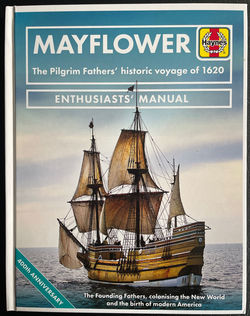
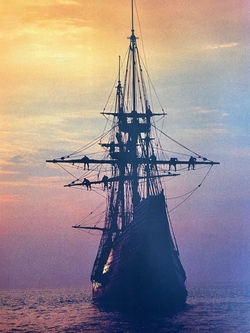
MAYFLOWER PILGRIM VOYAGE 1620 PLYMOUTH ROCK
THE SHIP VOYAGE PURITANS
HARDBOUND BOOK in ENGLISH by
JONATHAN FALCONER
-------------------
Additional Information from
Internet Encyclopedia
Mayflower was an English ship
that transported a group of English families, known today as the Pilgrims, from
England to the New World in 1620. After a grueling 10 weeks at sea, Mayflower,
with 102 passengers and a crew of about 30, reached America, dropping anchor
near the tip of Cape Cod, Massachusetts, on November 21 [O.S. November 11],
1620.
Differing from their
contemporaries, the Puritans (who sought to reform and purify the Church of
England), the Pilgrims chose to separate themselves from the Church of England
because they believed it was beyond redemption due to its Roman Catholic past
and the church's resistance to reform, which forced them to pray in private.
Starting in 1608, a group of English families left England for the Netherlands,
where they could worship freely. By 1620, the community determined to cross the
Atlantic for America, which they considered a "new Promised Land",
where they would establish Plymouth Colony.
The Pilgrims had originally
hoped to reach America by early October using two ships, but delays and
complications meant they could use only one, Mayflower. Arriving in November,
they had to survive unprepared through a harsh winter. As a result, only half
of the original Pilgrims survived the first winter at Plymouth. If not for the
help of local indigenous peoples to teach them food gathering and other
survival skills, all of the colonists might have perished. The following year,
those 53 who survived,celebrated the colony's first fall harvest along with 90
Wampanoag Native American people, an occasion declared in centuries later the
first American Thanksgiving.[4] Before disembarking the Mayflower, the Pilgrims
wrote and signed the Mayflower Compact, an agreement that established a
rudimentary government, in which each member would contribute to the safety and
welfare of the planned settlement. As one of the earliest colonial vessels, the
ship has become a cultural icon in the history of the United States.
A congregation of approximately
400 English Protestants living in exile in Leiden, Holland, were dissatisfied
with the failure of the Church of England to reform what they felt were many
excesses and abuses. But rather than work for change in England (as other
Puritans did), they chose to live as Separatists in religiously tolerant
Holland in 1608. As separatists, they were considered illegal radicals by their
home country of England.
The government of Leiden was
recognized for offering financial aid to reformed churches, whether English,
French or German, which made it a sought-after destination for Protestant
intellectuals.[1]: 17 Many of the separatists were illegal members of a church
in Nottinghamshire, England, secretly practicing their Puritan form of
Protestantism. When they learned that the authorities were aware of their
congregation, church members fled in the night with little more than the
clothes they were wearing, and clandestinely made it to Holland.
Life in Holland became increasingly
difficult for the congregation. They were forced into menial and backbreaking
jobs, such as cleaning wool, which led to a variety of health afflictions. In
addition, a number of the country's leading theologians began engaging in open
debates which led to civil unrest, instilling the fear that Spain might again
place Holland's population under siege, as it had done years earlier.[6]
England's James I subsequently formed an alliance with Holland against Spain,
with a condition outlawing independent English church congregations in
Holland.[1]: 26 In aggregate, these became the separatists' motivating factors
to sail for the New World, which would have the added benefit of being beyond
the reach of King James and his bishops.
Their desire to travel to
America was considered audacious and risky, as previous attempts to settle in
North America had failed. Jamestown, founded in 1607, saw most of its settlers
die within the first year. 440 of the 500 new arrivals died of starvation
during the first six months of winter. The Puritan separatists also learned of
the constant threat of attacks by indigenous peoples. But despite all the
arguments against traveling to this new land, their conviction that God wanted
them to go held sway: "We verily believe and trust the Lord is with
us," they wrote, "and that he will graciously prosper our indeavours,
according to the simplicity of our hearts therein."
Voyage
Leaving Holland
After deciding to leave Holland,
they planned to cross the Atlantic using two purchased ships. A small ship with
the name Speedwell would first carry them from Leiden to England. The larger
Mayflower would then be used to transport most of the passengers and supplies
the rest of the way.
Not all of the Separatists were
able to depart, as many did not have enough time to settle their affairs and
their budgets were too meager to buy the necessary travel supplies. The
congregation therefore decided that the younger and stronger members should go
first, with others possibly following in the future. Although the congregation
had been led by John Robinson, who first proposed the idea of emigrating to
America, he chose to remain in Leiden to care for those who could not make the
voyage.
In explaining to his
congregation why they should emigrate, Robinson used the analogy of the ancient
Israelites leaving Babylon to escape bondage by returning to Jerusalem, where
they would build their temple. "The Pilgrims and Puritans actually
referred to themselves as God's New Israel," writes Peter Marshall.[9] It was
therefore considered the destiny of the Pilgrims and Puritans to similarly
build a "spiritual Jerusalem" in America.
When it was time to leave, the
ship's senior leader, Edward Winslow, described the scene of families being
separated at the departure: "A flood of tears was poured out. Those not
sailing accompanied us to the ship, but were not able to speak to one another
for the abundance of sorrow before parting." William Bradford, another
leader who would be the second governor of the Plymouth Colony, similarly
described the departure:
Truly doleful was the sight of
that sad and mournful parting. To see what sighs and sobs and prayers did sound
among them; what tears did gush from every eye, and pithy speeches pierced each
heart...their Reverend Pastor, falling down on his knees, and they all with
him.
The trip to the south coast of
England took three days, where the ship took anchor at Southampton on August 5
[O.S. July 26], 1620. From there, the Pilgrims first laid eyes on their larger
ship, Mayflower, as it was being loaded with provisions.
Speedwell and Mayflower
Carrying about 65 passengers,
Mayflower left London in mid-July 1620. The ship then proceeded down the Thames
to the south coast of England, where it anchored at Southampton, Hampshire.
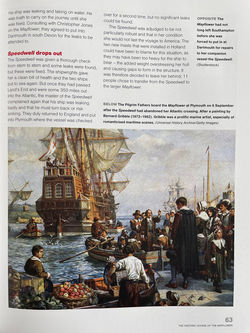
There she waited for the planned rendezvous on July 22 with the Speedwell,
coming from Holland with members of the Leiden congregation. Although both
ships planned to depart for America by the end of July, a leak was discovered
on Speedwell, which had to be repaired.
The ships set sail for America
around August 5, but Speedwell sprang another leak shortly after, which
necessitated the ships' return to Dartmouth for repairs. They made a new start
after the repairs, but more than 200 miles (320 km) beyond Land's End at the
southwestern tip of England, Speedwell sprang a third leak. It was now early
September, and they had no choice but to abandon Speedwell and make a
determination on her passengers. This was a dire event, as vital funds had been
wasted on the ship, which were considered very important to the future success
of their settlement in America. Both ships returned to Plymouth, England, where
20 Speedwell passengers joined the now overcrowded Mayflower, while the others
returned to Holland.
They waited for seven more days
until the wind picked up. William Bradford was especially worried: "We lie
here waiting for as fair a wind as can blow... Our victuals will be half eaten
up, I think, before we go from the coast of England; and, if our voyage last long,
we shall not have a month's victuals when we come in the country."
According to Bradford, Speedwell was refitted and seaworthy, having "made
many voyages... to the great profit of her owners." He suggested that
Speedwell's master may have used "cunning and deceit" to abort the
voyage by causing the leaks, fearing starvation and death in America.
Mayflower sets sail
At last the over-full and
hitherto baffled Mayflower was ready for the third trial. This final voyage
would be successful. On September 26, 1620, the gallant little craft slipped
out to sea. In proportion to her cubic feet of space, no heavier cargo had ever
been shipped across the Atlantic. The entirety of a new church, a new
commonwealth, a new nation, all of which were to bless the world, were confined
within the limits of Mayflower's hold. The course of empire was moving westward
indeed.
Rev. E. W. Bishop
In early September, western
gales turned the North Atlantic into a dangerous place to sail. Mayflower's
provisions were already quite low when departing Southampton, and they became
lower still by delays of more than a month. The passengers had been on board
the ship this entire time, feeling worn out and in no condition for a very
taxing, lengthy Atlantic journey cooped up in the cramped spaces of a small
ship.
When Mayflower sailed from
Plymouth alone on September 16 [O.S. September 6], 1620, with what Bradford
called "a prosperous wind", she carried 102 passengers plus a crew
of 25 to 30 officers and men, bringing the total aboard to approximately 130.
At about 180 tons, she was considered a smaller cargo ship, having traveled
mainly between England and Bordeaux with clothing and wine, not an ocean
ship.[a] Nor was she in good shape, as she was sold for scrap four years after
her Atlantic voyage. She was a high-built craft forward and aft, measuring
approximately 100 feet (30 m) in length and about 25 feet (7.6 m) at her widest
point.
The trip across the Atlantic
The living quarters for the 102
passengers were cramped, with the living area about 80 feet by 20 feet (1,600
sq. feet) and the ceiling about five feet high. With couples and children
packed closely together for a trip lasting two months, a great deal of trust
and confidence was required among everyone aboard.
John Carver, one of the leaders
on the ship, often inspired the Pilgrims with a "sense of earthly grandeur
and divine purpose". He was later called the "Moses of the
Pilgrims", notes historian Jon Meacham. The Pilgrims "believed they
had a covenant like the Jewish people of old", writes author Rebecca
Fraser. "America was the new Promised Land." In a similar vein, early
American writer James Russell Lowell stated, "Next to the fugitives whom
Moses led out of Egypt, the little shipload of outcasts who landed at Plymouth
are destined to influence the future of the world."
The first half of the voyage
proceeded over calm seas and under pleasant skies. Then the weather changed,
with continuous northeasterly storms hurling themselves against the ship, and
huge waves constantly crashing against the topside deck. In the midst of one
storm, the servant of physician Samuel Fuller died and was buried at sea. A
baby was also born, christened Oceanus Hopkins. During another storm, so fierce
that the sails could not be used, the ship was forced to drift without hoisting
its sails for days, or else risk losing her masts. The storm washed a male
passenger, John Howland, overboard. He had sunk about 12 feet (4 m) until a
crew member threw out a rope, which Howland managed to grab, and he was safely
pulled back on board.
The passengers were forced to
crouch in semi-darkness below deck. With waves tossing the boat in different
directions, men held onto their wives, who themselves held onto their children.
Water was soaking everyone and everything above and below deck.
In mid-ocean, the ship came
close to being totally disabled and may have had to return to England or risk
sinking. A storm had so badly damaged its main beam that even the sailors
despaired. By a stroke of luck, one of the colonists had a metal jackscrew that
he had purchased in Holland to help in the construction of the new settler
homes. They used it to secure the beam, which kept it from cracking further,
thus maintaining the seaworthiness of the vessel. All told, despite the
crowding, unsanitary conditions and sea sicknesses, there was only one fatality
during the voyage.
The ship's cargo included many
stores that supplied the Pilgrims with the essentials needed for their journey
and future lives. It is assumed that they carried tools, food and weapons, as
well as some live animals, including dogs, sheep, goats, and poultry. The ship
also held two small 21 feet (6 m) boats powered by oars or sails. There were
also artillery pieces aboard, which they might need to defend themselves
against enemy European forces or indigenous tribes.
Arrival in America
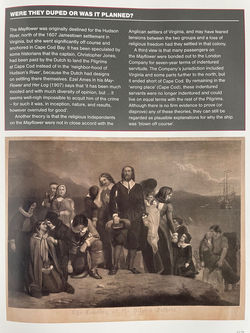
On November 19, 1620 [O.S.
November 9, 1620], they sighted present-day Cape Cod. They spent several days
trying to sail south to their planned destination of the Colony of Virginia,
where they had obtained permission to settle from the Company of Merchant
Adventurers. But the strong winter seas forced them to return to the harbor at
Cape Cod hook, known today as Provincetown Harbor, and they set anchor on
November 21 [O.S. November 11]
It was before setting anchor
that the male Pilgrims and non-Pilgrim passengers (whom members of the
congregation referred to as "Strangers") drew up and signed the
Mayflower Compact. Among the resolutions in the Compact were those establishing
legal order and meant to quell increasing strife within the ranks. Myles
Standish was selected to make sure the rules were obeyed, as there was a
consensus that discipline would need to be enforced to ensure the survival of
the planned colony. Once they agreed to settle and build a self-governing
community, they came ashore.
The moment the Pilgrims stepped
ashore was described by William Bradford, the second Governor of the Plymouth
Colony:
Being thus arrived in a good
harbor and brought safe to land, they fell upon their knees and blessed the God
of heaven, who had brought them over the vast and furious ocean, and delivered
them from all the perils and miseries thereof, again to set their feet on the
firm and stable earth, their proper element.
First winter
Plymouth Colony was the first
experiment in consensual government in Western history between individuals with
one another, and not with a monarch. The colony was a mutual enterprise, not an
imperial expedition organized by the Spanish or English governments. In order
to survive, it depended on the consent of the colonists themselves. Necessary
in order to bind the community together, it was revolutionary by chance.
On Monday, December 7 [O.S.
November 27], an exploring expedition was launched under the direction of Capt.
Christopher Jones to search for a suitable settlement site. There were 34
persons in the open small boat: 24 passengers and 10 sailors. They were
ill-prepared for the bitter winter weather which they encountered on their
reconnoiter, as the Pilgrims were not accustomed to winter weather which was
much colder than back home. They were forced to spend the night ashore due to
the bad weather they encountered, ill-clad in below-freezing temperatures with
wet shoes and stockings that froze overnight. Bradford wrote, "Some of our
people that are dead took the original of their death here" on the
expedition.
Plymouth faced many difficulties
during its first winter, the most notable being the risk of starvation and the
lack of suitable shelter. The Pilgrims had no way of knowing that the ground
would be frozen by the middle of November, making it impossible to do any
planting. Nor were they prepared for the snow storms that would make the
countryside impassable without snowshoes. And in their haste to leave, they did
not think to bring any fishing rods.
From the beginning, the
assistance they received from the local Native Americans was vital. One
colonist's journal reported, "We dug and found some more corn, two or
three baskets full, and a bag of beans. ... In all we had about ten bushels,
which will be enough for seed. It is with God's help that we found this corn,
for how else could we have done it, without meeting some Indians who might
trouble us." Governor Bradford held out hope:
Friends, if ever we make a
plantation, God works a miracle! Especially considering how scant we shall be
of victuals; and, most of all, ununited amongst ourselves, and devoid of good
tutors and leaders. Violence will break all. Where is the meek and humble
spirit of Moses and of Nehemiah, who re-edified the walls of Jerusalem, and the
State of Israel? ... I see not, in reason, how we shall escape, even the
gasping of hunger-starved persons: but God can do much; and his will be
done!"
During the winter, the
passengers remained on board Mayflower, suffering an outbreak of a contagious
disease described as a mixture of scurvy, pneumonia, and tuberculosis. After it
was over, only 53 passengers remained�just over half; half of the crew died as
well. In the spring, they built huts ashore, and the passengers disembarked
from Mayflower on March 31, 1621 [O.S. March 21, 1620].
After many hardships ... the
Pilgrim Fathers first set foot December, 1620 upon a bare rock on the bleak
coast of Massachusetts Bay, while all around the earth was covered with deep
snow ... Dreary, indeed, was the prospect before them. Exposure and privations
had prostrated one half of the men before the first blow of the ax had been
struck to build a habitation. ... One by one perished. The governor and his
wife died in April 1621; and on the first of that month, forty-six of the one
hundred emigrants were in their graves, nineteen of whom were signers of the
Mayflower Compact.
Jones had originally planned to
return to England as soon as the Pilgrims found a settlement site. But his crew
members began to be ravaged by the same diseases that were felling the
Pilgrims, and he realized that he had to remain in Plymouth Harbor "till
he saw his men began to recover."[17]: 91 Mayflower lay in New Plymouth
harbor through the winter of 1620�21, then set sail for England on April 15
[O.S. April 5], 1621. As with the Pilgrims, her sailors had been decimated by
disease. Jones had lost his boatswain, his gunner, three quartermasters, the
cook, and more than a dozen sailors. Mayflower made excellent time on her
voyage back to England. The westerly winds that had buffeted her on the initial
voyage pushed her along on the return trip home. She arrived in London on May
16 [O.S. May 6], 1621, less than half the time that it had taken her to sail to
America."
Passengers
Some families traveled together,
while some men came alone, leaving families in England and Leiden. More than a
third of the passengers were Separatists who sought to break away from the
established Church of England and create a society that incorporated their own
religious ideals. Other passengers were hired hands, servants, or farmers
recruited by London merchants, all originally destined for the Colony of
Virginia.
The passengers mostly slept and
lived in the low-ceilinged great cabins and on the main deck, which was 75 by
20 feet large (23 m � 6 m) at most. The cabins were thin-walled and extremely
cramped, and the total area was 25 ft by 15 ft (7.6 m � 4.5 m) at its largest.
Below decks, any person over five feet (150 cm) tall would be unable to stand
up straight. The maximum possible space for each person would have been slightly
less than the size of a modern-day single bed.
Passengers passed the time by
reading by candlelight or playing cards and games. They consumed large amounts
of alcohol such as beer with meals. This was known to be safer than water,
which often came from polluted sources and caused disease. No cattle or beasts
of draft or burden were brought on the journey, but there were pigs, goats, and
poultry.
Mayflower ship history
There were 26 vessels bearing
the name Mayflower in the Port Books of England during the reign of James I
(1603�1625); it is not known why the name was so popular.[36] The identity of
Captain Jones's Mayflower is based on records from her home port, her tonnage
(est. 180�200 tons), and the master's name in 1620 in order to avoid confusion
with the many other Mayflower ships.[36] It is not known when and where
Mayflower was built, although late records designate her as "of
London". She was designated in the Port Books of 1609�11 as "of
Harwich" in the county of Essex, coincidentally the birthplace of
Mayflower master Christopher Jones about 1570.
Records dating from August 1609
note Christopher Jones as master and part owner of Mayflower when his ship was
chartered for a voyage from London to Trondheim in Norway and back to London.
The ship lost an anchor on her return due to bad weather, and she made short
delivery of her cargo of herring. Litigation resulted, and this was still
proceeding in 1612. According to records, the ship was twice on the Thames at
London in 1613, once in July and again in October and November, and in 1616 she
was on the Thames carrying a cargo of wine, which suggests that the ship had
recently been on a voyage to France, Spain, Portugal, the Canaries, or some
other wine-producing land. Jones sailed Mayflower cross-Channel, taking English
woolens to France and bringing French wine back to London. He also transported
hats, hemp, Spanish salt, hops, and vinegar to Norway, and he may have taken
Mayflower whaling in the North Atlantic in the Greenland area or sailed to Mediterranean
ports.
After 1616, there is no further
record which specifically relates to Jones's Mayflower until 1624. This is
unusual for a ship trading to London, as it would not usually disappear from
the records for such a long time. No Admiralty court document can be found
relating to the pilgrim fathers' voyage of 1620, although this might be due to
the unusual way in which the transfer of the pilgrims was arranged from Leyden
to New England, or some of the records of the period might have been lost.
Jones was one of the owners of
the ship by 1620, along with Christopher Nichols, Robert Child, and Thomas
Short. It was from Child and Jones that Thomas Weston chartered her in the
summer of 1620 to undertake the Pilgrim voyage. Weston had a significant role
in Mayflower voyage due to his membership in the Company of Merchant
Adventurers of London, and he eventually traveled to the Plymouth Colony
himself.
Later history
Three of Mayflower's owners
applied to the Admiralty court for an appraisal of the ship on May 4, 1624, two
years after Captain Jones' death in 1622; one of these applicants was Jones'
widow Mrs. Josian (Joan) Jones. This appraisal probably was made to determine
the valuation of the ship for the purpose of settling the estate of its late master.
The appraisal was made by four mariners and shipwrights of Rotherhithe, home
and burial place of Captain Jones, where Mayflower was apparently then lying in
the Thames at London. The appraisement is extant and provides information on
ship's gear on board at that time, as well as equipment such as muskets and
other arms. The ship may have been laid up since Jones' death and allowed to
get out of repair, as that is what the appraisal indicates. The vessel was
valued at one hundred and twenty-eight pounds, eight shillings, and fourpence.
What finally became of Mayflower
is an unsettled issue. Charles Edward Banks, an English historian of the
Pilgrim ship, claims that the ship was finally broken up, with her timbers used
in the construction of a barn at Jordans village in Buckinghamshire. Tradition
claims that this barn still exists as the Mayflower Barn, located within the
grounds of Old Jordan in South Buckinghamshire. In 1624, Thomas Russell
supposedly added to part of a farmhouse already there with timbers from a ship,
believed to be from the Pilgrim ship Mayflower, bought from a shipbreaker's
yard in Rotherhithe. The well-preserved structure was a tourist attraction,
receiving visitors each year from all over the world and particularly from
America, but it is now privately owned and not open to the public.
Second Mayflower
Another ship called Mayflower
made a voyage from London to Plymouth Colony in 1629 carrying 35 passengers,
many from the Pilgrim congregation in Leiden that organized the first voyage. This
was not the same ship that made the original voyage with the first settlers.
The 1629 voyage began in May and reached Plymouth in August; this ship also
made the crossing from England to America in 1630 (as part of the Winthrop
Fleet), 1633, 1634, and 1639. It attempted the trip again in 1641, departing
London in October of that year under master John Cole, with 140 passengers
bound for Virginia. It never arrived. On October 18, 1642, a deposition was
made in England regarding the loss.
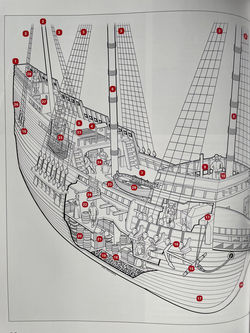
Mayflower design and layout
Mayflower was square-rigged with
a beakhead bow and high, castle-like structures fore and aft that protected the
crew and the main deck from the elements: designs that were typical of English
merchant ships of the early 17th century. Her stern carried a 30-foot high,
square aft-castle which made the ship difficult to sail close to the wind and
not well suited against the North Atlantic's prevailing westerlies, especially
in the fall and winter of 1620; the voyage from England to America took more
than two months as a result. Mayflower's return trip to London in April�May
1621 took less than half that time, with the same strong winds now blowing in
the direction of the voyage.
Mayflower's exact dimensions are
not known, but she probably measured about 100 feet (30 m) from the beak of her
prow to the tip of her stern superstructure, about 25 feet (7.6 m) at her
widest point, and the bottom of her keel about 12 feet (3.6 m) below the
waterline. William Bradford estimated that she had a cargo capacity of 180
tons, and surviving records indicate that she could carry 180 casks holding
hundreds of gallons each. The general layout of the ship was as follows:
Aft on the main deck in the
stern was the cabin for Master Christopher Jones, measuring about ten by seven
feet (3 m � 2.1 m). Forward of that was the steerage room, which probably
housed berths for the ship's officers and contained the ship's compass and
whipstaff (tiller extension) for sailing control. Forward of the steerage room
was the capstan, a vertical axle used to pull in ropes or cables. Far forward
on the main deck, just aft of the bow, was the forecastle space where the
ship's cook prepared meals for the crew; it may also have been where the
sailors slept.
The poop deck was located on the
ship's highest level above the stern on the aft castle and above Master Jones'
cabin. On this deck stood the poop house, which was ordinarily a chart room or
a cabin for the master's mates on most merchant ships, but it might have been
used by the passengers on Mayflower, either for sleeping or cargo.
The gun deck was where the
passengers resided during the voyage, in a space measuring about 50 by 25 feet
(15.2 m � 7.6 m) with a five-foot (1.5 m) ceiling. It was a dangerous place if
there was conflict, as it had gun ports from which cannon would be run out to
fire on the enemy. The gun room was in the stern area of the deck, to which
passengers had no access because it was the storage space for gunpowder and
ammunition. The gun room might also house a pair of stern chasers, small cannon
used to fire from the ship's stern. Forward on the gun deck in the bow area was
a windlass, similar in function to the steerage capstan, which was used to
raise and lower the ship's main anchor. There were no stairs for the passengers
on the gun deck to go up through the gratings to the main deck, which they
could reach only by climbing a wooden or rope ladder.
Below the gun deck was the cargo
hold where the passengers kept most of their food stores and other supplies, including
most of their clothing and bedding. It stored the passengers' personal weapons
and military equipment, such as armor, muskets, gunpowder and shot, swords, and
bandoliers. It also stored all the tools that the Pilgrims would need, as well
as all the equipment and utensils needed to prepare meals in the New World.
Some Pilgrims loaded trade goods on board, including Isaac Allerton, William
Mullins, and possibly others; these also most likely were stored in the cargo
hold.[47] There was no privy on Mayflower; passengers and crew had to fend for
themselves in that regard. Gun deck passengers most likely used a bucket as a
chamber pot, fixed to the deck or bulkhead to keep it from being jostled at
sea.
Mayflower was heavily armed; her
largest gun was a minion cannon which was brass, weighed about 1,200 pounds
(545 kg), and could shoot a 3.5 pound (1.6 kg) cannonball almost a mile (1,600
m). She also had a saker cannon of about 800 pounds (360 kg), and two base
cannons that weighed about 200 pounds (90 kg) and shot a 3 to 5 ounce ball
(85�140 g). She carried at least ten pieces of ordnance on the port and
starboard sides of her gun deck: seven cannons for long-range purposes, and
three smaller guns often fired from the stern at close quarters that were filled
with musket balls. Ship's Master Jones unloaded four of the pieces to help
fortify Plymouth Colony.
Mayflower officers, crew, and
others
According
to author Charles Banks, the officers and crew of Mayflower consisted of a
captain, four mates, four quartermasters, surgeon, carpenter, cooper, cooks,
boatswains, gunners, and about 36 men before the mast, making a total of about
50. The entire crew stayed with Mayflower in Plymouth through the winter of
1620�1621, and about half of them died during that time. The remaining crewmen
returned to England on Mayflower, which sailed for London on April 15 [O.S.
April 5], 1621