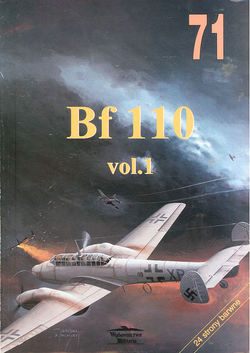
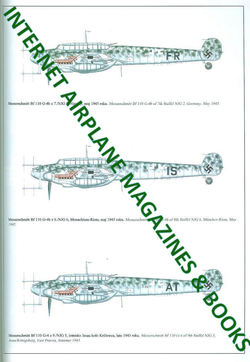
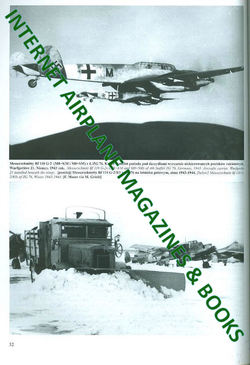
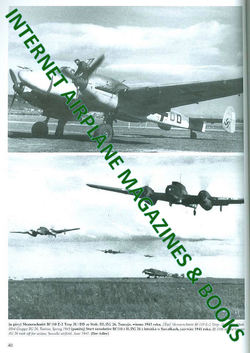
WYDAWNICTWO MILITARIA 71 MESSERSCHMITT Bf110 WW2 GERMAN LUFTWAFFE ZG NJG VOL.1 ZERSTORER
***TEXT IS IN POLISH WITH SOME ENGLISH (PHOTO CAPTIONS)***
SOFTBOUND BOOK ***BRAND NEW CONDITION***
------------------------------------------------------------------------------------------------------------------
Additional Information from Internet Encyclopedia
The Messerschmitt Bf 110, often called Me 110, was a twin-engine heavy fighter (Zerstörer—German for "Destroyer") in the service of the Luftwaffe during World War II. Hermann Göring was a proponent of the Bf 110, and nicknamed it his Eisenseiten ("Ironsides"). Development work on an improved type to replace the Bf 110, the Messerschmitt Me 210 began before the war started, but its teething troubles resulted in the Bf 110 soldiering on until the end of the war in various roles, alongside its replacements, the Me 210 and the Me 410.
The Bf 110 served with considerable success in the early campaigns, the Polish, Norwegian and Battle of France. The Bf 110's lack of agility in the air was its primary weakness. This flaw was exposed during the Battle of Britain, when some Bf 110-equipped units were withdrawn from the battle after very heavy losses and redeployed as night fighters, a role to which the aircraft was well suited. The Bf 110 enjoyed a successful period following the Battle of Britain as an air superiority fighter and strike aircraft in other theatres. During the Balkans Campaign, North African Campaign and on the Eastern Front, it rendered valuable ground support to the German Army as a potent fighter-bomber (Jagdbomber or Jabo). Later in the war, it was developed into a formidable night fighter, becoming the major night-fighting aircraft of the Luftwaffe. Most of the German night fighter aces flew the Bf 110 at some point during their combat careers, and the top night fighter ace of all time, Major Heinz-Wolfgang Schnaufer, flew it exclusively and claimed 121 victories in 164 combat missions.
The Bf 110's main strength was its ability to accept unusually powerful air-to-air weaponry. Early versions had four 7.92 mm (.312 in) MG 17 machine guns in the upper nose and two 20 mm MG FF/M cannons fitted in the lower part of the nose. Later versions replaced the MG FF/M with the more powerful 20 mm MG 151/20 cannons and many G-series aircraft, especially those which served in the bomber-destroyer role, had two 30 mm (1.18 in) MK 108 cannons fitted instead of the MG 17. The defensive armament consisted of a single, flexibly mounted 7.92 mm (.312 in) MG 15 machine gun. Late F-series and prototype G-series were upgraded to a 7.92 mm (.312 in) MG 81 machine gun with a higher rate of fire and the G-series was equipped with the twin-barreled MG 81Z. Many G-series night fighters were retrofitted or factory-built with the Schräge Musik off-bore gun system, firing upward at an oblique angle for shooting down bombers while passing underneath, frequently equipped with two 20 mm MG FF/M, but field installations of the 20 mm MG 151/20 or 30 mm (1.18 in) MK 108 cannons were also utilized. The Schräge Musik weapons were typically mounted to the back of the rear cockpit.
The Bf 110 G-2/R1 was also capable of accepting armament such as the Bordkanone series 37 mm (1.46 in) BK 3,7 autofed cannon, mounted in a conformal ventral gun pod under the fuselage. A single hit from this weapon was enough to destroy any Allied bomber.
Variants:
Bf 110A: Prototypes with two Junkers Jumo 210 engines.
Bf 110A-0: The designation of the first four pre-production aircraft.
Bf 110B: Small-scale production with two Jumo 210 engines.
Bf 110B-1: Zerstörer, four 7.92 mm (.312 in) MG 17 machine guns and two 20 mm MG FF cannons, nose-mounted.
Bf 110B-2: Reconnaissance, both MG FF cannons removed, and various camera models added.
Bf 110B-3: Trainer. MG FF cannons removed, and extra radio gear added. Some war weary B-1 were later refitted as B-3s.
Bf 110C-0: Ten pre-production aircraft.
Bf 110C-1: Zerstörer, DB 601 B-1 engines.
Bf 110C-2 Zerstörer, fitted with FuG 10 radio, upgraded from FuG III.
Bf 110C-3 Zerstörer, upgraded 20 mm MG FFs to MG FF/M.
Bf 110C-4 Zerstörer, upgraded crew armor.
Bf 110C-4/B: Fighter-bomber based on C-4, fitted with a pair of 250 kg (550 lb) ETC 250 bomb racks and upgraded DB 601 Ba engines.
Bf 110C-5: Reconnaissance version based on C-4, both MG FF removed, and Rb 50/30 camera installed, uprated DB 601P engines.
Bf 110C-6: Experimental Zerstörer, additional single 30 mm (1.18 in) MK 101 cannon in underfuselage mount, DB 601P engines.
Bf 110C-7: Fighter-bomber based on C-4/B, two ETC-500 centerline bomb racks capable of carrying two 500 kg (1,100 lb) bombs, uprated DB 601P engines.
Bf 110D: Heavy fighter/fighter-bomber, extreme range versions based on C-series, often stationed in Norway.
Bf 110D-0: Prototype utilizing C-3 airframes modified with 1,050 L (277 US gal) belly-mounted tank called Dackelbauch ("dachshund's belly" in German).
Bf 110D-1: Long-range Zerstörer, modified C series airframes with Dackelbauch belly tank.
Bf 110D-1/R1: Long-range Zerstörer, removed Dackelbauch ventral tank and replaced with wing mounted 900 L (240 US gal) drop tanks.
Bf 110D-2: Long-range Zerstörer, two wing-mounted 300 L (80 US gal) drop tanks and centerline mounted 500 kg (1,100 lb) ETC 500 bomb rack.
Bf 110D-3: Long-range Zerstörer, lengthened tail for rescue dingy. Either two wing-mounted 300 L (80 US gal) or 900 L (240 US gal) drop tanks could be fitted. 500 kg (1,100 lb) ETC 500 was optional.
Bf 110E-0: Pre-production version, Daimler-Benz DB 601B engines, pair of ETC50 bomb racks fitted outboard of engines, armament as C-4.
Bf 110E-1: Production version of E-0, DB 601P engines.
Bf 110E-2: DB 601P engines, rear fuselage extension same as for D-3.
Bf 110E-3: Long-range reconnaissance version.
Bf 110F: Same as the E, again strengthened airframe, better armor, two 993 kW (1,350 PS) DB 601F engines.
Bf 110F-1: Fighter-bomber.
Bf 110F-2: Long-range Zerstörer, often used against Allied heavy bombers.
Bf 110F-3: Long-range reconnaissance version.
Bf 110F-4: The first real night fighter (specially designed for this usage, 3-crew).
Bf 110G: Improved F-series, two 1,085 kW (1,475 PS) DB 605B engines, tail rudders increased in size.
Bf 110G-1: Not built.
Bf 110G-2: Fighter-bomber, fast bomber, destroyer, often used against Allied heavy bombers. (often equipped with rockets).
Bf 110G-3: Long-range reconnaissance version.
Bf 110G-4: Three-crew night fighter, FuG 202/220 Lichtenstein radar, optional Schräge Musik, usually mounted midway down the cockpit with the cannon muzzles barely protruding above the canopy glazing