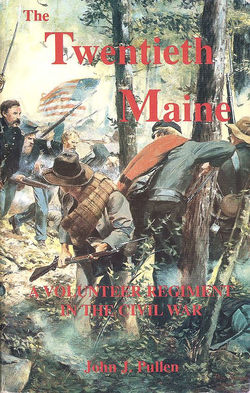
THE TWENTIETH
MAINE AMERICAN CIVIL WAR JOSHUA CHAMBERLAIN GETTYSBURG LITTLE ROUND TOP
SOFTBOUND BOOK BY JOHN J. PULLEN (340 PAGES)
----------------------------------------------------------------------------------------------------
Additional Information from Internet Encyclopedia
The 20th Maine
Volunteer Infantry Regiment was a regiment of the United States Army
during the American Civil War, most famous for its defense of Little Round Top
at the Battle of Gettysburg, July 1863.
The 20th Maine was organized in the state of Maine and
mustered into Federal service on August 29, 1862, with Col. Adelbert Ames as
its commander. It was assigned to the Army of the Potomac in the 3rd Brigade,
1st Division, V Corps, where it would remain until mustered out on July 16,
1865. At that time, the brigade also consisted of the 16th Michigan, the 12th,
17th, and 44th New York, 83rd Pennsylvania Volunteer Infantry regiments, and a
Michigan company of sharpshooters
Prior to their notable actions at Gettysburg, the
regiment was held in reserve at Antietam, was among those forced to remain
overnight within sight of the Confederate lines at Fredericksburg, forcing the
regiment's Lt. Col. Joshua Chamberlain to shield himself with a dead man. The
unit was unable to participate in the Battle of Chancellorsville due to a
quarantine prompted by a tainted smallpox vaccine that had been issued to the
unit's soldiers. On May 20, 1863, Colonel Ames was promoted and was succeeded
as colonel of the regiment by Joshua Chamberlain, who had been offered and
declined leadership of the unit at the time it was formed.
The most notable battle was the regiment's decisive role
on July 2, 1863, in the Battle of Gettysburg, where it was stationed on Little
Round Top at the extreme left of the Union line. When the regiment came under
heavy attack from the Confederate 15th and 47th Alabama regiments (part of the
division led by Maj. Gen. John Bell Hood), the 20th Maine ran low on ammunition
after one and a half hours of continuous fighting; it responded to the sight of
rebel infantry forming again for yet another push at them by charging downhill
with fixed bayonets, surprising and scattering the Confederates, thus ending
the attack on the hill. The 20th Maine and the adjacent 83rd Pennsylvania
together captured many men from both Alabama regiments (including Lt. Col.
Michael Bulger, commander of the 47th), as well as several other men of the 4th
Alabama and 4th and 5th Texas regiments of the same division. Had the 20th
Maine retreated from the hill, the entire Union line would have been flanked,
endangering other Union regiments in the vicinity.
Seeing the Confederates shifting around his flank,
Chamberlain first stretched his line to the point where his men were in a
single-file line, then ordered the southernmost half of his line to swing back
during a lull following another Confederate charge. It was there that they
"refused the line"�formed an angle to the main line in an attempt to
prevent the Confederate flanking maneuver. Despite heavy losses, the 20th Maine
held through two subsequent charges by the 15th Alabama and other Confederate
regiments for a total of ninety minutes.
On the final charge, knowing that his men were out of
ammunition, that his numbers were being depleted, and further knowing that
another charge could not be repulsed, Chamberlain ordered a maneuver that was
considered unusual for the day: He ordered his left flank, which had been
pulled back, to advance with bayonets in a "right-wheel forward" maneuver.
As soon as they were in line with the rest of the regiment, the remainder of
the regiment charged, akin to a door swinging shut. This simultaneous frontal
assault and flanking maneuver halted and captured a good portion of the 15th
Alabama.
Later actions in which the regiment participated included
Rappahannock Station, Mine Run, the Wilderness, Spotsylvania, Petersburg,
Peebles's Farm, Quaker Road, White Oak Road, Five Forks, and Appomattox.
The 20th Maine
marched from Appomattox, Virginia, on May 2, reaching Washington, D.C., on May
12, where the remaining original members were mustered out of service on June
4, 1865, with the remainder of the regiment leaving the service on July 16.
The 20th Maine had
a total wartime enrollment of 1,621 men (including initial muster,
replacements, and drafts), losing 147 dead from combat, 146 dead from disease,
381 wounded, and 15 in Confederate prisons.
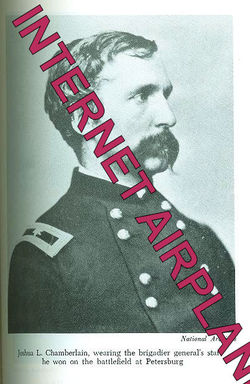
Joshua Lawrence Chamberlain (born Lawrence Joshua Chamberlain, September
8, 1828 � February 24, 1914) was an American college professor from the
State of Maine, who volunteered during the American Civil War to join the Union
Army. He became a highly respected and decorated Union officer, reaching the
rank of brigadier general (and brevet major general). He is most well-known for
his gallantry at the Battle of Gettysburg, which earned him the Medal of Honor.
Chamberlain was
commissioned a lieutenant colonel in the 20th Maine Volunteer Infantry Regiment
in 1862 and fought at the Battle of Fredericksburg. He became commander of the
regiment in June 1863. On July 2, during the Battle of Gettysburg,
Chamberlain's regiment occupied the extreme left of the Union lines at Little
Round Top. Chamberlain's men withheld repeated Confederate assaults and finally
drove them away with a bayonet charge. He was severely wounded while commanding
a brigade during the Second Battle of Petersburg in June 1864, and was given
what was intended to be a death bed promotion to brigadier general. In April
1865, he fought at the Battle of Five Forks and was given the honor of
commanding the Union troops at the surrender ceremony for the infantry of
Robert E. Lee's Army at Appomattox Court House, Virginia.