THIS AUCTION IS FOR A
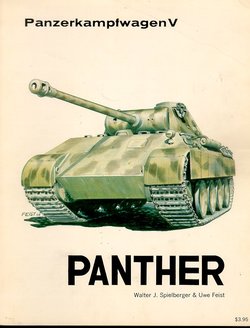
NEARLY MINT CONDITION 76-PAGE SOFTBOUND BOOK WRITTEN BY WALTER J. SPIELBERGER AND UWE
FEIST IN 1968.
IT IS A SUPER-DETAILED REFERENCE TO THIS WW2 GERMAN
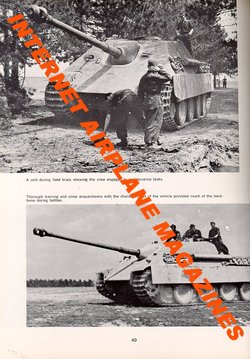
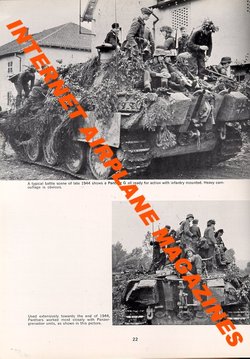
PANZER. INCLUDES HUNDREDS OF BW PHOTOS, SCALE DRAWINGS, COLOR
ILLUSTRATIONS. FULL OF DEVELOPMENT DETAILS AND OPERATIONAL
EMPLOYMENT HISTORY. ALL MAJOR VARIANTS ARE FULLY DESCRIBED. SD.KFZ
171 PANTHER, SD.KFZ 173 JAGDPANTHER, BERGEPANZER RECOVERY VEHICLE
THE
PANZERKAMPFWAGEN V PANTHER IS ONE OF THE BEST-KNOWN GERMAN TANKS IN EXISTENCE
AND IS CONSIDERED ONE OF THE GREATEST TANKS OF WORLD WAR II. WHEN GERMANY
INVADED RUSSIA IN JUNE 1941, PANZERTRUPPE ENCOUNTERED KV SERIES AND T-34/76
TANKS, FAR SUPERIOR IN FIREPOWER AND ARMOUR PROTECTION TO ANY PANZER IN SERVICE
AT THE TIME. IT WAS THEREFORE DECIDED TO DESIGN A NEW MORE POWERFUL MEDIUM
TANK, WHICH COULD BE QUICKLY PUT INTO PRODUCTION. THIS BOOK DETAILS THE RESULT,
THE PANTHER MEDIUM TANK, AVAILABLE FOR SERVICE IN JANUARY 1943. LATER MODELS
ENSURED THAT IT BECAME ONE OF THE MOST FEARED TANKS OF WWII.
PANTHER TANK DEVELOPMENT
PANTHER AUSF. D
ZITADELLE
AUSF. D EXHAUST
PANTHER AUSF. A (AUSF. A CUPOLA, BALL MOUNTED MG 34, AUSF
A EXHAUSTS, PANTHER TRACK)
THREE PAGES OF COLOR PROFILES
PANTHER ROADWHEELS
FLAK MG 34 FLIEGERBESCHUSSGERAT FUR MG 34
PANTHER AUSF. G
BERGEPANTHER TANK RECOVERY VEHICLE
JAGDPANTHER HUNTING PANTHER TANK DESTROYER 88mm PAK 43/3
L/71
YOU WILL FIND GREAT DEALS ON HARD-TO-FIND AVIATION, ARMOR,
NAUTICAL AND MILITARIA MAGAZINES AT MY EBAY STORE “INTERNET AIRPLANE MAGAZINES
AND BOOKS”!
I HAVE HUNDREDS OF ADDITIONAL LISTINGS
USING THE SIMPLE “BUY-IT-NOW” FORMAT. I
SPECIALIZE IN AVIATION REFERENCE MAGAZINES AND BOOKS. I ALSO CARRY TITLES ON
MILITARY HISTORY, ARMOR, TANKS, SHIPS, ELITE SPECIAL UNITS AND AMERICAN CIVIL
WAR. THESE ARE EXCELLENT GIFTS & REFERENCES FOR PILOTS, MILITARY AIRCREW,
VETERANS, MILITARY RE-ENACTORS, SCALE MODELERS & AIRCRAFT ENTHUSIASTS. TITLES CURRENTLY LISTED INCLUDED: THE ELITE,
TAKE OFF, WARPLANE, PROFILE PUBLICATIONS, AIRCRAFT ILLUSTRATED, AIRCRAFT
ILLUSTRATED EXTRA, AIR COMBAT, AIR ENTHUSIAST, AMERICAN AIRMAN AND THE
ILLUSTRATED ENCYCLOPEDIA OF AIRCRAFT.
HARD TO FIND GIFTS FOR SCALE MODELERS, PILOTS, AIRCREW &
VETERANS
HERE'S AN INEXPENSIVE FATHER'S DAY
GIFT, BIRTHDAY PRESENT OR CHRISTMAS PRESENT FOR THE VETERAN, REENACTOR, SCALE
MODELER, MILITARIA ENTHUSIAST OR HISTORY CHANNEL LOVER IN YOUR FAMILY
MONEY BACK GUARANTEE!
YOU WILL LOVE MY CUSTOMER FRIENDLY
RETURN POLICY. I WANT YOU OR YOUR GIFT
RECIPIENT TO BE HAPPY WITH YOUR PURCHASE.
I GUARANTEE THAT THE ITEM SHIPPED WILL BE AS DESCRIBED. YOU MAY RETURN THE ITEM WITHIN 14 DAYS FOR
ANY REASON. JUST EMAIL ME AND RETURN POST
THE PACKAGE ADEQUATELY PROTECTED AGAINST SHIPPING DAMAGE) AND I WILL RETURN
YOUR ITEM PURCHASE PRICE IN FULL.
I WILL LEAVE POSITIVE FEEDBACK FOR YOU
I WILL POST POSITIVE FEEDBACK FOR YOU
AFTER THE TRANSACTION IS COMPLETE AND I AM REASONABLY SURE THAT YOU HAVE
RECEIVED THE ITEM. IF THERE IS ANY
PROBLEM, PLEASE EMAIL ME TO WORK THINGS OUT BEFORE LEAVING FEEDBACK. MY GOAL IS TO LEAVE EVERY CUSTOMER 100%
SATISFIED WITH MY PRODUCTS AND SERVICE.
-----------------------------------------------------------------------------------------------------
Additional Information from
Internet Encyclopedia
Panther is the common
name of a medium tank deployed by Germany in World War II from mid-1943 to the end of the
European war in 1945. It was intended as a counter to the Russian T-34, and as a replacement for the Panzer
III and Panzer IV. While never replacing the latter, it
served alongside it and the heavier Tiger tanks until the end of the war. The Panther's excellent
combination of firepower, mobility, and protection served as a benchmark for
other nations' late war and post-war tank designs, and it is regarded as one of
the best tanks of World War II.
Until 1944, it was designated as the Panzerkampfwagen V Panther
and had the ordnance inventory
designation of Sd.Kfz. 171.
The Panther tank was a compromise of various requirements. While having
essentially the same engine as the Tiger I tank, it had better frontal armor
(including the benefit of a sloped armor, increasing effective armor depth),
better gun penetration, was lighter and thus faster, and could traverse rough
terrain better than the Tigers. The tradeoff was weaker side armor. The Panther
proved to be deadly in open country and long range engagements, but vulnerable
in close-quarters combat. Also, the 75 mm gun fired a slightly smaller
shell than the Tiger's 88 mm gun, providing less high explosive firepower against infantry.
The Panther was also far cheaper to produce than the Tiger tanks, and only
slightly more expensive than the Panzer IV, as its design came to fruition when
the Reich Ministry of Armament and War Production was making great efforts to
increase war production. Key elements of the Panther design, such as its armor,
transmission, and final drive, were compromises.
The Panther tank arrived in 1943 at a crucial phase in World War II for
Germany. Rushed into combat at the Battle of Kursk with un-corrected teething problems,
which resulted in breakdowns and other equipment failures, the Panther tank
would thereafter only be fighting outnumbered in Germany's steady retreat
against the Allies for the remainder of World War II. Its success as a
battlefield weapon was thus hampered by Germany's generally declining position
in the war, with the loss of airpower protection by the Luftwaffe, the loss of
fuel and training space, and the declining quality of tank crews. Nevertheless,
the Panther tank commanded respect from the Allies, and its combat capabilities
led directly to the introduction of heavier Allied tanks such as the Soviet IS-2 and the American M26 Pershing into the war.
The Panther was a direct response to the Soviet T-34 and KV-1
tanks. First encountered on 23
June 1941, the T-34 outclassed the existing models of the Panzer III and IV. At
the insistence of General Heinz Guderian, a special Panzerkommision
was dispatched to the Eastern Front to assess the T-34. Among the features of
the Soviet tank considered most significant were the sloping armor, which gave
much improved shot deflection and also increased the effective armor thickness
against penetration, the wide track, which improved mobility over soft ground,
and the 76.2 mm gun, which had good armor penetration and fired an
effective high explosive round. Daimler-Benz (DB) and Maschinenfabrik Augsburg-Nürnberg AG (MAN) were given the task of
designing a new 30- to 35-ton tank, designated VK30.02, by April 1942
(apparently in time to be shown to Hitler for his birthday).
The demand for this tank was so high that the manufacturing was soon
expanded beyond MAN to include Daimler-Benz, Maschinenfabrik
Niedersachsen-Hannover (MNH) and Henschel &
Sohn in Kassel.
The first 250 Panthers were powered by a Maybach HL 210 P30 engine, V-12
gasoline engine which delivered 650 metric hp at 3,000 rpm and had three simple air
filters. Starting in May 1943, the Panthers were built using the 700 PS (690 hp,
515 kW)/3000 rpm, 23.1 litre Maybach HL 230 P30 V-12 gasoline engine. To save aluminum, the light alloy
block used in the HL 210 was replaced by a cast iron block. Two multistage
"cyclone" air filters were used to automate some of the dust removal
process.
The suspension consisted of front drive sprockets, rear idlers and eight
double-interleaved rubber-rimmed steel road wheels on each side — in the
so-called Schachtellaufwerk
design, very similar to the Tiger I's own road wheel arrangement,
pioneered for large-scale production German full-track AFVs in 1942 — suspended
on a dual torsion bar suspension. The dual torsion bar system, designed by
Professor Ernst Lehr, allowed for a wide travel stroke and rapid oscillations
with high reliability, thus allowing for relatively high speed travel by this
heavy tank over undulating terrain.
Steering was accomplished through a seven-speed AK 7-200 synchromesh
gearbox, designed by Zahnradfabrik Friedrichshafen, and a MAN single radius
steering system, operated by steering levers.
The main gun was a 7.5 cm Rheinmetall-Borsig KwK 42 (L/70) with semi-automatic shell ejection
and a supply of 79 rounds (82 on Ausf. G). The main gun used three different
types of ammunition: APCBC-HE
(Pzgr. 39/42), HE (Sprgr. 42) and APCR (Pzgr. 40/42), the last
of which was usually in short supply. While it was of only average caliber for
its time, the Panther's gun was one of the most powerful tank guns of World War
II, due to the large propellant charge and the long barrel, which gave it a
very high muzzle velocity
and excellent armor-piercing qualities. The flat trajectory also made hitting targets much
easier, since accuracy was less sensitive to range. The high velocity increased
the chance of hitting a moving target.
The tank typically had two MG 34 machine guns of a specific version
designed for use in armored combat vehicles featuring an armored barrel sleeve.
An MG 34 machine gun was located co-axially with the main gun on the gun
mantlet; an identical MG 34 was located on the glacis plate and fired by the
radio operator. Initial Ausf. D and early Ausf. A models used a
"letterbox" flap enclosing its underlying thin, vertical arrowslit-like aperture, through which the
machine gun was fired. In later Ausf A and all Ausf G models (starting in late
November-early December 1943), a ball mount in the glacis plate with a K.Z.F.2
machine gun sight was installed for the hull machine gun.