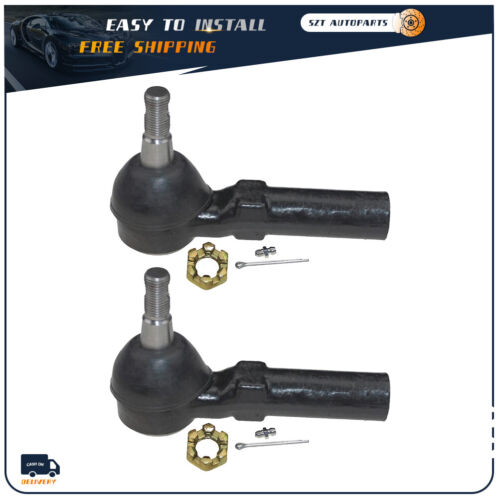
Purchase Steps:
(Note: This Step Cannot Be Ignored Before Purchasing)
- First, Find The Select Vehicle Button At The Top Of The Page And Enter Your Vehicle (Year, Brand, Model, Trim, Engine)
- Then Enter And Add To Show If The Part You Purchased Is Suitable For Your Vehicle. Especially Need To See The Vehicle Note
- If You Are Not Sure About Your Vehicle Configuration, You Can Tell Us Your Vehicle Vin And We Will Try Our Best To Answer Your Questions
1.Fitting the Following vehicle:
1997-2006 Jeep Wrangler
2.Package Includes:
2x Front Inner Steering Tie Rod End -ES3096L
2x Front Upper Ball Joint -K3134T
2x Front Lower Ball Joint -K3161T
2x Front Sway Bar End Link -K3197
1x Front Track Bar -DS1235
1x Rear Track Bar -DS1461
3.Note
(1).Please check the Compatible Fitment Chart above before payment making sure all the suspension parts listed on this page are compatible with your automobile.
(2).Although some parts have grease fittings, other parts are factory sealed, but do not affect the fit and quality of the parts.
Tie-Rod End Replacement Guideline:
If you feel a bump in the steering when driving over road bumps or curbs, this might be due to worn tie rod ends or inner tie rods. Clicking noises during sudden steering movements can also be symptoms of a defective tie rod. In order to determine the exact cause and replace the defective tie rod, the car must be elevated with a vehicle lift in order to be examined more closely.
This useful tip applies to the exchange of tie rod ends and inner tie rods, which together form the so-called tie rod.


Picture(A)
Note: Cleanliness is extremely important when working on the power steering. Incorrect work and contamination can lead to leakage and, in the worst case, to failure of the steering assistance.
1.Lift the vehicle and dismount the front axle wheels.
2.Spray the fastening nut of the tie rod end with rust remover and leave it on for a few minutes.
Picture(B)
3.Dismount the front underride guard.


Picture(C)
4.Loosen the fastening nut from the tie rod and remove it completely.
5.Remove the tie rod end from the steering knuckle using an appropriate ball joint separator.
Picture(D)
6.Remove the clamp of the bellow on the steering gear.
7.Push the bellow towards the tie rod end.


Picture(E)
8.Unscrew the inner tie rod from the rack.
9.Clean the sealing face of the bellow at the steering gear.
Picture(F)
10.Clean the lug of the rubber contact surface of the ball joint in the steering knuckle.
Note:Always use new self-locking nuts and bolts for a reliable repair.
11.Screw the new inner tie rod into the rack and tighten it with the tightening torque that has been specified by the vehicle manufacturer.


Picture(G)
12.Mount the bellow and close the clamps with the appropriate special tool.
Note:Incorrect mounting of the bellow can lead to corrosion of the rack: the steering gear starts leaking which can lead to a failure in the steering assistance.
Picture(H)
13.Secure the ball joint in the steering knuckle and mount the nut. Please observe the tightening torque suggested by the vehicle manufacturer.
Note:During mounting, the ball stud should not turn within the ball joint. This can cause damage inside the ball joint and can lead to early failure.
Tip:Secure the ball stud against twisting with a suitable tool.

Picture(I)
14.Mount the front underride guard.
15.Mount the front wheels and tighten them with the tightening torque recommended by the vehicle manufacturer.
16.Align the wheels and adjust them if necessary. Observe the vehicle manufacturer specifications.
17.Perform a test drive.
Note:When performing the test drive, pay special attention to the handling while cornering and listen for possible noise emission.
Frequently Asked Questions
(1).What are the symptoms of a bad sway bar?
Some of the common symptoms of a bad sway bar bushing or sway bar links going bad are: clunking noise, rattling noise, knocking uneven noise road, lack of stability when driving and noise going over speed bumps. poor handling during turns.
(2).What happens when a sway bar breaks?
Because a sway bar helps the car's suspension to put more pressure on loaded springs, a broken sway bar means that the car's suspension will not be able to handle corners as well or as quickly. While it is possible to drive with a broken sway bar, as a precaution do not take corners with excessive speeds.
Ball Joint Replacement Guideline:
If there is a knocking or clunking noise in the area of the front axle when the car is traveling over road bumps, potholes or curbs, then there is usually a defect in a component of the wheel suspension.

Picture(A)
The side of the front axle from which the (vibration) noise is emanating can already be determined during a test drive. The type of noise also already provides certain indications for maintenance regarding which components might be faulty.


Picture(B)
1.Raise the vehicle and remove the front wheels.
2.To loosen the fastening screws and fixing nuts of the compression ball joint more easily, spray them with rust remover and allow to act for a few minutes.
Picture(C)
3.Loosen the fastening screws of the broken ball joint on the control arm and remove the nuts.


Picture(D)
4.Loosen and remove the fixing nut of the ball joint on the steering knuckle.
Tip:If the ball stud rotates, hold the ball stud in place with a hexagon socket.
Picture(E)
5.Remove the bad or worn ball joint from the control arm.
6.Loosen the compression ball joint on the steering knuckle using a suitable special tool.


Picture(F)
7.Clean the cone connection.
Tip:For better sealing and durability of the ball joint sleeve, a little silicone grease can be applied to the contact surface.
Picture(G)
8.Insert new compression ball joint in the control arm and steering knuckle and tighten with new fixing nuts.
9.Reinstall front wheels. Lower the vehicle and tighten the wheel studs to the tightening torque specified by the vehicle manufacturer.
10.Measure the chassis and adjust it using the various holes on the compression ball joint if necessary.
11.Finally, carry out a test drive.
Frequently Asked Questions
(1).How will I know that I have to renew my ball joint parts? Or replace them?
If your ball joint fails, you will listen to a strange sound while driving. And that sound may help you to realize that your ball joint has failed and you have to renew them.
(2).What happens if a ball joint breaks?
When a ball joint breaks, you will hear a mysterious noise inside your car wheel.
Your car tire will wear-out since your alignment will be broken, and you will feel the car getting out of control.
If the ball joint breaks completely, it can be separated, and things can turn sour quickly. The wheel will stop being nice and can even steer you off the road. It can be serious.
Broken ball joints will seriously affect the steering and suspension. It can even result in your wheel falling off the car.
(3).Are worn ball joints dangerous?
Yes, it can be quite dangerous. Because, a worn ball joint causes suspension damage, inspection failure, and breakage of related parts.
It might make your front suspension come apart while driving, so the wheels move in whatever direction inertia takes them. That can lead to a fatal accident.
(4).What happens if I don't replace ball joints?
If you don't want to replace your ball joints, then get ready to experience some serious issues. The old ball joints cause mysterious clunking noise or drifting steering. Once they are worn-out, it will seriously affect your steering and suspension. However, you do not need to change the ball joints if it is new.
(5).Do I need to grease new ball joints?
I would say it will be a wise decision if you grease your new ball joints. At least I will always grease a new one after the installation. Greasing a new ball joint will make it stronger and extend its lifetime because there is a minimal amount of grease inside. I suggest you do so after the first installation. Follow the instruction card.
Sway Bar Stabilizer Link Replacement Guideline:
While driving, the following signs may indicate a faulty sway bar stabilizer link:
(1).Rattling and thumping noises on rough roads.
(2).Imprecise vehicle handling.
(3).Stronger inclination of the vehicle during cornering.
If the sway bar stabilizer link is found to be defective, it should be replaced as described below.


Picture(A)
1.Raise vehicle and remove front wheels.
Tip:Always check both stabilizer links and replace them in pairs if necessary.
2.Spray fastening nuts of the stabilizer link with rust remover and let act for a few minutes.
Picture(B)
3.Loosen the lower fastening nut of the stabilizer link at the stabilizer and remove.
Tip:If the ball stud also starts to turn, hold it with a suitable tool.
4.Press stabilizer link out of torsion bar.


Picture(C)
5.Loosen the upper fastening nut of the stabilizer link at the suspension strut and remove it.
Tip:If the ball stud also starts to turn, hold it with a suitable tool.
Picture(D)
6.Press stabilizer link at suspension strut out of bracket.


Picture(E)
7.Insert new stabilizer link at suspension strut.
Picture(F)
8.Tighten stabilizer link at suspension strut to the tightening torque specified by the vehicle manufacturer.
Tip:Secure the ball stud against twisting with a suitable tool.


Picture(G)
9.Insert new stabilizer link at stabilizer.
10.Tighten stabilizer link at stabilizer to the tightening torque specified by the vehicle manufacturer.
Tip:Secure the ball stud against twisting with a suitable tool.
Picture(H)
11.Remount the front wheels. Lower the vehicle and tighten the wheel studs to the tightening torque specified by the vehicle manufacturer.
Tip:Even if replacing the stabilizer link does not directly affect the chassis setting, we recommend checking the axle setting and adjusting if necessary after working on the suspension.
12.Conclude with a test drive.
Frequently Asked Questions
(1).Why should I get my tie rods inspected on a regular basis?
If you don't get your tie rods inspected on a regular basis, there are some warning signs to watch (and listen) for. If your vehicle pulls to one side while driving, or when braking, it's possible that bad tie rods may be the culprit. Your vehicle's tires will also show uneven wear on the inside and outside edge of the tire when there's a tire rod issue. However, one of the most noticeable signs of tie rods going bad will be a knocking sound coming from the front end of the vehicle when you turn into a parking space, or some other low speed, tight turning situation.
(2).Vibrations
One of the first symptoms that your tie rods are damaged or breaking is that the steering wheel will vibrate slightly. This is especially prevalent when you are speeding up or turning. This happens because the steering wheel is losing its control over the tires, causing the steering wheel to shimmy as you drive.
(3).Shaking
As the tie rods become further damaged, you will start to notice that the car itself will start to shake. This happens because the tires may start to wobble without you having full control over them. Although you should take your car into a mechanic at the first sign of tie rod problems, if you experience your car shaking you could be at risk for serious tie rod damage-which can cause accidents. Take your car into a mechanic if you experience this tie rod symptom.
(4).Wandering
If your tie rods continue to go unchecked or unfixed, the rods can completely break. This can cause you to lose all control of your car, possibly resulting in an accident. When this occurs, the car will may "wander" as you drive. At this point, the steering wheel will have no control over the tires and the tires will start moving independently, causing the car to drift while you are driving. If this happens while you are on a freeway or busy road, you and others could be at serious risk of an accident. If you experience wandering, stop your car, call a tow truck and take your car to the nearest mechanic.
Center Link Stabilizer Bar
The stabilizer bar is attached to the chassis and interconnects the lower control arms. Rubber insulating bushings are used at all stabilizer bar mounting positions. Some stabilizer bars are attached to the underside of the front crossmember, and the outer ends of the stabilizer bar are connected to the lower side of the front control arms. This type of torsion bar may be called "direct contact" because the outer ends of the bar are in direct contact with the lower control arms. Other stabilizer bars are attached to the upper side of the front longitudinal supports, and links are connected between the outer ends of the bar and the upper side of the front control arms. On some MacPherson strut front suspension systems, the stabilizer bars are attached to the upper side of the front subframe and the outer ends of the bar are linked to the front struts.

Frequently Asked Questions
(1).What is the center link all about?
The center link is a tubular-shaped length of metal that goes from one side of a vehicle's suspension to the other. The purpose of a center link is to act as a lever arm and reduce a vehicle's body roll around corners. As the vehicle is driven around a corner, the link forces the side of the vehicle on the inside of the corner toward the ground, reducing body roll and increasing the stability of the vehicle.
(2).How long does a center link last?
Your steering and suspension system is incredibly complex, and while there is no specified lifespan for a center link, these components can be damaged in accidents or through impact by debris. If you suspect you have a worn, bent center link, or have similar symptoms, please turn to your local mechanics for help.
(3).How can I maintain my center link?
By following your vehicle's regular maintenance schedule, you should have the linkage beneath the vehicle, including the center link, inspected whenever you have the vehicle lubed. Most often, though, today's ball joints, tie rods, and other parts are sealed and require little to no maintenance.
(4).What common symptoms indicate center link should be replaced?
1.Vibration while driving
2.Wobbling while driving
(5).What is the result when center link fails?