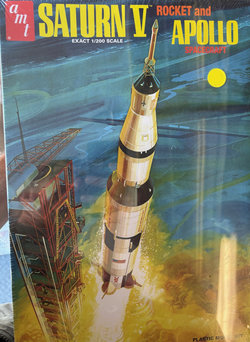
AMT 1/200-scale
SATURN V ROCKET BOOSTER APOLLO MOON LANDING SPACECRAFT KIT
--------------------------
Additional Information from
Internet Encyclopedia
The Saturn V is a retired
American super heavy-lift launch vehicle developed by NASA under the Apollo
program for human exploration of the Moon. The rocket was human-rated, had
three stages, and was powered by liquid fuel. Flown from 1967 to 1973, it was
used for nine crewed flights to the Moon, and to launch Skylab, the first
American space station.
As of 2024, the Saturn V remains
the only launch vehicle to have carried humans beyond low Earth orbit (LEO).
The Saturn V holds the record for the largest payload capacity to low Earth
orbit, 311,152 lb (141,136 kg), which included unburned propellant needed to
send the Apollo command and service module and Lunar Module to the Moon.
The largest production model of
the Saturn family of rockets, the Saturn V was designed under the direction of
Wernher von Braun at the Marshall Space Flight Center in Huntsville, Alabama;
the lead contractors for construction of the rocket were Boeing, North American
Aviation, Douglas Aircraft Company, and IBM. Fifteen flight-capable vehicles
were built, not counting three used for ground testing. A total of thirteen
missions were launched from Kennedy Space Center, nine of which carried 24
astronauts to the Moon from Apollo 8 (December 1968) to Apollo 17 (December
1972)
History
In September 1945,[12] the U.S.
government brought the German rocket technologist Wernher von Braun and over
1,500 German rocket engineers and technicians to the United States in Operation
Paperclip,[13][14] a program authorized by President Truman.[15] Von Braun, who
had helped create the German V-2 rocket, was assigned to the Army's rocket
design division.[16] Between 1945 and 1958, his work was restricted to
conveying the ideas and methods behind the V-2 to American engineers,[12]
though he wrote books and articles in popular magazines.
This approach changed in 1957,
when the Soviets launched Sputnik 1 atop an R-7 ICBM, which could carry a
thermonuclear warhead to the U.S.[18][19][20] The Army and government began
putting more effort towards sending Americans into space before the Soviets.
They turned to von Braun's team, who had created the Jupiter series of
rockets.[21] The Juno I rocket launched the first American satellite in January
1958.[22] Von Braun considered the Jupiter series of rockets to be a prototype
of the upcoming Saturn series of rockets, and referred to it as "an infant
Saturn".
Saturn development
Named after the sixth planet
from the Sun, the design of the various Saturn rockets evolved from the Jupiter
vehicles.
Between 1960 and 1962, the
Marshall Space Flight Center (MSFC) designed a series of Saturn rockets that
could be deployed for Earth orbit and lunar missions.
NASA planned to use the Saturn
C-3 as part of the Earth orbit rendezvous (EOR) method for a lunar mission,
with at least two or three launches needed for a single landing on the
moon.[26] However, the MSFC planned an even bigger rocket, the C-4, which would
use four F-1 engines in its first stage, an enlarged C-3 second stage, and the
S-IVB, a stage with a single J-2 engine, as its third stage. The C-4 would only
need to carry out two launches to carry out an EOR lunar mission.
On January 10, 1962, NASA
announced plans to build the C-5. The three-stage rocket would consist of the
S-IC first stage, with five F-1 engines; the S-II second stage, with five J-2
engines; and the S-IVB third stage, with a single J-2 engine.
The C-5 would undergo component
testing even before the first model was constructed. The S-IVB third stage
would be used as the second stage for the C-1B, which would serve both to
demonstrate proof of concept and feasibility for the C-5, but would also provide
flight data critical to the development of the C-5.[29] Rather than undergoing
testing for each major component, the C-5 would be tested in an
"all-up" fashion, meaning that the first test flight of the rocket
would include complete versions of all three stages. By testing all components
at once, far fewer test flights would be required before a crewed launch.[30]
The C-5 was confirmed as NASA's choice for the Apollo program in early 1962,
and was named the Saturn V.[31][32] The C-1 became the Saturn I and C-1B became
Saturn IB.[32] Von Braun headed a team at the MSFC to build a vehicle capable
of launching a crewed spacecraft to the Moon.[33] During these revisions, the
team rejected the single engine of the V-2's design and moved to a multiple-engine
design.
The Saturn V's final design had
several key features. F-1 engines were chosen for the first stage, while new
liquid hydrogen propulsion system called J-2 for the second and third stage.
NASA had finalized its plans to proceed with von Braun's Saturn designs, and
the Apollo space program gained speed.
The stages were designed by von
Braun's Marshall Space Flight Center in Huntsville, and outside contractors
were chosen for the construction: Boeing (S-IC), North American Aviation
(S-II), Douglas Aircraft (S-IVB), and IBM (instrument unit).
Selection for Apollo lunar
landing
Early in the planning process,
NASA considered three methods for the Moon mission: Earth orbit rendezvous
(EOR), direct ascent, and lunar orbit rendezvous (LOR). A direct ascent
configuration would require an extremely large rocket to send a three-man spacecraft
to land directly on the lunar surface. An EOR would launch the direct-landing
spacecraft in two smaller parts which would combine in Earth orbit. A LOR
mission would involve a single rocket launching two spacecraft: a mother ship,
and a smaller, two-man landing module which would rendezvous back with the main
spacecraft in lunar orbit. The lander would be discarded and the mother ship
would return home.
At first, NASA dismissed LOR as
a riskier option, as a space rendezvous had yet to be performed in Earth orbit,
much less in lunar orbit. Several NASA officials, including Langley Research
Center engineer John Houbolt and NASA Administrator George Low, argued that a
lunar orbit rendezvous provided the simplest landing on the Moon with the most
cost�efficient launch vehicle, and the best chance to accomplish the lunar
landing within the decade.[38] Other NASA officials became convinced, and LOR
was then officially selected as the mission configuration for the Apollo
program and announced by NASA administrator James E. Webb on November 7,
1962.[39] Arthur Rudolph became the project director of the Saturn V rocket
program in August 1963. He developed the requirements for the rocket system and
the mission plan for the Apollo program. The first Saturn V launch lifted off
from Kennedy Space Center and performed flawlessly on November 9, 1967,
Rudolph's birthday.[40] He was then assigned as the special assistant to the
director of MSFC in May 1968 and subsequently retired from NASA on January 1,
1969. On July 16, 1969, the Saturn V launched Apollo 11, putting the first men
on the Moon.
Launch history
All Saturn V launches, 1967�1973
SA-500F Facilities integration Used to check precise fits and
test facilities operation on Pad 39A before a flight model was ready. First
stage scrapped, second stage converted to S-II-F/D, third stage on display at
Kennedy Space Center.[43]
SA-500D Dynamic testing Used to evaluate the vehicle's response
to vibrations. On display at the U.S. Space & Rocket Center, Huntsville,
Alabama.
S-IC-T All Systems Test First
stage used for static test firing at Marshall Space Flight Center. On display
at Kennedy Space Center.
SA-501 Apollo 4 November
9, 1967
12:00:01 39A First uncrewed, all-up test flight; complete
success.
SA-502 Apollo 6 April 4,
1968
12:00:01 39A Second uncrewed test flight; J-2 engine
problems caused early shutdown of two engines in second stage, and prevented
third stage restart.
SA-503 Apollo 8 December
21, 1968
12:51:00 39A First crewed flight; first trans-lunar
injection of Apollo command and service module.
SA-504 Apollo 9 March 3,
1969
16:00:00 39A Crewed low Earth orbit test of complete
Apollo spacecraft with the Lunar Module (LM).
SA-505 Apollo 10 May 18,
1969
16:49:00 39B Second crewed trans-lunar injection of
complete Apollo spacecraft with LM; Only Saturn V launched from Pad 39B.
SA-506 Apollo 11 July 16,
1969
13:32:00 39A First crewed lunar landing, at Sea of
Tranquility.
SA-507 Apollo 12 November
14, 1969
16:22:00 39A Vehicle
was struck twice by lightning shortly after liftoff, but not causing any
serious damage. Precision crewed lunar landing, near Surveyor 3 at Ocean of
Storms.
SA-508 Apollo 13 April 11,
1970
19:13:03 39A Severe pogo oscillations in second stage
caused early center engine shutdown; guidance compensated by burning remaining
engines longer. Third crewed lunar landing mission was aborted by service
module failure.
SA-509 Apollo 14 January 31,
1971
21:03:02 39A Third crewed lunar landing, near Fra Mauro,
Apollo 13's intended landing site.
SA-510 Apollo 15 July 26,
1971
13:34:00 39A Fourth crewed lunar landing, at
Hadley�Apennine. First extended Apollo mission, carrying lunar orbital
Scientific Instrument Module and Lunar Roving Vehicle.
SA-511 Apollo 16 April 16,
1972
17:54:00 39A Fifth
crewed lunar landing, at Descartes Highlands.
SA-512 Apollo 17 December
7, 1972
05:33:00 39A Only night launch.
Sixth and final crewed lunar landing, at Taurus�Littrow.
SA-513 Skylab 1 May 14,
1973
17:30:00 39A Uncrewed launch of
the Skylab orbital workshop, which replaced the third stage, S-IVB-513, on
display at Johnson Space Center.[43] Originally designated for canceled Apollo
18.
SA-514 Unused Originally designated for canceled Apollo 18 or 19;[44] never
used. It was proposed for launching an International Skylab. This station would
have been serviced by Apollo, Soyuz and later by the Space Shuttle.[45] The
first stage (S-IC-14) on display at Johnson Space Center, second and third
stage (S-II-14, S-IV-14) on display at Kennedy Space Center.[43] The S-II
interstage is located at Parque de las Ciencias in Puerto Rico.[46]
SA-515 Unused Originally designated for Apollo 20, never used. Later it was
proposed to launch the backup Skylab station into orbit sometime between
January 1975 and April 1976.[45] That way, it could expand the Apollo�Soyuz
mission by 56�90 days. The first stage was on display at Michoud Assembly
Facility, until June 2016 then was moved to the INFINITY Science Center in
Mississippi. The second stage (S-II-15) is on display at Johnson Space Center.
The third stage was converted to a backup Skylab orbital workshop and is on
display at the National Air and Space Museum.
Description
The size and payload capacity of
the Saturn V dwarfed those of all other previous rockets successfully flown at
that time. With the Apollo spacecraft on top, it stood 363 feet (111 m) tall,
and, ignoring the fins, was 33 feet (10 m) in diameter. Fully fueled, the
Saturn V weighed 6.5 million pounds (2,900,000 kg)[3] and had a low Earth orbit
(LEO) payload capacity originally estimated at 261,000 pounds (118,000 kg), but
was designed to send at least 90,000 pounds (41,000 kg) to the Moon.[47] Later
upgrades increased that capacity; on the final three Apollo lunar missions, it
sent up to 95,901 lb (43,500 kg) to the Moon.
At a height of 363 feet (111 m),
the Saturn V stood 58 feet (18 m) taller than the Statue of Liberty from the
ground to the torch,[48] and 48 feet (15 m) taller than the Elizabeth Tower,
which houses Big Ben at the Palace of Westminster.[49] In contrast, the
Mercury-Redstone Launch Vehicle used on Freedom 7, the first crewed American
spaceflight, was approximately 11 feet (3.4 m) longer than the S-IVB stage and
delivered less sea level thrust (78,000 pounds-force (350 kN))[50] than the
Launch Escape System rocket (150,000 pounds-force (667 kN) sea level thrust)
mounted atop the Apollo command module.[51] The Apollo LES fired for a much
shorter time than the Mercury-Redstone (3.2 seconds vs. 143.5 seconds).
The Saturn V was principally
designed by the Marshall Space Flight Center in Huntsville, Alabama, although
numerous major systems, including propulsion systems, were designed by
subcontractors. The rocket used the powerful F-1 and J-2 rocket engines; during
testing at Stennis Space Center, the force developed by the engines shattered
the windows of nearby houses.[52] Designers decided early on to attempt to use
as much technology from the Saturn I program as possible for the Saturn V.
Consequently, the S-IVB-500 third stage of the Saturn V was based on the
S-IVB-200 second stage of the Saturn IB. The instrument unit that controlled
the Saturn V shared characteristics with the one carried by the Saturn IB.
The Saturn V was primarily
constructed of aluminum. It was also made of titanium, polyurethane, cork and
asbestos.[54] Blueprints and other plans of the rocket are available on
microfilm at the Marshall Space Flight Center.
The Saturn V consisted of three
stages�the S-IC first stage, S-II second stage, and S-IVB third stage�and the
instrument unit. All three stages used liquid oxygen (LOX) as the oxidizer. The
first stage used RP-1 for fuel, while the second and third stages used liquid
hydrogen (LH2). LH2 has a higher specific energy (energy per unit mass) than
RP-1, which makes it more suitable for higher-energy orbits, such as the
trans-lunar injection required for Apollo missions. Conversely, RP-1 offers
higher energy density (energy per unit volume) and higher thrust than LH2,
which makes it more suitable for reducing aerodynamic drag and gravity losses
in the early stages of launch. If the first stage had used LH2, the volume
required would have been more than three times greater, which would have been
aerodynamically infeasible at the time.[56] The upper stages also used small
solid-propellant ullage motors that helped to separate the stages during the
launch, and to ensure that the liquid propellants were in a proper position to
be drawn into the pumps.
S-IC first stage
The S-IC was built by the Boeing
Company at the Michoud Assembly Facility, New Orleans, where the Space Shuttle
external tanks would later be built by Lockheed Martin. Most of its mass at
launch was propellant: RP-1 fuel with liquid oxygen as the oxidizer.[58] The
stage was 138 feet (42 m) tall and 33 feet (10 m) in diameter. It provided
7,750,000 lbf (34,500 kN)[10] of thrust at sea level. The S-IC stage had a dry
mass of about 303,000 pounds (137,000 kilograms); when fully fueled at launch,
it had a total mass of 4,881,000 pounds (2,214,000 kilograms). The S-IC was
powered by five Rocketdyne F-1 engines arrayed in a quincunx. The center engine
was held in a fixed position, while the four outer engines could be
hydraulically turned with gimbals to steer the rocket.[9] In flight, the center
engine was turned off about 26 seconds earlier than the outboard engines to
limit acceleration. During launch, the S-IC fired its engines for 168 seconds
(ignition occurred about 8.9 seconds before liftoff) and at engine cutoff, the
vehicle was at an altitude of about 42 miles (67 km), was downrange about 58
miles (93 km), and was moving around 7,500 feet per second (2,300 m/s).
While not put into production, a
proposed replacement for the first stage was the AJ-260x. This solid rocket
motor would have simplified the design by removing the five-engine
configuration and, in turn, reduced launch costs.
S-II second stage
The S-II was built by North
American Aviation at Seal Beach, California. Using liquid hydrogen and liquid
oxygen, it had five Rocketdyne J-2 engines in a similar arrangement to the
S-IC, and also used the four outer engines for control. The S-II was 81.6 feet
(24.87 m) tall with a diameter of 33 feet (10 m), identical to the
S-IC,[61][62] and thus was the largest cryogenic stage until the launch of the
Space Shuttle in 1981. The S-II had a dry mass of about 80,000 pounds (36,000
kg); when fully fueled, it weighed 1,060,000 pounds (480,000 kg). The second
stage accelerated the Saturn V through the upper atmosphere with 1,100,000
pounds-force (4,900 kN) of thrust in a vacuum.
When loaded with fuel, more than
90 percent of the mass of the stage was propellant; however, the
ultra-lightweight design had led to two failures in structural testing. Instead
of having an intertank structure to separate the two fuel tanks as was done in
the S-IC, the S-II used a common bulkhead that was constructed from both the
top of the LOX tank and bottom of the LH2 tank. It consisted of two aluminum
sheets separated by a honeycomb structure made of phenolic resin.[62][35] This
bulkhead had to be able to insulate against the 126 �F (70 �C) temperature
difference between the two tanks. The use of a common bulkhead saved 7,900
pounds (3.6 t) by both eliminating one bulkhead and reducing the stage's
length.[35] Like the S-IC, the S-II was transported from its manufacturing
plant to Cape Kennedy by sea.[63]
S-IVB third stage
The S-IVB stage was built by the
Douglas Aircraft Company at Huntington Beach, California. It had one Rocketdyne
J-2 engine and used the same fuel as the S-II.[11] The S-IVB used a common
bulkhead to separate the two tanks. It was 58.6 feet (17.86 m) tall with a
diameter of 21.7 feet (6.604 m) and was also designed with high mass
efficiency, though not quite as aggressively as the S-II. The S-IVB had a dry
mass of about 23,000 pounds (10,000 kg) and, when fully fueled, weighed about
262,000 pounds (119,000 kg).
The S-IVB was the only rocket
stage of the Saturn V small enough to be transported by the cargo plane Aero
Spacelines Pregnant Guppy.
For lunar missions it was fired
twice: first for Earth orbit insertion after second stage cutoff, and a second
time for translunar injection (TLI).
Instrument unit
The Saturn V's instrument unit
was built by IBM and was placed on top of the rocket's third stage. It was
constructed at the Space Systems Center in Huntsville, Alabama. This computer
controlled the operations of the rocket from just before liftoff until the
S-IVB was discarded. It included guidance and telemetry systems for the rocket.
By measuring the acceleration and vehicle attitude, it could calculate the
position and velocity of the rocket and correct for any deviations.
Assembly
After the construction and
ground testing of each stage was completed, they were each shipped to the
Kennedy Space Center. The first two stages were so massive that the only way to
transport them was by barge. The S-IC, constructed in New Orleans, was transported
down the Mississippi River to the Gulf of Mexico.
After rounding Florida, the
stages were transported up the Intra-Coastal Waterway to the Vehicle Assembly
Building (originally called the Vertical Assembly Building). This was
essentially the same route which would be used later to ship Space Shuttle external
tanks. The S-II was constructed in California and traveled to Florida via the
Panama Canal. The third stage and Instrument Unit was carried by the Aero
Spacelines Pregnant Guppy and Super Guppy, but could also have been carried by
barge if warranted.
Upon arrival at the Vertical
Assembly Building, each stage was inspected in a horizontal position before
being oriented vertically. NASA also constructed large spool-shaped structures
that could be used in place of stages if a particular stage was delayed. These
spools had the same height and mass and contained the same electrical
connections as the actual stages.
NASA stacked (assembled) the
Saturn V on a Mobile Launcher, which consisted of a Launch Umbilical Tower with
nine swing arms (including the crew access arm), a "hammerhead"
crane, and a water suppression system which was activated prior to engine
ignition during a launch. After assembly was completed, the entire stack was
moved from the Vehicle Assembly Building (VAB) to the launch pad using the
Crawler Transporter (CT). Built by the Marion Power Shovel Company (and later
used for transporting the smaller and lighter Space Shuttle, as well as the
Space Launch System), the CT ran on four double-tracked treads, each with 57
"shoes". Each shoe weighed 2,000 pounds (910 kg). This transporter
was also required to keep the rocket level as it traveled the 3 miles (4.8 km)
to the launch site, especially at the 3 percent grade encountered at the launch
pad. The CT also carried the Mobile Service Structure (MSS), which allowed
technicians access to the rocket until eight hours before launch, when it was moved
to the "halfway" point on the Crawlerway (the junction between the
VAB and the two launch pads).
Cost
From 1964 until 1973, $6.417
billion (equivalent to $40.9 billion in 2023)[67] was appropriated for the
Research and Development and flights of the Saturn V, with the maximum being in
1966 with $1.2 billion (equivalent to $8.61 billion in 2023).[1] That same
year, NASA received its largest total budget of $4.5 billion, about 0.5 percent
of the gross domestic product (GDP) of the United States at that time.
Two main reasons for the
cancellation of the last three Apollo missions were the heavy investments in
Saturn V and the ever-increasing costs of the Vietnam War to the U.S. in money
and resources. In the time frame from 1969 to 1971 the cost of launching a
Saturn V Apollo mission was between $185,000,000 to $189,000,000, of which $110
million were used for the production of the vehicle[68] (equivalent to $1.18
billion�$1.2 billion in 2023).
Lunar mission launch sequence
The Saturn V carried all Apollo
lunar missions,[69] which were launched from Launch Complex 39 at the John F.
Kennedy Space Center in Florida.[70] After the rocket cleared the launch tower,
flight control transferred to Mission Control at the Johnson Space Center in
Houston, Texas. An average mission used the rocket for a total of just 20
minutes. Although Apollo 6 experienced three engine failures, and Apollo 13
experienced one engine shutdown, the onboard computers were able to compensate
by burning the remaining engines longer to achieve parking orbit.
Range safety
In the event of an abort
requiring the destruction of the rocket, the range safety officer would
remotely shut down the engines and after several seconds send another command
for the shaped explosive charges attached to the outer surfaces of the rocket to
detonate. These would make cuts in fuel and oxidizer tanks to disperse the fuel
quickly and to minimize mixing. The pause between these two actions would give
time for the crew to escape via the Launch Escape Tower or (in the later stages
of the flight) the propulsion system of the Service module. A third command,
"safe", was used after the S-IVB stage reached orbit to irreversibly
deactivate the self-destruct system. The system was also held inactive as long
as the rocket was still on the launch pad.
Startup sequence
The first stage burned for about
2 minutes and 41 seconds, lifting the rocket to an altitude of 42 miles (68 km)
and a speed of 6,164 miles per hour (2,756 m/s) and burning 4,700,000 pounds
(2,100,000 kg) of propellant.
At 8.9 seconds before launch,
the first stage ignition sequence started. The center engine ignited first,
followed by opposing outboard pairs at 300-millisecond intervals to reduce the
structural loads on the rocket. When thrust had been confirmed by the onboard
computers, the rocket was "soft-released" in two stages: first, the
hold-down arms released the rocket, and second, as the rocket began to
accelerate upwards, it was slowed by tapered metal pins pulled through holes
for half a second.
Once the rocket had lifted off,
it could not safely settle back down onto the pad if the engines failed. The
astronauts considered this one of the tensest moments in riding the Saturn V,
for if the rocket did fail to lift off after release they had a low chance of
survival given the large amounts of propellant. To improve safety, the Saturn
Emergency Detection System (EDS) inhibited engine shutdown for the first 30
seconds of flight. If all three stages were to explode simultaneously on the
launch pad, an unlikely event, the Saturn V had a total explosive yield of 543
tons of TNT or 0.543 kilotons (2,271,912,000,000 J or 155,143 lbs of weight
loss), which is 0.222 kt for the first stage, 0.263 kt for the second stage and
0.068 kt for the third stage.[76] (See Saturn V Instrument Unit)[9] Contrary to
popular myth, the noise produced was not able to melt concrete.
It took about 12 seconds for the
rocket to clear the tower. During this time, it yawed 1.25 degrees away from
the tower to ensure adequate clearance despite adverse winds; this yaw,
although small, can be seen in launch photos taken from the east or west. At an
altitude of 430 feet (130 m) the rocket rolled to the correct flight azimuth
and then gradually pitched down until 38 seconds after second stage ignition.
This pitch program was set according to the prevailing winds during the launch
month.
The four outboard engines also
tilted toward the outside so that in the event of a premature outboard engine
shutdown the remaining engines would thrust through the rocket's center of
mass. The Saturn V reached 400 feet per second (120 m/s) at over 1 mile (1,600
m) in altitude. Much of the early portion of the flight was spent gaining
altitude, with the required velocity coming later. The Saturn V broke the sound
barrier at just over 1 minute at an altitude of between 3.45 and 4.6 miles
(5.55 and 7.40 km). At this point, shock collars, or condensation clouds, would
form around the bottom of the command module and around the top of the second
stage.
Max Q sequence
At about 80 seconds, the rocket
experienced maximum dynamic pressure (max q). The dynamic pressure on a rocket
varies with air density and the square of relative velocity. Although velocity
continues to increase, air density decreases so quickly with altitude that
dynamic pressure falls below max q.
The propellant in just the S-IC
made up about three-quarters of Saturn V's entire launch mass, and it was
consumed at 13,000 kilograms per second (1,700,000 lb/min). Newton's second law
of motion states that force is equal to mass multiplied by acceleration, or
equivalently that acceleration is equal to force divided by mass, so as the
mass decreased (and the force increased somewhat), acceleration rose. Including
gravity, launch acceleration was only 1+1⁄4 g, i.e., the astronauts felt 1+1⁄4
g while the rocket accelerated vertically at 1⁄4 g. As the rocket rapidly lost
mass, total acceleration including gravity increased to nearly 4 g at T+135
seconds. At this point, the inboard (center) engine was shut down to prevent
acceleration from increasing beyond 4 g.
When oxidizer or fuel depletion
was sensed in the suction assemblies, the remaining four outboard engines were
shut down. First stage separation occurred a little less than one second after
this to allow for F-1 thrust tail-off. Eight small solid fuel separation motors
backed the S-IC from the rest of the vehicle at an altitude of about 42 miles
(67 km). The first stage continued on a ballistic trajectory to an altitude of
about 68 miles (109 km) and then fell in the Atlantic Ocean about 350 miles
(560 km) downrange.
The engine shutdown procedure
was changed for the launch of Skylab to avoid damage to the Apollo Telescope
Mount. Rather than shutting down all four outboard engines at once, they were
shut down two at a time with a delay to reduce peak acceleration further
S-II sequence
For the first two uncrewed
launches, eight solid-fuel ullage motors ignited for four seconds to accelerate
the S-II stage, followed by the ignition of the five J-2 engines. For the first
seven crewed Apollo missions, only four ullage motors were used on the S-II,
and they were eliminated for the final four launches. About 30 seconds after
first stage separation, the interstage ring dropped from the second stage. This
was done with an inertially fixed attitude�orientation around its center of
gravity�so that the interstage, only 3 feet 3 inches (1 m) from the outboard
J-2 engines, would fall cleanly without hitting them, as the interstage could
have potentially damaged two of the J-2 engines if it was attached to the S-IC.
Shortly after interstage separation the Launch Escape System was also
jettisoned.
About 38 seconds after the
second stage ignition, the Saturn V switched from a preprogrammed trajectory to
a "closed loop" or Iterative Guidance Mode. The instrument unit now
computed in real time the most fuel-efficient trajectory toward its target
orbit. If the instrument unit failed, the crew could switch control of the
Saturn to the command module's computer, take manual control, or abort the
flight.
About 90 seconds before the
second stage cutoff, the center engine shut down to reduce longitudinal pogo
oscillations. At around this time, the LOX flow rate decreased, changing the
mix ratio of the two propellants and ensuring that there would be as little
propellant as possible left in the tanks at the end of second stage flight.
This was done at a predetermined delta-v.
Five level sensors in the bottom
of each S-II propellant tank were armed during S-II flight, allowing any two to
trigger S-II cutoff and staging when they were uncovered. One second after the
second stage cut off it separated and several seconds later the third stage
ignited. Solid fuel retro-rockets mounted on the interstage at the top of the
S-II fired to back it away from the S-IVB. The S-II impacted about 2,600 miles
(4,200 km) from the launch site.
On the Apollo 13 mission, the
inboard engine suffered major pogo oscillation, resulting in an early automatic
cutoff. To ensure sufficient velocity was reached, the remaining four engines
were kept active for longer than planned. A pogo suppressor was fitted to later
Apollo missions to avoid this, though the early fifth engine's cutoff remained
to reduce g-forces.
S-IVB sequence
Apollo 17 S-IVB rocket stage,
shortly after transposition and docking with the Lunar Module.
Unlike the two-plane separation
of the S-IC and S-II, the S-II and S-IVB stages separated with a single step.
Although it was constructed as part of the third stage, the interstage remained
attached to the second stage. The third stage did not use much fuel to get into
LEO (Low Earth Orbit), because the second stage had done most of the job.
During Apollo 11, a typical
lunar mission, the third stage burned for about 2.5 minutes until first cutoff
at 11 minutes 40 seconds. At this point it was 1,645.61 miles (2,648.35 km)
downrange and in a parking orbit at an altitude of 118 miles (190 km) and
velocity of 17,432 miles per hour (28,054 km/h). The third stage remained
attached to the spacecraft while it orbited the Earth one and a half times
while astronauts and mission controllers prepared for translunar injection
(TLI).
For the final three Apollo
flights, the temporary parking orbit was even lower (approximately 107 miles or
172 kilometers), to increase payload for these missions. The Apollo 9 Earth
orbit mission was launched into the nominal orbit consistent with Apollo 11,
but the spacecraft were able to use their own engines to raise the perigee high
enough to sustain the 10-day mission. The Skylab was launched into a quite
different orbit, with a 270-mile (434 km) perigee which sustained it for six
years, and also a higher inclination to the equator (50 degrees versus 32.5
degrees for Apollo).
Lunar Module sequence
On Apollo 11, TLI came at 2
hours and 44 minutes after launch. The S-IVB burned for almost six minutes,
giving the spacecraft a velocity close to the Earth's escape velocity of 25,053
mph (40,319 km/h). This gave an energy-efficient transfer to lunar orbit, with
the Moon helping to capture the spacecraft with a minimum of CSM fuel
consumption.
About 40 minutes after TLI, the
Apollo command and service module (CSM) separated from the third stage, turned
180 degrees, and docked with the Lunar Module (LM) that rode below the CSM
during launch. The CSM and LM separated from the spent third stage 50 minutes
later, in a maneuver known as transposition, docking, and extraction.
If it were to remain on the same
trajectory as the spacecraft, the S-IVB could have presented a collision
hazard, so its remaining propellants were vented and the auxiliary propulsion
system fired to move it away. For lunar missions before Apollo 13, the S-IVB
was directed toward the Moon's trailing edge in its orbit so that the Moon
would slingshot it beyond earth escape velocity and into solar orbit. From
Apollo 13 onwards, controllers directed the S-IVB to hit the Moon.[79]
Seismometers left behind by previous missions detected the impacts, and the
information helped map the internal structure of the Moon.
Skylab sequence
In 1965, the Apollo Applications
Program (AAP) was created to look into science missions that could be performed
using Apollo hardware. Much of the planning centered on the idea of a space
station. Wernher von Braun's earlier (1964) plans employed a "wet
workshop" concept, with a spent S-II Saturn V second stage being launched
into orbit and outfitted in space. The next year AAP studied a smaller station
using the Saturn IB second stage. By 1969, Apollo funding cuts eliminated the
possibility of procuring more Apollo hardware and forced the cancellation of
some later Moon landing flights. This freed up at least one Saturn V, allowing
the wet workshop to be replaced with the "dry workshop" concept: the
station (now known as Skylab) would be built on the ground from a surplus
Saturn IB second stage and launched atop the first two live stages of a Saturn
V.[81] A backup station, constructed from a Saturn V third stage, was built and
is now on display at the National Air and Space Museum.
Skylab was the only launch not
directly related to the Apollo lunar landing program. The only significant
changes to the Saturn V from the Apollo configurations involved some
modification to the S-II to act as the terminal stage for inserting the Skylab payload
into Earth orbit, and to vent excess propellant after engine cutoff so the
spent stage would not rupture in orbit. The S-II remained in orbit for almost
two years, and made an uncontrolled re-entry on January 11, 1975.
Three crews lived aboard Skylab
from May 25, 1973, to February 8, 1974. Skylab remained in orbit until July 11,
1979.