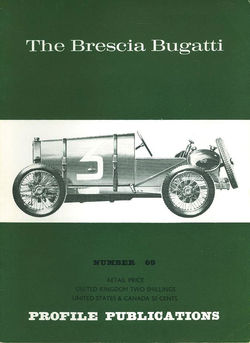
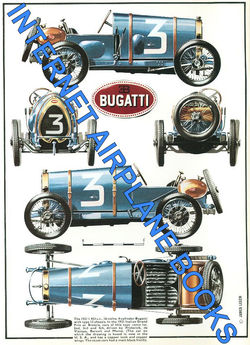
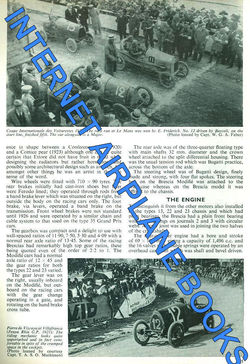
AUTOMOBILE PROFILE 69 BRESCIA
BUGATTI TYPE 13 RACE CAR LEMANS GRAND PRIX HILL-CLIMBER
SOFTBOUND - ILLUSTRATED WITH VINTAGE PHOTOGRAPHS, COLOR
SCALE VIEWS, DETAIL DRAWINGS, CUTAWAYS AND EXTENSIVE TEXT (DESIGN, DEVELOPMENT,
PERFORMANCE, VARIATIONS, MODIFICATIONS, SPECIFICATIONS, PRODUCTION & RACING
RESULTS)
-------------------------------------------------------------------------------------------------
Additional Information from Internet Encyclopedia
The Type 13 was the first true Bugatti car. Production of
the Type 13 and later Types 15, 17, 22, and 23, began with the company's founding
in 1910 and lasted through 1920 with 435 examples produced. Most road cars used
an eight-valve engine, though five Type 13 racers had 16-valve heads, some of
the first ever produced. The road cars became known as pur-sang
("thoroughbred") in keeping with Ettore Bugatti's feelings for his
designs.
The car was brought back after World War I with a
multi-valve engine to bring fame to the marque at Brescia. The production
Brescia tourer also brought in much-needed cash.
The Bugatti automobile was prototyped as the Type 10 in
Ettore Bugatti's basement in 1908 and 1909 while he was chief engineer at Deutz
Gasmotoren Fabrik in Cologne, Germany.
The Type 10 used a monobloc straight-four engine of
Ettore's own design. it was an overhead cam unit with two valves per cylinder,
which was highly advanced for the time. A very-undersquare design, it had a 60
mm bore and 100 mm stroke for a total of 1.1 L (1131 cc/69 in3). This was
attached to an open roadster body with solid axles front and rear. Leaf springs
suspended the front with no suspension at all in the rear. Cables operated rear
drum brakes.
On ending his contract with Deutz, Ettore loaded his
family into the Type 10 and headed to the Alsace region, then still part of the
German Empire, looking for a factory to begin producing cars of his own. After
World War I, Alsace became a part of France again, and with it Bugatti.
The car was preserved and nicknamed "la
baignoire" ("the bathtub") by the staff at Molsheim in later
years due to its shape. Ettore restored it in 1939 and repainted it an
orange-red color, earning it a new nickname, "le homard" ("the
lobster"). It was moved to Bordeaux for the duration of World War II and
remained there for decades before falling into private ownership. Today, the
car is in California in the hands of a private collector.
Upon starting operations at his new factory in Molsheim,
Bugatti refined his light shaft-driven car into the Type 13 racer. This
included boring the engine out to 65 mm for a total of 1.4 L (1368 cc/83 in3).
A major advance was the 4-valve head Bugatti designed — one of the first of its
type ever conceived. Power output with dual Zenith Carburetters reached 30 hp
(22 kW) at 4500 rpm, more than adequate for the 660 lb (300 kg) car. Leaf
springs were now fitted all around, and the car rode on a roughly 2 m (79 in)
wheelbase.
The new company produced five examples in 1910, and
entered the French Grand Prix at Le Mans in 1911. The tiny Bugatti looked out
of place at the race, but calmly took second place after seven hours of racing.
World War I caused production to halt in the disputed
region. Ettore took two completed Type 13 cars with him to Milan for the
duration of the war, leaving the parts for three more buried near the factory.
After the war, Bugatti returned, unearthed the parts, and prepared five Type
13s for racing.
The Type 15 was a version of the Type 13 with a longer,
2400 mm (94.5 in), wheelbase. It had a six-sided radiator in front and
semi-elliptic rear leaf springs.
Another version, the Type 17, was also produced. This
used a 2550 mm (100.4 in) wheelbase. It shared its hexagonal radiator and rear
springs with the Type 15.
The Type 15 was updated in 1913 as the Type 22. It had a
larger roadgoing body, an oval radiator, and quarter-circle springs.
A two-valve version of the Type 17 with a boat-tail body
was built in 1913 as the Type 23. It also had the oval radiator of the Type 22.
A Grand Prix for Voiturettes at Le Mans was the only
French event of 1920, and Bugatti entered the two completed cars from Milan and
one more from the remaining parts. Ettore's illegal act of placing a hand on
the radiator cap during the race brought disqualification to the leading car,
however.
The Type 13 was unbeatable. Bugatti's cars finished in
the top four places at the Brescia Grand Prix in 1921, and orders poured in.
Capitalizing on this victory, all subsequent four-valve Bugatti models bore the
Brescia moniker.
These were the only Bugatti models to locate the
carburettor on the left hand side of the engine and the exhaust on the right.
Front wheel brakes were added in 1926.
Bugatti
capitalized on the racing success of the Type 13 "Brescia" with the
full-production post-war Brescia Tourer'. It used the multi-valve Brescia
engine, and 2,000 examples were built from 1920 through 1926, making it the
first full-production multi-valve car ever made.